
Launching a tech product is all about speed and the proficiency to deliver without
overstretching limited resources. Most small businesses and startups know the pressure of trying
to build great software without burning through capital or delaying timelines.
That’s why programmer outsourcing has become more than a
cost-cutting trend. It’s a strategic advantage that gives emerging businesses access to top-tier
development talent without the risk and commitment of hiring full-time staff.
If your team is looking to scale an MVP or fix a growing backlog of product features, the
decision to outsource programmers can create a serious edge. You’ll reduce overhead and free
your core team to focus on strategy and customer acquisition.
What is
Programmer Outsourcing?
Programmer outsourcing is the procedure of hiring
external developers to deal with software development projects on a contract or freelance basis.
These professionals are not part of your internal team. But, they work under your direction or
through an agency to complete tasks or support long-term product development.
It’s a flexible way for companies to access technical expertise without hiring full-time staff
or building in-house development departments. Thus, no matter if you choose to partner with a
global firm or contract an individual developer, the goal remains the same: deliver great
software while staying lean and focused.
You can outsource computer programming for nearly any task: front-end work, back-end systems,
API integration, or mobile development. Businesses can also hire entire teams to manage
full-stack development and product roadmaps.
Outsourcing does not mean handing over control. It means extending your capabilities by bringing
in trusted experts who operate under your timelines and product goals.
Benefits of Programmer Outsourcing
for Small Businesses and Startups
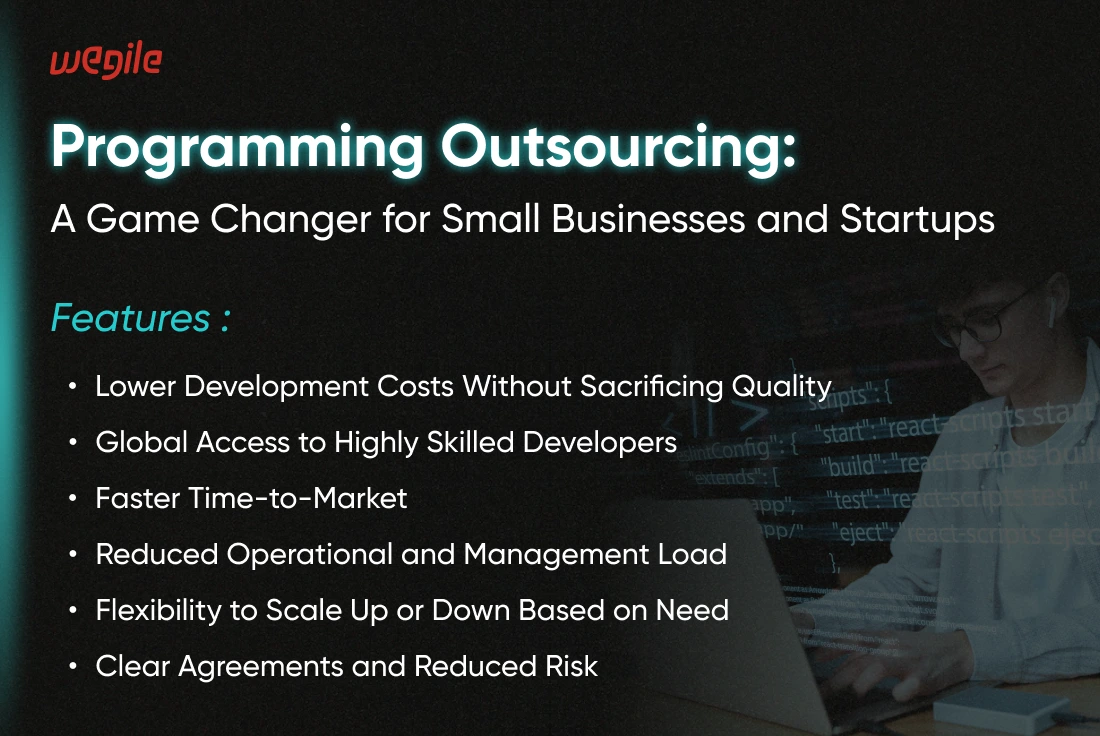
The advantages of outsourcing computer programming are especially valuable for startups and
smaller companies that need to stay agile. Right from reducing development costs to increasing
delivery speed, outsourcing opens doors that would otherwise be out of reach for small teams
with tight budgets.
1. Lower Development Costs Without
Sacrificing Quality
Hiring a full-time developer comes with a substantial financial obligation. Beyond
salary, there are expenses tied to training and recruiting. These costs can be
unsustainable for startups or small teams. Programmer outsourcing supports you to work
with skilled developers from around the world at competitive rates.
You can match talent to your exact needs and budget without compromising on quality.
This frees up capital for marketing or other growth initiatives while still moving
development forward.
2. Global Access to Highly Skilled Developers
When you outsource programmers, you are no longer restricted by geography. It brings you
the power to work with top specialists regardless of location. For example, you might
hire a mobile app developer in Eastern Europe or a machine learning expert in India.
This model is especially useful when your app needs a specific tech stack or specialized
features. The best talent is not always local. Outsourcing allows you to tap into a
global network of experienced developers and engineers.
3. Faster Time-to-Market
Getting your product to market quickly can make or break a startup. The longer
development takes, the more opportunities you miss. You can eliminate long hiring
processes and onboarding delays by selecting programming outsourcing.
Outsourced developers are often ready to start immediately and already have experience
building the type of application you need. It can enormously accelerate development
cycles, therefore assisting you launch faster and stay ahead of the competition.
4. Reduced Operational and Management Load
Managing a technical team comes with its own set of challenges. Performance reviews,
team collaboration, project tracking, and task assignments all take time. When you
outsource computer programming, most of these management tasks are handled by your
outsourcing partner.
You receive regular updates and performance metrics without having to build internal HR
or tech management systems. It allows your leadership team to concentrate on customer
strategy or expanding partnerships instead of daily development issues.
5. Flexibility to Scale Up or Down Based on
Need
Startup life is unpredictable, as business models evolve and timelines change
frequently. Having the ability to adjust your team size without legal or financial
complications is a massive advantage.
gives you the flexibility to onboard a team for a specific sprint, scale
down when the workload is lighter, or bring in extra help during a launch. You can make
staffing decisions based on your product roadmap, and not long-term headcount planning.
6. Clear Agreements and Reduced Risk
Outsourcing typically operates under defined scopes and payment structures. This level
of clarity reduces risk and sets firm expectations from the start. Reputable outsourcing
partners also provide documentation and agile workflows that align with your business
goals.
Many small businesses benefit from this structure, especially when working on fixed
budgets or hard launch dates. It brings transparency and a more predictable path to
delivery.
Applications of
Programmer Outsourcing for Small Businesses and Startups
You can outsource computer programming for nearly every type of software project. Right from
idea to execution, outsourcing fits into each phase of digital product development.
MVP and Rapid Prototyping
Startups often need to build a minimum viable
product (MVP) to test the
market or pitch to investors. Instead of hiring a full in-house team, outsourcing allows you to
develop a working prototype with fewer resources. You’ll get to launch and iterate faster,
without sacrificing build quality or burning through funding.
Full App Development
Whether it’s a mobile app, web app, or a cross-platform tool, outsourcing development gives you
access to entire teams who specialize in taking products from concept to launch. You can keep
your internal resources focused on customer acquisition and business development while
outsourcing handles the tech build.
Backend Infrastructure and API Work
If your app needs strong backend architecture, secure data storage, or third-party API
integration, you can outsource programmers with the
right experience. They bring knowledge of frameworks and security protocols that are essential
to long-term success.
Feature Additions and Product Iteration
Once your product is live, you’ll need to iterate. New features, improvements, user feedback
loops, all require development time. Outsourcing lets you bring in specialists on-demand without
the delay of traditional hiring cycles.
Code Refactoring and Bug Fixing
Outsourced developers can clean up legacy code and fix bugs without disrupting your live
product. This is especially helpful when your internal team is already overloaded or lacks
specific expertise.
Step-by-Step Guide to
Implement Programmer Outsourcing
If you are considering programming outsourcing but are unsure how to begin, the following
step-by-step framework will help you move from idea to
execution with clarity. Many small businesses hesitate because they fear communication issues or
misalignment. With the right structure, you can avoid common pitfalls and work effectively with
outsourced developers.
1. Define the Scope of Work Clearly
Before you look for a partner or post a job, make sure you understand what needs to be
built. Is this a short-term fix or a long-term engagement? Is your product still in
ideation or are you building on top of an existing system?
Clarity in scope prevents miscommunication. Create a simple brief that outlines the
objectives, tech requirements, target platforms, and timeline.
2. Decide on the Engagement Model
There are several ways to outsource computer programming, each with pros and cons:
- Project-based: Best for fixed deliverables and short-term
timelines. - Dedicated team: Ideal for startups that need consistent development
support without full-time hiring. - Hourly or retainer: Useful for ongoing maintenance, bug fixes, or
flexible task lists.
Choose a model based on your budget and the nature of your product cycle.
3. Shortlist and Evaluate Partners
If you are ready to outsource programmers, vet candidates carefully. Look for:
- Proven experience with your technology stack.
- Clear client reviews and portfolio examples.
- Communication skills and availability across time zones.
- Understanding of startup workflows and product development cycles.
Set up initial interviews or discovery calls to evaluate fit beyond technical skills.
Cultural alignment and transparency matter just as much.
4. Start Small with a Pilot Task
Before committing to a long engagement, assign a small paid test project. It could be a
feature build, a bug fix, or UI
improvements.
A pilot helps both parties understand working styles, expectations, and collaboration
dynamics. It also allows you to assess quality and delivery accuracy without high risk.
5. Use Project Management and
Communication Tools
Once the project begins, invest in systems that keep everyone aligned. Use tools like:
- Trello, Asana, or Jira for task management.
- Slack or Microsoft Teams for daily updates.
- GitHub or Bitbucket for code repositories.
- Loom or Zoom for walkthroughs and demos.
Clear documentation and regular check-ins are key to keeping outsourced teams in sync
with your business goals.
6. Establish Milestones and Feedback Loops
Structure your timeline with milestones tied to deliverables. Break the project into
sprints or phases and review progress at each checkpoint.
Provide actionable feedback. Avoid vague comments like “This isn’t working” and focus on
what needs to be improved or refined. Agile-friendly outsourcing partners will welcome
this and adjust accordingly.
7. Secure Your Code and IP
Before development begins, make sure all contracts cover intellectual property rights and
code ownership. Use NDAs, service agreements, and access controls to protect your
product.
Ensure that source code is always stored in your version control system and that
documentation is updated regularly.
8. Evaluate the Relationship for Long-Term
Potential
After the initial project wraps up, review the results. Did the developers deliver what
you expected? Was communication smooth? Were bugs resolved quickly?
If yes, consider deepening the relationship. Many startups start with one developer and
expand into a remote team once trust is established.
Traditional
In-House Development vs. Programmer Outsourcing
When deciding how to approach software development, small businesses and startups typically
weigh two paths: hiring an in-house team or using programmer outsourcing. Each model has its
pros and cons, but the differences are especially significant when you’re working with limited
time and budget.
The table below compares the two approaches across key business factors, helping you determine
which option aligns best with your goals.
| Category | In-House Development | Programmer Outsourcing |
|---|---|---|
| Cost | High ongoing salaries, benefits, and recruitment expenses | Lower hourly or project-based costs with no long-term contracts |
| Hiring Time | Several weeks to months | Often within days or a week |
| Access to Skills | Limited to local talent pool | Global access to specialized expertise |
| Scalability | Time-consuming and expensive | Easily scalable based on project needs |
| Management Overhead | Requires full-time oversight and HR involvement | Minimal overhead; often managed by the outsourcing partner |
| Time to Market | Slower due to team setup and onboarding | Faster execution and quicker delivery |
| Flexibility | Fixed resources, even if workload shifts | Teams can expand or contract based on demand |
| Risk Management | Full responsibility on internal management | Shared risk with defined scope and contractual terms |
Conclusion
Small businesses often struggle to balance product quality and cost. Hiring full-time developers
is expensive and risky if priorities are still shifting. Programmer outsourcing solves that
problem by offering skilled talent and cost-efficient delivery. It allows founders to focus on
their business strategy while development continues in the background.
Whether you are building your first product or simply trying to move faster, outsourcing
computer programming can be the difference between stalling and scaling. It gives you the space
to focus on customers and market fit while experienced professionals handle the technical build.
That’s where Wegile becomes a valuable partner. Wegile stands out among providers offering
Top IT Software Development and Consulting Services, helping
businesses bring their digital vision to life with minimal risk and maximum efficiency. Our
developer teams are tailored to your product needs and growth stage, making us a smart choice
for startups and small companies ready to execute fast.
Leave a Reply