Retail is no longer only about product availability. It’s about timing, location, and prediction. In
2025, customers expect the right item to be available when they want it and where they want it.
Delays, overstocks, and missed opportunities are no longer acceptable.
To meet these expectations, retailers are turning to artificial intelligence, not as a trend but as
an operational core. AI in retail is being used to improve everything from product forecasting to
fulfillment timing. The biggest impact comes from smart allocation and real-time product
distribution, where data becomes the driver behind movement, not guesswork.
Retailers who understand and implement AI-driven systems are seeing measurable improvements in
turnover rates, inventory accuracy, and customer satisfaction. Let us learn more about the vitality
of AI in retail:
What Is Smart Allocation in
Retail?
Smart allocation refers to using data and algorithms to decide where, when, and how much stock
should be sent across a retail network. This includes stores, fulfillment centers, and dark
warehouses. Instead of making decisions based on seasonal intuition or fixed rules, AI enables
real-time evaluation of demand signals, sales trends, and geographic performance.
Why Traditional
Allocation Falls Short?
Most legacy systems use static historical data and forecast in weekly cycles. They cannot adjust
mid-season or during promotions. As a result, one store ends up overstocked while another runs out.
Here are signs your allocation strategy needs AI:
-
Inventory sits too long in low-performing locations.
-
Reallocation decisions take too much manual effort.
-
Stockouts occur despite good supply at nearby stores.
-
In-store demand fluctuates more often than the system can react.
AI solves this through learning models that identify patterns in real time.
How AI Improves Allocation Accuracy?
An AI model ingests live sales data, seasonal trends, regional behavior, and external factors like
weather or local events. It then recommends what units to send, hold, or transfer. The model gets
smarter with every cycle.
Key Benefits of
AI-Driven Smart Allocation
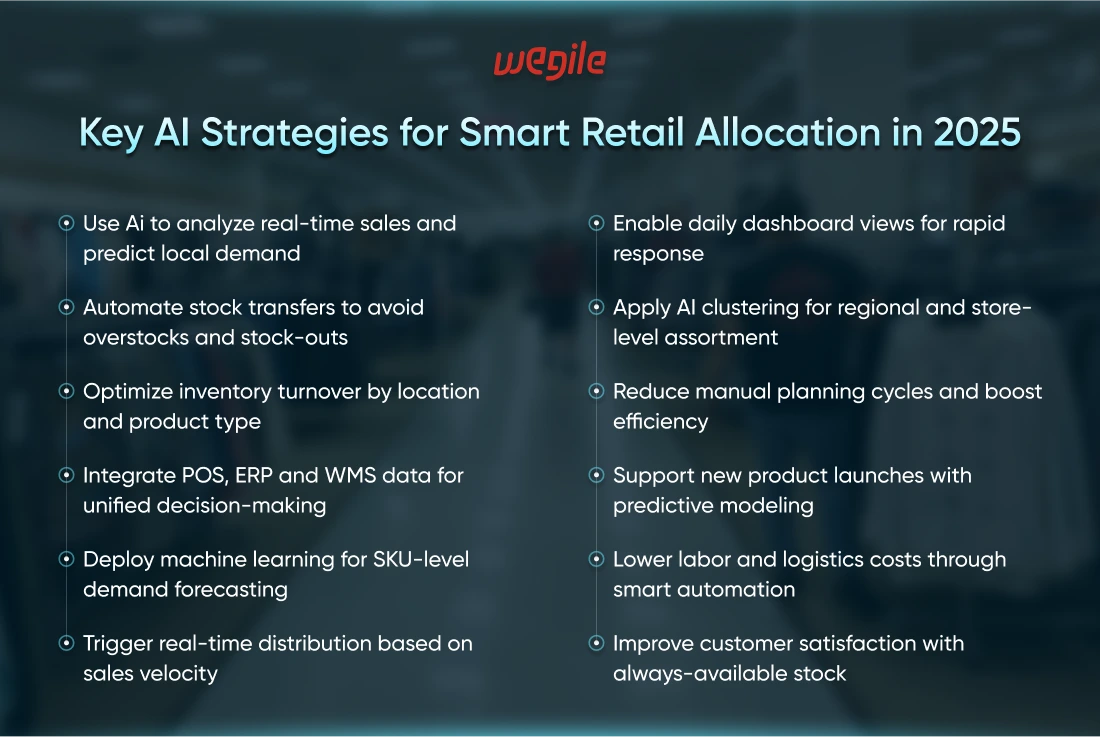
-
Higher inventory turnover in both high- and
mid-tier stores. -
Lower carrying costs due to reduced overstock and dead inventory.
-
Better margin protection through timely transfers instead of markdowns.
-
Store teams can focus on customer service instead of logistics decisions.
AI does not replace human insight. It augments it with faster, broader, and bias-free data
processing.
Real-Time Product Distribution in
Action
Traditional product distribution is reactive. Orders are fulfilled when inventory hits reorder
points or when stores request replenishment. This causes delay, especially when customer demand
spikes unexpectedly.
Real-time distribution uses AI models to trigger movement before shortages occur. The system
identifies patterns across regions, products, and customer segments, pushing the right products to
the right locations without waiting for stockouts.
How It Works?
A real-time distribution engine continuously scans sales velocity, inventory levels, and product
affinity. It simulates different scenarios and executes transfers or reorders before human teams
notice a shortage.
This engine is not isolated. It integrates with ERP, WMS, and POS data to maintain flow and accuracy
across channels.
Why Is AI Critical for Modern Retail
Networks?
Retailers now manage hybrid supply chains with physical stores, micro-fulfillment centers, and
online orders. No human team can coordinate all variables: warehouse space, customer demand,
shipping cost, and seasonal behavior without help.
AI in retail addresses this complexity through scalable automation. Once trained,
the models monitor thousands of SKUs across locations and shift inventory faster than any rule-based
system.
Use Cases Where AI
Makes the Difference
Agriculture is undergoing a massive change with AI and ML solutions. These aim at increasing yield
and reducing costs in following ways:
-
Flash sale inventory reallocation across regions.
-
New product launches with no historical demand.
-
Retail media campaigns driving unpredicted local demand.
-
Store openings or closings requiring rebalancing stock.
These cases require fast action. Waiting for weekly reviews leads to missed revenue.
Building a Foundation for AI in Smart
Retail Allocation
Before AI can enhance allocation or distribution, your business must lay a stable data foundation.
Most AI models fail not due to algorithms, but because the underlying data lacks structure or
accuracy.
Start with Clean and
Unified Data
-
Consolidate data from POS, ERP, and warehouse systems.
-
Clean inconsistencies in SKU naming, unit conversions, and regional tags.
-
Time-stamp all data to allow historical modeling and trend extraction.
Map Product Movement in
Detail
-
Track lead times between hubs and stores by actual travel, not estimates.
-
Measure sell-through rates at the daily level.
-
Log customer returns and restocking delays.
AI models need to learn from behavior, not from ideal flowcharts.
Advanced AI Techniques Used in Smart
Retail Systems
To power smart allocation and real-time product distribution, retailers need more than just basic
automation. Sophisticated AI tools enable predictive decision-making, demand sensing, and
multi-variable analysis in ways traditional systems cannot handle.
1. Machine
Learning for Demand Forecasting
Rather than relying on last year’s numbers, machine learning models examine hundreds of influencing
factors. These include location-specific trends, recent promotional activities, pricing changes, and
even weather.
-
Predicts SKU-level demand by region and day.
-
Learns from returns and refunds to fine-tune future stock allocation.
-
Continuously retrains based on new inputs from POS systems.
2. Reinforcement
Learning for Distribution Optimization
Reinforcement models test multiple scenarios and adjust stock levels based on reward signals like
conversion rates, delivery time, or lost sale penalties.
-
Suggests stock movement strategies between warehouses and stores.
-
Adapts to changing constraints like truck capacity or labor shortages.
-
Balances inventory between digital and physical sales channels.
3. AI-Driven
Clustering for Store Segmentation
Grouping stores by customer profile, purchase behavior, and product affinity allows the system to
allocate more precisely.
-
Helps avoid overstocking stores that sell fewer seasonal items.
-
Enables regional variation in assortment planning.
-
Personalizes stock delivery based on local patterns.
When layered together, these models build a dynamic system where stock flows meet real-world
complexity without constant human supervision.
Step-by-Step Implementation
Strategy for Retail AI
Introducing AI into your retail allocation and distribution process requires alignment between data
systems, business goals, and operational structure. It is not a quick integration. It is a
structured rollout.
Here’s how to start:
Step 1: Audit Current
Allocation Workflows
Understand how allocation decisions are currently made. Identify gaps in timing, accuracy, and
flexibility. List systems involved and key failure points like manual overrides or outdated
forecasts.
Step 2:
Centralize and Structure Data
Bring inventory, sales, logistics, and promotional data into one source. Data must be real-time,
labeled correctly, and historically rich. Without this, AI models will generate poor outputs.
Step 3: Start
With a Single Use Case
Select a limited test case, such as allocation of high-margin products across 10 stores. Test AI
recommendations, compare against traditional decisions, and track sales results.
Step 4: Train
Teams to Understand AI Logic
While the system makes suggestions, retail teams must know how the model arrived at those results.
Provide dashboards that offer transparency, not just outputs.
Step 5:
Gradually Expand Scope
As confidence grows, scale to more product categories, locations, and distribution actions. Build
feedback loops into the model using real-world sales and fulfillment outcomes.
AI adoption in retail is most successful when it starts small, proves value, and scales
strategically.
Organizational Shifts That
Support AI Adoption in Retail
The most advanced AI models fail without operational alignment. Teams must shift how they view
inventory, location strategy, and planning cycles. That requires structural readiness.
1. Reduce
Reliance on Weekly or Monthly Planning Cycles
AI works in real time. If your teams only review stock once per month, they will miss the value.
Move toward daily dashboards and quick-response teams.
2. Assign
Ownership Over AI Strategy
Create roles like AI Product Owner or Data Strategy Lead. These individuals bridge tech and
merchandising, making sure the system is usable and accurate.
3.
Prioritize Collaboration Between Data, Ops, and Merch
AI systems depend on collaboration. Data teams must share insight with store ops. Planners must
communicate promotions in advance. Merchandisers must tag inventory properly.
This cross-functional alignment turns AI from a background tool into a core business function.
Business Impact of Real-Time AI
Allocation
AI is not an abstract improvement. It delivers measurable business value that compounds with scale.
Here are outcomes retailers report after successful adoption:
-
Inventory turnover improves by 15 to 25 percent in optimized locations.
-
Stockouts decrease without requiring large inventory buffers.
-
Markdowns drop due to better mid-season allocation decisions.
-
Labor cost savings from fewer manual planning cycles and reactive shipping.
-
Customer satisfaction increases when availability is consistent across channels.
AI lets businesses operate leaner while delivering more. That creates a dual advantage of margin
protection and loyalty building.
Final Thoughts
Retailers that still depend on manual planning or basic rules are already behind. Customers shop
across devices, expect fast fulfillment, and rarely forgive missed expectations. Smart allocation
and real-time product distribution have moved from luxury to necessity.
AI makes this shift not only possible but profitable. When implemented correctly, it becomes the
difference between reacting to demand and staying ahead of it.
To build this kind of system, you need not just tools, but the right partner who understands both
your business logic and technology needs.
Build the Future of Retail with Wegile: A Leading AI App Development Company
Implementing AI in retail requires more than code. It demands a deep understanding of retail flow,
SKU dynamics, and operational nuance. That’s where Wegile stands out.
As an experienced AI app development company, Wegile builds custom AI-driven
systems for smart allocation, real-time distribution, and inventory intelligence. From data modeling
to mobile app development, Wegile helps you move beyond reactive planning and toward automated
optimization.
Ready to bring AI into your retail ecosystem? Build with Wegile, the AI app development company
trusted by future-ready businesses.
FAQs on AI in Retail Allocation and
Distribution
should be sent across store networks. It improves accuracy, reduces waste, and
responds to demand changes faster than traditional planning systems.
product movement across locations. This helps prevent stockouts and avoids
overstocking slow-moving stores.
quality of data from your ERP or POS will affect the performance of AI
recommendations.
and historical category behavior to forecast performance of new products. This helps
with initial stock allocation when no past data exists.
integration across systems and locations may take 6 to 12 months, depending on
complexity.
to 30 percent reduction in lost sales due to stockouts. ROI depends on product
volume, region count, and responsiveness of the operational team.
Leave a Reply