E-commerce portals have become pivotal in transforming how businesses connect with consumers in
digital spaces. These dynamic platforms facilitate a broad spectrum of transactions. They also offer
unparalleled convenience and accessibility.
Recent statistics highlight the massive growth of online retail, with global e-commerce sales
projected to hit US $4,117.00 billion by the end of
2024. E-commerce is indeed a
boon as it provides businesses with the power to immerse themselves in global markets and cater to a
large customer base.
Understanding e-commerce portals is important for anyone looking to go deeper into the mechanisms of
these platforms. The benefits of adopting e-commerce are immense. They include cost reduction and
improved customer insights. Another important benefit of e-commerce portals is personalized
marketing.
If you’re captivated by how e-commerce portals can elevate your business or simply curious about the
future of online shopping, keep reading our blog. It is packed with actionable insights and
strategies. They are tailored to help you navigate the complex yet rewarding landscape of
e-commerce.
Know how to use the power and potential of e-commerce portals and revamp your business strategy
today:
What are the
E-commerce Portals?
E-commerce portals are dynamic online platforms. They facilitate the buying and selling of goods and
services over the Internet. These portals are virtual marketplaces where businesses and consumers
can engage in transactions anytime and anywhere. They are designed to accommodate a variety of
business models.
An e-commerce portal delivers a seamless and efficient shopping experience. They combine top
e-commerce
features such as secure payment gateways and advanced
search options. They also provide customer support to enrich user engagement and satisfaction.
E-commerce portals are a cornerstone of modern retail as they provide businesses with the power to
reach a global audience. They also present consumers with the convenience of shopping from home.
They also cover e-commerce trends to streamline and simplify
services for both customers
and businesses.
Types of E-commerce
Portals
E-commerce portals vary widely by catering to different markets and needs. Understanding the various
types of
e-commerce portals is important for businesses looking to establish a robust online
presence.
Here is a quick overview of the main types of e-commerce portals. They are seamlessly designed to
help you identify which best fits your business strategy:
1. B2C (Business-to-Consumer) Portals
B2C portals are the most common type of e-commerce websites. Here, businesses sell goods and services
directly to consumers. Examples include Amazon and Walmart. These platforms prioritize customer
experience by offering extensive product ranges. They cater to other benefits, too, such as customer
reviews and personalized recommendations.
2. B2B (Business-to-Business) Portals
B2B e-commerce portals connect businesses with other businesses. These platforms are essential for
manufacturers, suppliers, and wholesalers. They include sites like Alibaba and ThomasNet. They
feature bulk ordering capabilities and varied payment terms.
3. C2C (Consumer-to-Consumer) Portals
Consumer-to-consumer portals present transactions between individuals. They are often designed for
use or unique items. Platforms such as eBay and Etsy are popular examples. They offer user ratings
and auction-style listings to enhance trust among users.
4. C2B (Consumer-to-Business) Portals
In a C2B setup, consumers offer products or services to businesses. They do this by reversing the
traditional e-commerce model. Platforms like Upwork or Freelancer allow individuals to bid for
business projects by providing a diverse marketplace for skills and services.
5. B2G (Business-to-Government) Portals
Business-to-government e-commerce portals stimulate transactions between companies and governmental
entities. These portals are tailored for tenders and direct contracting. They also facilitate
procurement processes by adhering to specific regulatory standards.
Benefits of
E-commerce Portals
E-commerce portals bring numerous advantages for both businesses and consumers. They streamline the
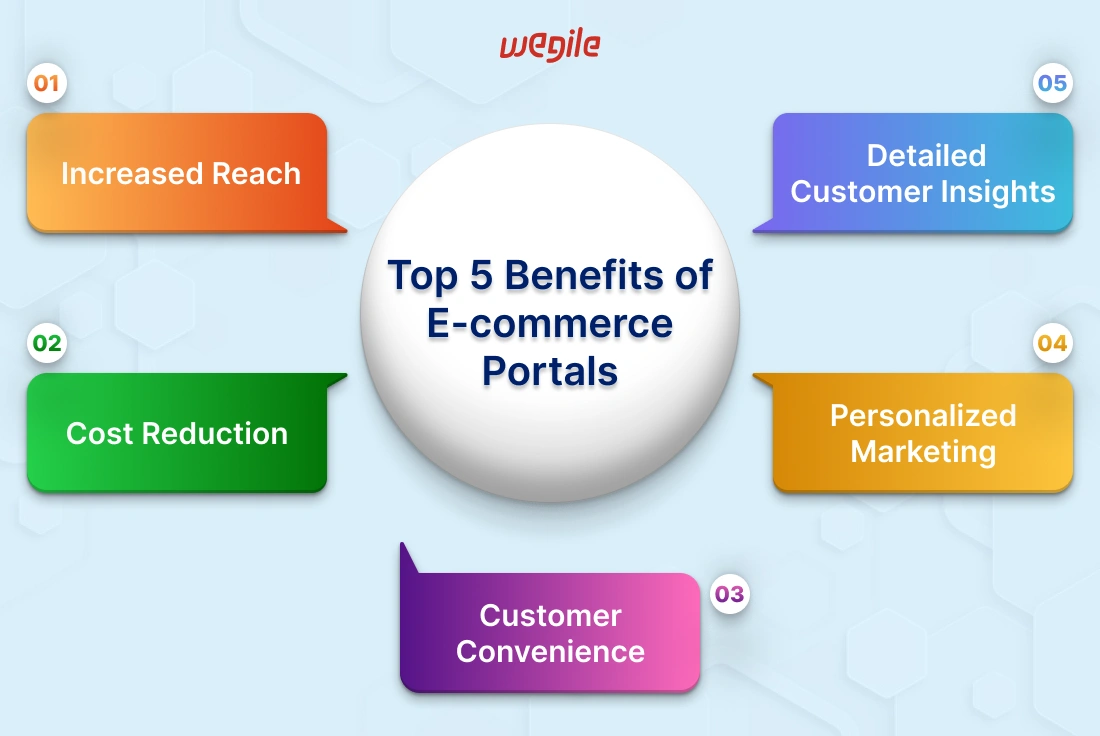
shopping experience by expanding the market reach. Here are five key benefits of e-commerce portals:
1. Increased Reach
E-commerce portals break geographical barriers by allowing businesses to reach a global audience.
Physical store locations do not allow this expansion. Portals help brands access customers
worldwide, which increases their potential market share.
2. Cost Reduction
Operating an online store costs less than maintaining a physical location. Savings come from reduced
staffing and no rent. Fewer utilities also contribute to cost-reduction efforts. These lower
operational costs can translate to competitive pricing for customers and profitable margins for
businesses.
3. Customer Convenience
E-commerce portals provide the ultimate convenience. They help customers to shop 24/7 from the
comfort of their own homes. This easy access is a big advantage, especially for busy people or those
in remote locations. It helps them to shop anytime without worrying about time limits.
4. Personalized Marketing
Online platforms can collect and analyze customer data to tailor marketing efforts effectively.
Businesses can create personalized experiences by understanding purchasing habits, preferences, and
behaviors. They also do this by recommending products and sending targeted promotions that meet
individual customer needs.
5. Detailed Customer Insights
E-commerce sites can track user interactions with advanced analytics tools. These tools deliver
valuable insights into customer preferences and buying patterns. This data is important for
optimizing marketing strategies. It also helps improve product offerings and enrich overall customer
satisfaction.
Top
E-commerce Portal Features to Consider
Selecting the right features is vital for success when launching or upgrading an e-commerce portal.
Here are five key features to look for that can improve user experience, streamline operations, and
boost sales:
1. User-Friendly Interface
A user-friendly interface is important for keeping customers engaged and reducing bounce rates. Make
sure that your portal is easy to navigate. It should have clear categories and a simple search
function. Also, add a streamlined and simple checkout process. An intuitive design helps customers
find what they’re looking for quickly. It leads to higher satisfaction and increased sales.
2. Mobile Optimization
Having a mobile-optimized portal is essential because shopping via smartphones is a notable trend. A
responsive design makes your site look great and function well on all devices. It provides a
seamless shopping experience, whether on a phone, tablet, or desktop.
3. Safe Payment Options
Safety is a top priority for online shoppers. Present multiple secure payment options, including
credit cards, PayPal, and digital wallets. Also, ensure all transactions are encrypted. It creates
trust and encourages more customers to complete purchases.
4. Advanced Search and Filter Options
Advanced search and filter capabilities help customers find products faster. Include filters by
price, brand, and features. Also, provide a smart search bar that suggests products as users type.
It enriches the user experience by making product discovery simpler and more efficient.
5. Customer Support and Service
Excellent customer service can differentiate your portal from competitors. Deliver multiple support
channels, such as live chat, email, and phone support. Make sure that help is readily available, as
this can improve customer satisfaction and nurture loyalty.
Examples of Successful E-commerce Portals
E-commerce portals have changed the way we shop by providing convenience, variety, and competitive
pricing all at our fingertips. Here’s a look at some notable examples of successful e-commerce
portals. They have made significant impacts in the digital marketplace.
1. Amazon
Amazon is the quintessential B2C e-commerce portal. It offers everything from books and electronics
to groceries and fashion. It is known for its vast product range and competitive pricing. It is also
celebrated for customer-centric services like Amazon Prime.
Amazon excels with features such as one-click ordering. Other important features are personalized
recommendations and robust customer reviews. Its logistical prowess and innovative technologies like
Alexa further enrich the shopping experience.
2. eBay
eBay operates as a C2C and B2C marketplace where individuals and businesses can sell new and used
items. It is particularly renowned for auctions as it allows buyers to bid on items.
eBay’s auction system is complemented by Buy It Now options and user ratings. PayPal integration and
other embedded features provide a safe and diverse buying experience.
3. Alibaba
Alibaba is a leading B2B e-commerce portal that connects Chinese manufacturers with overseas buyers.
It is an important resource for businesses looking to source products at wholesale rates.
Alibaba offers Trade Assurance, which is a payment protection service. It has a vast range of
products that can be bought in bulk, which facilitates efficient global trade.
4. Etsy
Etsy specializes in handmade, vintage, and unique factory-manufactured items. They cater to artists,
artisans, and collectors. It’s a niche platform that promotes personalized products.
Etsy’s strengths include a strong community feel. It also includes a focus on unique products and
tools for sellers, like custom shops and easy shipping setups.
5. Shopify
Shopify offers a platform for businesses to create their own customized online stores, unlike
traditional consumer-facing portals. It’s a comprehensive solution for small to medium-sized
enterprises to launch, manage, and scale their online sales.
Shopify excels with its ease of use and scalable hosting. It has perfect features like diverse app
integrations. It enables businesses to customize their sites extensively.
These e-commerce portals illustrate the diverse approaches to online selling. Each comes with unique
features that cater to specific markets and customer needs.
Step-by-Step Guide to E-commerce Portal Development
Developing an e-commerce portal is an important step for businesses looking to expand into the
digital marketplace. This comprehensive guide will walk you through the entire process. It will
ensure that you build a robust, user-friendly, and scalable e-commerce website.
Step 1: Planning and Strategy
Start by setting clear goals for what you want your e-commerce portal to achieve. Note your target
audience, expected traffic, and revenue goals. Then, analyze your competition and target market to
determine product offerings. Finally, work on pricing models and differentiators.
Step 2: Choosing the Right Technology
Select an e-commerce platform that fits your budget and technical requirements. Options available are
Shopify, Magento, WooCommerce, and custom solutions. Go with a reliable hosting provider to make
sure that your website is always available and fast.
Step 3: Design and User Experience
Focus on creating an intuitive and engaging user interface. Work on hiring a professional designer to
bring the best user experience. Make sure your e-commerce portal is mobile-friendly, as a
significant portion of users shop on mobile devices.
Step 4: E-commerce Features and Functionalities
Use a system for organizing product listings, descriptions, prices, and inventory management.
Design a seamless shopping cart
experience. Present a safe and easy-to-use checkout process. Also, integrate multiple payment
options to accommodate all your customer’s needs and preferences.
Step 5: Security Measures
Guard your site with SSL certificates to safeguard user data and transactions. Use robust data
protection measures to comply with regulations like GDPR.
Step 6: Testing and Launch
Conduct thorough testing, including functionality testing, usability testing, and performance
testing. Consider a soft launch to a limited audience to compile initial feedback and make necessary
adjustments.
Step 7: Marketing and SEO
Optimize your content and meta tags to improve your search engine rankings. Add images, too, and work
on digital marketing campaigns using social media. Also, go with email marketing and PPC advertising
to bring in traffic and sales.
Step 8: Maintenance and Scaling
Keep your e-commerce portal updated with the latest security patches and features. Plan to scale your
infrastructure as your business grows to deal with increased traffic and transactions.
By following these steps, you’ll create a successful e-commerce portal. It will not only meet but
exceed the expectations of your online customers. It will help you effortlessly drive growth and
increase revenue.
Challenges in E-commerce Portal Development
Developing and managing an e-commerce portal comes with several challenges. And businesses need to
address these challenges to guarantee smooth operations and customer satisfaction:
1. Security Concerns
Providing security for transactions and customer data is very important. E-commerce portals are
frequent targets for cyberattacks, which makes robust security measures essential.
2. Scalability Issues
E-commerce platforms must handle increased traffic and transactions without performance degradation.
They need scalable infrastructure and efficient resource management.
3. User Experience (UX) Design
Creating an intuitive and engaging user experience is essential. Poorly designed interfaces can
result in high bounce rates and lost sales.
4. Integration Complexities
Integrating various back-end systems is challenging. However, it is important to incorporate these
systems, including inventory, shipping, and CRM.
5. Compliance and Regulations
Sticking to legal and regulatory requirements across different regions. It includes data protection
laws like GDPR, which adds complexity to e-commerce operations.
Best
Practices for E-commerce Portal Development
Developing and managing an e-commerce portal comes with several challenges. And businesses need to
address these challenges to guarantee smooth operations and customer satisfaction:
1. Prioritize User Experience
Design your portal with the user in mind. Make sure that it’s easy to navigate and visually
appealing. Keep it optimized for various devices and screen sizes.
2. Implement Robust Security
Protect user data and transactions with strong encryption. Add secure payment gateways and regular
security audits to cut down on breaches and build trust.
3. Optimize for SEO
Enrich your portal’s visibility on search engines by using SEO best practices. These practices
include keyword optimization, quality content creation, and mobile-friendly design.
4. Use High-Quality Images and Descriptions
Provide clear and high-resolution images and detailed product descriptions to support customers in
making informed decisions.
5. Streamline the Checkout Process
Minimize the number of steps in the checkout process to cut cart abandonment rates. Present multiple
payment options to cater to different preferences.
6. Offer Excellent Customer Support
Provide multiple channels for customer support. Do this by including live chat, email, and phone.
Also, ensure quick and helpful responses to enrich customer satisfaction and loyalty.
7. Regularly Update Content and Features
Keep your portal fresh and up-to-date with new products. Add exclusive features and relevant content
to encourage repeat visits and engagements.
Final Words
E-commerce portals are comprehensive online platforms. They streamline buying and selling of goods
and services by enabling businesses and consumers to transact effortlessly across digital spaces.
These portals are integral to modern retail and are designed to support various business models. Key
features such as secure payment systems and advanced search capabilities are central to enhancing
user engagement and satisfaction.
E-commerce portals can extend the reach of businesses by offering global access and round-the-clock
convenience. They can also revolutionize the shopping experience for consumers by setting a new
standard in the retail industry.
Are you also looking to elevate your online business with e-commerce portals? E-commerce app
development with Wegile is your next step towards digital excellence. Rely on our expertise and let
us build an e-commerce portal that not only meets your business needs but also enhances your
customer experience. Start your journey with Wegile in e-commerce app development,
where your vision meets innovation!
FAQ
1. What is a portal in e-commerce?
A portal in e-commerce is an online platform that supports the buying and selling of products or
services. It offers a wide range of features, such as search capabilities and secure payment
systems. It also provides customer service to enrich the user experience and streamline
transactions.
2. What are the 7 Types of E-commerce?
E-commerce is divided into seven main types:
1. B2B (Business-to-Business)
2. B2C (Business-to-Consumer)
3. C2C (Consumer-to-Consumer)
4. C2B (Consumer-to-Business)
5. B2A (Business-to-Administration)
6. C2A (Consumer-to-Administration)
7. B2G (Business-to-Government)
3. Is Amazon an E-commerce Portal?
Yes, Amazon is an e-commerce portal. It operates as a B2C platform by promoting the sale of products
and services from businesses to individual consumers globally.
4. What is the Main Purpose of an E-commerce Portal?
The main purpose of an e-commerce portal is to streamline the buying and selling of goods and
services over the Internet. It works to facilitate transactions and expand market access. It also
reduces costs and improves convenience and efficiency for both vendors and customers.
5. What are the 7 Cs of E-commerce?
The 7 Cs of e-commerce are vital elements that contribute to the success of online business
strategies:
1. Content
The relevant information and products delivered on an e-commerce site.
2. Context
The site’s layout and design should be user-friendly and aesthetically pleasing.
3. Commerce
The power of conducting transactions over the internet.
4. Connection
The network of partnerships and links to other notable sites.
5. Communication
The way businesses connect and interact with their customers.
6. Community
Building and retaining a network where users can interact.
7. Customization
Personalizing the experience for users based on their needs and preferences.
Leave a Reply