Have you ever wondered why some eCommerce sites have you clicking “buy now” instantly while others
have you bouncing faster than you can say “cart abandonment”? It all comes down to customer
experience. Creating a seamless and pleasurable buyer journey is critical to attracting loyal
customers in the competitive online world. But how can you produce the “wow” factor that keeps
customers returning for more? Every engagement is essential, from when someone visits your website
to the post-purchase follow-ups.
Small changes, such as faster loading times or personalized product recommendations, can have a
significant influence on customer satisfaction and sales. And do you know what the best thing is?
It’s easy to create an unforgettable customer experience. By considering a few smart approaches, you
can convert casual visitors into passionate supporters. Imagine customers purchasing from your store
and referring it to their friends so that you can promote your brand with each click. So, are you
ready to create an eCommerce experience that stands out from the competition? Let’s dive into these
10 tips to get you started!
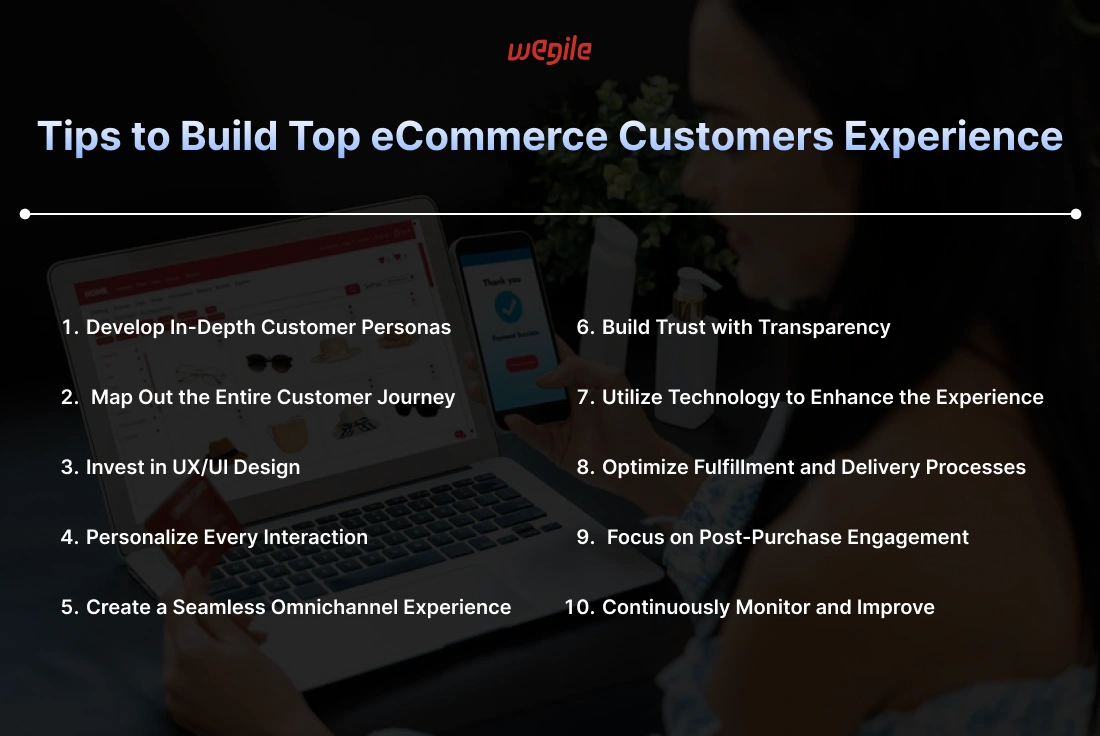
Tips to
Build Top eCommerce Customers Experience
Tip 1: Develop In-Depth Customer Personas
-
Understand Who Your Customers Are
Imagine trying to sell winter coats in a tropical country. Doesn’t make much sense, right?
That’s where understanding your customers becomes essential. You must know your ideal
customers to develop a great eCommerce experience. This requires studying their demographics
(age, gender, and location), behavior(shopping habits and device use), and preferences (what
products they enjoy and how they connect with your business). Create a thorough customer
persona to represent your ideal audience. Use this persona as your ‘go-to’ guide for app
design, features, and promotion. -
Customize Experiences Based on Personas
Put your customer personas to use! Make your customers feel unique with tailored experiences
using these personas. If your persona is a busy mom seeking nutritious and quick meals,
showcase recipes and meal kits on the homepage. Or, for tech-savvy teens, emphasize the
latest products and enable frictionless mobile shopping. Each customer should feel like your
app was developed for them. Customers stay longer and buy more when they feel understood.
Tip 2: Map Out the Entire Customer Journey
-
Identify All Customer Touchpoints
Think of assembling a puzzle without knowing the picture. Mapping your customer’s journey is
like seeing that picture. It helps you understand where every piece fits. Start by detailing
every customer encounter with your business, from finding your site through a Google search
or social media post to making their first purchase and receiving post-purchase support.
Every step counts. Knowing all the touchpoints will help you ensure that each one offers a
consistent and delightful experience. -
Address Pain Points and Friction Areas
People hate barriers, especially while shopping. Identifying issues becomes the next step
after mapping the customer journey. Is there a confusing step in the checkout process? Are
late shipping charges driving cart abandonment? Identifying these pain points will allow you
to create a friction-free experience. Consider it like removing pebbles from a path. This
results in fewer bumps and a smoother journey.
Must Read: Top 5 eCommerce Case
Studies:
Wegile’s Success Stories
Tip 3: Invest
in UX/UI Design
-
Focus on Intuitive Navigation
Have you ever been on a website that feels like a maze? It’s pretty annoying, isn’t it?
That’s why your app and website need to be as easy to navigate as a well-organized
supermarket. Create clear menus, logical categories, and seamless page transitions.
Customers should be able to find what they need without having to think too hard. A
straightforward layout makes it easier for customers to buy from your site. -
Use Visuals to Enhance Usability
A picture is worth a thousand words! Similarly, in eCommerce, it’s
worth a
thousand sales. High-quality
graphics, interesting videos, and clear icons make your site attractive and easy to use. For
example, product videos can show off details that photos miss, and icons can direct visitors
to relevant functions like the cart or customer support. Remember, visuals help customers
understand and interact with your site and not merely just decorate it.
Tip 4:
Personalize Every Interaction
-
Utilize Customer Data for Personalized Recommendations
Imagine entering a store with the salesperson knowing your lifestyle and suggesting what you
need. Personalization
works similarly. Offer tailored product
recommendations by using customer data, including browsing history, purchases, and item
viewing time. Think of it as your way of saying, “I know what you’ll love!” Send tailored
emails with relevant items and targeted deals based on their buying patterns. Relevant
suggestions increase the likelihood of customers clicking on the “Add to Cart” button. -
Implement AI for Real-Time Personalization
Customers love feeling special, and AI can help you deliver that personalized touch
instantly. Your app learns what your customers are interested in as they browse your site.
Afterward, it updates the webpage with related items and provides a coupon code for their
chosen category. This is the power of AI-driven personalization. It lets you customize
content, offers, and messaging to make each connection feel personalized. It’s similar to
having a personal shopper who knows what they want before they do!
Tip 5:
Create a Seamless Omnichannel Experience
-
Ensure Consistency Across Channels
Like a great story, your brand should offer a consistent experience irrespective of how
people engage with it. Consistency is critical when customers shop online, regardless of
whether they use your app or visit your store. This requires consistent tone, graphics, and
messaging across all channels. Consistency generates trust and helps customers recognize
your brand everywhere. It’s like meeting an old friend who’s familiar, reliable, and always
fun to interact with. -
Enable Cross-Channel Interactions
Customers today want their purchasing experience to keep up with their busy lifestyles. This
means they may shop on your app, their laptop, or your store. Create a seamless channel flow
to do this. Allow them to add items to their cart on one device and seamlessly continue on
another. Also, let them check product availability in-store using your app. No matter
whichever channels they choose, it’s about making their journey easy.
Must Read: A Guide to MultiChannel
eCommerce to Grow Online in 2023- Wegile
Tip 6: Build
Trust with Transparency
-
Communicate Clearly and Honestly
Honesty is the best policy, especially in eCommerce policy. No one likes surprises at
checkout. Thus, it’s necessary to be clear about product features, pricing,
shipping, and delivery schedules.
List what’s in stock and when products will return if sold out. Clear communication sets
expectations and prevents disappointments. Give your customers a map before they shop so
they know what to expect. -
Be Transparent with Policies and Practices
Ever had trouble finding a company’s return policy? It’s frustrating and a little suspicious.
Showcase your return, refund, and data privacy procedures to avoid this. Explain these
policies in straightforward language to show customers that you’re on their side. Tell them
why and how gathering their data benefits them, such as personalized discounts or faster
checkouts. Transparency builds trust and integrity, going beyond just preventing confusion.
Tip
7: Utilize Technology to Enhance the
Experience
-
Use AR for Product Visualization
Think about purchasing a sofa online and seeing how it would appear in your living room
without leaving home. That’s AR’s charm. AR elements in your eCommerce app let users
visualize things in their location before buying. This reduces uncertainty, boosts
confidence, and drastically lowers return rates. AR also makes buying a hands-on experience,
regardless of whether your customers are trying on virtual sunglasses or placing a 3D coffee
table model in their living room. -
Deploy AI-powered chatbots for Instant Support
No one likes waiting, especially when they have a question or order issue. This is where
AI-powered chatbots come in. Virtual assistants can respond to common queries, update
orders, and recommend products 24/7. The best part? Over time, they learn from encounters to
improve support. This boosts client satisfaction and frees up agents to handle more
difficult situations.
Tip
8: Optimize Fulfillment and Delivery
Processes
-
Offer Multiple Shipping Options
Customers today want shipping flexibility. Offering standard, expedited, and same-day
delivery lets customers choose the best approach. Providing choices allows you to reach more
customers, whether they need a last-minute gift or can wait for standard delivery. Most
importantly, avoid cart abandonment by being transparent about the shipping costs and
delivery times from the start. -
Keep Customers Informed About Order Status
We’ve all experienced the anxiety of waiting for an order to arrive. You can ease this worry
by providing real-time information on processing, shipping, and delivery. Send email or SMS
notifications with easy-to-find tracking information. This transparency reassures customers
and helps them feel valued, turning a tense situation into a manageable one.
Tip 9: Focus on Post-Purchase Engagement
-
Create a Memorable Unboxing Experience
After opening a package, the rush of excitement continues. A special unboxing experience with
unique packaging, personalized thank-you cards, or a modest gift can make a delivery
memorable. Social media encourages customers to share their experiences, freeing up brands
to promote themselves more organically. Plus, it’s a great way to leave a lasting impression
and encourage repeat business. -
Implement Loyalty and Referral Programs
Getting new customers is great, but retaining existing ones is even better. Implement loyalty
programs to reward repeat buyers. Customers feel valued with points systems, discounts, and
early product access. Consider referral systems, which reward loyal customers and attract
new ones by offering rewards for suggesting friends and family.
Tip 10: Continuously Monitor and Improve
-
Track Customer Experience Metrics
You can’t improve what you don’t measure. Keep an eye on key metrics like Net
Promoter Score (NPS), Customer
Satisfaction
(CSAT), and Customer Effort Score
(CES) to
see how well your
strategies are working. These data show how satisfied your customers are, places where
you’re doing great, and where you might improve. Reviewing these data regularly keeps you on
top of client experience. -
Iterate Based on Feedback
Act on feedback and not just listen! Customer feedback, whether positive or negative, could
impact your next action. Make real adjustments to your app’s design and customer service
with this feedback. Listening to clients and responding to their comments creates trust and
shows you care about their experience.
Wrapping It Up
Creating an excellent eCommerce consumer experience does not have to be complicated. Following these
simple tips will transform your online business into a place where people want to browse, feel
valued, and keep coming back. Fast loading times, tailored recommendations, and a simple checkout
procedure will also help convert visitors into repeat buyers. Are you looking to build an eCommerce
app
for your business? We’re here to help you!
At Wegile, we’re dedicated to helping businesses elevate their e-commerce experience to the next
level. As a leading eCommerce app development company, we specialize in developing
customized solutions that enhance every aspect of your customer’s experience. From design to
functionality, we guarantee that your online store will run smoothly and give the type of experience
that will keep customers returning for more. Let’s build an unforgettable eCommerce experience! Are
you ready?
Leave a Reply