Inventory management for e-commerce is the fundamental block for carving a successful online
business. The reason for the increasing importance of inventory management is that it directly
impacts customer satisfaction and operational costs and eventually multiplies your profits.
Effective inventory management promises the right products are there at the right time. It reduces
stockouts and overstock situations, eroding customer trust and inflating costs.
Let’s jump in and explore everything related to warehouse or inventory management for e-commerce.
What
is Inventory Management in E-Commerce?
Inventory management in e-commerce refers to the systematic control and oversight of ordering,
storing, and using goods sold online. It comprises tracking various product levels across multiple
warehouses and managing stock replenishments. It also aids in confirming that the advertised
products are available for purchase and ready for delivery.
One cannot deny the essentiality of inventory and warehouse management in the e-commerce domain. A
point worth noting is that inventory management is crucial in e-commerce and dropshipping
both. Proper inventory management in these spheres helps businesses avoid the pitfalls of
overstocking.
Let’s decode how effective inventory management fundamentally influences two key pillars of the
extensive online universe: Customers and Businesses.
Impact on
Customer Satisfaction
-
Product Availability: The foremost boon of warehouse/ inventory management
for
e-commerce is that it guarantees that products are in stock. It also confirms that products
are
accurately listed on the website to prevent customer disappointment and lost sales. -
Faster Delivery Times: Efficient inventory or warehouse management means
quicker order processing. It leads to faster delivery times, a key determinant of customer
satisfaction in the e-commerce industry. -
Accurate Order Fulfilment: Good inventory control reduces the chances of
order
errors. It can eliminate issues such as sending the wrong item to a customer. It eventually
becomes your best friend in enhancing the overall customer experience.
Impact on
Business Growth
-
Cost Reduction: Efficient inventory management cuts holding costs and
reduces
the likelihood of markdowns on overstocked items. It primarily improves the overall
financial
health of the operation. -
Increased Sales Opportunities: By maintaining optimal stock levels,
businesses
can capitalize on every sales opportunity without the risk of stockouts. This is
particularly a
plus during peak shopping seasons. -
Scalability: Advanced inventory management systems provide analytics and
forecasting tools. They help businesses predict demand more accurately, scale operations,
and
manage increased order volumes without compromising service quality.
How do I
track my eCommerce inventory?
Setting Up and Managing Inventory Tracking Systems
Inventory tracking is crucial for controlling stock levels and guaranteeing efficient order
fulfillment in e-commerce operations.
Here’s a detailed guide on how to set up and manage these systems effectively:
-
1. Choose the Right Inventory Management
Software (IMS)First, select an IMS
that
integrates seamlessly with your existing e-commerce platform and other business tools. Focus
on finding features such as real-time tracking, automated
ordering, and analytics capabilities. Examples include Oracle NetSuite, Zoho
Inventory, and Shopify for smaller enterprises. -
2.
Implement Barcoding TechnologyResort to barcodes to automate the tracking of inventory. Each item or batch is labeled with
a unique barcode that, when scanned, provides information about the item, including its
quantity, location, and status. This technology revs up processing and reduces human error. -
3.
Systematic SKU ManagementThen, create a structured system for Stock Keeping
Units (SKUs) that shows your inventory’s variety, characteristics, and storage
locations. SKUs make it easy to identify and track products throughout the inventory
management process. -
4. Regular
AuditsWhile automated systems are quite effective, manual checks or audits are also essential.
They
ensure the accuracy of the electronic records. Scheduled audits help identify discrepancies
early and maintain the integrity of inventory data. -
5.
Integrate with E-commerce PlatformsMake sure your IMS integrates with your e-commerce platform to update inventory levels
automatically as sales are made. This integration is crucial for maintaining accurate stock
levels on your website, which helps prevent over-selling. -
6.
Training and Continuous ImprovementTrain staff on how to use inventory tracking tools and processes effectively. You must
regularly review the performance of your inventory management system and make adjustments to
improve accuracy and efficiency.
Benefits of Real-Time Inventory Tracking for
E-Commerce Businesses
-
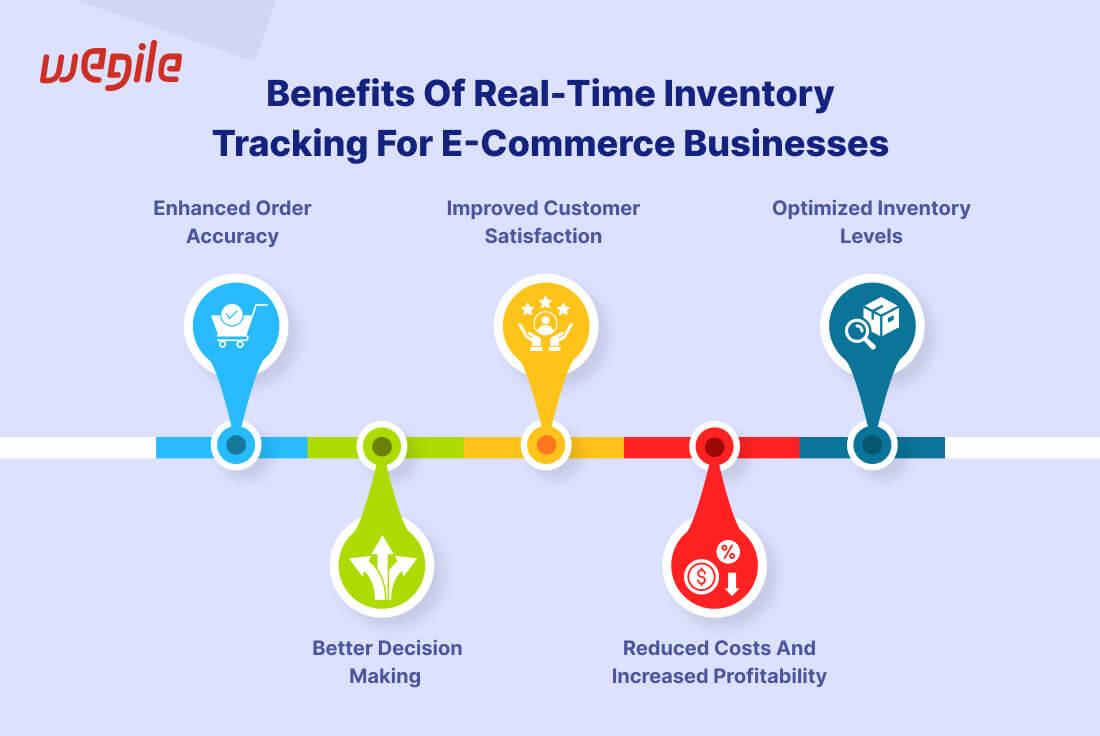
Enhanced Order Accuracy
Real-time inventory tracking ensures that the inventory data displayed online reflects the
actual stock levels accurately. This precision is critical because it directly impacts
customer experience and sales efficiency. By maintaining accurate inventory records,
businesses minimize the risk of order cancellations due to stockouts. It also helps in
avoiding the reputational damage that comes from having to inform customers that an item is
out of stock after they’ve placed an order. This reliability not only streamlines operations
but also enhances the brand’s credibility and trustworthiness. -
Improved Customer Satisfaction
One of the key benefits of real-time inventory management is its ability to enhance customer
satisfaction through dependable product availability and faster delivery times. When
customers see accurate stock information, their confidence in the availability of products
increases, making them more likely to complete purchases. Moreover, accurate stock levels
allow companies to process and ship orders more quickly, leading to faster delivery times,
which is a critical determinant of customer satisfaction in today’s fast-paced e-commerce
environment. This seamless experience can increase customer loyalty, encouraging repeat
purchases. -
Optimized Inventory Levels
Real-time inventory tracking empowers businesses to maintain just the right amount of stock
sufficient to meet customer demand but not excessive to avoid unnecessary capital tie-up in
unsold goods. This balance is crucial for financial health as overstocking leads to
increased holding costs, including storage, insurance, and potential spoilage, while
understocking can result in missed sales opportunities and customer dissatisfaction.
Real-time data allows businesses to respond dynamically to changes in demand, adjusting
orders to suppliers and reducing the risk of overstock and stockouts. -
Better Decision Making
Access to real-time inventory data provides managers with a powerful tool for making
informed
decisions. This encompasses a wide range of business activities from purchasing to marketing
and sales strategy formulation. Managers can quickly identify which products are performing
well and adjust purchasing decisions accordingly to avoid overstock of slow-moving items.
Additionally, marketing campaigns can be better aligned with current stock levels, targeting
promotions for surplus items to boost sales or withdrawing promotions for out-of-stock items
to prevent customer frustration. -
Reduced Costs and Increased
ProfitabilityEfficient inventory tracking directly contributes to cost reduction and increased
profitability. By preventing overstocking, businesses reduce holding costs associated with
storage, insurance, and capital tied up in inventory. It minimizes losses from expired or
obsolete stock, which is especially important for businesses dealing with perishable goods
or technology items that rapidly depreciate. Better inventory turnover achieved through
real-time tracking enhances cash flow and profitability by ensuring that capital is not
unnecessarily locked up in inventory but is available for other revenue-generating
activities.
Inventory Management Techniques Used by Top
E-Commerce Giants
Case Study: What Inventory Method Does Amazon
Use?
Amazon is a renowned and one of the largest e-commerce platforms globally. It employs a
sophisticated
multi-tier inventory management system known as “chaotic storage.” Chaotic storage does
not categorize items by type or size; instead, it places them wherever there is space. This method
maximizes space utilization and curtails the time needed to stock and retrieve items.
Amazon also utilizes advanced algorithms to predict purchasing trends and seasonal demands. It
allows
them to optimize their inventory levels dynamically. They also implement Just-In-Time (JIT)
inventory principles which eliminate overstocking and reduce storage costs by receiving goods only
as they are needed.
Insights into the Strategies Used by Other
Leading E-commerce Platforms
-
Walmart: It employs a robust inventory management system that integrates
online
and offline data to ensure inventory visibility across all channels. They bring real-time
inventory updates to reflect accurate stock levels on their e-commerce site. -
eBay: It uses a vendor-managed inventory model where sellers manage their
inventory. eBay provides tools and data analytics to assist sellers optimize their inventory
based on demand and sales performance. -
Alibaba: It primarily works on technology-driven solutions, which include
artificial intelligence to forecast demand and manage inventory effectively. They also
underline
strong supplier relationships to ensure quick restocking and reduced lead times.
Best Practices for Warehouse/Inventory Management in
E-Commerce
-
Adopt Lean Inventory Techniques: Go with strategies like JIT to reduce
waste
and avoid overstocking. It is an inventory management methodology in which goods are
obtained
from suppliers only when required. It eventually helps in minimizing storage costs. -
Efficient Layout Design: Focus on designing the warehouse layout to
facilitate
easy movement of goods and cut handling time. Also, place high-demand items near the packing
area and guarantee that aisles are wide enough to adjust peak traffic. -
Incorporation
of Automated Storage and Retrieval Systems (ASRS): Also, implement
automated systems that can retrieve items quickly. It cuts labor costs and enhances order
processing speed. -
Implement Cross-Docking: Reduce storage time by unloading materials from
incoming vehicles and loading them directly onto outbound vehicles. This technique is
particularly useful for items with high turnover rates. -
Technology Integration: Invest in inventory management software with
features
like real-time tracking, automated reordering, and detailed analytics. This software will
help
you make informed decisions and improve operational efficiency.
Technologies Transforming Inventory Management for
E-Commerce
-
Artificial Intelligence (AI): AI revolutionizes inventory management by
encouraging more accurate demand forecasting and smarter decision-making. AI algorithms
analyze
historical sales data, seasonal trends, and consumer behavior to predict future product
demands.
It helps businesses to optimize their inventory levels efficiently. -
Internet of Things (IoT): IoT
devices such as smart shelves and RFID
tags are also
extensively
used to monitor real-time inventory. These devices can automatically update inventory levels
in
the management system when stock is added or removed. It eventually reduces manual errors
and
labor costs. -
Automation and Robotics: Automated
storage and retrieval systems (ASRS) and robots are being deployed in warehouses to
handle repetitive tasks such as picking, packing, and sorting. This speeds up operations,
reduces human error, and improves safety.
Implementation of Technologies in Current E-Commerce
Inventory System
Generative AI is expected to keep transforming the travel industry by enhancing personalization and
streamlining operations. As AI technology becomes more sophisticated, it is likely to be integrated
more deeply into travel planning platforms. This will offer more intuitive and interactive
experiences. AI’s capability to generate dynamic content and personalized recommendations will
advance further, improving the accuracy and relevance of the information provided to travelers.
-
Integration with Existing Systems: Most advanced technologies offer APIs
for
integration with existing inventory management systems. This seamless integration guarantees
that businesses can adopt new technologies without disrupting their current operations. -
Scalable Solutions: Technologies like AI and IoT are scalable, which means
they
can be adjusted according to the size and needs of the business. This flexibility allows
even
small e-commerce businesses to gain an advantage from advanced inventory management
technologies. -
Training and Support: Vendors typically provide training and ongoing
support
for their technologies. It is crucial to ensure staff understand how to make the most of
these
new tools and troubleshoot any issues.
Common Challenges and Solutions in E-Commerce
Inventory Management
-
Overstocking and Understocking: Balancing inventory levels to avoid excess
stock and stockouts is one of the most common challenges. Misjudging inventory can lead to
tied-up capital or lost sales and customer dissatisfaction. -
Inaccurate Data: Manual processes and outdated systems can lead to errors
in
inventory data. It affects sales and inventory planning. -
Supply Chain Disruptions: External factors such as supply chain
interruptions
can impact inventory management. It led to delays and inventory shortages.
Practical Solutions and Preventive Measures to
Address These Challenges
Generative AI is expected to keep transforming the travel industry by enhancing personalization and
streamlining operations. As AI technology becomes more sophisticated, it is likely to be integrated
more deeply into travel planning platforms. This will offer more intuitive and interactive
experiences. AI’s capability to generate dynamic content and personalized recommendations will
advance further, improving the accuracy and relevance of the information provided to travelers.
-
Robust Forecasting Tools: Switch to AI-driven tools to enhance accuracy in
forecasting demand. These tools can analyze large datasets to predict sales trends more
reliably. -
Regular Audits and Reconciliations: Conduct regular audits to confirm that
physical stock levels match those recorded in the inventory system. It can help identify
discrepancies early and correct them. -
Diversified Supplier Base: Reduce dependency on a single supplier by
diversifying the base. This strategy can help thwart risks associated with supplier
reliability
and supply chain disruptions. -
Enhanced Inventory Visibility: Go with IoT technology to enrich visibility
across the supply chain. Real-time tracking of goods from the supplier to the warehouse and
from
the warehouse to the customer helps ensure smooth operations and quick responses to any
issues.
Future
Trends in Inventory Management for E-Commerce
The future of inventory management in e-commerce will be shaped by the integration of advanced
technologies. It will include more strategic plus data-driven decision-making processes. We can
foresee greater adoption of artificial intelligence and machine learning for even more explicit
demand forecasting and inventory optimization. Technologies like blockchain could revolutionize how
inventory data is shared across the supply chain as it enhances transparency and efficiency.
Businesses must invest in scalable technology to stay agile and relevant in this competitive
landscape.
Conclusion
As we wrap up this blog, we can conclude that employing inventory management in e-commerce is
essential for the sustainable growth and efficiency of any online business. It helps not only
streamline operations but immensely enhance customer satisfaction and operational
cost-effectiveness. It is not just about keeping stock levels optimal; it’s about leveraging these
capabilities to drive substantial improvements across your entire e-commerce operation. Be it
enhancing customer satisfaction through reliable product availability and swift delivery to
optimizing business growth by cutting costs and maximizing sales opportunities; inventory management
stands out in providing these benefits. The integration of advanced technologies and continuous
refinement of these processes will keep you ahead in the big digital world of e-commerce. So, it is
indeed high time for you to focus on making your inventory management not just a functional
necessity but a strategic asset.
Ready to take your e-commerce business to the next level? Connect with Wegile today and leverage our
expert inventory management solutions to optimize your operations, enhance customer satisfaction,
and drive growth. As a leading Ecommerce App Development
Company, we understand the nuances of e-commerce platforms. Don’t miss out on the
opportunity to transform your e-commerce strategy. Contact Wegile now and start making smart
inventory decisions that propel your business forward. Let’s build success together!
Leave a Reply