Are you thinking about launching the next big social media platform? Over 3.6 billion people worldwide use social media, and the number was projected to reach almost 4.41 billion by the end of 2025. The potential in the market of social media app development services is undeniably immense. Designing a social media application that stands out requires an in-depth understanding of user needs, analysis of market trends, and innovative features.
This blog will guide you through crafting an engaging, interactive, and advanced social media app. Ready to convert your idea into a thriving social network? Keep reading to discover how to make a solid mark in the digital world.
1. Defining Your Niche and Audience
Identifying Your Target Audience
Understanding your target audience is crucial for the success of your social media application. This understanding shapes all aspects of app development, from design to marketing. Various demographics can define your target audience. The crucial parameters are age, interests, and geography. For example, if your app focuses on lifestyle and wellness, your target might be health-conscious individuals who prioritize fitness tips and dietary advice.
Social media analytics and customer surveys can help you capture essential data about your existing and potential users. These tools assist you in observing which demographic interacts most with your content. They also decode their preferences, which further helps you tailor your approach effectively.
Choosing Your Niche
Selecting the right niche within the vast social media landscape is key to distinguishing your app from competitors. By targeting a specific market segment, you can engage users more effectively than with a broader and less defined audience. For example, an application focusing on pet lovers or DIY craft enthusiasts can offer tailored content and include features that resonate strongly with these groups.
A well-defined niche not only tempts users looking for specific content but also helps create more targeted and effective marketing campaigns. It can further lead to higher engagement rates and better conversion. Niche markets also face less competition, which provides a more straightforward path to becoming a market leader within that specific area.
2. Research and Market Analysis
Competitor Analysis
Understanding what existing apps do well and their loopholes can also influence your app’s design and strategy. Start by recognizing both your direct and indirect competitors in the social media space. Direct competitors offer similar services, whereas indirect ones might cater to the same audience with different offerings. Tools like SocialPilot can assist in monitoring these competitor’s social media activities. It majorly includes their engagement tactics, content strategy, and promotional efforts. Key metrics to estimate are engagement rates and audience growth rates. It also involves a share of voice, which further helps determine your market position relative to others.
Observing and studying these metrics allows you to craft mindful and successful strategies. It also lets you recognize areas where competitors do not meet audience needs. Analyzing competitor’s content types, posting frequency, and audience interactions can bring insights into what content resonates and does not.
Trending Features
Staying aware of current trends is also crucial. Short video content, AR filters, and interactive media have recently dominated social media platforms. These features appeal to user’s desires for engaging, interactive, and immersive experiences. Platforms like TikTok and Instagram have leveraged these trends to enrich user interaction and time spent on the app. Incorporating such trending features can help you attract a younger demographic and encourage more active participation.
User Expectations
Conduct surveys and focus groups to align your application with user expectations. This direct feedback can reveal what users enjoy about current platforms and what they feel is missing. This approach not only assists in enriching user satisfaction but also aids in differentiating your app by filling these gaps. Effective surveys should include questions about preferred content types. It should also contain features and information about what users dislike about existing social media apps. Accumulating this data is a foundational step toward building a social media app that genuinely resonates with its intended audience.
3. Planning App Features and Functionality
Every social media app requires a high-quality set of core features to function effectively:
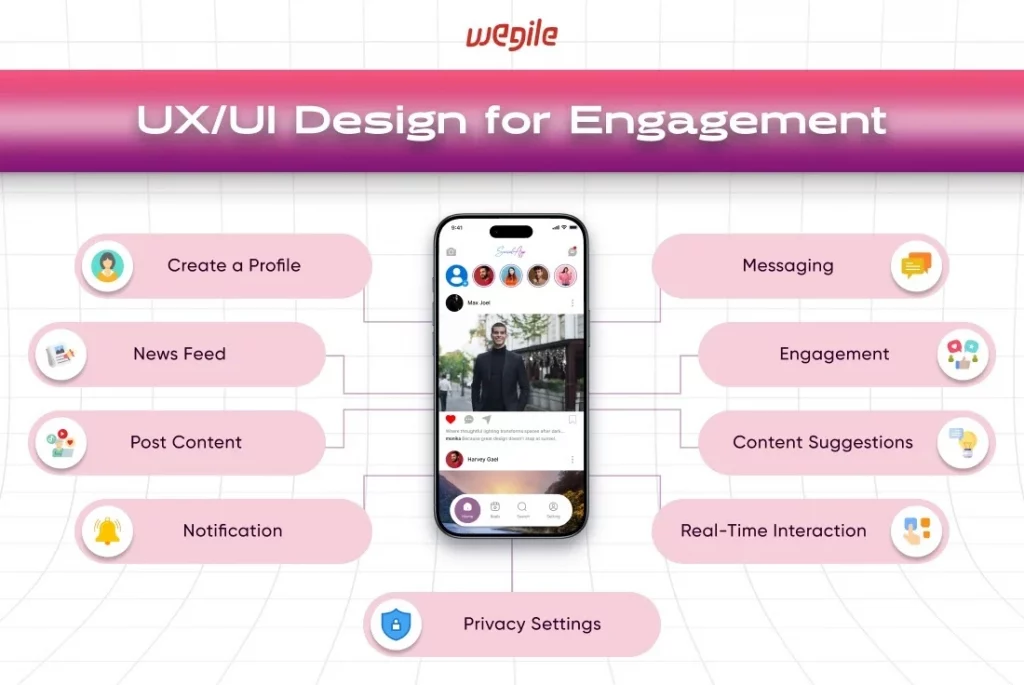
- User Profiles: It helps users create detailed profiles that showcase their interests, activities, and personal information.
- News Feed: A dynamic feed displaying updates, stories, and content from friends and followed pages is also crucial for user engagement.
- Real-time messaging: Real-time messaging features are essential for direct and group communication within the app, ensuring users can connect privately.
- Social Interactions: Features like comments, likes, shares, and tagging are fundamental for nurturing user interaction and content circulation.
- Search Functionality: Advanced search tools help users discover relevant content, profiles, and groups based on their interests.
Innovative Features: To stand out in a competitive market, your social media should not just encompass basic features but also follow these innovative features:
- Augmented Reality (AR) Filters: Enriches user engagement by allowing them to interact with content through AR, similar to features on Snapchat and Instagram.
- AI-driven Personalization: Use AI to tailor content feeds and notifications based on user behavior. It further enhances the relevance and engagement of the displayed content.
- Voice Commands and Accessibility Features: Improve accessibility with voice command capabilities and customizable text sizes to accommodate all users, including those with disabilities.
Scalability and Security: Plan for scalability right from the start:
- Robust Infrastructure: Make sure the backend can handle increased loads as user numbers grow, using scalable cloud services and databases.
- Data Security: Implement strong encryption for data transmission and incorporate other stringent features, such as secure authentication methods and regular security audits, to protect user data and build trust.
4. UX/UI Design for Engagement
User Experience (UX) Design: Creating a seamless user experience is vital:
- Intuitive Navigation: Make sure the app is easy to use, with a logical flow that minimally disrupts the user experience.
- Personalization: Use data analytics to decode user preferences and customize the UX to meet individual needs and habits.
User Interface (UI) Design: The visual characteristics of your app should be attractive, streamlined and consistent:
- Aesthetic Appeal: Use a clean and modern design with consistent color schemes fonts that reflect the brand’s personality.
- Responsive Design: Ensure the social media app is functional and visually pleasing across all devices and screen sizes.
Prototyping and Feedback: Use tools such as Sketch or Figma for prototyping. Early and continuous user testing is crucial to iterate on design based on honest user feedback. It further ensures the final product is both functional and meets user expectations.
5. Choosing the Right Technology Stack
Front-end and Back-end Technologies
Popular frameworks such as AngularJS, ReactJS, and VueJS exist for front-end development. AngularJS is renowned for its robust structure, supported by Google. It is ideal for interactive, streamlined, and dynamic web applications. Facebook developed ReactJS, which offers efficient UI development capabilities. VueJS is valued for constructing interactive user interfaces on a progressive framework.
For back-end development, Node.js is highly recommended because of its ability to administer data-intensive real-time applications that are scalable across distributed devices. ExpressJs and Django are also popular; ExpressJs bestows flexibility for web applications and APIs, and Django is favored for its quick development cycles and robust security features.
Database Management
Selecting the correct database is crucial for performance and scalability. SQL databases like MySQL are traditional choices that offer robustness and a rich feature set. For applications requiring flexibility with unstructured data, NoSQL databases like MongoDB can be pretty advantageous. They have incredible features, such as schema-less structure, which makes them suitable for handling big data and real-time web apps.
APIs and Integrations
Incorporating third-party services via APIs can bolster app functionality without reinventing the wheel. Common integrations include payment gateways, social media services, and data analytics tools. These integrations can help enrich the app’s features and streamline operations. They also aid in improving the user experience and user interactions.
6. Development Process
Agile Methodology
Using agile methodology allows for flexible planning and progressive development. It also aids in early deployment and continuous improvements. It further facilitates adaptive planning and evolutionary development and encourages rapid and flexible responses to change.
Milestone Planning
Establishing clear milestones and deadlines is also crucial in project management. It helps track progress and recognize issues early, ensuring the project stays on schedule. Milestones act as checkpoints that help teams stay aligned with the project goals and timelines.
Testing Phases
Quality Assurance (QA) testing is integral to developing a robust application. It involves multiple stages of testing to catch and fix bugs before the final version is released. This ensures the app is stable, functional, and ready for deployment without significant issues. Regular testing phases include unit testing, integration testing, system testing, and user acceptance testing (UAT).
7. Launch and Marketing Strategy
Beta Testing
Beta testing ensures your app meets user expectations before its release. It includes releasing your app to a select group of end users to validate its functionality and accumulate feedback. Effective beta testing requires careful planning, which provides for defining the test’s goals. It also includes selecting the right mix of testers and deciding whether to conduct open or closed tests. Feedback from beta testing should be used to make any necessary tweaks or adjustments to improve the app.
Launch Plan
Timing the launch of your app is crucial for maximizing exposure. To choose the optimal launch date, consider market trends, potential competing products, and marketing activities. Ensure that your app launch aligns with a time when you can capture the attention of your target audience, potentially leveraging significant dates or events relevant to your app’s niche.
Marketing Tactics
Impactful social media marketing strategies for a social media app include utilizing social media platforms, influencer partnerships, and targeted ads. Creating buzz through teaser campaigns involves leveraging SEO strategies for app visibility. It also includes engaging potential users via email marketing. Also, make sure your marketing messages highlight the unique features of your app to attract potential users.
8. Post-Launch Strategies
User Feedback and Updates
After the social media app launches, continuously collect and analyze user feedback to refine and improve the app. Regular updates fix bugs and introduce new features that respond to user needs and preferences. This eventually helps keep the app relevant and enhances user satisfaction.
Monetization Strategies
You can also employ monetization strategies like in-app advertisements, subscription models, or premium feature offerings. Go with a plan that matches your app’s design and user expectations, ensuring it does not detract from the user experience.
Growth Hacking
Use growth hacking techniques such as viral marketing campaigns to expand your user base rapidly. You can also resort to referral programs or gamification elements that encourage more frequent and engaged app use. Analyzing and monitoring data to understand user behavior and adapt strategies accordingly can also be a powerful part of a growth hacking approach.
Final words
Each step is pivotal in sculpting a social media app, from recognizing your niche to engaging with users post-launch. This helps meet user expectations and thrives in the digital marketplace. Following this guide can transform your visionary idea into a dynamic social network.
Start on your journey to create a standout social platform with Wegile’s social media app development services. Tap into expert guidance and innovative strategies to launch a thriving social network. Whether you’re aiming to captivate a niche audience or engage a global community, Wegile provides the tools and expertise necessary to convert your ideas into a dynamic digital reality. Start today and make a solid mark in the digital world with a custom-designed app from Wegile!
Leave a Reply