Do you have a brilliant app concept that could be a game-changer? Hold on for a moment before diving into development. Just because it sounds like a great idea to you does not guarantee your audience will also like it.
It is crucial to validate your app idea first to save time, money, and effort. Before investing, make sure your concept addresses a real problem or meets a real demand. There are several more things you need to consider before you invest your resources in app development.
In this blog, we’ll discuss key factors you need to consider to validate your app idea. Ready to explore if your app idea has what it takes? Let’s begin!
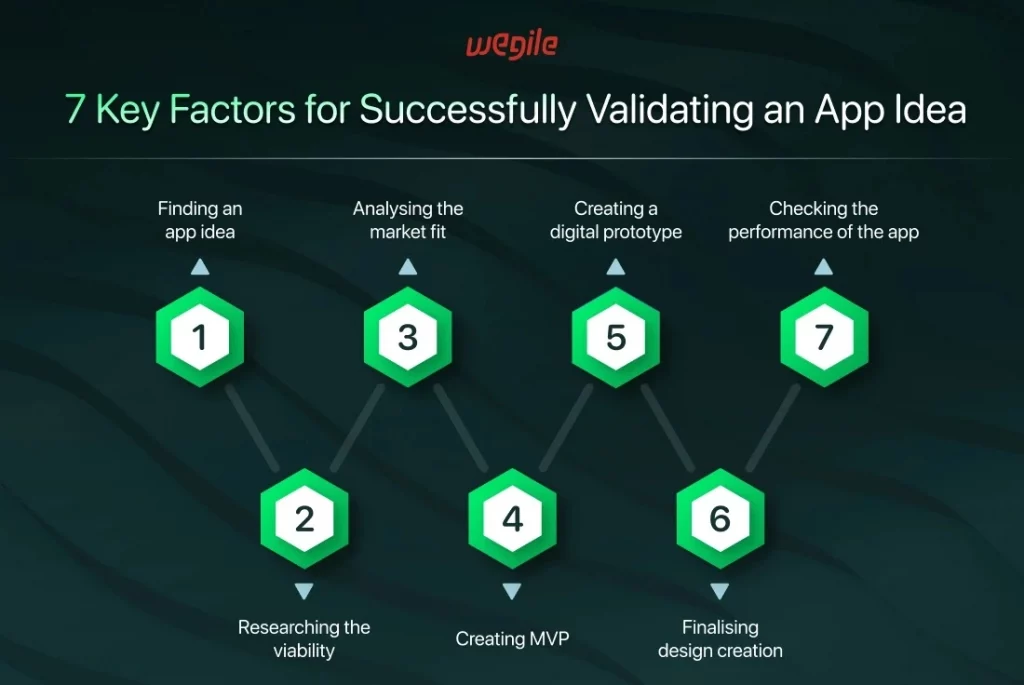
7 Key Factors for Successfully Validating an App Idea
1. Understanding the Core of Your App Idea
Every successful app starts with a simple question: What problem does it solve? Even the best-designed app can fail to discover its market niche without having a clear purpose.
Focusing on the main idea involves establishing its worth and making certain that it caters to a specific demand.
Data suggests that only 0.5% of apps taste success. Hence, defining the purpose of your app’s existence and its audience is of utmost importance. It sets the stage for everything that follows.
- Defining Your Problem Statement
Pinpointing the problem that your application solves is the first step towards validation. If you can’t explain the issue you’re solving, your target audience won’t download your app.
Consider asking yourself: What inconvenience does this app eliminate? For instance, if your app helps users manage their tasks, the issue you’re dealing with can be overwhelming, such as daily to-do lists.
In addition to stating the problem, a good problem statement will hint at the solution that your software provides. This clarity guides app development and gives your idea a laser-sharp focus.
- Identifying and Understanding Your Target Audience
Who is the intended user of your app? Without knowing your audience, creating an app that resonates with users becomes a guessing game. Create a semi-fictional user persona to reflect your ideal consumer.
Consider criteria such as age, interests, pain points, and your user’s daily behavior. Are they busy professionals seeking productivity tips or young parents who are seeking a way to manage their family schedule?
The more thorough your persona, the better you will be able to customize the app’s features and user experience. Understanding your audience ensures you develop an app that answers their problems instead of what you assume.
2. Conducting Market Research Like a Pro
Research is the backbone of any successful app idea. Believe in your idea, but back it up with statistics.
Market research helps you understand the competition, evaluate demand, and discover emerging trends.
When done correctly, it can help you understand what works, what doesn’t, and where untapped opportunities may exist.
- Analyzing Competitors and Their Offerings
Before building, inspect the battlefield. Competitive app analysis allows you to identify what’s already being offered and, more crucially, what’s lacking. List similar apps that relate to your idea.
Analyze their features, reviews by customers, and the number of updates. What do users love and dislike about the existing solutions?
For instance, an app may lack vital functionality or a seamless user experience. Discovering these shortcomings allows your app to fill the gap.
- Understanding Market Trends
Markets change quickly, so being ahead could turn out to be your advantage. Monitor industry reports, tech blogs, and social media trends.
Consider user preferences: do they favor voice feature search? Do they prefer simple designs? Adjusting to such changes can offer your app an edge.
Knowing the latest trends in your niche helps you refine and align your idea with demand, boosting its chances of success.
- Validating Demand with Hard Data
Data is needed to back up the idea you have, not gut feelings. Google Trends or keyword research platforms can show you how often users search for app problem solutions.
Join potential user forums and communities. Are they discussing the pain points your app solves? For example, join online fitness communities to understand what problems fitness enthusiasts are experiencing.
Take surveys to get straight feedback. Numbers don’t lie, and if you notice significant interest in the benefits you offer from your research, it means you’re on the right track.
3. Prototyping and Testing Your App Concept
Prototype before final development. A prototype or MVP lets you visualize your app’s main functionality without spending too much time or money.
Like a rough draft, you can see what works and what doesn’t, and gather input to fine-tune the concept.
- Creating a Low-Fidelity Prototype
Quick and simple low-fidelity prototypes highlight your app’s core functionality and flow. At this point, you should not be concerned with complex designs but rather with the user journey. Figma or Sketch can be used to wireframe critical screens and navigation paths.
The idea is to visually demonstrate how users will interact with the app. It’s a great approach to avoid getting bogged down in design details while effectively conveying your vision to stakeholders and test users.
Remember, it’s always better to start with a rough draft you can tweak rather than a polished design you may have to delete.
- Collecting User Feedback on Prototypes
After having built a prototype, the next step is to test it with actual people. Feedback at this stage is crucial for identifying issues early.
Show a small group of potential users the prototype and monitor their interactions. Are they lost on navigation? Are the key aspects understood?
Use tools like InVision to get comments directly on the mockup. Encourage honest feedback to find issues, not just get appreciation. These findings will help you tweak the idea before committing to full development.
- Iterating Based on Feedback
It is time to implement changes after you have collected feedback from users. Rapid iteration without high expenses is the beauty of prototyping. As Reid Hoffman, co-founder of LinkedIn, said, ‘If you are not embarrassed by the first version of your product, you’ve launched too late.’
Consider the input, prioritize the modifications, and update your prototype. Iterative development improves user experience, aligns features with user expectations, and reduces risks before full-scale production.
Keep the feedback loop in your validation process since each iteration puts you closer to a user-friendly application.
4. Engaging with Potential Users for Validation
Early engagement with your target audience helps prevent significant blunders. Real customer feedback helps you understand their wants and expectations, revealing your app’s potential. Users’ participation makes your app more refined and user-friendly.
- Conducting Surveys and Interviews
Surveys and interviews can provide deep user insights. Short, targeted surveys with open-ended questions might reveal their pain spots and preferences.
Collecting responses is easy with Google Forms or Typeform. For more detailed feedback, conduct one-on-one interviews.
Craft questions to understand user requirements, frustrations, and app expectations. Dig deeper into their problems and evaluate your app’s problem-solving capabilities.
- Leveraging Online Communities and Social Media
Online communities are full of opinions and insights. Reddit, LinkedIn, and Facebook Groups have niche users who love to comment. Engage in app-related topics without overpromotion. Instead, ask for honest feedback.
Inquire about “What features would make this app valuable to you?” This approach validates your idea and creates a network of early users who care about your software.
- Building a Pre-Launch Audience
Creating buzz before your app’s release can help it succeed. Start by establishing a pre-launch audience with a simple landing page highlighting the app’s capabilities and value. Offer early sign-ups a sneak peek or exclusive access to a beta version.
Use marketing strategies that include email and social media to keep your audience interested and involved. Early input and advertising from this community can play a vital role in your product launch.
5. Choosing the Right App Development Company
The app development partner you choose can greatly impact your app idea. It’s important to work with a team that knows your vision, communicates well, and has knowledge, not just someone who can code.
The right development business can convert your idea into a finished product, while the wrong one might cause delays and lead to frustration.
- Assessing Expertise and Portfolio
Check the company’s portfolio before signing to evaluate their performance and delivery. Compare projects to your app idea and evaluate their quality. Evaluate their apps for user experience, functionality, and design consistency.
Customer testimonials reflect how the organization manages projects and communicates with clients. The team’s outstanding portfolio and positive feedback demonstrate their expertise and track record of delivering apps.
- Prioritizing Communication and Collaboration
In app development, good communication can make all the difference. Opt for a transparent company that keeps you well-informed throughout the process. They should listen to your ideas, give honest comments, and answer questions promptly.
Collaboration that values your input creates a better working relationship and delivers products that align with your vision. A responsive team, clear timeframes, and regular updates eliminate misunderstandings and keep the project on track.
- Evaluating Cost vs. Quality
While cost must be considered, the lowest choice frequently comes with unintended consequences such as worse quality and longer delivery times. You shouldn’t judge a service by its price alone but rather by how well it meets your needs.
Look for a provider that lists what’s included, has transparent pricing, and can justify their charges with value. It may appear expensive to hire a qualified team upfront, but it reduces the need for costly revisions and corrections later on.
- Reviewing Technical Expertise
Your app needs a robust technical foundation to operate and scale. Ensure your development provider has experience with the top and latest project-related technologies and frameworks.
They should be skilled in areas such as cloud integration, security, and API development while building complex apps.
Feel free to ask technical questions or talk to developers. When you work with a solid technical team, you can rest assured that your software will be built to last, taking scalability and performance into consideration.
6. Leveraging Advanced Tools and Analytics for Validation
Using the appropriate tools can streamline and enhance the app validation process. Advanced platforms enable data collection, user behavior analysis, and market demand estimation without relying on assumptions. These tools reveal insights that might help you make confident decisions.
AI and Machine Learning contribute to a great effort in determining the success factors for multiple technological advancements in 2026.
- Using Keyword Research for Market Demand
Keyword analysis shows what people are searching for online. Tools like SEMrush and Ahrefs help you identify popular search terms related to your app’s core features.
Start by listing keywords for your app’s core functions. Check the search volume and look for trends over time. If there’s a steady increase in interest, it’s a good sign that your app addresses a need.
You can also look at related keywords to spot potential niches or overlooked features that could set your app apart.
- Tracking Engagement on Landing Pages
To gauge potential users’ interest before developing the complete app, a landing page could prove to be an effective strategy. Showcase your app’s major features and benefits on a basic page with a clear call-to-action like “Sign up for early access.”
Use tools like Unbounce or Leadpages to track user behavior. Page visits, sign-up rates, and click-through rates show how interesting your app idea is to users. An excellent sign of demand is when individuals interact with your content and provide their email addresses.
- Analytics Platforms for Pre-Launch Testing
Once you have an MVP or prototype available, analytics tools may give you a lot of information about how users interact with it. Platforms like Mixpanel and Hotjar let you track how users navigate your app, which features they use most, and where they encounter issues.
Hotjar heatmaps reveal where the user clicks to identify areas of interest or confusion. Mixpanel’s event tracking lets you adjust the app’s flow based on user behavior. Before the official launch, you can use this information to make informed adjustments.
7. Finalizing the Validation Process
After gathering all your data, it’s time to pull everything together. This final phase comprises assessing feedback, comprehending findings, and choosing whether to develop or make adjustments. Validating your decisions with real data helps you make confident choices.
- Summarizing Validation Findings
Take a step back and review all the data you’ve collected during the validation phase. Use surveys, feedback from users, market research, and analytics.
Create a summary report with key findings: Which features were popular among users? What needs improvement? Has the demand for your idea been validated by market research?
This report works as a roadmap, highlighting your app’s strengths and weaknesses.
- Making the Go/No-Go Decision
Choosing full development is a major decision. Consider the pros and downsides after validation. If users are interested and market demand is clear, it’s a green signal.
However, if user involvement or demand is low, reconsider your proposal. This decision is strategic, not cautious. Sometimes, a tiny shift in perspective can make all the difference.
- Preparing for the Next Steps
Develop a strategy for your project’s future if you’re going to move forward. Outline the key milestones, set timelines, and allocate resources. To ensure user expectations are met, share the validation outcomes with your development team.
Address any areas for improvement early in development. On the other hand, if the feedback suggests a significant pivot, don’t be afraid to adapt. The goal is to build a product that resonates with users and meets their needs effectively.
Wrapping Up
Turning an app idea into a successful reality starts with solid validation. Your concept should be tested, refined, and adapted based on real feedback. Follow a clear validation process to reduce risk and start your project successfully.
Now that you’re ready to move from idea to development, Wegile can help you turn your vision into reality. We are a leading mobile app development company with deep expertise in creating innovative apps for a wide range of businesses. Let’s team up to transform your validated app idea into a product that stands out in the market!
Leave a Reply