What Is
Financial Software Development?
Financial software development
involves creating computer software programs specifically designed to aid in financial and
accounting tasks, such as bookkeeping and investment tracking. In many respects, the process mirrors
the operations of a business itself. Just as one would conceive a product, subject it to testing,
and address any flaws before launching it, the creation of Fintech demands a similar approach.
At Wegile, a financial software development company, we often draw parallels between this process and
the art of baking a cake. Imagine carefully measuring out each ingredient, skillfully combining
them, and placing the cake in the oven at the precise temperature and duration. The result? A
delight ready to savor. In the world of financial software development services, we follow a
comparable path: meticulous measurement, skillful amalgamation of key components, faithful adherence
to the prescribed procedure, and rigorous product testing, culminating in a product that’s ready to
be presented to our valued clients.
Benefits
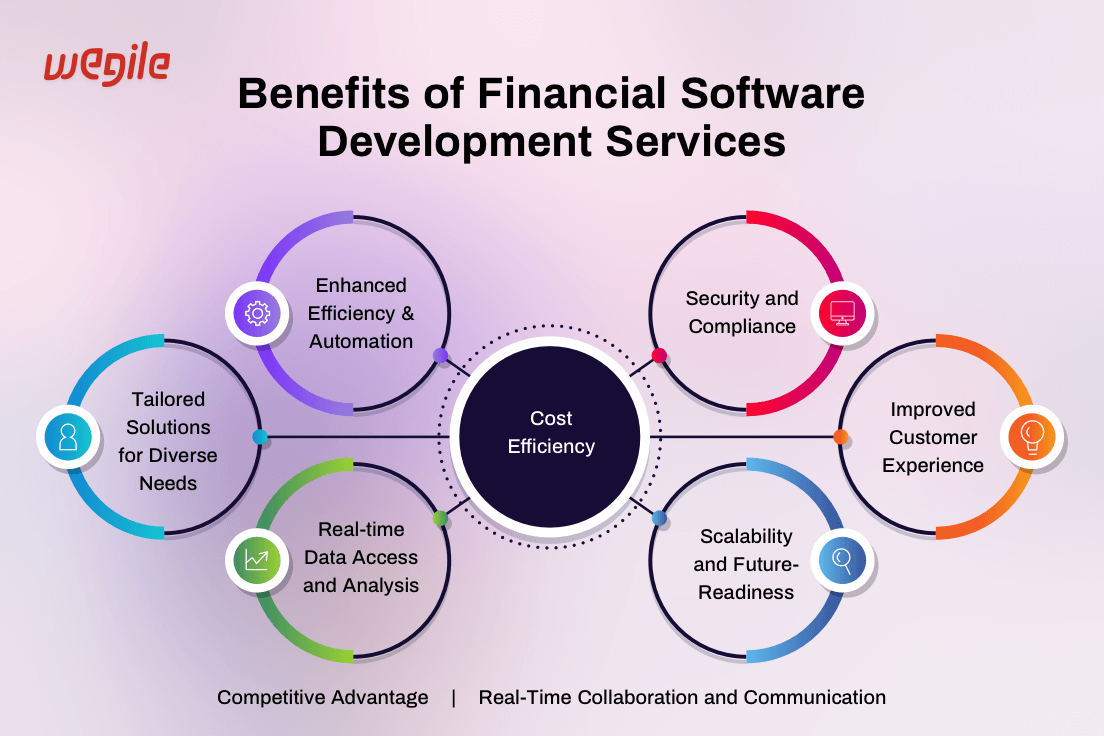
of Financial Software Development Services
-
1. Enhanced Efficiency and Automation
Streamlining Manual Tasks: Financial software development services can take those repetitive
manual tasks and turn them into smooth, automated processes.Reduced Errors: Automated processes significantly reduce the risk of human errors, ensuring
higher accuracy in financial transactions and calculations.Data Reconciliation Made Easy: With improved accuracy, the need for time-consuming data
reconciliation is minimized. -
2. Tailored Solutions for Diverse Needs
Custom-Crafted for You: Financial institutions are unique, and so are their requirements. The
Financial software development can be tailor-made to fit like a glove.Tackling Challenges Head-On: Customization options mean your software can specifically
address the challenges your institution faces.Adapting to Change: Markets shift, and regulations change – your software can adapt
seamlessly, keeping you on the cutting edge. -
3. Real-time Data Access and Analysis
Power of Real-Time: The Financial software development company, through their financial
software development services, will give you access to financial data from various sources
in real-time, providing up-to-the-minute insights.Fast Decisions: Quick access to current data enables faster, informed decision-making.
Seeing into the Future: Financial software offers intuitive interfaces for clients and
internal users, enhancing their experience. -
4. Security and Compliance
Fortified Data Security: Sensitive financial info is protected through robust encryption,
keeping your clients’ trust intact.Meeting Regulations: Financial software development ensures that the compliance features in
the financial software are built-in, ensuring you stay within the industry’s ever-evolving
regulations.Regulatory Confidence: The financial software developer ensures detailed audit trails and
documentation to simplify regulatory compliance. -
5. Improved Customer Experience
User-Friendly Interfaces: The financial software development company offers intuitive
interfaces for clients and internal users, enhancing their experience.Access Anywhere: Web and mobile platforms mean users can access their financial tools on the
go.Personalized Touch: Self-service options and personalized insights make for happier clients.
-
6. Scalability and Future-Readiness
Grow Without Worry: As your institution expands, your software can scale up effortlessly.
Modular Design: Modular architecture allows for easy integration of new features and
functionalities as technology evolves.Tech Harmony: Seamless integration with other software and tech ensures a harmonious
workflow. -
7. Cost Efficiency
Bye-Bye Operational Costs: Automation by a financial software development company reduces the
need for labor-intensive tasks, cutting down on operational expenses.Less Manual Intervention: Manual intervention becomes a rarity with automation doing the
heavy lifting.Long-Term Savings: Optimized processes lead to ongoing cost savings over time.
-
8. Competitive Advantage
Tech-Savvy Edge: Embracing financial software sets you apart in a rapidly changing industry.
Innovative Services: Offering innovative financial services powered by cutting-edge software
provides a competitive edge in the market.Ahead of the Curve: Position your institution as a forward-looking player in the financial
landscape. -
9. Real-time Collaboration and
CommunicationTeamwork, Anywhere: Financial software development makes sure that geographically dispersed
teams collaborate seamlessly through real-time software.Swift Solutions: Real-time communication means issues are resolved faster, keeping operations
smooth.Transparent Decisions: Transparent communication through the software ensures that all
stakeholders are on the same page, promoting informed decision-making.So, whether you’re aiming for smoother operations, happier clients, or a leg up in the
competitive arena, financial software development services are your ticket to a tech-driven
financial future.
Types of
Financial Software Development Services
List of various types of financial software development services:
- 1. Accounting Software:
-
1. Financial transaction management
-
2. Expense tracking and reporting
-
3. Invoicing and payroll automation
-
- 2. Investment and Portfolio Management:
-
1. Portfolio tracking and analysis
-
2. Risk assessment and management
-
3. Market trend identification
-
- 3. Payment Processing Solutions:
-
1. Online payment systems
-
2. Electronic fund transfers
-
3. Digital wallet integration
-
- 4. Loan and Mortgage Software:
-
1. Loan origination and processing
-
2. Underwriting automation
-
3. Mortgage payment calculation
-
- 5. Financial Planning Tools:
-
1. Budgeting and financial goal-setting
-
2. Retirement and investment planning
-
3. Tax optimization strategies
-
- 6. Risk Management Software:
-
1. Insurance policy management
-
2. Claims processing automation
-
3. Risk assessment and mitigation tools
-
- 7. Trading Platforms:
-
1. Online trading platforms for stocks, commodities, and currencies
-
2. Real-time market data analysis
-
3. Trade execution and order management
-
- 8. Regulatory Compliance Solutions:
-
1. AML (Anti-Money Laundering) software
-
2. KYC (Know Your Customer) verification
-
3. GDPR (General Data Protection Regulation) compliance tools
-
- 9. Financial Reporting and Analytics:
-
1. Customizable financial reporting dashboards
-
2. Data visualization for trend analysis
-
3. Performance metrics and KPI tracking
-
- 10. Credit Scoring and Analysis:
-
1. Credit assessment and scoring models
-
2. Credit risk evaluation tools
-
3. Loan eligibility calculation
-
- 11. Tax Management Software:
-
1. Automated tax calculation and filing
-
2. Tax planning and optimization strategies
-
3. Integration with tax authorities’ systems
-
- 12. Robo-Advisory Platforms:
-
1. Algorithm-driven investment advice
-
2. Personalized financial recommendations
-
3. Portfolio rebalancing algorithms
-
These are just a few examples of the diverse range of financial software development services that
cater to various aspects of the financial industry, offering automation, efficiency, and improved
decision-making capabilities.
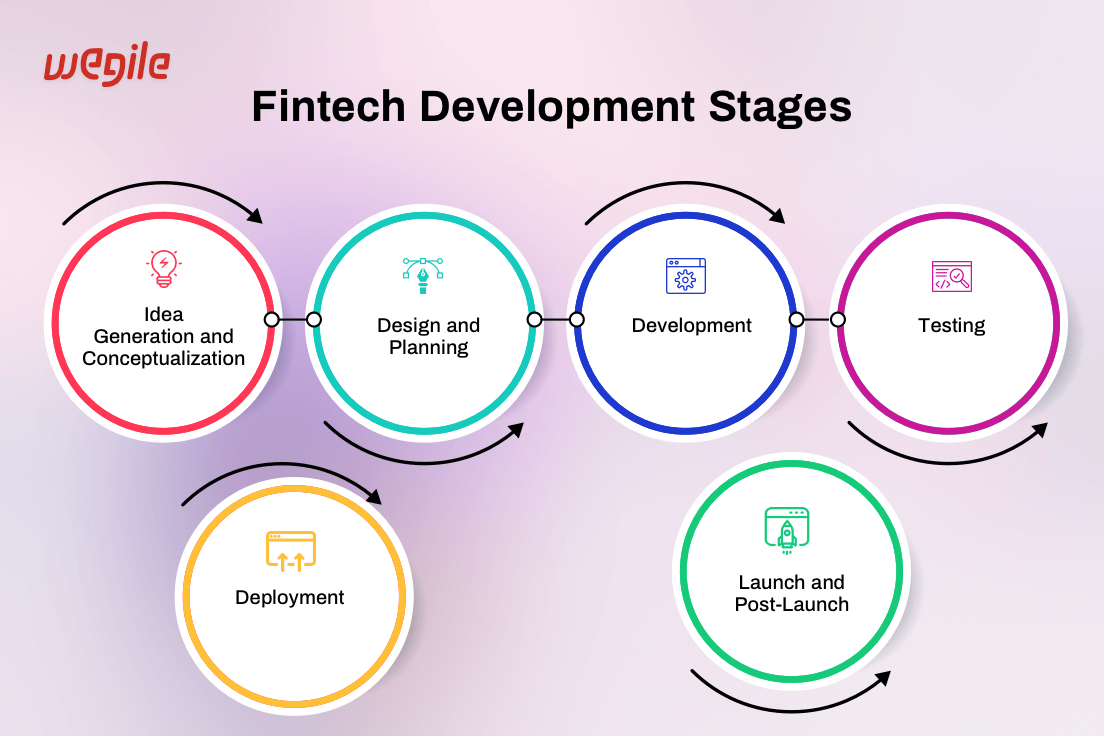
Stages of Fintech
Development
-
1. Idea Generation and Conceptualization
Identifying a Niche in Financial Software Development: The process begins by identifying a
specific problem or gap in the financial software development landscape that a fintech
solution could address.Market Research for Financial Software Development: Thorough market research is conducted to
understand existing financial software solutions, competition, and potential user needs
within the industry. This research plays a crucial role in refining the idea and identifying
unique selling points for a financial software development company.Concept Development in Financial Software: Based on research insights, a clear and
well-defined concept for the fintech solution in the world of financial software development
is developed. This outlines the core features, functionalities, and benefits the financial
software development company will offer through its services. -
2. Design and Planning
User-Centric Design for Financial Software Development: The design phase involves creating
User Interfaces (UI) And User Experiences (UX) that prioritize user needs, making the
financial software development solution intuitive and engaging for clients.Wireframing and Prototyping in Financial Software Development: Wireframes and prototypes are
created to visualize the layout, navigation, and interaction flow of the financial software
development solution. This stage in Fintech development helps identify potential design
issues early on in the development process.Functional Specification for Financial Software Development Services: A detailed functional
specification is prepared for the financial software development services, outlining the
technical requirements, system architecture, and integration points crucial for developing
financial software. -
3. Development
Frontend Development for Financial Software: The front end of the fintech solution for
financial software is developed, incorporating the UI/UX design, ensuring it meets the high
standards expected from a financial software development company.Backend Development for Financial Software: The backend of the solution is developed to
handle data storage, processing, and business logic, adhering to the robust standards of
financial software development.Integration of Financial Software: Integrating third-party APIs and services, such as payment
gateways or data providers, is a critical aspect of financial software development services,
ensuring seamless functionality. -
4. Testing
Functional Testing in Financial Software Development: Developers perform thorough testing to
ensure that each feature and functionality of the financial software development solution
works as intended for financial services.User Acceptance Testing (UAT) for Financial Software Development: Real users test the
financial software development services to ensure they meet their needs and expectations,
helping refine and perfect the product.Security and Compliance Testing for Financial Software: Rigorous security testing is
conducted to identify vulnerabilities and ensure compliance with industry regulations, which
is vital for a financial software development company’s reputation. -
5. Deployment
Deployment Strategy for Financial Software Development: A deployment strategy is formulated
to ensure a smooth transition from development to production for financial software
development services. Deployment Strategy involves planning for server setup, data
migration, and system configuration.Staging Environment for Financial Software: The solution is deployed in a staging environment
for final testing before the actual launch, ensuring the highest quality for financial
software development.Launch of Financial Software Development Services: The fintech solution for financial
software development is officially launched, and marketing efforts are initiated to promote
the services of the financial software development company. -
6. Launch and Post-Launch
Monitoring Financial Software Development Services: After launch, the performance of the
financial software development solution, user engagement, and overall functionality are
closely monitored, which is essential for financial software developers.User Feedback and Iteration in Financial Software Development: User feedback gathered
post-launch is used to identify areas for improvement and inform future updates in the
financial software development services.Adapting to Industry Changes: Financial software developers and development companies
continuously monitor industry trends and regulations, ensuring the software remains relevant
and compliant.Scaling for Growth: As the software gains users, scalability measures are implemented to
accommodate increased user loads and data volumes.
What are the Must-Have Features for Financial
Software Systems
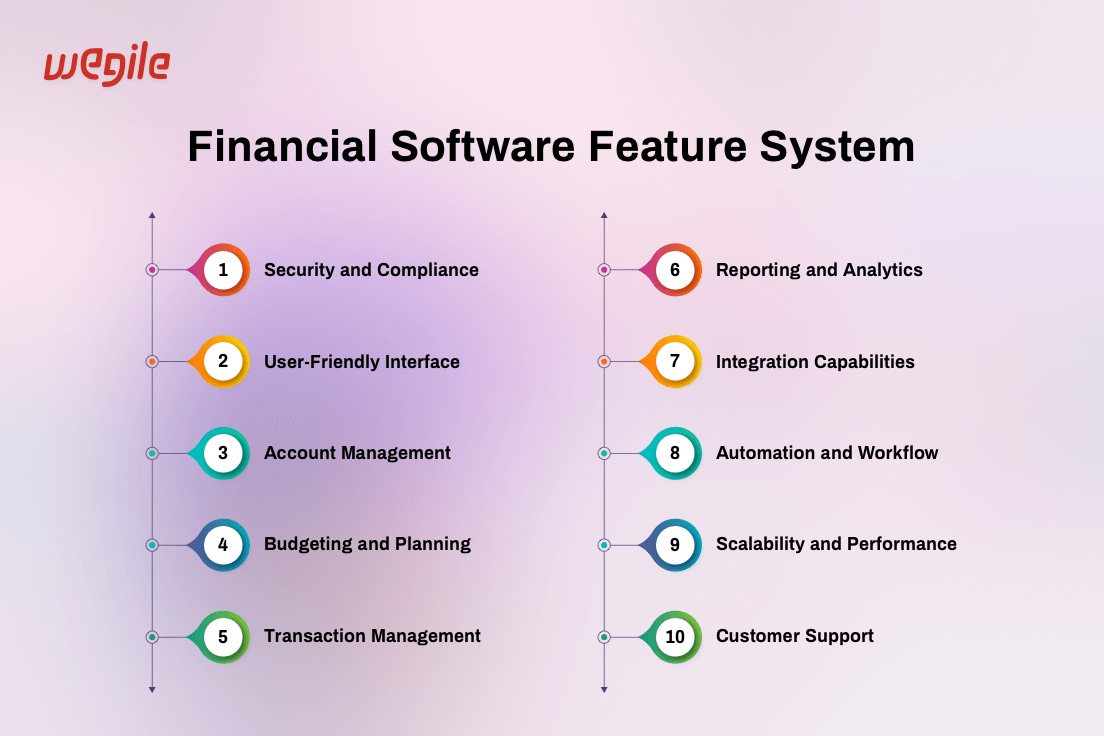
Security and Compliance
-
1. Data Encryption: Robust encryption algorithms guarantee the protection of
sensitive financial data from unauthorized access. -
2. Multi-Factor Authentication (MFA): MFA adds an extra layer of security by
requiring additional verification steps beyond passwords for enhanced user authentication. -
3. Compliance Tools: Integration of compliance modules aids businesses in
adhering to industry regulations and standards like GDPR or
KYC. -
4. Secure Socket Layer (SSL) Certification: The financial software development
company employs SSL certificates to establish secure connections between users and the software
system.
User-Friendly Interface
-
1. Intuitive Dashboard: A thoughtfully organized dashboard provides users with
a comprehensive view of their financial activities, accounts, and transactions. -
2. Easy Navigation: Clear and logical navigation pathways by the financial
software development company enable users to swiftly access desired software features and
functions. -
3. Personalization: Allowing users to tailor their dashboard and settings
enhances both user experience and operational efficiency.
Account Management
-
1. Account Aggregation: This feature consolidates financial information from
various accounts, institutions, and sources into a single, accessible location.
Budgeting and Planning
-
1. Budget Creation: Users can generate, modify, and oversee budgets for
different categories and timeframes. -
2. Bill Payment Integration: Integration with bill payment services simplifies
timely and convenient bill payments directly within the software.
Transaction Management
-
1. Automated Transactions: Streamline financial activities with scheduled
payments, recurring transfers, and automated bill payments. -
2. Transaction Categorization: Automatic categorization of transactions assists
users in comprehending their spending patterns, enabling informed decision-making.
Reporting and Analytics
-
1. Customizable Reports: The financial software developer lets the users gain
the ability to produce tailored financial reports, empowering them to analyze their financial
health and make well-informed decisions. -
2. Data Visualization: Incorporating graphs, charts, and visual representations
transforms intricate financial data into comprehensible formats.
Integration Capabilities
-
1. API Integration: API Integration: Seamlessly integrating with other
financial tools, accounting software, and third-party services enhances the software’s overall
functionality. -
2. Mobile App Integration: Cross-platform compatibility ensures users can
access the software from a range of devices, enhancing accessibility.
Automation and Workflow
-
1. Workflow Automation: Financial software development involves automating
tasks such as generating invoices, sending payment reminders, and reconciling accounts. This
automation helps to streamline financial processes. -
2. Notification and Alerts: Real-time alerts for account activities, payments,
or critical financial events keep users promptly informed.
Scalability and Performance
-
1. Scalable Architecture: The financial software development company ensures
that the system is designed to handle increasing data volumes and user loads as the business
expands. -
2. Optimized Performance: Quick response times, minimal downtime, and efficient
data processing contribute to a seamless user experience.
Customer Support
-
1. Responsive Support: Multiple customer support channels, including live chat,
email, and phone, are offered to address user inquiries and concerns promptly. -
2. Knowledge Base: A comprehensive knowledge base or FAQ section equips users
with self-help resources and troubleshooting assistance.
Find the right financial software development service for you with Wegile – because a great financial
software can do so much more than just crunch numbers and move numbers around. It can take the
burden off of managing your finances and give you the freedom to focus on more important things,
like growing your business or spending time with family. Get the best possible service – choose the
company that offers you everything you need for personal finance excellence. With Wegile, you can
make sure your financial software development meets all of your expectations — and then some! Contact us today!
Leave a Reply