Introduction
In an increasingly digital economy, businesses must maximize the use of modern technology to stay
competitive. One effective approach for achieving this goal is a cloud-first strategy approach –
utilizing cloud computing and services instead of on-premises hardware or software solutions when
possible. Such an approach offers numerous benefits, ranging from scalability and cost savings to
significant time efficiency gains through improved security protocols and automated operations.
A successful deployment of a cloud-first strategy approach can provide greater product visibility
while minimizing
data duplication issues — enabling companies with global reach as well as better customer
service capabilities than ever before imagined by traditional methods. When implemented correctly,
such a plan ensures increased agility in addressing future problems caused by rapid technological
evolution over recent years — positioning any business to stay ahead of its competitors in today’s
highly connected landscape.
What Is a Cloud-First Strategy
Cloud-first strategies are a business approach that prioritizes the implementation of cloud computing
technology and services, aligning them with an organization’s business goals. This strategy can help
to foster greater agility while significantly decreasing costs related to hardware,
software deployment, and
maintenance—allowing organizations more time for innovation instead.
At its core, cloud technology grants access from any connected device at any time – making it easier
for teams across all departments to collaborate effectively without geographic boundaries slowing
down progress or complicating efforts. For larger businesses, this further allows operational
scalability through attractive cost savings when you need additional resources but don’t require
running the entire IT infrastructure yourself. Additionally, system redundancy is built in, which
eliminates outages due to associated equipment failure as well as training your team on physical
setup/maintenance – leading to better project timelines and smoother operations over long periods of
time no matter how big the user base grows.
How Does a Cloud-First Strategy
Help Clients?
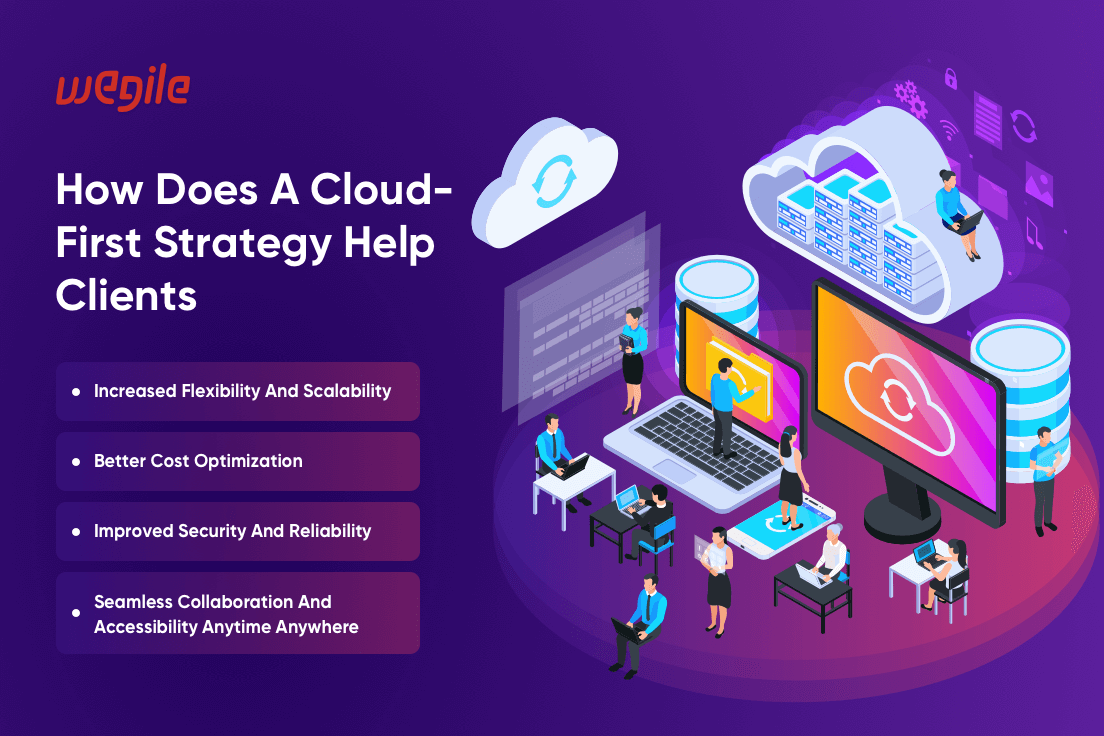
A Cloud First Strategy equips clients with maximum flexibility, scalability, and cost-efficiency. By
utilizing cloud technology for their business operations, they can enjoy the benefits of improved
security, reliability, accessibility, and collaboration facilitated by advanced analytics functions
not available elsewhere. To answer the question of how does a cloud-first strategy help clients, the
following are the ways how cloud-first strategy help clients:
-
1. Increased flexibility and scalability
The ability to quickly adjust capacity or use resources on the go makes it easier than ever
before for businesses to meet changing needs without additional costs. -
2. Better cost optimization
When combined with automation technologies like machine learning (ML) or artificial intelligence (AI),
conducting business operations via cloud platforms can significantly reduce spending
associated with human labor. -
3. Improved security and reliability
With enhanced encryption protocols, state-of-the-art firewalls, automated intrusion detection
systems, regular risk assessments, and proactive threat monitoring capabilities, data is
always secure any time it’s accessed from all devices used by the organization. -
4. Seamless collaboration and accessibility
anytime, anywhereEmployees benefit from easy access, making project planning much simpler, allowing teams to
work simultaneously no matter how remote they might be working from one another.. By
implementing such a strategy now instead of delayed response times, you have
high-performance goals today achievable tomorrow.
Benefits Of A Cloud-First Strategy
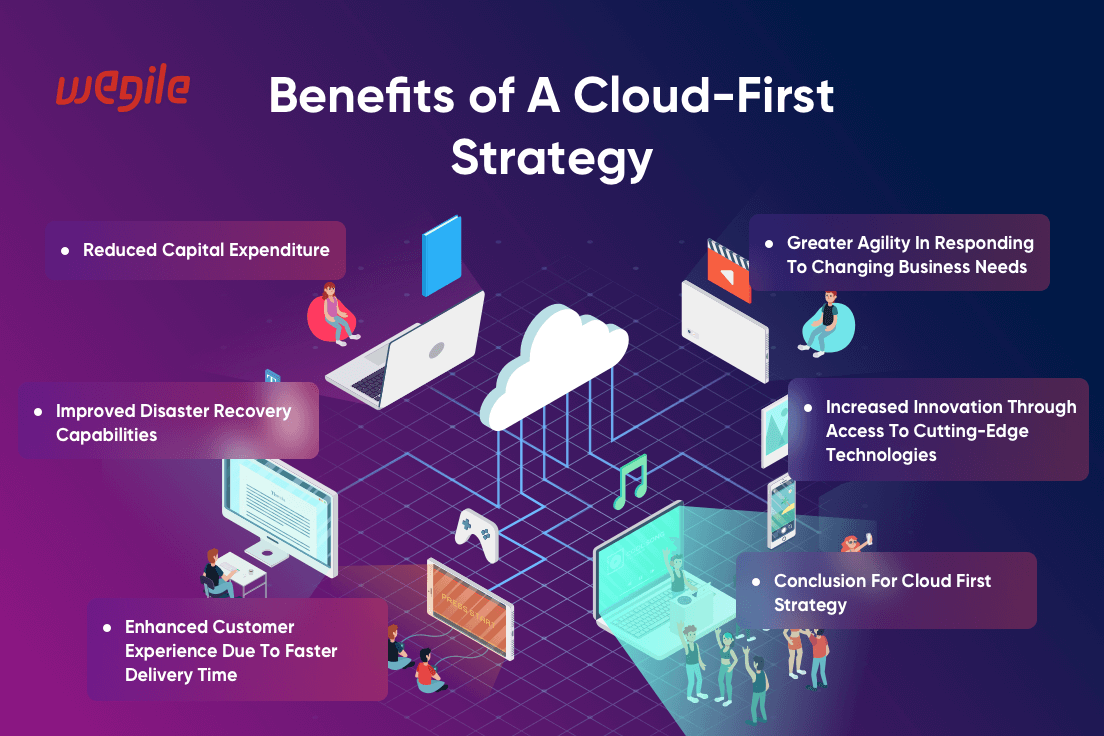
If you are a business looking for the benefits of a cloud-first strategy approach, we at Wegile have
created the following to help you understand all the benefits of a cloud-first strategy:
-
1. Reduced Capital Expenditure
A cloud-first strategy offers companies numerous advantages, particularly when it comes to
reducing capital expenditure. By leveraging the scalability of cloud resources and services
such as Compute Engine, businesses can reduce their capital spending by eliminating legacy
hardware costs incurred during the on-premise deployment process. Cloud computing also
eliminates server maintenance costs, allowing organizations to reallocate budgets previously
spent toward upkeep and toward more innovative initiatives or projects.Furthermore, they are no longer responsible for IT
infrastructure updates, including integrating new upgrades into existing systems;
instead, these processes are handled outside of internal operations entirely. Ultimately
this leads to a decrease in overall operating expenses due to reduced demand placed on an
organization’s human resources while enabling them efficiently take full advantage of all
that modern digital technologies have available without sacrificing quality or commitment
levels from staff members alike. -
2. Greater Agility in Responding to Changing
Business NeedsAs businesses adapt to increasing market challenges and competitive pressures, they must be
prepared to respond quickly. A cloud-first strategy approach is an effective solution due to
its scalability and agility in responding to changing business needs. With the ability for
resources such as applications or storage systems on demand when needed, companies can avoid
financial constraints while scaling up exactly what their company requires at any given time
with minimal effort.Furthermore, this approach allows individual teams or departments within a large organization
more autonomy in decision-making processes which leads not only faster problem-solving but
also greater ownership of success from each group – all without having to make significant
investments upfront into infrastructure that may soon become outdated anyway. -
3. Improved Disaster Recovery Capabilities
Organizations of all sizes are vulnerable to potentially devastating outages caused by
natural disasters, cyberattacks, or human errors. Traditional disaster recovery approaches
can be costly and labor-intensive to implement, leaving businesses at risk for prolonged
downtime and significant financial losses. A Cloud First strategy eliminates these
drawbacks, enabling companies to tap into a cost-effective and efficient solution that uses
cloud-based backups. This approach provides reliable data replication across multiple
geographically diverse data centers, ensuring rapid recovery in the event of an outage or
data loss. -
4. Increased Innovation Through Access to
Cutting-Edge TechnologiesA cloud-first strategy offers businesses the unparalleled opportunity to integrate
cutting-edge technologies into their operations. By embracing this approach, organizations
are exposed to many powerful benefits – chief among them is an increase in innovation
through access to modern tools and resources. These advancements range from Artificial
Intelligence (AI) and Machine
Learning (ML), which can automate mundane tasks and identify consumer trends, to the
Internet of Things devices that detect environmental anomalies or blockchain technology for
secure data storage solutions. Adopting a cloud-first strategy approach ensures you’re
taking full advantage of the latest industry technologies while remaining agile enough to
evolve with emerging innovations. -
5. Enhanced Customer Experience Due to Faster
Delivery TimeOrganizations around the world are leveraging cloud computing to bolster their operational
capacities. Enhancing agility and responsiveness, businesses can now process orders, ship
products, and address customer inquiries at unprecedented speeds. Cloud providers boast
expansive global infrastructures that expedite system delivery, ensuring that applications
and services are available wherever customers may be.Moreover, companies can take advantage of enhanced data analytics through machine learning
algorithms to better identify customer behaviors and preferences for more meaningful
interactions. A cloud-first approach empowers these firms to engineer more refined
solutions, delivering high levels of customer satisfaction.
Conclusion For Cloud-First Strategy Approach
A well-planned cloud-first strategy is a key component in achieving business goals, providing
increased flexibility and scalability, cost optimization, improved security, easier collaboration
and accessibility, reduced capital expenditure, greater agility, enhanced disaster recovery
capabilities, access to cutting-edge technologies, and an improved customer experience. With a
careful assessment of existing IT infrastructure, identification of suitable cloud services,
migration planning, and ongoing management and optimization, businesses can maximize the benefits of
a cloud-first strategy and ensure their long-term success. All this can be done with the help of
Wegile, the best IOT app development company. Contact us today!
Leave a Reply