Introduction
Cloud computing is transforming the way businesses store, access, and manage their data. It’s a
technology that enables us to store data, applications, and resources on remote cloud servers with
secure virtualization methods for ease of use. What this means is users can gain instantaneous 24/7
access from any device in an affordable manner which minimizes hardware costs as well as human
resource investments required by physical data centers or IT teams since most companies no longer
need expertise onsite when using a cloud service provider (CSP).
Thanks to its scalability, flexibility, and cost-effectiveness, more companies are now turning
towards cloud computing, making it one of today’s most sought-after digital solutions. By 2022 a
report by MarketsandMarkets, an estimated $545.8 billion was spent on global investments into this
innovative space as high demand continues driving incredible market growth over several years – with
projections reaching $1240.9 billion worldwide by 2027. (CAGR).
But what’s next after cloud computing? With technologies such as 5G networks being developed at
breakneck speeds; faster speed data transmission across devices will pave new roads not just in
business but also consumer-focused platforms like gaming entertainment where low latency via
enhanced responsiveness can mean ‘life-like experiences’. As these opportunities become available
through Cloud Services, we’ll continue seeing the further disruption of traditional models becoming
far more efficient than ever before.
What Is The Future Scope Of Cloud
Computing
From what started as an act of storing data and running applications remotely in the cloud, cloud
computing has come a long way. With increased security standards protecting sensitive data from
malicious third parties and with reduced expenses associated with managing inbound IT requests – it
is no surprise why cloud usage across many sectors has skyrocketed since its inception two decades
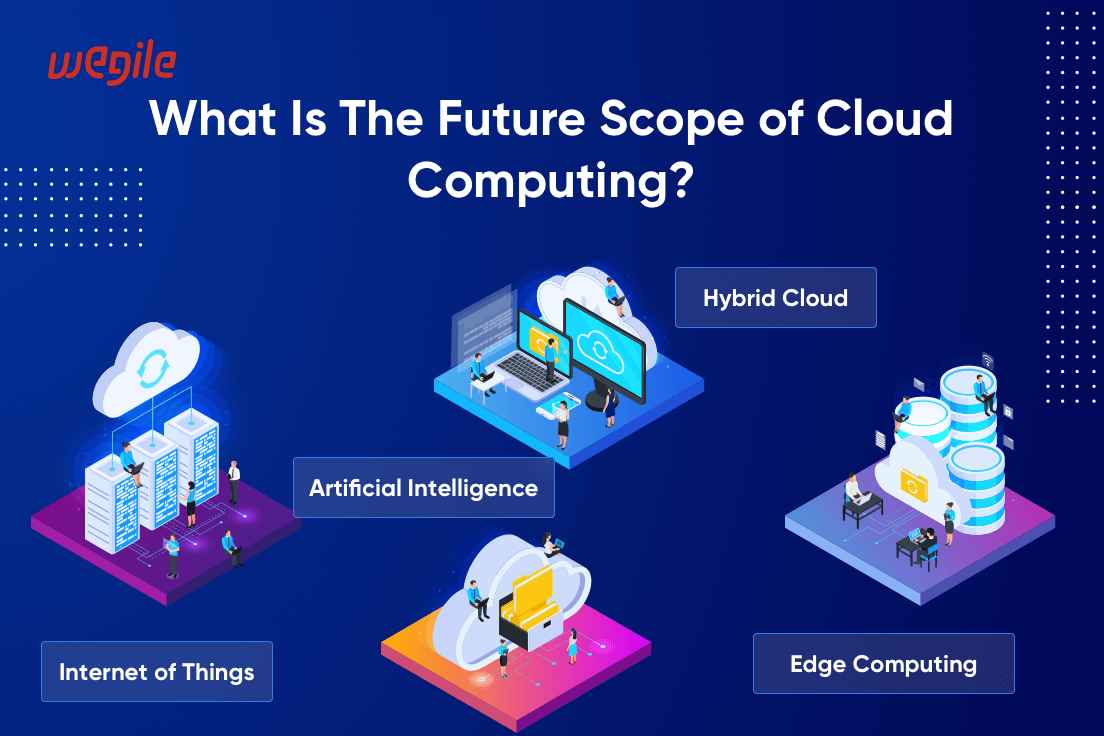
ago. Companies today should ask ‘What Is The Future Scope Of Cloud Computing?’ Let us take a look at
it and understand what are the trends in cloud computing.
-
1. Hybrid Cloud:
The hybrid cloud offers an attractive middle ground for businesses—an optimal balance of
public and private cloud services. Merging these two worlds expands the possibilities,
enabling companies to maximize efficiency and protection in tandem. With this approach,
cloud computing in the future will help businesses unlock the potential of cloud technology
while retaining control over their sensitive data. -
2. Internet of Things (Iot):
As IoT continues to
evolve at a rapid rate so does cloud computing — driving growth in areas such as smart home
automation systems and connected cars. By harnessing their combined power, businesses will
be able to make better decisions faster while still being able to accommodate an
ever-increasing appetite for real-time analytics.In addition, cloud
computing with IoT also has great potential in enabling remote monitoring/management
of critical infrastructure, which can improve efficiency by reducing energy use as well as
improving security measures against cyber threats, thus helping protect user privacy &
public safety from unauthorized access or malicious attacks on these centralizes systems
hence playing a crucial role not only for enterprises but governments too when it comes
managing traffic flows without inhibiting innovation. -
3. Artificial Intelligence (AI)
The future potential of cloud computing with AI is tremendous. The combination of two
powerful technologies has the capacity to revolutionize many sectors, such as healthcare and
retail, by automating complex tasks while delivering insights more efficiently than ever
before. Cloud technology is revolutionizing the present and transforming the future.
Real-time data analysis at lightning speed? Check. Unparalleled accuracy in decision-making?
Double check. Predictive analytics and machine learning algorithms? Triple check. Store
massive amounts of data? You get the gist—it’s time to soar into a new era of innovation and
get to know what is the future scope of cloud computing!The AI revolution is in full swing, and leading the charge are SaaS products powered by
artificial intelligence. With a minimal capital outlay and access to timely releases and
cutting-edge features, businesses can leverage these advances to maximize customer
experiences and streamline operations. Plus, data insights gleaned from AI-driven software
create unprecedented opportunities for growth strategies. And with two titans of
tech—OpenAI’s ChatGPT and Google’s
Bard—filing into the arena, the future of AI looks
even brighter. Nobody can be sure about what’s next after cloud computing or what the future
of cloud computing will be in 2025. -
4. Edge Computing:
Cloud computing has entered a new age with the emergence of edge computing. By leveraging
both cloud and local compute resources efficiently, businesses are now able to reduce
latency, improve response times for faster analysis of data generated from mobile devices or
IOT sensors as well as enable better financial models by reducing bandwidth needs to
transfer large volumes of data stored in multiple geographies.This is leading to opportunities such as using machine learning algorithms closer to where
it’s being used rather than overloading the cloud with heavy workloads; enabling faster
decision-making at scale without needing specialized hardware infrastructure; creating
applications that can interact almost immediately, which could provide customers added
agility and control when accessing their service providers or other suppliers needed
information offline quickly during outages etc., ultimately resulting in improved user
experiences overall. It is clear that technological advancements such as Edge Computing will
continue shaping our digital landscapes while solidifying its role within Cloud ecosystems
into further maturity in the near future.
What’s Next After Cloud Computing?
As Cloud Computing continues to revolutionize the IT sector, foresighted industry professionals are
making preparations for what lies beyond. Organizations today benefit from greater agility and
scalability due to this innovation, yet we must remember that technology is always advancing. Edge
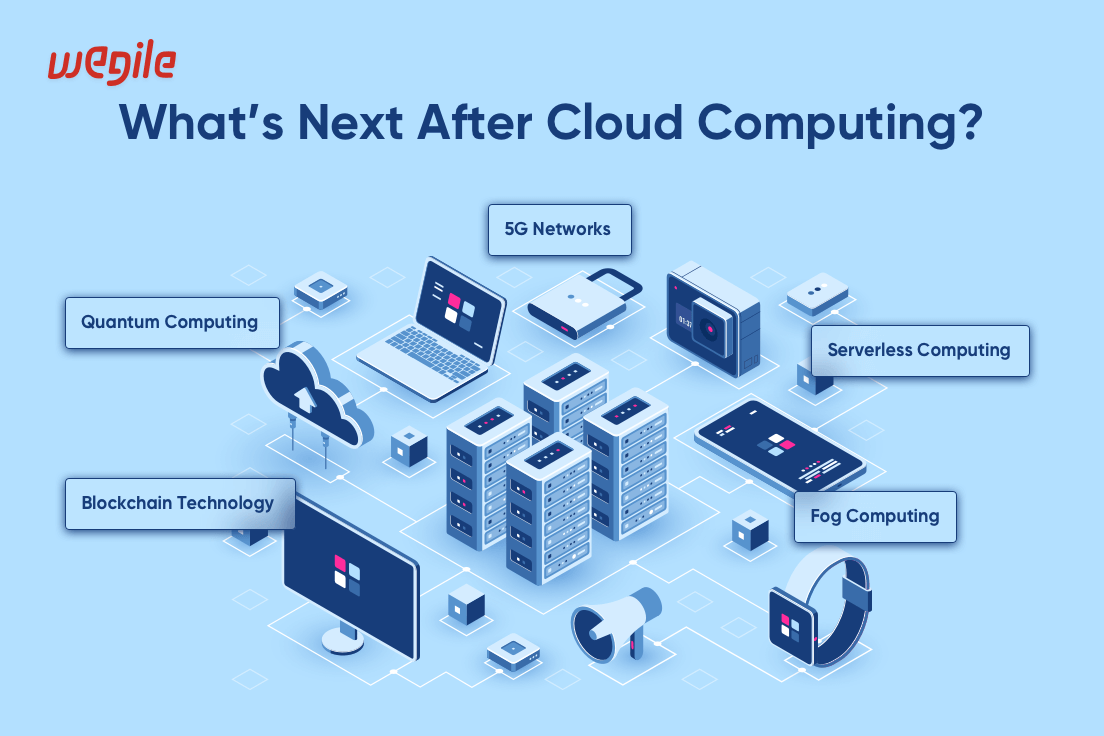
Computing, Quantum Computing, and Blockchain are just a few of the emerging technologies that have
caught the public’s attention, and companies need to begin strategizing now for the future of cloud
computing. In this section, we’ll delve into these potential successors or complimenters to Cloud
Computing to understand what’s next after cloud computing.
-
1. Quantum Computing:
At Quantum Computing’s core lies a revolutionary approach to problem-solving, leveraging
exotic phenomena such as superposition and entanglement to tackle tasks deemed unsolvable by
classical means. This cutting-edge discipline offers an unprecedented opportunity to unlock
solutions to the most complex conundrums, paving the way for dynamic progress with
remarkable speed and efficiency. -
2. Blockchain Technology:
Decentralized digital ledgers allow secure data exchange and transactions to take place
anonymously in distributed networks without requiring third-party validation or central
authority. Blockchain
will be an integral part of cloud computing in the future. -
3. 5G Networks:
The next phase of wireless networking promises faster speeds, more reliable connections and
wider coverage areas for both personal users and businesses alike. It offers greater
efficiency for everyday tasks like sending files between devices as well as accessing
networked resources quickly from any location on earth. -
4. Serverless Computing:
By outsourcing all administrative-related activities to cloud vendors such as AWS Lambda and
Microsoft Azure Functions, companies are able to take their apps’ functionality off the
traditional server racks – allowing them access to computing resources when needed without
owning the physical hardware required. This may answer your question of what’s next after
cloud computing. -
5. Fog Computing:
Fog computing decentralizes application architectures by running processes at edge nodes
closer to where applications actually occur — instead relying solely on remote service
providers (hosts) located far away than local endpoints would require. This helps bring
latency down significantly while improving scalability & reliability thanks to its
structure ‘ fog ‘’ architecture.
Conclusion
With the continuous evolution and rise in the use of cloud computing, it’s apparent that companies
need to adopt new technologies to stay competitive. Staying abreast of these advancements by
regularly monitoring trends in the industry will be key to remaining ahead when planning any changes
within established IT systems from now onwards. By understanding what is the future scope of cloud
computing, you’ll get a deep understanding of the future of cloud computing.
Leave a Reply