What Is SaaS Revenue Model
The Software-as-a-Service (SaaS) revenue model involves software companies charging customers a
recurring fee for ongoing access to software services. Saas revenue model is parallel to renting a
product rather than buying it, similar to leasing an apartment instead of purchasing a house.
Rather than a single upfront payment for software ownership, customers pay a regular subscription fee
– either monthly or annually or in the ways mentioned below in this article – to utilize the
software. This grants continuous access to an ever-improving software version, eliminating the need
for individual updates and maintenance.
This model is appealing to companies due to its steady and predictable income flow. It allows them to
prioritize service enhancement without the concern of individual sales. For users, the option to pay
smaller ongoing fees is often preferred over a substantial upfront payment.
What Is SaaS Revenue
Recognition
In the intricate tapestry of SaaS (Software as a Service) enterprises, the distinction between the
influx of cash and the recognition of revenue assumes paramount significance. This nuanced
differentiation underlines the essence of financial integrity, wherein revenue recognition stands as
a cornerstone concept with far-reaching implications for SaaS businesses.
In SaaS Revenue Recognition or any other case, Cash refers to the physical currency or money that a
company receives; It includes actual banknotes, coins, and electronic funds. Revenue, on the other
hand, refers to the total income generated by a company from its normal business operations. It
includes sales of goods or services, royalties, interest, and other sources of income.
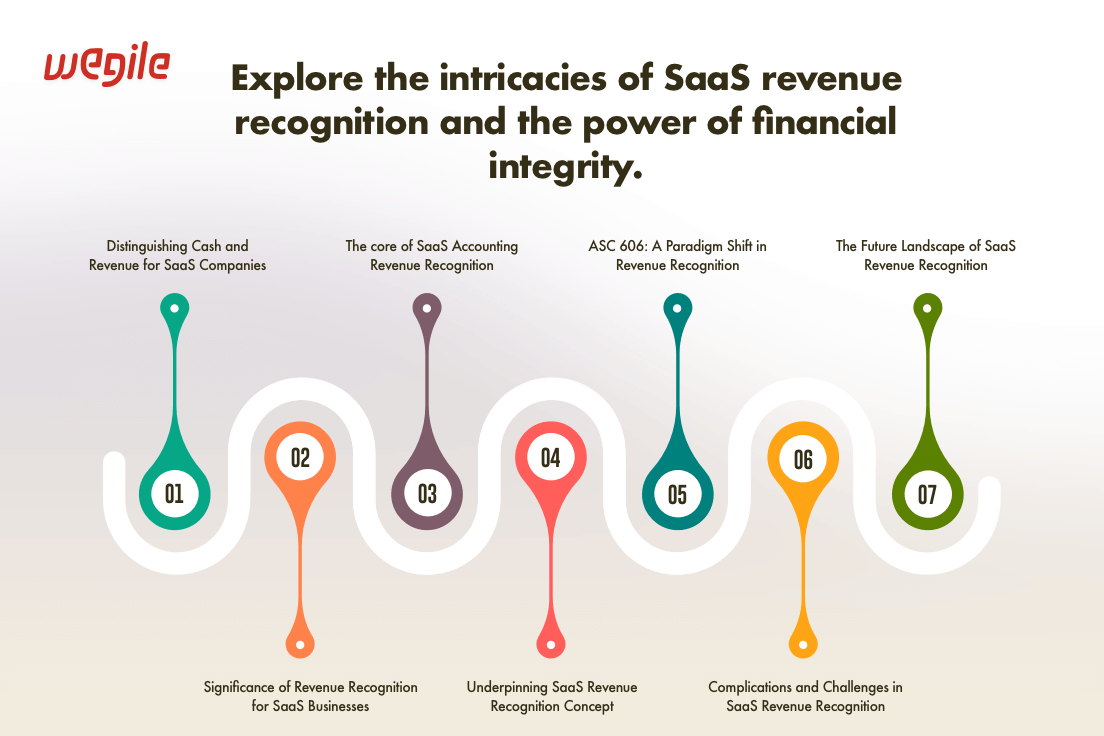
Distinguishing Cash and Revenue for SaaS
Companies
-
1. Cash vs. Revenue
The demarcation between cash receipts and revenue realization is pivotal in SaaS operations.
-
2. Proper Financial Reflection
Revenue recognition ensures accurate earnings representation, regardless of the timing of
cash inflows. -
Holistic Financial Reporting
Distinguishing between cash and revenue guarantees comprehensive financial reporting,
offering stakeholders a transparent view of actual business performance.
Significance of Revenue Recognition for SaaS
Businesses
-
1. Decisive Business Insights
Revenue recognition serves as a compass, guiding informed decision-making by providing a
precise portrayal of financial accomplishments. -
2. Stakeholder Confidence
Proper revenue recognition fosters confidence among investors, shareholders, and stakeholders
through standardized practices. -
Comparability Across Companies
Uniform revenue recognition practices allow meaningful comparisons across SaaS companies,
illuminating their relative financial health.
The core of SaaS Accounting: Revenue
Recognition
-
1. Accrual-based Methodology
Revenue recognition forms the bedrock of SaaS accounting, operating within the contours of
the accrual basis. -
2. Adherence to GAAP
Grounded in the pillars of Generally Accepted Accounting Principles (GAAP), revenue
recognition aligns financial reporting with established standards.
Underpinning SaaS Revenue Recognition Concept
-
1. Defining Recognition Conditions
Revenue recognition is the linchpin that identifies the circumstances triggering revenue
acknowledgment and the subsequent accounting protocol. -
2. Earning and Realization
Revenue is recognized not merely upon cash receipt but when it is both earned and
realistically collectible.
ASC 606: A Paradigm Shift in Revenue
Recognition
-
1. Introduction of
ASC
606The pivotal juncture arrived on December 16, 2016, with the joint efforts of FASB and IASB
introducing ASC 606, a revolutionary 5-step guide to revenue recognition. -
2. Structured Framework
ASC 606 offers a coherent framework for recognizing revenue, eliminating ambiguity in the
process. -
3. Five Steps of ASC 606: This process
encapsulates-
Identifying contracts with customers.
-
Recognizing separate performance obligations within contracts.
-
Determining the transaction price.
-
Allocating the transaction price to distinct obligations.
-
Recognizing revenue as obligations are met.
-
Complications and Challenges in SaaS Revenue
Recognition
-
1. Navigating FASB Criteria
SaaS entities grapple with challenges in meeting FASB criteria, leading to complexities in
revenue recognition. -
2. Supplementary Service Revenue
Recognizing revenue for supplementary services presents intricacies, demanding careful
valuation of standalone worth.
The Future Landscape of SaaS Revenue
Recognition
-
1. Evolving Dynamics
Revenue recognition is poised for ongoing evolution, particularly pertinent to the fluid
revenue models of SaaS companies. -
2. Responsive Standards
Regulatory standards for SaaS revenue recognition are set to evolve in tandem with the
industry’s progression.
In navigating the intricate symphony of revenue recognition in the SaaS realm, seeking professional
expertise and vigilantly staying abreast of evolving standards becomes paramount. This synergy
ensures transparent financial reporting and the congruence of financial operations with industry
demands and expectations.
If you need a better understanding of the features of the SaaS business model, please refer to our
article: SaaS Business Model
Features: What You Need To Know For Success
Understanding SaaS Revenue
Model with Examples
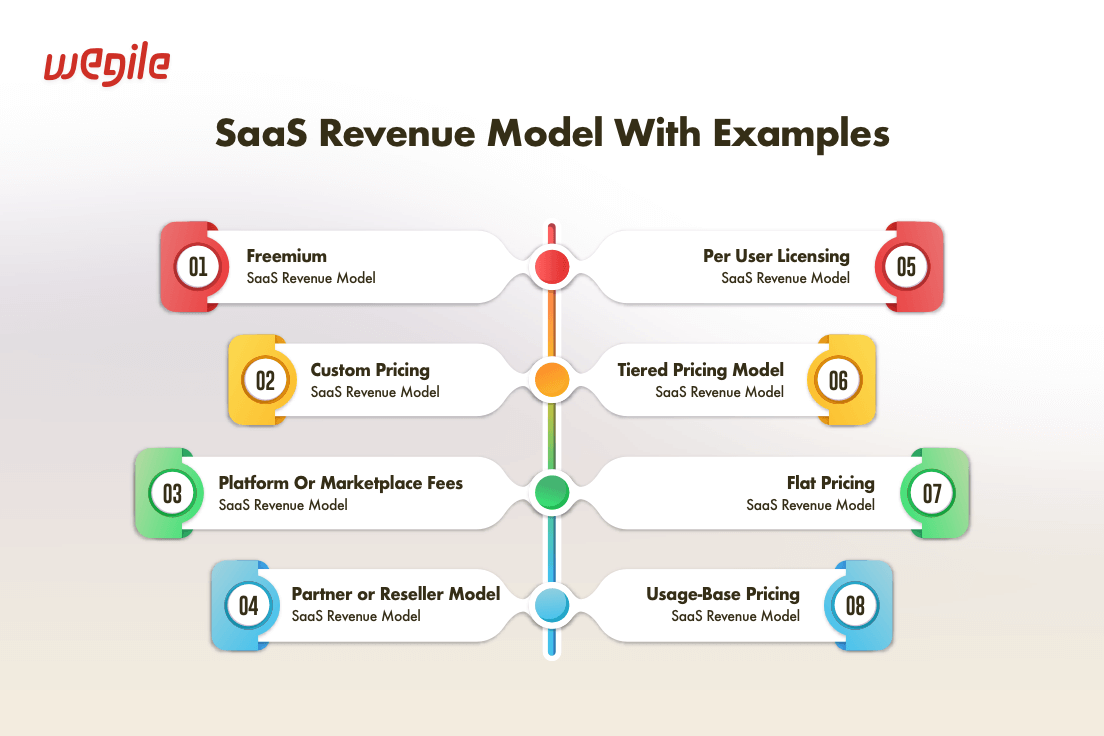
Freemium – SaaS Revenue Model
Think about a freemium SaaS business model as a ‘try before you buy’ concept. The customers can try
your SaaS product for free, and if they like it, they’re encouraged to pay to upgrade to a premium
experience. This means businesses can provide access to a basic version of their service at no cost,
getting users familiar with their offerings. Then, through adding additional features or service
levels with associated costs, users are encouraged to upgrade to the full version – helping bring in
long-term revenue streams. With the Freemium SaaS revenue model, the business benefits from more
loyal customers – as users have already used the product for free and then paid for premium features
that improve customer retention. With freemium, your customers are more likely to stay for longer
due to the low-risk entry point.
Canva– Freemium SaaS
Revenue Model Example
Canva’s freemium SaaS revenue model is like giving people a taste of something good for free. With
the free version of Canva, you can use some of its tools to make cool designs and see if you like
them. You don’t have to pay anything at first.
But if you want even cooler stuff like fancy templates and special design tools, you can choose Canva
Pro. This is a fancier version that you pay for every month or every year. This money helps Canva
keep things running smoothly and make the platform even better.
For you, it means you can check out Canva without spending money right away. It makes it easy to try
and see if you like it. If you really enjoy it and want more special features, you can decide to
upgrade to Canva Pro.
Think of it like going to an ice cream shop. You start with a free sample to see if you like the
flavor. If you want more toppings and flavors, you can pay a bit more for a bigger deluxe cone. This
helps the shop offer both simple and fancy options, and you get to pick what suits your taste and
budget best.
Custom Pricing – SaaS Revenue Model
A custom pricing SaaS revenue model allows companies to tailor their software costs for a variety of
usage and feature needs. It’s ideal for larger companies that require additional features and access
for multiple users beyond what’s offered in regular subscription plans. Think of it like a
custom-fit suit: you pay more upfront for a product that perfectly fits your needs and budget. The
same is true when it comes to SaaS custom pricing. With this type of pricing model, you can select
the features and access levels you need now and upgrade (or downgrade) over time to meet changing
usage demands. Stop settling for off-the-rack SaaS solutions! Get a custom-tailored fit with custom
pricing.
Clevertap– Custom Pricing
SaaS Revenue Model Example
CleverTap’s Custom Pricing model is like getting a menu at a restaurant where you only pay for the
dishes you order. It’s all about giving businesses a personal and tailored way to make their
marketing and user engagement better. This special way of pricing ensures that businesses pay just
for what they really need, like picking only the foods you want to eat.
CleverTap starts by having a chat with the business to understand exactly what they want and need.
It’s like talking to the waiter about your favorite flavors and how hungry you are. Based on this
chat, CleverTap creates a pricing plan that matches the business’s wishes. It’s like the chef making
a plate with exactly the flavors and portions you want.
If the business grows or changes its marketing plans, CleverTap’s pricing can change too. It’s like
being able to add more dishes to your order if you suddenly get hungrier.
For bigger businesses or those with special needs, CleverTap has even fancier options with
extra-special features and support. So, CleverTap’s Custom Pricing SaaS Revenue model example is a
bit like a restaurant that lets you order just what you want. It’s a smart way for businesses to get
exactly what they want and make their marketing and engagement strategies super effective.
Platform or Marketplace Fees –
SaaS Revenue Model
Like any economy, the SaaS world has revenue models based on fees. One common model is the platform
or marketplace fee. This fee occurs when a platform acts as an intermediary between buyers and
sellers, connecting them together. It’s like a marketplace charging rent to vendors so they can sell
their wares in a public space. On a SaaS platform, buyers are provided with options, and sellers are
connected to the right customers. In exchange for this SaaS, the SaaS platform charges both buyers
and sellers a fee for connecting them. This fee makes up part of the SaaS company’s revenue stream.
Zomato– Platform or Marketplace
Fees SaaS Revenue Model Example
Zomato, the foodie hero, shows off the Platform or Marketplace Fees SaaS Revenue Model dance! Imagine
this: Zomato throws an online party where two cool gangs meet up – the food wizards (restaurants)
and the hungry explorers (customers). Zomato plays a matchmaker and charges a small fee for its
matchmaking skills.
Here’s the scoop: Zomato is like the ultimate menu book where restaurants can flaunt their dishes,
prices, and reviews. Restaurants join the Zomato party to get famous and meet more foodies. And
guess what? Hungry folks use Zomato to find awesome restaurants, check out menus, and order up some
tasty delights for delivery or dining in. When the orders roll in, Zomato takes a tiny cut from the
bill as its reward.
This party is a win-win! Food adventurers get an easy-peasy way to explore and order from loads of
restaurants. The food wizards, in return, get more fame and help with their orders. Zomato isn’t
just a local celebrity; it’s spread its food magic far beyond India, connecting restaurants and food
fans across the globe.
Partner or Reseller Model – SaaS
Revenue Model
The Partner or Reseller Model operates like having your own dedicated sales force without the
associated operational expenses while still reaping the full benefits. This symbiotic arrangement of
the reseller model represents a mutual advantage to both the business and the reseller. Through this
SaaS revenue model, SaaS enterprises can leverage an extensive network of established businesses
that are enthusiastic about generating fresh revenue streams by vending your software offerings.
This enthusiasm stems from the fact that these partners and resellers participate in a profit-sharing
structure that motivates them to endorse and distribute these products actively. The Partner or
Reseller Model offers a streamlined route to swiftly introduce your offerings to a broader customer
base, circumventing the need for significant investments in sales and marketing avenues; it can also
be considered as affiliate marketing. Think of it as an assembly of sales representatives, all
laboring on your behalf, effectively disseminating information about your SaaS product without any
upfront cost.
Hubspot- Partner or Reseller SaaS Revenue Model Example
HubSpot is a great
Partner or Reseller SaaS revenue model example. Think of it as a helpful matchmaker, which is like
when a friend sets you up with someone. HubSpot invites marketing and sales pros, like experts and
agencies, to team up with them.
These partners get to use HubSpot’s special software, just like how you might use a powerful toolbox
to build something cool. These partners then use the software to make smart marketing and sales
plans for their own clients, kind of like helping someone plan an awesome party.
The partner program has different levels, like earning badges in a video game. Partners can earn
rewards like money or a share of the fees paid by their clients to HubSpot.
HubSpot doesn’t stop there! They also teach partners how to use the software super well and provide
help whenever needed. And they team up with their partners to do exciting things together, like
throwing fun events or creating cool stuff.
For the clients, it’s like having a team of experts to make their plans even better. They benefit
from both the partner’s skills and the cool software from HubSpot. So, HubSpot’s Partner or Reseller
model is like a win-win-win situation, where everyone gets something great – businesses get amazing
services, partners get to help and earn, and HubSpot gets to spread its awesome tools far and wide.
Per User Licensing – SaaS Revenue
Model
Per-user licensing serves as a SaaS revenue framework where enterprises incur charges based on the
number of users engaging with and utilizing the software. The main benefit of this model is
scalability; as more users are added, more revenue is generated for the business. Additionally, it
allows businesses to offer a tiered pricing structure, catering to customers with different user
requirements and budgets.
To explain this concept further, envision the process of getting theater tickets. When you buy an
individual ticket, the expense pertains solely to that one person – akin to per-user licensing,
where patrons are exclusively billed for each user of the software. Alternatively, think of the
scenario of acquiring an entire theater in one go. This would entail a substantial upfront fee, much
resembling an enterprise or site-wide license.
Google Workspace–
Per User Licensing SaaS Revenue Model Example
Google Workspace adopts a per-user licensing SaaS (Software as a Service) revenue structure. The
Per-user licensing approach lets the customers pay a monthly fee per user to enjoy Google Workspace
services. The pricing differs based on the chosen plan – whether Business Starter, Business
Standard, Business Plus, or Enterprise.
This Saas revenue model example proves advantageous for both customers and Google. For customers, it
delivers flexibility, allowing them to adjust user numbers as needed. This means they only pay for
the users in play. Moreover, it opens the door to a suite of productivity tools, including Gmail,
Drive, Meet, Calendar, and Chat, increasing work efficiency.
This per-user licensing scheme ensures a steady revenue stream anchored in the user count subscribed
for Google. It facilitates tailored service scaling, ongoing support, and updates. Plus, diverse
plans spanning features and pricing empower Google to cater to varied customer groups and expand
market outreach.
The SaaS model of per-user licensing in Google Workspace provides customers with cost-effective
access to essential tools while also establishing a sustainable revenue stream for Google, thereby
enhancing business viability and customer satisfaction.
Tiered Pricing Model – SaaS Revenue
Model
Tiered pricing models are commonly used in Software as a Service (SaaS) subscriptions. This Saas
revenue model lets the customers choose a plan that best matches their needs. The basic plan gives
customers access to the most essential features, while higher-tier plans offer additional features
that become more powerful as you move up in levels.
Think of Tiered pricing models like a staircase, with each step providing you with more capabilities.
Those with more complex or specialized needs can climb the pricing “staircase” and access plans with
a higher cost but with more impressive features and benefits. To make this model even more
appealing, the cost of moving to the next tier isn’t typically punishingly high— thus enabling
businesses to scale up in an orderly and affordable fashion.
The tiered pricing model provides flexibility for businesses and customers alike – everyone gets
exactly what they need. Plus, it can help drive profits for the business since customers who find
great value in the available features are willing to pay more for access to higher tiers.
HBO Max – Tiered Pricing
Model – SaaS Revenue Model
Think of HBO Max’s Tiered Pricing Model – SaaS Revenue Model example, like different types of ice
cream at a shop. Just like how some ice cream scoops cost more than others, HBO Max offers different
levels of access for different prices.
Imagine you’re choosing between ice cream flavors. HBO Max gives you choices, too – their basic plan
lets you watch with ads, like getting a simple ice cream cone. But if you want more, you can get a
fancier plan that’s ad-free and has extra stuff, such as 4k, like a deluxe ice cream sundae.
So, HBO Max looked at how software companies offer different versions at different prices. Just like
people might prefer certain ice cream flavors, viewers can choose the HBO Max plan that suits them
best.
This clever idea shows how companies can learn from different fields. HBO Max’s way of offering
choices, inspired by the SaaS model, gives customers what they want – a bit like picking the perfect
ice cream treat at the shop.
Flat Pricing – SaaS Revenue Model
Imagine you are running a summer camp, and parents need to pay for their kids to attend. Instead of
charging for each activity – kayaking, hiking, etc. – you charge one flat fee that grants access to
every activity no matter how many times their kids participate.
That’s the concept behind Flat Pricing – Customers pay one flat fee regardless of the number of users
or features used on a platform with the SaaS business model. Flat Pricing creates a recurring Saas
revenue stream that’s reliable and creates value for customers. And there’s no need to worry about
overpaying when usage is low or underpaying when usage is high. That means the customer doesn’t have
to worry about unexpected costs increasing the price of your membership or certain features not
being available if you can’t afford them. With a flat pricing SaaS model, you get what you pay for
upfront – no surprises, no extra costs.
ChatGPT– Flat Pricing
SaaS Revenue Model Example
ChatGPT employs a straightforward and cost-efficient flat pricing SaaS revenue model, granting
customers convenient access to the advanced GPT-4 model, quicker response rates, and exclusive beta
functionalities such as Browsing, Plugins, and Code Interpreter. This SaaS revenue model example
heightens the user experience and ensures a steady income stream for OpenAI.
The flat pricing approach adeptly balances the delivery of customer value with the nurturing of
business sustainability. Through a single monthly payment, customers gain unfettered access to
ChatGPT’s full range of offerings, effectively optimizing both their operational efficiency and
OpenAI’s financial well-being.
Through appealing pricing structures and an extensive array of benefits, ChatGPT simplifies the
process for customers to harness the complete potential of the GPT-4 platform in a manner that is
both cost-effective and foreseeable.
If you want to further understand ChatGPT and how it is different from Claude, take a look at our
article: What Is The Difference Between
Claude Vs. ChatGPT.
Usage-Based Pricing – SaaS
Revenue Model
Usage-based pricing is an increasingly favored revenue model in the world of Software as a Service
(SaaS). Here, customers pay in accordance with the volume of services they use. It’s especially
well-suited for companies on a fast growth trajectory, expanding their service consumption. Think of
it like topping up your gas tank – the more you pump in, the higher your payment climbs.
This model’s charm lies in its transparency and customer control. Users gain a clear understanding of
their expenses and the extent of their usage. It’s akin to having the reins on your car’s fuel
consumption – you choose how much to use and pay for. For businesses relying on SaaS to fuel their
progress, usage-based pricing slashes risk while enabling growth and enhancement, all within a
reasonable budget.
Heroku– Usage-Based
Pricing SaaS Revenue Model Example
Heroku has some perks for both itself and its customers with the Usage-Based Pricing SaaS Revenue
Model. For Heroku, they get paid according to their resources used and consumption – making sure
that a steady income stream is coming in. On top of this, they are incentivized to be more
resourceful given this structure so as to increase the efficiency of their services. For customers,
they can choose pricing options that match their projects regardless of scale. Furthermore, they
have options for database management, Apache Kafka, and other services that they can add or remove
depending on their needs. Additionally, Heroku provides Private Spaces and Heroku Shield with their
own unique pricing plans for businesses with security requirements. Lastly, those with
enterprise-level applications would benefit from their bespoke plans – these plans have custom
pricing and specialized features to meet the particular demands of large organizations.
Leave a Reply