What is the Business Model Canvas?
The Business Model Canvas (BMC) is a widely used tool developed by Alexander Osterwalder and
Yves Pigneur to help organizations map
out their business strategies. Consisting of nine building blocks, the BMC provides a visual
framework for exploring and articulating new or existing business models, broken down into value
propositions, customers, channels, customer relationships, revenue streams, resources, activities,
partners, and cost structure.
By demystifying complex business models, the business model canvas enables entrepreneurs to quickly
illustrate, test and refine their strategies in order to increase revenues and foster growth.
Check out our Portfolio to see why we are the leading
website and app developer.
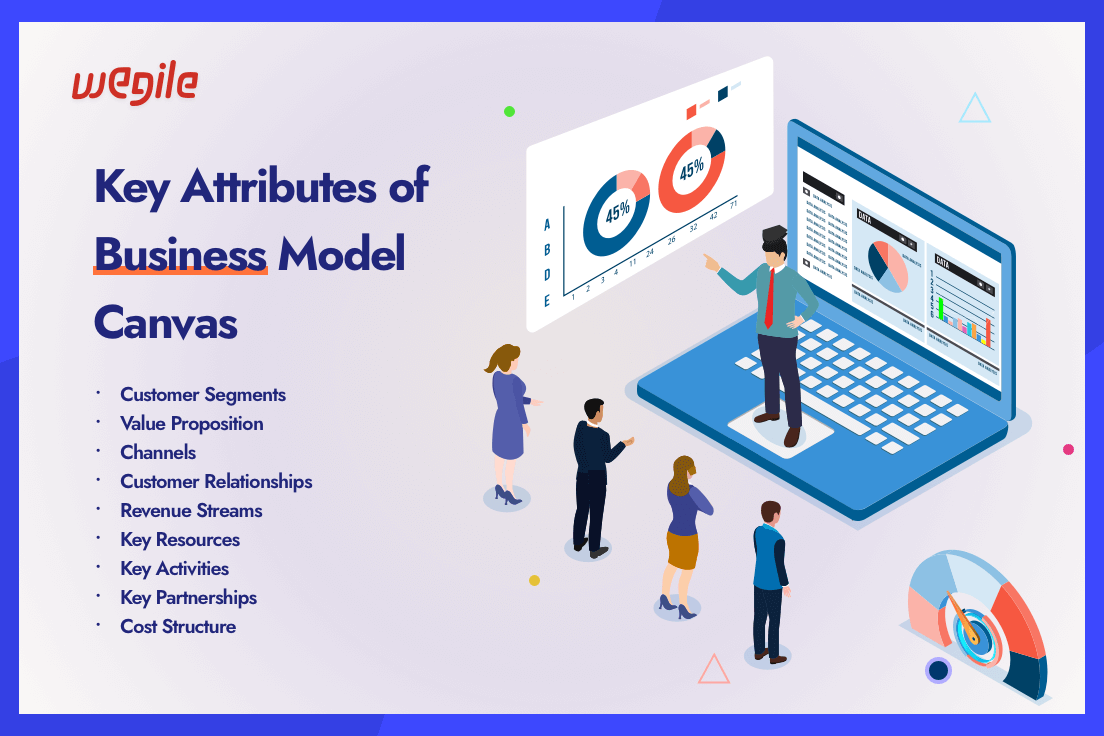
Key Attributes of Business Model
Canvas
-
1. Customer Segments
This outlines the target customer base that the company targets with its offerings.
-
2. Value Proposition
This refers to how an organization creates value within its business model. It should provide
a customer-centric description of what the company does and offers customers. -
3. Customer Relationships
This highlights how companies interact with customers and how they should be managed
throughout the duration of the relationship. -
4. Revenue Streams
This business model canvas attribute defines how entrepreneurs monetize their value
proposition by identifying potential sources of revenue. -
5. Key Resources
This describes the means by which a startup or business has access to materials, knowledge,
or technology that enables the delivery of its value proposition to customers. -
6. Key Activities
This identifies the core activities necessary for businesses to develop value propositions
and customer relationships. -
7. Key Partnerships
This outlines the partners needed to help companies execute their value chain activities in
order to deliver their value proposition to customers. -
8. Cost Structure
Determining an optimal cost structure that enables profitability while sustaining growth.
Organizations can thoroughly comprehend their business model and make informed decisions
about strategy, operations, and growth opportunities by delineating these fundamental
characteristics. With Business Model Canvas, Entrepreneurship has never been easier.Take a look at: Pros And Cons: Of AI In Healthcare – Analysis By Wegile
Business Model Canvas Examples –
Startups & Businesses
Tesla Motors
Tesla Motors is a pioneering force in the auto industry and a business model canvas examples of
startups, one that defies traditional conventions and incorporates innovative designs and
technology. Tesla is the most valuable brand within the automotive sector worldwide as of 2023, with
a brand
value of more than $ 67.7 billion with a market cap of $854.52 billion as of
July 2023. Let’s take a look at the business model canvas examples of startups.
Customer Segments
-
1. Environmental enthusiasts who prioritize sustainability in their purchasing decisions.
-
2. Early adopters of new technology and innovation in the automotive industry.
-
3. Individuals who seek luxurious automobiles with exceptional quality and high-performance
capabilities.
Value Propositions
-
1. Environmentally friendly vehicles with zero emissions.
-
2. Electric vehicles that offer impressive performance that can match the speed and
acceleration of traditional luxury cars. -
3. Innovative autonomous driving features for enhanced safety and convenience.
Channels
-
1. Tesla-owned showrooms located in major cities around the world where customers
can view and test drive vehicles before making a purchase decision. -
2. Online sales platform allowing customers to configure their vehicle, place an
order, and track delivery progress.
Customer Relationships
-
1. Direct sales through Tesla-owned showrooms or online channels.
-
2. Maintaining customer loyalty through excellent after-sales service, including
software updates and over-the-air improvements.
Key Resources
-
1. Intellectual property related to electric vehicle technology, including
patents and trademarks. -
2. Manufacturing facilities and equipment.
-
3. Skilled engineers and designers.
Key Activities
-
1. Designing and manufacturing electric vehicles, including cars and
energy storage products. -
2. Developing autonomous driving technology.
3. Operating a network of Supercharger stations for electric vehicle charging.
Key Partnerships
-
1. Various automotive suppliers and service providers.
-
2. Suppliers of raw materials and components
-
3. Battery manufacturers
-
4. Charging infrastructure providers
-
5. Dealerships and distribution partners
-
6. Governments for regulatory support
Cost Structure:
-
Research and development expenses for continuous innovation.
-
Manufacturing costs (raw materials, labor).
-
Marketing and advertising expenses to reach target customers
(mostly done by Tesla’s CEO Elon Musk).
Zoho
Corporation
-
Small and medium-sized businesses (SMBs) in search of
cost-effective software solutions that can effortlessly scale
alongside their business. -
Professionals and freelancers seeking productivity tools.
Value Proposition
-
1. Comprehensive suite of cloud-based business applications
that address various needs, including CRM, finance, HR,
project management, and more. -
2. Cost-effective solutions with flexible pricing plans to
cater to different customer budgets. -
3. User-friendly interfaces and customizable features that
enhance productivity and efficiency.
Channels
-
1. Online platforms such as the Zoho website, app
stores, and partner websites. -
2. Direct sales through a team of sales representatives.
-
3. Strategic partnerships with technology resellers and
consultants.
Customer Relationships
-
1. Self-service model with extensive documentation,
tutorials, user forums, and a knowledge base for
customers to find answers to their queries. -
2. Responsive customer support through email, chat,
phone calls, and social media channels. -
3. Continuous product updates and enhancements based
on user feedback.
Revenue Streams
-
1. Subscription-based pricing models with tiered
plans offering different features and levels of
support. -
2. Additional revenue from add-on services such
as data migration, customization assistance, or
training programs.
Key Activities
-
1. Product development to continually
enhance existing applications and develop
new ones. -
2. Marketing campaigns to create awareness
about Zoho’s products across target
segments. -
3. Sales activities, including lead
generation, demo presentations, and
negotiations. -
4. Customer support services to ensure
customer satisfaction.
Key Resources
-
1. Skilled software developers for
product development -
2. Sales team for acquiring new
customers -
3. Customer support team for assisting
users -
4. Marketing team for promoting products
Key Partnerships
-
1. Technology partners providing
integration capabilities with other
popular business tools -
2. Reseller partners who offer
Zoho’s products as part of their
portfolio -
3. Consultants and trainers who
assist customers with implementation
and training services
Cost
Structure
-
1. Research and development
costs for product enhancement is
key in business model canvas
examples of startups. -
2. Operational expenses related
to infrastructure maintenance,
customer support, marketing,
sales, and administrative
functions. -
3. Infrastructure costs for
hosting cloud-based
applications.
Planning to start your own small
business? Don’t forget to plan and
prepare for the challenges ahead.
Take a look at Conquer
Small Business Challenges: Your
Action Guide to Success
2023.
Zoho Corporation is an established
software company that specializes in
creating cloud-based office
productivity applications. Founded
in 2005, Zoho has grown to become
one of the leading providers of
business products today – with
over
50 million users benefiting
from their solutions all across the
globe. Let us dive in and understand
this business model canvas examples
of startups.
Conclusion for Business Model Canvas
The Business Model Canvas for
entrepreneurship and startups
provides a comprehensive and
adaptable framework for
entrepreneurs to envision, construct
and refine their business models. It
enables clear thinking around
strategy and operations while also
encouraging creative collaboration
to foster novel solutions. Whether
you are launching a startup or
rejuvenating an existing venture,
the Business Model Canvas is the key
to successful entrepreneurship in
this business environment.
Hopefully, these business model
canvas examples of startups helped
you and gave you the information you
were looking for.
Leave a Reply