Introduction
Our world is changing – and fast. We’re seeing a rapid trend towards automation, with machines
beginning to overtake many of the jobs that used to be done by humans alone. Nowhere has this been
more evident than in healthcare, where artificial
intelligence (or AI) now plays an integral role in diagnostics and treatment strategies for
most modern medical professionals.
In this article by Wegile, we’ll dive deep into the debate
surrounding the pros and cons of artificial intelligence in healthcare — exploring what makes it so
attractive as well as looking at any potential drawbacks that come along with its increasing
adoption rate. Is there still space left for human judgement when decisions regarding patient care
are being made? Can AI systems truly provide better outcomes than those provided by doctors? What
are the advantages and disadvantages of artificial intelligence in healthcare? Let’s find out!
Pros and Cons of Artificial
Intelligence in Healthcare
Pros of Artificial Intelligence
in Healthcare
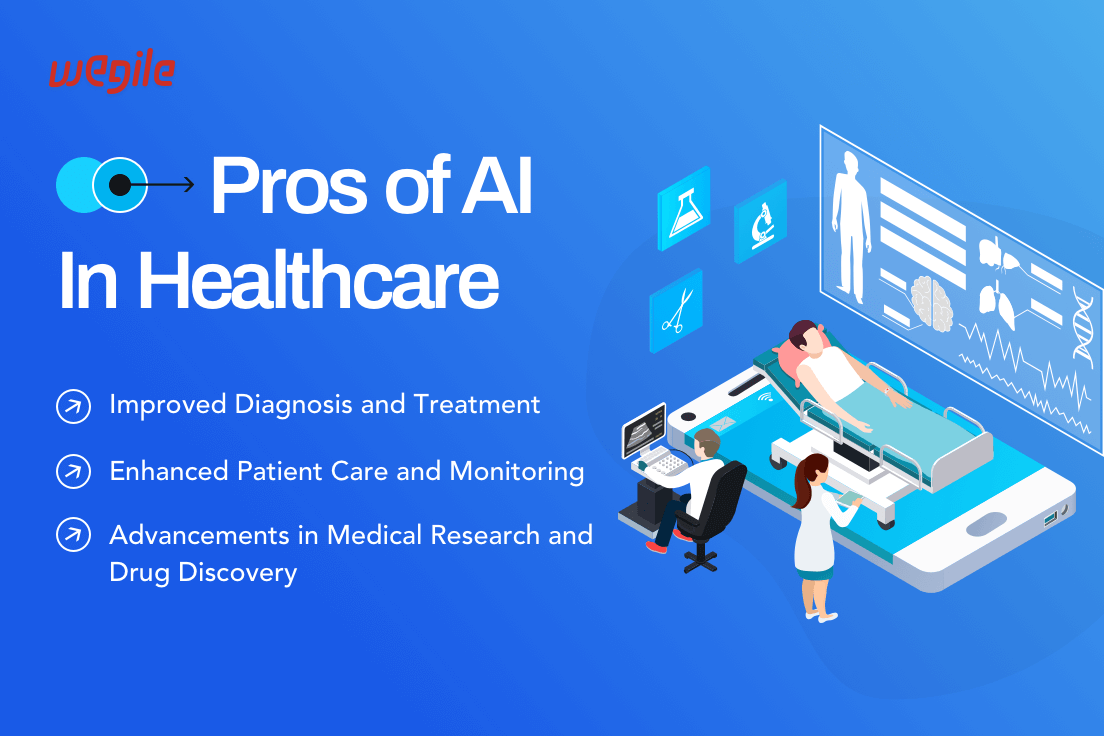
Improved Diagnosis and Treatment | #1 Pro in Pros and Cons
of AI in Healthcare
Medical practitioners have long relied on their experience and intuition for diagnosis and treatment
plans; expert insight has been augmented with new technologies that utilize artificial intelligence
(AI) in creative ways. AI-assisted diagnostics allow doctors to make more accurate diagnoses faster
than ever before—a benefit that cascades down into every aspect of patient care, from treatments
tailored specifically to individual needs through predictive analytics for early detection right up
until successful management programs are set in motion.
When used together with human expertise, AI offers unprecedented opportunities for revolutionary
practices like precision medicine or personalized treatments based on data analysis at scale
materializing much earlier predictions about diseases as well as improving traditionally slow
decision processes around resource allocation within hospitals. In short: when applied thoughtfully
alongside research-driven, evidence-based approaches and clinical insights gained by experienced
professionals – Artificial Intelligence unlocks a world of potential benefits across all areas of healthcare!
Enhanced Patient Care and Monitoring | #2 Pro in
Artificial Intelligence in Healthcare Pros and Cons
When arguing the pros and cons of artificial intelligence in healthcare, AI promises to revolutionize
healthcare, enabling more individualized treatments and preventative steps to ensure better patient
care. Remote monitoring capabilities use artificial intelligence (AI) algorithms that capture vital
signs from digital signals like wearables or
sensors in the home environment, allowing continuous remote assessment of a person’s state
of health including their physical activity level and sleep patterns —all transmitted automatically
for easy access by clinicians.
AI-powered virtual assistants can answer common questions about medical procedures or explain
explanations with natural language processing while predictive modeling will provide deeper insights
into disease states than ever before possible—and faster: Generating complex data readouts with deep
learning networks that analyze lab results and personal charts alongside environmental factors such
as air pollution levels within minutes rather than hours has already been proven feasible.
Ultimately these new innovations are paving the way for novel personalized approaches to patient
care on both an outpatient basis through clinics but also supporting patients recovering at home
after surgery in greatly enhanced ways when compared to our current state healthcare systems
capability today!
Advancements in Medical Research and Drug Discovery |
#3 Pro in Advantages and Disadvantages of Artificial Intelligence in Healthcare
While arguing the pros and cons of artificial intelligence in healthcare, AI technology proves
to be a powerful tool for accelerating the drug discovery process by providing efficient data
analysis methods that allow researchers quick access to relevant information related to any disease
condition from all sources, including existing literature databases and clinical records– giving
them their current best picture of what is going on with it based on past observations. Not only
does this require fewer resources such as time or money, but it also allows scientists an
understanding of how different drugs perform when given at similar dosages during tests – leading us
closer towards personalized medicine care tailored specifically linked to one’s genetics than ever
before!
Additionally, due to its ability to utilize large datasets within minutes compared to hours manually
analyzing feedback sheets – artificial intelligence can offer numerous advantages making Medical
Research more accurate & suggesting never explored treatment options much faster- allowing
physicians better insight into patient’s actual health progressions which could potentially defend
humanity against rising pandemics around the world without being dependent upon extrapolated
findings anymore
Cons of Artificial Intelligence in
Healthcare
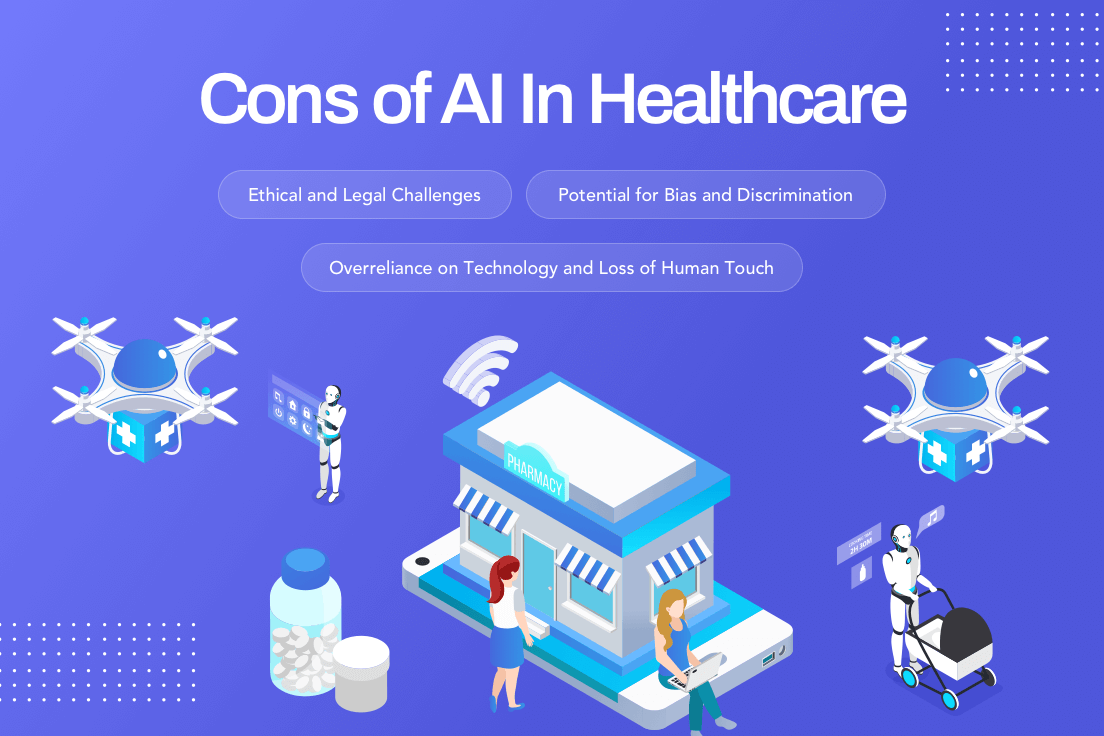
Ethical and Legal Challenges | #1 Con in Advantages and Disadvantages of Artificial
Intelligence in Healthcare
One of the primary issues lies in patient privacy and data security when using AI algorithms. With
increased access to a wide range of personal information, there are serious concerns about properly
protecting this sensitive health data from breaches or unauthorized dissemination. Another concern
relates to accountability for any errors that occur as well as transparency around how these
decisions were made; if an incorrect diagnosis occurs due to unforeseen pitfalls within the AI model
itself, then regulation will be required concerning who takes responsibility for such malfunctions –
whether this rests solely on human negligence or also on algorithmic malfunctioning remains unclear.
Finally, liability-related problems may arise depending upon which group should take ownership over
faulty software programming faults leading up to erroneous outcome predictions stemming from
improper training datasets used while developing medical learning models — treating doctors or
software vendors?
Potential for Bias and Discrimination | #2 Con in Artificial
Intelligence in Healthcare Pros and Cons
While arguing the pros and cons of artificial intelligence in healthcare; There are potential
pitfalls related to bias and discrimination when introducing artificial intelligence. Issues can
arise from algorithms generating biased decisions or recommendations due to a lack of diversity in
the training data provided, as well as disparities resulting from access (or lack thereof) to AI
technologies across different communities or demographics. It is important for stakeholders such as
health IT professionals, clinicians, and policymakers alike not only to develop appropriate policies
but also implement measures that identify possible instances where biases could impact
decision-making processes within an organization’s patient-care system.
Furthermore, it is crucial that proactive steps be taken towards ensuring unprecedented opportunity
for all residents who have traditionally had unequal opportunities with regards to their ability to
benefit and fully utilize the most advanced available applications offered by technology today –
thus mitigating any concerns posed by issues surrounding fairness perception among both consumers
and practitioners associated with using said systems.
Overreliance on Technology and Loss of Human Touch | #3 Con in Pros
and Cons of Artificial Intelligence in Healthcare
One significant con of ai in healthcare is the possibility of overreliance on technology, which may
result in a loss of human touch when interacting with patients. This could lead to doctors relying
less upon their own judgment or expertise during decision-making processes; instead, trusting AI
systems that often source data from limited evidence bases without considering pertinent
context-based factors affecting the treatment.
Additionally, leveraging machine learning algorithms instead of relying on humans’ expertise means
properly trained personnel must always monitor output from such technologies, as these faulty
outputs have growing implications with regard to outcomes delivered in care settings if not used
correctly. Lastly, robots will struggle to demonstrate empathy towards some emotionally charged
situations faced in healthcare contexts that only humans can provide due to cultural nuances present
regarding certain diseases or treatments where clinical insight alone cannot suffice
Leave a Reply