In today’s fast-paced data-driven environment, Machine learning has emerged as a vital technological
tool.
From online purchasing and binge viewing your favorite collections to obtaining personalized clinical
suggestions, Machine learning(ML) is essential in enhancing experience in a variety of fields.
This blog is your entry point into the enthralling world of machine learning, where we’ll learn about
the amazing concept and its incomparable benefits!
Moreover, later in the blog, we will also learn about how to build a model from scratch. So let’s
dive in!
What is a
Machine Learning Model?
At the core of machine learning lies the Machine learning model, an algorithm or a set of algorithms
that learns patterns and relationships from data
ML models act as the virtual brains of apps that recognize faces, forecast stock prices, and
recommend things based on an algorithm.
Consider these models to be information symphony conductors! Automated machine learning models assist
us in making predictions, discovering unexpected insights, and automating jobs that were previously
handled only by people.
In the later section, we’ll learn the benefits of the ML model and how it fits into the fascinating
world.
Benefits of
Machine Learning Model
-
1. Data-Driven Decision Making
Every time you open your Netflix to watch movies, you get movie recommendations. However, the
surprising part here is all these movies are recommended on the basis of your taste and
preferences. But how does this happen? Here, Machine learning is the secret sauce that
powers these suggestions. These applications analyze the previous content you’ve watched
and, on that basis, provide suggestions on what to watch next. Moreover, businesses also
consider including app modernization in their strategy for a better app experience. -
2. Predictive Analysis
What if we told you there is a crystal ball that can help you see into the future? Machine
learning tools let you forecast trends with impressive accuracy. For example, Machine
learning can predict stock prices based on past data, which can help investors make informed
decisions to optimize their investments and earn higher profits. -
3. Personalization
Not sure what you should buy for this festive season? Well, don’t worry! Machine learning
models rock here. Your favorite eCommerce website uses ML for recommending products based on
your past purchases, which further results in chances of finding items you would adore.
Hence, if you have your own brand, you might want to consider the support of a mobile app
development company to incorporate the use of ML in your app to enhance your
customer’s shopping experience. -
4. Error Minimization
Remember how you felt when you discovered there could be flaws in a critical document?
Machine learning (ML) can help to reduce such incidents. Grammar-checking tools and
ML-powered language translation services ensure that your files are error-free and
comprehensible. -
5. Quality Assurance
Quality is important in both manufacturing and healthcare environments, which is why Machine
learning models exist. Machine learning models are used to discover flaws or anomalies and
can even help ensure that every automobile produced satisfies high safety regulations,
ensuring safer roads for all. -
6. Boost Productivity
Time is money, and Machine learning may help you save it for more creative and strategic
work. Routine duties could be done automatically, freeing up more of your valuable time for
innovative and creative ideas. Consider getting access to data through machines rather than
manually dealing with routine report technology. -
7. Resolve Complex Problems
Complex problems may appear unsolvable, but Machine learning thrives on them. With Machine
learning, medical diagnoses using X-rays or MRI scans become significantly more accurate,
bringing hope in difficult conditions.
How to Develop
a Machine Learning Model from Scratch?
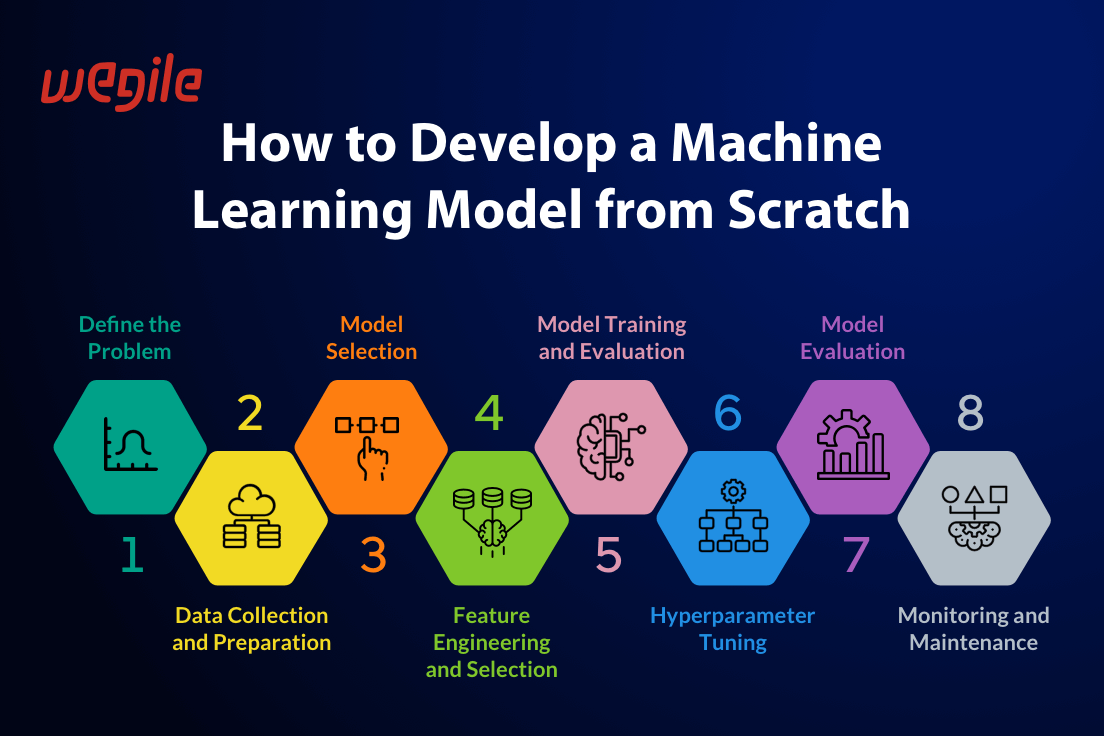
Now that we have understood the benefits of Machine learning models let’s understand how to build a
model from scratch. Below is the step-by-step guide that explains the entire process of developing a
machine learning model.
-
1. Define The Problem
Defining issues is crucial to the success of Machine learning models. When planning and
reviewing venture implications, create an ordered list of difficulties that include every
probable obstacle.For example, Early sickness identification necessitates more than just knowing their names.
It also needs specifications of the diseases you aim to detect, as well as demographics of
target audiences and ethical issues regarding patient’s confidential information.Every project would benefit from starting with a detailed definition of its obstacles in
order to successfully deal with constraints and create clear fulfillment requirements that
allow initiatives to continue their path of discovery or growth. -
2. Data Collection and Preparation
Finding important data required to develop your model may feel like a treasure hunt.
Therefore, collecting all essential documents, such as electronic clinical records, image
tests, and clinical evaluations will be critical in combining all necessary elements.Data cleaning includes detecting mistakes and inconsistencies as well as properly managing
missing records. It also contains forms for standardization for easy inclusion into
corporate processes.These stages are critical components of an effective data education plan.
Patient’s’ privacy rights are one of the top ethical objectives in healthcare programs, and
hence, anonymization should be addressed as well.Employing good data collection and guiding methods will ensure trust in your model!
-
3. Model Selection
Model selection is at the heart of effective machine learning. The crucial step in this
journey is to choose the appropriate algorithm and architecture that would best handle a
problem.A proper selection process is determined by a number of factors, including the available data
and its quality, as well as the obstacles faced when executing tasks and the intended
outcomes.Deep learning models, due to their
excellent pattern recognition skills, are one of the finest techniques for early illness
diagnosis when using medical images.Decision trees
and logistic
regression models provide more appropriate diagnostic procedures.Careful consideration should be made when selecting among these choices to ensure that they
fit your criteria and the peculiarities of the situation at hand. -
4. Feature Engineering and Selection
Selecting relevant and valuable data items from your files to employ in engineering projects
is an art in itself, similar to making something out of raw materials.Accurate early diagnosis necessitates the collection of age groups, lifestyle indices,
genetic markers, or past clinical information. Once your model has all of these vital facts,
it can generate accurate predictions.Extraneous details may limit its effectiveness; therefore, careful thought must be given to
both information collecting and the problem space in order to devise an efficient approach
for identifying aspects that contribute the most to model accuracy. -
5. Model Training and Evaluation
Training a model is similar to training someone how to play an instrument. At this stage,
your model analyzes the relationships between its fact points in an attempt to expose any
hidden patterns within them.After training has been given to the model, its efficacy must be thoroughly analyzed to
ensure its fine-tuned performance.Accuracy, precision, recall, F1-score, and ROC-AUC are all fantastic measures of overall
version performance.At this level, it is critical that the model not only retains statistical information but
also applies it promptly to real-world challenges.You may use evaluation metrics to test individual programs or evaluate their capacity to
tackle various problems. -
6. Hyperparameter Tuning
Hyperparameter tuning is the process of determining appropriate settings for your machine
learning version, comparable to tuning musical instruments to obtain accurate tunes.Hyperparameters are external to your model and influence its learning processes, such as
learning rates, batch sizes, and regularization terms.Tuning these models can significantly increase performance, usually through grid search or
random search, to identify an ideal combination of hyperparameters that results in maximum
correctness and efficient results. -
7. Model Evaluation
Since ML models can have real-world consequences and consumer preferences can shift over
time, comparing one model to another is never an exact science.To meet the ever-changing requirements of recommendation, the use of real-time metrics that
measure accuracy and effectiveness over time must be in place.Any deviations faced must be addressed immediately by intervening protectively to fine-tune
or reconfigure functionality to prevent decline and regression in results. -
8. Maintenance and Inspection
Consider your deployed version as someone who needs continual support, similar to real
patients. As a result, its performance should be examined on a regular basis.When examining model performance in real-world applications, forecast accuracy, system
responsiveness, and resource consumption must all be frequently reviewed.When you do this on a regular basis, you will be able to detect any differences as they
arise.If you observe performance deteriorating as a consequence of altering record distributions,
customer habits, or external outcomes, rapid action should be taken to restore its efficacy.Ongoing maintenance activities, such as retraining models or hyperparameter settings or
evaluating features, can ensure that your model continues to perform successfully for longer
periods.
Wrapping Up
At this point in our journey toward Machine learning mastery, it should be clear that this technology
represents far more than just another trend or buzzword.
Its profound impact extends into all spheres of daily life since Machine learning decisions become
part of everyday improvements that enrich lives on a daily basis.
Integrating advanced models into your application may appear to be a difficult task, but you don’t
have to confront it alone.
Wegile can help and improve your app journey by providing expert assistance, bespoke solutions, and
an experienced team dedicated to ensuring its successful and smooth integration.
Leave a Reply