Artificial Intelligence (AI) is changing how we use social media today. The advanced tech is
responsible for turning it into a powerful tool for enhancing user engagement and experience. AI
integration in social media platforms has improved content delivery. Further, it provides deeper
insights into related aspects such as user behavior, preferences, and trends. Several crucial
elements of AI are often overlooked, even though we keep talking about its ability to personalize
content and improve ad targeting. For example, Artificial Intelligence can detect emotional cues in
text, images, and videos. It allows platforms to create more empathetic and human-like interactions.
In this blog, we will explore the crucial and transformative role of AI in social media.
The Evolution of AI in
Social Media
Artificial Intelligence (AI) has steadily evolved, significantly impacting social media platforms.
From its humble beginnings to its current sophisticated applications, AI’s journey in social media
is marked by continuous advancements that have enhanced user experiences and platform capabilities.
Early Beginnings
In the early stages, social media platforms utilized basic AI technologies primarily to automate
simple tasks. These included basic algorithms for sorting content chronologically and automating
responses for customer service. Though rudimentary, these initial applications laid the foundation
for more complex AI integrations.
Advancements in Machine Learning and AI
As AI technology advanced, machine learning and deep learning algorithms became central to social
media platforms. These technologies enabled more sophisticated features such as predictive
analytics, personalized content recommendations, and advanced data analytics. Machine learning
models trained on vast amounts of user data could now predict user behavior and preferences with
high accuracy, creating more engaging and relevant content feeds.
Must Read: How To Build
Generative AI Apps:
A Comprehensive Guide
How AI is Used in
Social Media
AI’s integration into social media has led to a wide array of applications that enhance user
experience and platform efficiency. These applications range from content personalization to user
protection mechanisms.
-
Personalized Content Recommendations
One of the most visible applications of AI in social media is personalized content
recommendations. AI algorithms analyze user behavior, interests, and interactions to curate
content feeds tailored to individual preferences. This increases user engagement and boosts
the time users spend on the platform, enhancing overall user satisfaction. -
Enhanced User Interaction and Chatbots
AI-powered chatbots have revolutionized user interaction on social media. These intelligent
bots provide instant customer support, answer queries, and engage users in real-time
conversations. Advanced natural language processing (NLP) capabilities enable chatbots to
understand and respond to user inquiries contextually, offering a seamless and interactive
experience. -
Image and Video Recognition
AI’s prowess in image and video recognition has significantly impacted social media.
Platforms now use AI to automatically tag content, identify objects and scenes, and detect
inappropriate material. This technology improves the searchability of visual content and
aids in maintaining community standards by filtering harmful or offensive content. -
Sentiment Analysis and Social Listening
Sentiment analysis powered by AI helps brands and platforms monitor and respond to user
sentiments. By analyzing text, images, and videos, AI can gauge public opinion and detect
emerging trends. This capability allows businesses to adjust their strategies
in real time and engage more effectively
with their audience.
Must Read: Exploring Top 13
Use
Cases For
Generative AI
How AI is
Changing Social Media
AI
is fundamentally reshaping social media platforms,
introducing features and capabilities that were previously unimaginable. One of the most critical
roles of AI is in protecting users. How AI helps social media platforms protect the user is
multifaceted. AI algorithms monitor content for harmful or inappropriate material, ensuring a safer
environment. Additionally, AI systems detect and prevent cyberbullying, harassment, and fake news
dissemination by identifying patterns and anomalies in user behavior and content.
AI in social media is growing rapidly. The market, valued at USD 0.99 billion in 2021, is projected
to expand from USD 1.27 billion in 2022 to USD 9.59 billion by 2030 , with an impressive
compound annual growth rate (CAGR) of
28.7% during the forecast period from 2023 to 2030. By leveraging AI, social media platforms can
offer a more secure and enjoyable user experience while also driving innovation and growth. In the
next sections, we will delve deeper into the benefits of AI in social media, the challenges and
ethical considerations it brings, and the future trends that will shape this dynamic landscape.
Benefits of AI in
Social Media
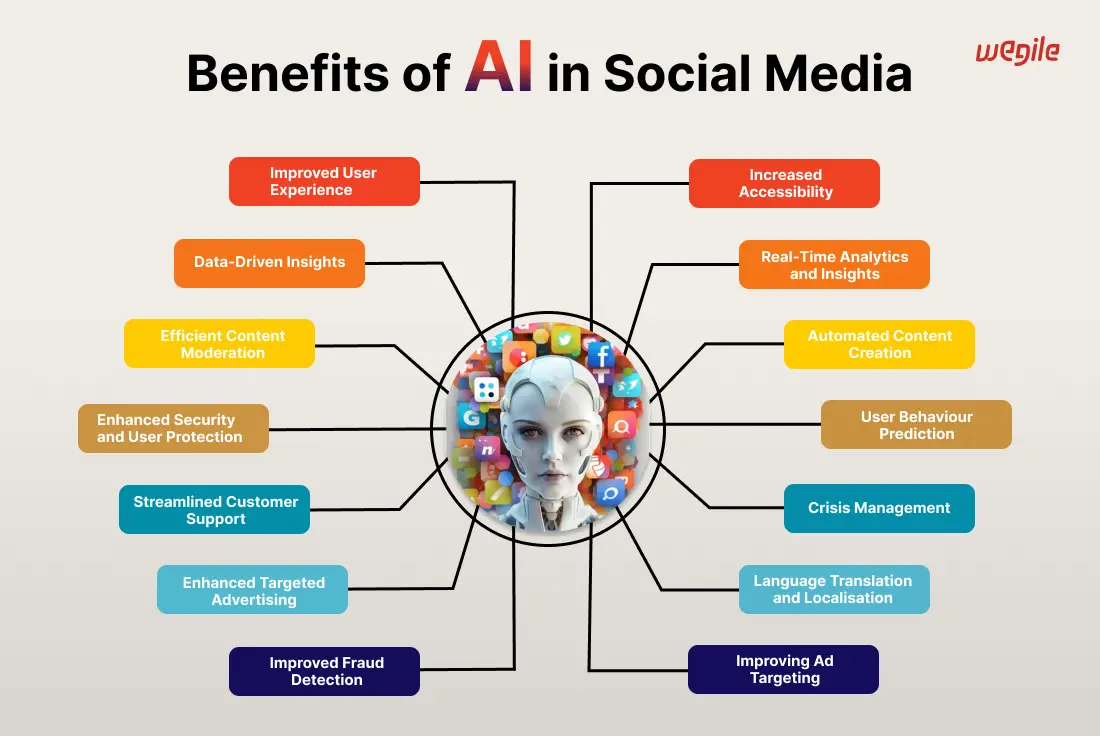
The integration of AI into social media platforms has brought numerous benefits. It enhances user
experiences and provides valuable insights for businesses. These advantages address both user
engagement and operational efficiency.
1. Improved User Experience
AI has significantly improved user experience on social media platforms. By leveraging machine
learning algorithms, platforms can offer personalized content that aligns with individual user
preferences. This customization keeps users engaged and increases the time they spend on the
platform. Additionally, AI-driven features such as real-time language translation enable users to
connect and communicate seamlessly with people from different linguistic backgrounds, fostering a
more inclusive global community.
2. Data-Driven Insights for Businesses
Businesses benefit immensely from AI’s ability to analyze vast amounts of data quickly and
accurately. AI tools can track user behavior, preferences, and trends, providing businesses with
actionable insights. These insights enable companies to tailor their marketing strategies, optimize
content creation, and predict market trends. Furthermore, AI-powered analytics tools help businesses
measure the effectiveness of their social media campaigns, allowing for continuous improvement and
higher return on investment.
3. Efficient Content Moderation
Content moderation is critical to maintaining a positive and safe online environment. AI systems
excel in this area by automatically detecting and filtering inappropriate, harmful, or offensive
content. Unlike manual moderation, which can be slow and prone to errors, AI can analyze vast
amounts of content in real-time, ensuring swift action. Advanced AI algorithms can understand
context and nuance, making them more effective at distinguishing between genuine harmful content and
harmless posts that may contain certain flagged keywords.
4. Enhanced Security and User Protection
AI plays a vital role in enhancing security and protecting users on social media platforms. How AI
helps social media platforms protect the user includes monitoring for suspicious activities,
identifying fake accounts, and detecting potential threats such as cyberbullying and harassment. By
analyzing patterns and anomalies in user behavior, AI can proactively identify and mitigate risks,
ensuring a safer environment for all users.
5. Streamlined Customer Support
AI-powered chatbots and virtual assistants have revolutionized customer support on social media.
These tools provide instant responses to user queries, significantly reducing wait times and
enhancing customer satisfaction. With the ability to handle multiple inquiries simultaneously,
AI-driven customer support ensures that users receive timely and accurate assistance, improving
their overall experience with the platform.
6. Enhanced Targeted Advertising
AI significantly enhances targeted advertising by analyzing user data to understand preferences,
behaviors, and purchase patterns. This allows advertisers to deliver highly personalized ads that
resonate with specific user segments. With AI, ad campaigns can be optimized in real time, adjusting
to user interactions and feedback, resulting in higher engagement and conversion rates.
7. Improved Fraud Detection
AI plays a crucial role in detecting and preventing fraud on social media platforms. Machine
learning
algorithms can identify unusual patterns and behaviors that may indicate fraudulent activity, such
as fake accounts, spam, and phishing attempts. By continuously monitoring and analyzing data, AI
systems can quickly flag and mitigate potential threats, protecting both users and the integrity of
the platform.
8. Increased Accessibility
AI-driven tools improve accessibility on social media platforms by providing features such as
automatic captioning, voice recognition, and text-to-speech. These innovations make it easier for
users with disabilities to engage with content. For example, AI can generate captions for videos in
real-time, make visual content accessible to hearing-impaired users, and convert text to speech for
visually impaired users.
9. Real-Time Analytics and Insights
AI provides social media platforms with real-time analytics and insights, allowing businesses to
make
data-driven decisions swiftly. By analyzing user interactions, sentiment, and engagement metrics, AI
tools can offer actionable insights that help businesses refine their strategies. This real-time
feedback loop enables more effective content creation, marketing campaigns, and overall user
engagement strategies.
10. Automated Content Creation
AI-powered tools can assist in content creation by generating text, images, and even videos. These
tools can help marketers produce engaging content quickly, saving time and resources. For instance,
AI can write social media posts, create visual assets, and even compose music, enabling brands to
maintain a consistent and dynamic content pipeline.
11. User Behavior Prediction
AI’s ability to predict user behavior is a game-changer for social media platforms. By analyzing
historical data, AI can forecast future actions, preferences, and trends. This predictive capability
allows platforms to proactively suggest content, products, and services that users are likely to
engage with, enhancing user satisfaction and retention.
12. Crisis Management
In times of crisis, AI can help social media platforms respond swiftly and effectively. AI systems
can monitor social media for signs of emerging crises, such as natural disasters, public health
emergencies, or brand-related issues. By detecting these signals early, platforms can initiate
appropriate responses, disseminate critical information, and manage public perception more
effectively.
13. Language Translation and Localization
AI-powered language translation and localization tools enable social media platforms to cater to a
global audience. These tools can automatically translate content into multiple languages, making it
accessible to users worldwide. Localization goes beyond translation, adapting content to fit
cultural nuances and regional preferences, ensuring that the message resonates with diverse
audiences.
14. Improving Ad Targeting
One of AI’s key benefits in social media is improving ad targeting. By leveraging AI algorithms,
advertisers can identify the most relevant audience segments for their campaigns. AI analyzes vast
amounts of user data to deliver ads that are not only relevant but also timed to reach users when
they are most likely to engage. This results in higher click-through rates and better return on
investment for advertisers.
AI in Social Media: Future
Trends
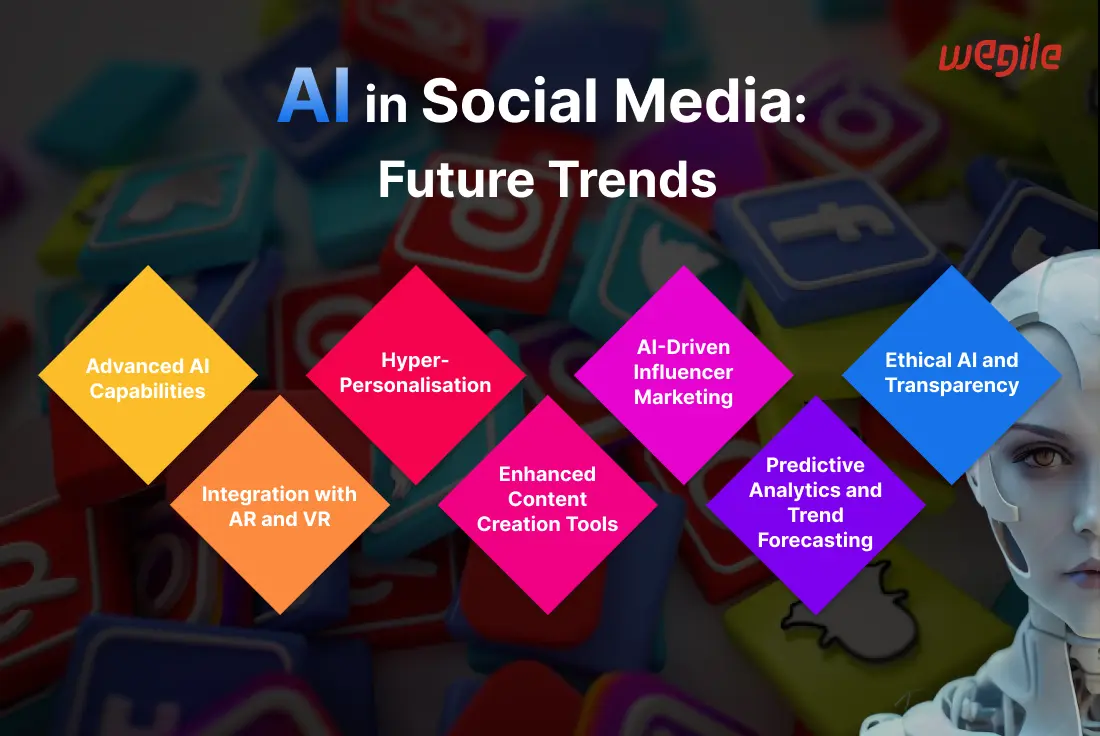
As AI technology continues to advance, its influence on social media will become even more profound.
Emerging trends are poised to redefine the social media landscape, introducing new capabilities and
reshaping user experiences. Here are some of the key future trends in AI and social media.
1. Advanced AI Capabilities
The future will see the integration of even more advanced AI capabilities in social media platforms.
These will include more sophisticated machine learning algorithms, enhanced natural language
processing (NLP), and improved computer vision. These advancements will enable platforms to offer
more personalized and engaging user experiences. For instance, AI could generate more nuanced and
context-aware responses, better understand complex user emotions, and recognize and analyze visual
content with higher accuracy.
2. Integration with AR and VR
The integration of AI with AR and VR will create immersive social media experiences. AI-driven AR
filters and effects are already popular, but future developments will enable more interactive and
personalized AR experiences. AI-enhanced virtual reality social platforms will allow users to
interact in virtual environments, making social media interactions more engaging and lifelike.
3. Hyper-Personalization
AI will take personalization to the next level with hyper-personalization. This involves using AI to
analyze user data in real-time and deliver content, ads, and recommendations tailored to individual
preferences and behaviors at an unprecedented level of detail. Hyper-personalization will make user
experiences on social media highly relevant and engaging, driving deeper user engagement and
satisfaction.
4. Enhanced Content Creation Tools
AI-powered content creation tools will become more advanced, enabling users and businesses to create
high-quality content effortlessly. These tools will include AI-driven video editing, graphic design,
and automated writing assistants that produce content indistinguishable from that created by humans.
Enhanced AI tools will streamline the content creation process, making it accessible to a broader
audience and enabling more dynamic and diverse content on social media platforms.
5. AI-Driven Influencer Marketing
AI will revolutionize influencer marketing. AI tools will be able to identify potential influencers,
predict their impact, and measure the effectiveness of influencer campaigns with greater accuracy.
By analyzing vast amounts of data, AI can match brands with influencers whose audiences align
perfectly with their target demographics, ensuring more successful and impactful influencer
marketing strategies.
6. Predictive Analytics and Trend Forecasting
AI’s ability to predict trends and analyze user behavior will become even more refined. Social media
platforms will use predictive analytics to anticipate user needs, preferences, and emerging trends.
This will allow businesses to stay ahead of the curve, adapt their strategies in real-time, and
engage users with timely and relevant content.
7. Ethical AI and Transparency
As AI becomes more integral to social media, there will be a growing emphasis on ethical AI and
transparency. Platforms will need to ensure that their AI systems are fair, unbiased, and
transparent. Users will demand greater accountability from social media companies regarding how
their data is used and how AI-driven decisions are made. Ethical AI practices will become a key
differentiator for social media
platforms, fostering trust and credibility among users.
How Top
Social Media Companies Are Leveraging AI?
AI has become a transformative force in the social media landscape, with several brands successfully
leveraging its capabilities to enhance user experiences, improve operational efficiency, and drive
growth. Here are some notable case studies of social media brands that have effectively utilized AI.
-
Facebook
Facebook has been at the forefront of integrating AI into its platform. One of the most
prominent applications is its content personalization algorithm, which curates the news feed
for each user based on their interests and interactions. Facebook uses machine learning to
detect fake news and misinformation, implementing AI to identify and remove harmful content
quickly. Additionally, Facebook’s AI-powered facial recognition technology helps users tag
friends in photos and videos automatically. -
Instagram
Instagram, owned by Facebook, uses AI extensively to enhance user engagement. The platform’s
Explore feature leverages machine learning to recommend posts, stories, and videos tailored
to individual user preferences. AI also powers Instagram’s comment moderation tool,
filtering out offensive or inappropriate comments in real-time. Furthermore, Instagram’s
AI-driven shopping features provide personalized product recommendations, making it easier
for users to discover and purchase products directly through the app. -
Twitter
Twitter employs AI to enhance the user experience and ensure platform integrity. The
platform
uses machine learning algorithms to surface relevant tweets and trends, providing users with
personalized content. AI also helps Twitter identify and combat spam and abusive behavior,
improving the overall safety of the platform. During live events, AI-driven real-time
analysis allows Twitter to highlight trending topics and relevant tweets, keeping users
informed and engaged. -
LinkedIn
LinkedIn utilizes AI to optimize professional networking and career development. The
platform’s AI algorithms recommend job opportunities, potential connections, and relevant
content based on user profiles and activity. LinkedIn’s Talent Insights tool leverages AI to
provide companies with data-driven insights into workforce trends, helping them make
informed hiring decisions. Additionally, LinkedIn Learning uses AI to offer personalized
course recommendations, enhancing the user learning experience. -
TikTok
TikTok has rapidly gained popularity, thanks in large part to its AI-driven recommendation
system. The platform uses machine learning to analyze user interactions and preferences,
curating a personalized feed of videos for each user. This AI-powered approach ensures that
users are continually engaged with content that resonates with them. TikTok also employs AI
for content moderation, ensuring a safe and positive environment by detecting and removing
inappropriate or harmful content.
How Wegile Can Help You?
Navigating the complexities of AI in social media requires expertise and a strategic approach.
Wegile, with its extensive experience in AI and social media development, can provide invaluable
assistance to
brands looking to harness the power of AI. Here’s how Wegile can help you:
-
Tailored AI Solutions
Wegile offers customized AI solutions that address your specific needs and challenges.
Whether you need advanced analytics, content personalization, or automated customer support,
Wegile can develop and implement AI technologies
that align with your goals. -
Data Privacy and Security
With growing concerns about data privacy, Wegile ensures that all AI solutions comply with
the highest standards of data protection. They implement robust security measures to
safeguard user data and maintain compliance with relevant regulations. -
Mitigating Algorithmic Bias
Wegile focuses on creating fair and unbiased AI models. They use diverse training datasets
and implement continuous monitoring to detect and address any biases in AI algorithms,
ensuring equitable treatment for all users. -
Transparency and Accountability
Wegile emphasizes transparency in AI operations. They provide clear explanations of how AI
algorithms work and how decisions are made, fostering trust among users. Reliable
frameworks
are established to ensure responsible AI
use. -
Advanced AI Capabilities
By staying at the cutting edge of AI technology, Wegile integrates the latest advancements
into your social media platforms. This includes sophisticated machine
learning
models , enhanced natural language
processing, and real-time analytics to drive innovation and improve user engagement. -
Ongoing Support and Optimization
Wegile offers continuous support and optimization for AI solutions. They monitor
performance,
gather feedback, and make necessary adjustments to ensure that the AI systems remain
effective and aligned with evolving business needs.
Conclusion
The integration of AI in social media is a fundamental shift in how platforms operate and engage
with
users. AI technologies enable personalized content, efficient moderation, enhanced security, and
valuable business insights. While challenges like privacy concerns and algorithmic bias persist, the
benefits of AI in social media are undeniable. As AI continues to evolve, it will drive further
innovation, making social media platforms more intuitive, interactive, and secure. For social media
platforms looking to harness the potential of AI, partnering with an AI app development company
and
Generative AI
development
company can fully make a significant
difference. At Wegile, we offer tailored AI solutions that address your specific needs and
challenges. Contact us today to learn how we can help you navigate the complexities of AI in social
media and ensure your platfor
Leave a Reply