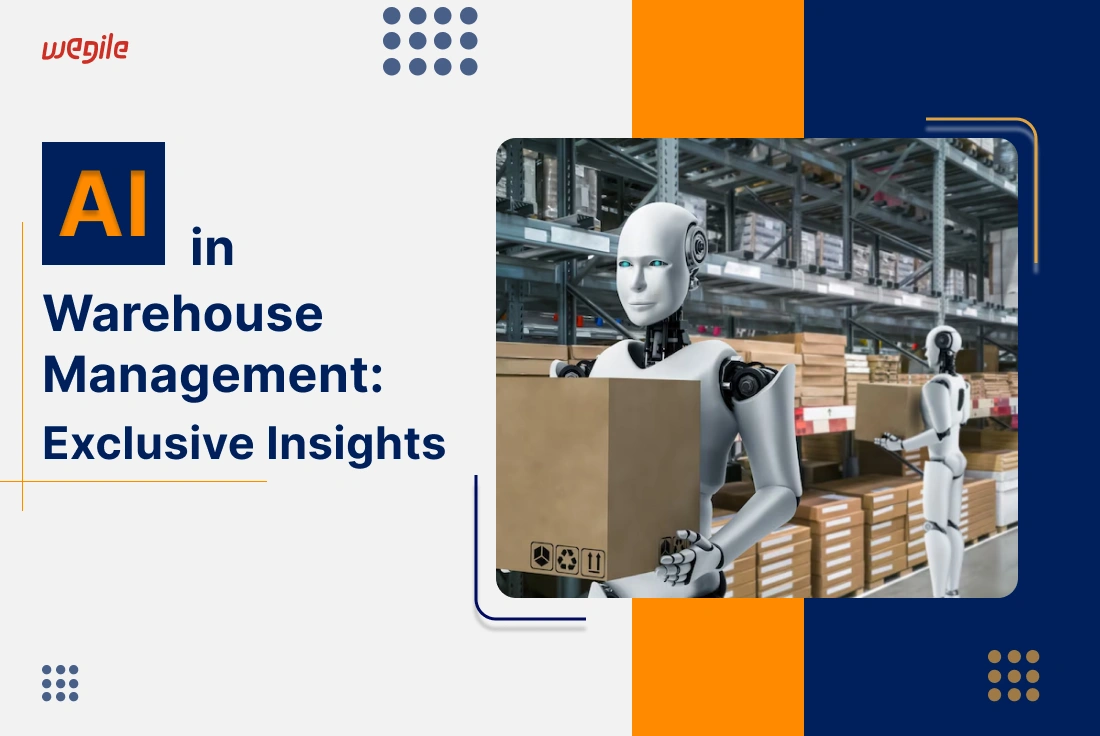
AI warehouse management is transforming the logistics industry, offering unparalleled efficiency,
accuracy, and flexibility. Modern warehouses are no longer just storage spaces; they are dynamic
environments where AI-driven systems streamline operations, optimize workflows, and reduce costs.
From robotics to predictive analytics, AI technologies are enhancing every aspect of warehouse
management, enabling businesses to meet increasing demands with greater precision and speed. This
article explores the key advantages of automated warehouses with AI, the implementation process, and
the future trends shaping the industry. Whether you’re a CEO, investor, or a
supply chain professional, understanding
these advancements is crucial for staying competitive in today’s fast-paced market.
Advantages of
Using AI in Warehouse Management
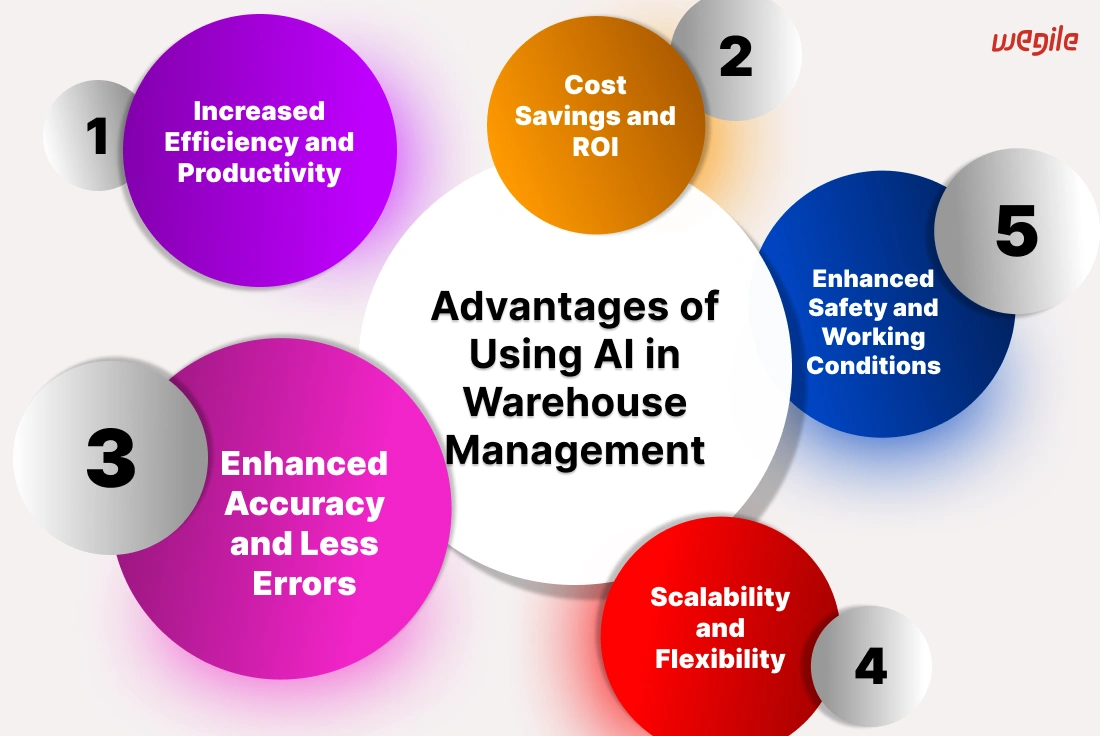
1.
Increased Efficiency and Productivity
AI isn’t just a fancy word; it is an advanced technology that warehouses use to boost productivity.
Modern giant storage places adapt this tech to enhance their workflow and ensure their everyday
activities are completed on time. Machines based on advanced algorithms handle repetitive tasks such
as picking, sorting, and packing. This reduces the need for manual labor, which would have taken a
huge amount of time to complete the same task. But AI isn’t limited to function.
Advanced AI technologies integrated into systems keep on improving working processes by reducing
bottlenecks that could deteriorate task rhythm. In this way, the operational tempo speeds up and
ensures the timely completion of work. Also, when it comes to order fulfillment, human labor can’t
even touch the speed of these AI technologies. It’s that quick to complete the out-the-door orders;
it completes it before you can say “next-day delivery.”
2. Cost Savings and
ROI
The success of every business depends on how well it generates revenue, and for warehouses, AI is a
money-generating machine! As a business owner of a warehouse or one who knows how they function, you
know that running a warehouse is no small feat. Costs can quickly pile up! But with AI, you can
quickly trim those expenses. This is done by optimizing resource use like space, energy, and labor,
keeping the operation lean and mean.
Next, AI saves your day (and wallet) by reducing errors that can cost a fortune! It slashes out
mistake rates, which results in fewer returns and rework. And that’s the cash in your pocket! Also,
if you’re just starting up your new venture, initial investments can bother you. However, with AI,
you can rest assured that at the starting stage, with the support of AI automation, you can lower
your operational costs and boost efficiency.
Must Read: How To Build Generative AI Apps: A Comprehensive Guide
3.
Enhanced Accuracy and Less Errors
AI doesn’t just guess- it calculates, predicts, and ensures your warehouse runs like a well-oiled
machine. Have you ever wondered how warehouse businesses keep track of thousands of items? No,
there’s no magic wand behind it; it does it with the support of AI, which helps giant storage houses
with real-time tracking and predictive analytics. Artificial Intelligence analyzes data in seconds
and ensures your inventory is always spot on so that you can prevent stockout and overstocking.
AI isn’t just known for its accuracy; it also plays a vital role in quality control in warehouses.
Quality matters, especially to your customers. Humans are great, but they’re not infallible. So,
here, AI steps in to take care of quality control. This is done by pinpointing defects present in
products before they leave the warehouse. Advanced inspection systems meet the expected standard
quality and ensure the quality of the final output stays consistent and exceeds the customer’s
expectations.
4. Scalability
and Flexibility
The world is changing fast, and your warehouse needs to keep up. Fluctuating demands and seasonal
spikes can make things difficult for you. However, with AI at your back, you can breathe easily.
AI-based systems can analyze demand patterns and adjust operations accordingly. Whether it’s a
sudden rush or a quiet period, AI ensures efficiency without missing a beat.
With changing times, the future is also becoming uncertain. Tomorrow’s technology is unknown, but AI
isn’t scared. By staying ahead of trends and innovations, AI is future-proofing your warehouse and
making it sufficient enough to adapt to upcoming technological requirements without any hassle.
Whether it is new software or smarter robots, AI keeps your operations flexible, prepared, and ready
for whatever
challenges and opportunities arise ahead!
5.
Enhanced Safety and Working Conditions
AI’s role in warehouses isn’t restricted to making things quicker–it’s also about making them safer
and more comfortable for everyone involved. AI and robotics are like superheroes of the warehouse,
swooping in to take on dangerous tasks. They replace human staff and step in to handle heavy
lifting, hazardous materialism, and repetitive moments. This way, AI dramatically cuts down on the
risk of accidents and instills safety in warehouses.
Apart from handling the grunt work, it keeps an eye on everything to make sure your warehouse runs
smoothly. Through predictive maintenance, AI monitors equipment in real time, spotting potential
issues before they become big problems. This proactive approach results in fewer unexpected
breakdowns and a protected environment for everyone. It’s the same as having a vigilant watchtower
keeping everything in check. Hence, by transforming your warehouse into a haven of safety and
comfort, AI promotes happier employees and more productive operations- truly a win-win situation.
Implementing
AI in Warehouse Management Systems
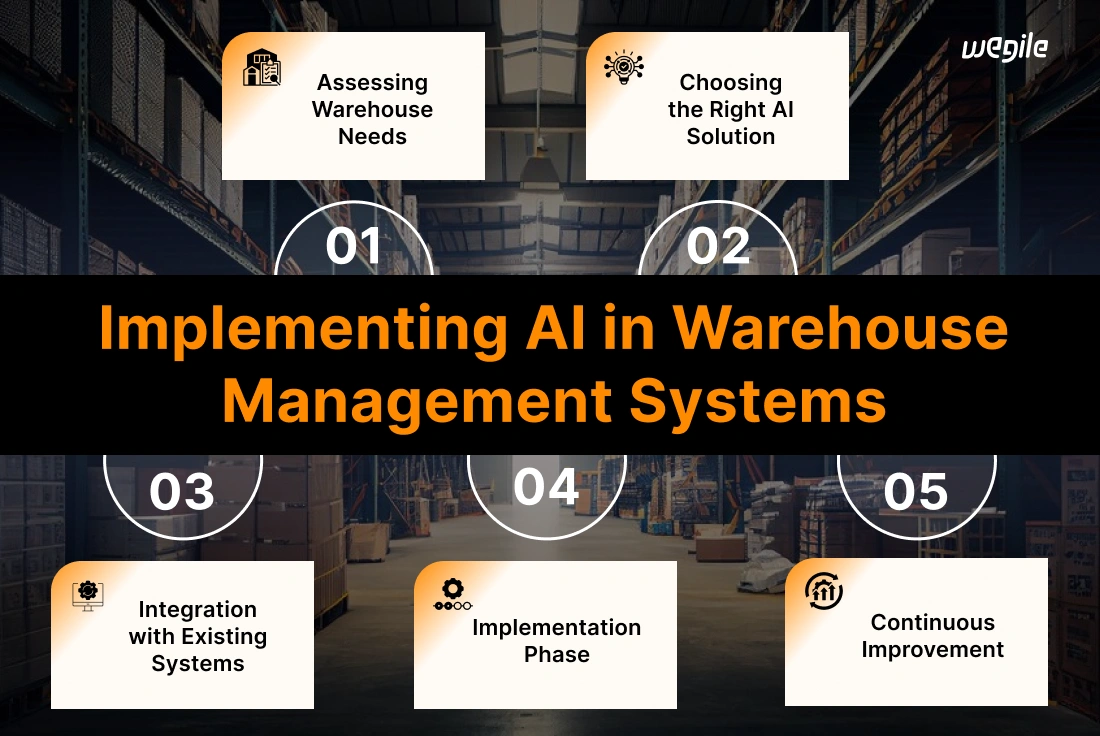
Implementing AI in your warehouse is like upgrading from a car to a rocket ship. But before you take
off, it is crucial to lay the groundwork and choose the right tools. Here’s how to get started.
1. Assessing
Warehouse Needs
Before choosing AI, you need to understand your warehouse’s specific needs and challenges. This step
is crucial to make sure that your AI implementation is targeted and effective. First, identify the
main pain points and inefficiencies in your current operations. Ask yourself certain questions, such
as:
-
Are there delays in order processing?
-
Do you face issues with inventory accuracy?
By pinpointing these areas, you can better know where AI can make the most significant impact.
Then, you’ll have to carefully check into the current workflows and analyze every step, from getting
inventory to shipping orders. This way, you’ll be able to find places where AI can streamline
operations. This can help you know about opportunities for automation and optimization that are not
easy to see right away.
After you’ve identified the pain points and analyzed workflows, now it’s time to set clear and
measurable objectives for AI implementation. It can be either about reducing order processing by 30%
or cutting inventory errors in half. Whatever your goals are, having clarity will guide your AI
strategy and measure success.
2. Choosing
the Right AI Solution
Selecting the right tools is crucial for successful implementation. Here’s how to ensure you pick the
perfect fit for your warehouse.
I. Evaluate AI Vendors and Solutions
Start by evaluating different AI vendors and their solutions. Look for reliability, scalability,
and the level of support they offer. Read reviews
and check out their portfolio. This can help you get a glimpse into their expertise with AI
solutions, and this way, you can find a reliable resource.
II. Customization and Integration
Choose AI-customized solutions that meet your specific needs and can easily integrate with your
existing systems. Flexibility is the key here; your AI tools should fit into how you work, not make
you change your way of working. You need to make sure the AI systems properly connect with your
warehouse management system(WMS), ERP, and other crucial software.
III. Cost-Benefit Analysis
Conduct a deep cost-benefit analysis to confirm that the chosen AI solution delivers a strong ROI.
Consider not just the upfront costs but also the long-term savings and efficiency gains. Calculate
possible decreases in labor costs, processing times, and error rates to see if the investment makes
financial sense.
Must Read: How Can
Generative AI Help In
Application Development?
3.
Integration with Existing Systems
Integrating AI into your existing warehouse system is like fitting new gears into a well-oiled
machine–it takes careful planning and precision to ensure that everything is running smoothly.
Before you begin with integration, assess the compatibility of new AI tech with your current
warehouse systems. If you fail to do so, you’ll likely encounter inefficiencies and delays, so a
thorough assessment is key!
Another crucial aspect you need to tackle is migration. Transfer existing data to the new AI system
while maintaining data integrity and accuracy. Develop a robust strategy for data migration,
including cleansing, transformation, and validating processes. Effective data management will ensure
that your AI system has access to the right information.
This step doesn’t end here! Implementing AI is more about people than just technology. Train your
staff on how to use the new AI tools properly. Provide comprehensive training sessions tailored to
different roles and guarantee ongoing support. Manage the change process carefully to address any
resistance and ensure the smooth adoption of AI across your organization.
4. Implementation
Phase
Rolling out AI in your warehouse is more than just a sprint; it is a well-paced marathon. You cannot
run a marathon in one go; it is completed in parts. The same is true with the implementation
process; break it down into manageable phases to ensure success without experiencing disruptions in
your work. Keep reading to know how you can do it:
I. Pilot Testing
Start with pilot testing. Implement AI solutions on a smaller scale in a controlled environment to
identify potential issues and refine the full-scale deployment. Pilot testing gives you the freedom
to gather feedback, tweak configurations, and optimize performance without impacting the entire
operation.
II. Gradual Rollout
Once you’ve fine-tuned your AI systems through pilot testing, proceed with a gradual rollout
strategy. Implement AI solutions in phases across different departments and processes. This allows
for minimizing disruptions and adjustments based on the real-world
feedback received. It also guarantees that each
phase is successful before moving to the next.
III. Full Deployment and Monitoring
Finally, AI systems will be deployed across the entire warehouse operation. Monitor performance
closely during initial rollout and continue to monitor post-deployment. It will ensure everything
operates smoothly. Implement continuous monitoring and feedback loops to detect any issues early and
optimize AI systems for ongoing improvements.
5. Choosing
the Right AI Solution
The final step in the AI implementation is all about setting the stage for ongoing success and
improvement. Consider the following key aspects:
I. Key Performance Indicators(KPIs)
Think of KPIs as your warehouse’s report card for AI. Measure metrics like order fulfillment rates,
inventory accuracy, and cost savings to see how AI is performing. These indicators give you tangible
insights into how AI is performing and driving results.
II. Feedback and Iteration
Gather feedback from your team and stakeholders to refine AI systems. Use this input to optimize
workflows, tweak algorithms, and enhance user experiences. The more you iterate, the smarter your AI
systems will become at solving challenges in your warehouse.
III. Long-term Strategy and Scaling
Imagine AI as a growth partner for your warehouse. Build a solid long-term strategy to scale AI
solutions as your operations expand. Anticipate future needs, plan for scalability, and stay ahead
of the curve with upcoming technologies. A well-thought-out strategy will ensure that AI evolves
with your warehouse. This will drive innovation and efficiency for years to come.
Overcoming Challenges in AI Warehouse Management with
Wegile
Implementing AI in warehouse management brings about numerous advantages, but it also presents unique
challenges. These hurdles require careful consideration and strategic planning to ensure a smooth
transition and effective integration. Here are some key challenges and how to overcome them.
1. Data Security
and Privacy
Data security and privacy are paramount in AI-driven warehouse management systems. With the
integration of AI, vast amounts of sensitive data are generated, processed, and stored. This data
can include inventory details, operational metrics, and customer information. Ensuring this data is
secure and private is critical to maintaining trust and compliance with regulations.
To overcome these challenges, warehouses must implement robust cybersecurity measures. Encryption,
secure access controls, and regular security audits are essential. Additionally, adopting
privacy-by-design principles ensures that data protection is integrated into the system from the
outset. Wegile provides advanced security features that help safeguard data, guaranteeing that
warehouses can leverage AI without compromising privacy.
2. Managing
Workforce Transition
The adoption of AI in warehouse management can significantly alter workforce dynamics. Automation of
routine tasks can lead to concerns about job displacement and require employees to adapt to new
roles and responsibilities. Managing this transition is crucial to maintaining workforce morale and
productivity.
A proactive approach involves retraining and upskilling employees. Providing training programs that
focus on new skills required for AI-enhanced operations helps employees transition smoothly.
Communication is key—keeping the workforce informed about the benefits of AI and how it will augment
their roles rather than replace them can alleviate concerns. Wegile supports these initiatives by
offering comprehensive training modules and resources to assist in workforce adaptation.
Must Read: Exploring Top 13 Use Cases For
Generative AI
3. Ensuring Scalability and Flexibility
Scalability and flexibility are vital for adapting to changing warehouse demands. As market
conditions fluctuate, the ability to scale operations up or down efficiently is essential. AI
solutions must be able to handle varying workloads and integrate seamlessly with existing systems.
To achieve scalability, warehouses should choose AI solutions that are modular and easily expandable.
This allows for incremental upgrades and avoids the need for complete overhauls. Flexibility can be
ensured by selecting AI systems that support interoperability with a range of technologies and
platforms. Wegile’s AI solutions are designed with scalability and flexibility in mind, guaranteeing
that warehouses can adapt quickly to new challenges and opportunities.
AI-Powered Solutions for Warehouse Inventory Tracking
Efficient inventory tracking is the backbone of successful warehouse management. AI-powered solutions
are revolutionizing this critical aspect by offering unprecedented accuracy, real-time monitoring,
and predictive insights. Here’s a closer look at how AI is transforming inventory tracking in
warehouses.
Real-Time
Inventory Monitoring
Real-time inventory monitoring is one of AI’s most significant advantages in warehouse management. AI
systems use IoT sensors and advanced algorithms to provide continuous updates on inventory levels.
This ensures that managers always have an accurate view of stock levels, reducing the risk of
overstocking or stockouts. With real-time data, warehouses can respond promptly to inventory needs,
streamline restocking processes, and maintain optimal inventory levels. This level of precision
enhances operational efficiency and improves customer satisfaction by ensuring that products are
available when needed.
Predictive Analytics for Inventory Management
Predictive analytics powered by AI goes beyond mere tracking; it forecasts future inventory needs
based on historical data, market trends, and demand patterns. This proactive approach helps
warehouses anticipate stock requirements, plan for seasonal fluctuations, and reduce the likelihood
of inventory shortages. AI-driven predictive analytics can also identify slow-moving items, allowing
managers to make informed decisions about promotions or stock clearance. By leveraging these
insights, warehouses can optimize their inventory turnover rates, reduce holding costs, and improve
overall profitability.
Future
Trends in AI Warehouse Management
As technology continues to advance, the future of AI in warehouse management is set to be
transformative. Emerging trends and advancements are poised to make warehouses more efficient,
responsive, and integrated with global supply chains.
Emerging
Technologies in AI and Robotics
The convergence of AI and robotics is driving groundbreaking innovations in warehouse management.
Collaborative robots, or cobots, are a significant development designed to work alongside human
workers. Cobots enhance productivity by assisting with tasks that require precision and strength,
reducing physical strain on employees. Advanced machine learning algorithms
for predictive analytics are
another exciting advancement.
These algorithms analyze vast amounts of data to predict inventory needs, optimize storage solutions,
and forecast maintenance requirements, minimizing downtime and ensuring peak efficiency.
Additionally, the integration of AI with IoT devices is creating smarter warehouses. IoT sensors
provide real-time data on inventory levels, environmental conditions, and equipment status. Combined
with AI, this data automates decision-making processes, enhancing operational efficiency and
reducing human error.
The
Impact of AI on Global Supply Chains
AI’s influence extends beyond individual warehouses, significantly impacting global supply chains.
One major area is supply chain visibility. AI-powered systems provide end-to-end visibility,
allowing real-time tracking of goods from manufacturer to end customer, identifying bottlenecks, and
improving overall efficiency.
AI also enhances the agility of global supply chains by analyzing market trends and demand patterns,
helping businesses anticipate changes and adjust strategies. This agility is crucial in responding
to market disruptions like geopolitical events or natural disasters. Furthermore, AI plays a pivotal
role in sustainability efforts. AI-driven analytics optimize transportation routes, reducing fuel
consumption and emissions. Additionally, AI assists in managing product life cycles, promoting
recycling and reuse, and supporting circular economy practices.
Conclusions
The future of warehouse management is undeniably intertwined with AI. As we’ve explored, the
integration of AI technologies can significantly enhance efficiency, reduce costs, and improve
accuracy in warehouse operations. From collaborative robots to predictive analytics and IoT
integration, AI is revolutionizing the way warehouses function. Moreover, its impact extends beyond
individual facilities, transforming global supply chains by providing better visibility, agility,
and sustainability. For businesses looking to stay ahead, partnering with an AI
app development company like Wegile can be instrumental. Wegile offers the expertise and
innovative generative AI development
services needed to harness the full
potential of AI in warehouse management, ensuring your operations are not only efficient but also
future-proof.
Leave a Reply