
We live in a world where technology shapes every aspect of our lives. Custom AI models are
essential for innovation and efficiency in this extensive technology era. These tailored
solutions help businesses and organizations leverage specific data and workflows to address
unique challenges. Custom AI models are outperforming generic AI models that lack a touch of
customization. But, the road to developing these specialized models is filled with hurdles
ranging from data management to ethical concerns.
This blog will explore the fundamental challenges encountered when constructing custom AI models.
So, let’s uncover the details of custom AI model development and learn how to fetch their full
potential in various industries.
What are Custom
AI Models?
Custom AI models are intelligent models designed to meet the unique requirements of a business or
project. They differ from ordinary and off-the-shelf AI models that offer only a
one-size-fits-all solution. These custom models have the precision to utilize the specific type
of data. They also grasp an organization’s operational nuances and allow it to achieve more
accurate results and operational efficiency.
There are peculiar distinctions between traditional AI models and custom AI models. Custom AI
models are highly adaptable to an organization’s specific challenges and data environments,
which ensures they perform better in specialized tasks than their generic counterparts. Another
great perk that custom AI models offer is exclusivity. As they are customized, they can combine
proprietary features and capabilities absent in basic AI models. We can thus conclude that
custom AI models are way more promising and advanced than ordinary AI models.
Industries like healthcare, finance, hospitality, and retail are gaining a significant edge from
custom AI models. In healthcare, custom models digest and analyze patient data. They can use
this analyzed data to predict outcomes and personalize treatment plans effectively.
Customization in healthcare can streamline processes, enhance patient satisfaction, and improve
recovery. In the finance sector, custom AI models help detect fraudulent transactions, and
automate risk assessments with a high degree of accuracy.
Hospitality sectors use custom AI to personalize their websites and digital offerings by
understanding user’s needs and moods. Retail businesses use custom AI to enhance customer
experience through personalized recommendations. Custom AI models also find extensive uses in
inventory management.
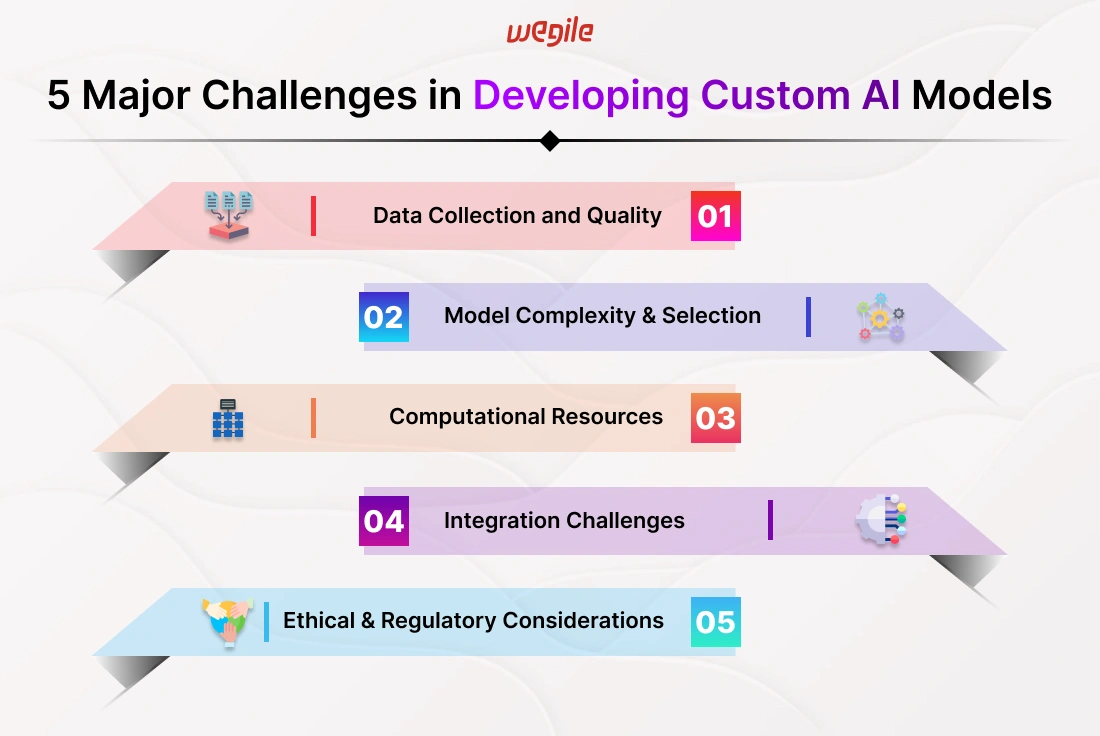
5 Major Challenges in Developing Custom AI Models
-
1. Data Collection and Quality
One of the primary hurdles in custom AI development is acquiring high-quality and relevant
data. Without sufficient data, AI models cannot learn effectively. This further leads to
inaccuracies in predictions and decisions. The challenge intensifies when the available data
is of poor quality and contains errors. This challenge is even more aggravated when the data
has inconsistencies and biases. These parameters can directly affect the performance of the
custom AI model. For example, inaccurate data can lead to incorrect diagnoses in the
healthcare sector. It eventually hampers all the treatment plans and puts patient health in
danger. -
2. Model Complexity and Selection
Getting the appropriate model architecture for specific tasks is yet another challenging
issue. The complexity of an AI model often relates directly to its ability to perform
complex tasks. But, highly complex AI models require more data and computational power. They
also need more expertise to develop and maintain. This complexity can lead to models that
are difficult to manage and update. It ultimately impacts their performance over time. For
example, a highly complex model used in automated trading might perform exceptionally well
under stable market conditions. On the other hand, it can miserably fail to adapt quickly to
sudden market shifts without extensive fine-tuning and retraining. This can have severe
consequences and might result in heavy financial losses or missed opportunities. -
3. Computational Resources
Developing and running custom AI models requires considerable computational resources, which
can lead to high costs. Training complex models, particularly those involving large datasets
or deep learning, further demands powerful processors and a lot of memory. These resource
requirements multiply as businesses aim to scale their AI models to regulate more data or
provide more insights. It necessitates investment in expensive hardware or cloud services.
This challenge can restrict the ability of small to medium enterprises to use advanced AI
technologies effectively. -
4. Integration Challenges
One of the biggest hurdles is integrating AI models with existing IT infrastructure. Many
organizations face difficulties deploying AI systems due to compatibility issues with
current software and hardware. For example, older systems may not support integrating novice
AI technologies without substantial upgrades or modifications. The AI deployment might also
need changes in existing business processes and systems. This can further disrupt operations
and require significant time and effort from IT departments to guarantee smooth integration. -
5. Ethical and Regulatory Considerations
Ethical concerns and regulatory compliance are also critical challenges in custom AI
development. Data privacy, algorithmic bias, and transparency are at the front of ethical AI
discussions. For example, AI models trained on biased data can lead to unfair outcomes. They
can result in discriminatory hiring practices or biased credit scoring. Similarly,
transparency in AI processes is crucial for building trust. Trust building is significant in
sectors like healthcare and finance, where decisions directly affect people’s lives. Plus,
different geographic regions have varying regulations governing data use and AI deployment,
which organizations must deal with carefully to avoid legal repercussions.
Top
Solutions to Overcome Development Challenges
-
Enhanced Data Management
A crucial step in developing effective custom AI models is data management. It involves both
the improvement of data collection methods and the assurance of high data quality.
Implementing robust data governance practices ensures data is accurate, consistent, and
ethically collected. Advanced data capture technologies can help gather data more
efficiently. They also help in reducing the errors often found in manual collection
processes.Tools and techniques like
data normalization, handling missing values, and outlier
detection are essential for data preprocessing. These methods help refine the dataset,
making it more suitable for training AI models. Automated data cleaning tools can also play
a significant role. They allow developers to spend less time on data preparation and more on
model development and iteration. -
Model Optimization Techniques
Simplifying the model architecture in custom AI model development is vital to enhancing
performance and reducing computational demands. Techniques like model
pruning can be employed where unnecessary or redundant
model parts are trimmed without compromising the model’s performance. This makes the model
lighter and faster and reduces the resources required for training and inference.Using Automated Machine Learning (AutoML) platforms facilitates optimal model selection.
AutoML helps identify the best model architecture and parameters for a given dataset and
task without requiring deep expertise from the user. This technology automates the model
selection process. It speeds up the development cycle and ensures that the deployed models
are efficient and effective. -
Leveraging Cloud and Edge Computing
Utilizing cloud resources and edge computing is a strategic solution for
managing the
significant computational loads associated with custom AI models. Cloud computing offers
scalable resources on demand and authorizes organizations to access mighty computing power
and storage capabilities without the upfront cost of physical hardware. This is quite
beneficial for training large AI models that require massive processing power.Edge computing complements this by processing data locally, on or near the device where data
is generated, rather than sending it across long routes to data centers or clouds. This
reduces latency and increases the speed of data processing. It also helps maintain
functionality even with intermittent connectivity. Hybrid deployments that combine cloud and
edge computing bring together the best of both worlds; they offer scalability from the cloud
with the responsiveness and data locality of edge computing. -
Robust Integration Practices
Sticking to robust integration practices is crucial for seamlessly integrating AI models into
existing business environments. It involves confirming that the AI models are compatible
with the existing IT infrastructure and can interact effectively with other systems and
software.Successful case studies often highlight the importance of a well-planned integration
strategy. For example, a financial institution integrated AI into its existing risk
assessment systems to improve fraud detection rates without disrupting ongoing operations.
This was achieved by gradually implementing AI functionalities and ensuring they were fully
compatible with existing data management systems. -
Ethical AI Frameworks
Implementing ethical AI frameworks includes setting up guidelines that supervise the
development and use of custom AI models to ensure they are used responsibly. These
frameworks help address data privacy, algorithmic bias, and transparency. Regular audits and
compliance checks are keys to maintaining adherence to these guidelines, which ensure that
AI systems operate within legal and ethical boundaries.For example, an international tech company implemented a comprehensive ethical AI guideline
that included routine audits to check for data bias and ensure transparency in how AI
systems made decisions. This helped align AI systems with regulatory requirements and build
trust among users and stakeholders by demonstrating a commitment to ethical standards.
Case Studies: Real-World Examples of Overcoming Challenges in AI Development
-
Zebra Medical Vision: Focusing on medical imaging, Zebra Medical Vision
tackled significant data privacy and compliance hurdles by adhering to stringent
regulations like HIPAA. They used anonymized patient data to train AI models, ensuring
patient privacy and model effectiveness. Their custom AI solutions now assist doctors by
identifying indicators of diseases such as liver fibrosis and cardiovascular illnesses.
This further enhances diagnostic accuracy and potentially saves lives through earlier
detection. -
Stitch Fix: Stitch Fix is an online personal styling service that uses
custom AI models to personalize clothing selections for its customers. Progressively
integrating AI with existing systems allowed them to refine their algorithms without
disrupting the user experience. This strategic approach has encouraged them to enhance
customer satisfaction by accurately predicting and aligning with consumer fashion
preferences. This is now helping them drive higher engagement, 10x revenue, and
retention rates. -
JPMorgan Chase: JPMorgan Chase developed the COIN program to automate
the interpretation of commercial loan agreements, a process that typically requires
360,000 hours of lawyer work each year. By using natural language processing and custom
AI models, they reduced errors and saved thousands of hours. They eventually streamlined
operations and reduced costs. The successful integration of custom AI into their
existing digital infrastructure demonstrated a significant improvement in efficiency and
accuracy in their legal documentation processes. -
Tesla: The automotive giant integrates custom AI models into its vehicle
manufacturing processes to optimize production and enhance its cars’ safety features.
Tesla utilizes advanced in-house hardware and software specifically designed for its
production lines to address scalability and computational demands. This helps it
maintain high efficiency and innovation rates and guarantees its vehicles are safe and
technologically advanced.
Final words
The journey to developing custom AI models is complex and involves many challenges ranging from
data management to ethical considerations. Despite these hurdles, the examples detailed above
show that these challenges can be successfully overcome with strategic approaches. Organizations
across industries from healthcare to automotive have successfully harnessed the power of custom
AI to enhance operational efficiency. With custom AI models, organizations are successfully
improving customer experiences and driving innovation. This blog has outlined the challenges,
strategies, and real-world examples that illustrate the profound impact of custom AI models. As
technology continues to evolve, the importance of ongoing learning and adaptation in AI
development cannot be ignored. Welcoming these practices will enable organizations to remain
competitive and make the most of AI technologies.
At Wegile, we use our expertise as a leading AI
app development company to create remarkable solutions tailored to your business needs.
Whether you’re looking to innovate operations, revamp customer engagement, or streamline
processes, our team is equipped to deliver the most promising custom AI applications that drive
success. Join us in converting your ideas into reality with the power of AI. Reach out today to
learn how our customized AI solutions can benefit your organization.
Leave a Reply