In recent times, staying ahead of the competition has been difficult with the evolution of oil and
gas. Companies today are struggling with market fluctuations, regulatory demands, environmental
issues, and operational inefficiencies. Though daunting, what if these obstacles could be turned
into opportunities? AI promises to transform the industry. Imagine using AI to improve operations,
control expenses, and make decisions. AI-driven solutions can optimize drilling processes, forecast
equipment failures, and improve safety while reducing environmental impact. Find out how AI could
assist oil and gas companies in succeeding in a complicated world as we explore its enormous
possibilities. Ready to uncover the future of energy? Let’s dive in!
Use
Cases of AI in the Oil and Gas Industry
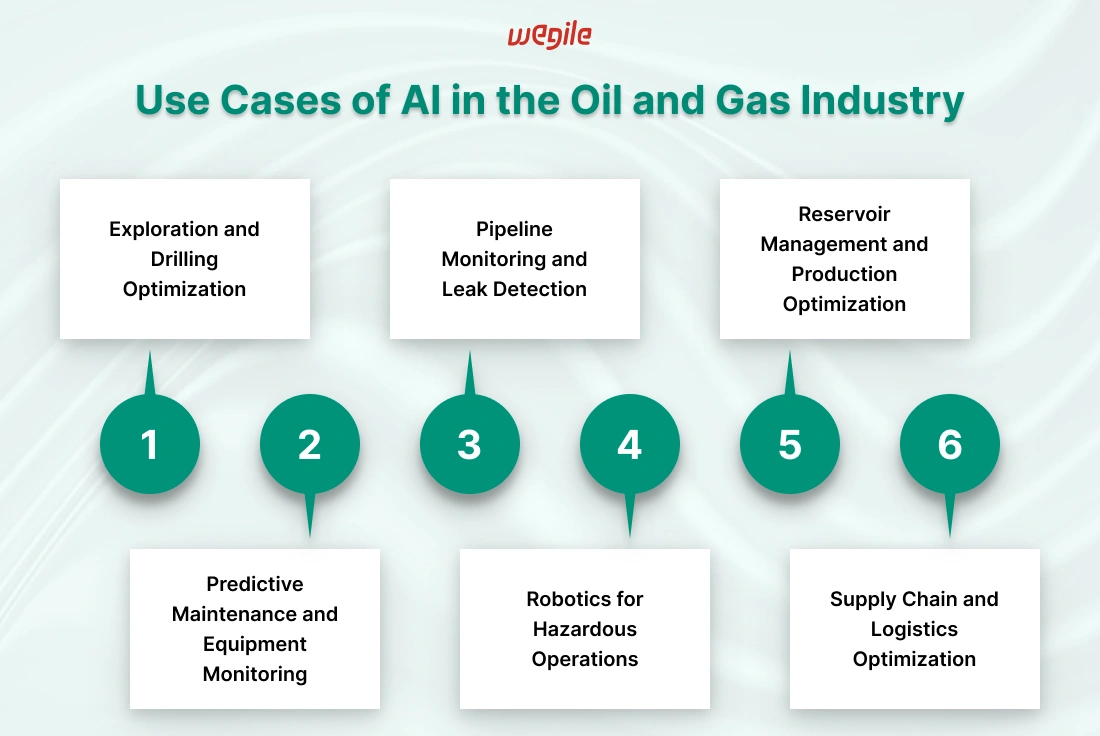
1.
Exploration and Drilling Optimization
AI is changing the exploration and drilling game in the oil and gas industry. Think about the
difficulty and time required to study geological data to determine the optimal location to drill for
oil. But, AI can help companies quickly sort through huge amounts of geological data. AI systems can
predict where oil and gas reserves are likely to be located, making it easier to locate exact spots
for drilling. This speeds up exploration and minimizes the chance of drilling in the wrong area,
saving millions. Plus, AI helps optimize the drilling process by assessing real-time data and
changing methods on the go. This reduces environmental impacts. It’s as if a smart, efficient, and
economical digital assistant is leading the whole business.
2. Predictive
Maintenance and Equipment Monitoring
One of the major oil and gas problems is equipment failure. Critical machine failures can stop
production, lead to expensive repairs, and endanger lives. Here’s where AI changes everything.
Predictive maintenance uses AI to understand patterns from equipment sensors and predict problems.
Think of it as having a crystal ball for your machinery. AI warns operators before problems grow,
helping them schedule maintenance at the proper time. This prevents unforeseen downtime and costly,
panic-inducing repairs. Plus, companies can maximize the efficiency and life of equipment by
maintaining it. It works like a “heads-up” for the machines before a tough section, keeping
everything functioning smoothly.
Must Read:
What
Every CEO Must Know About
Generative AI?
3.
Pipeline Monitoring and Leak Detection
AI is a true hero when it comes to pipeline monitoring and leak detection. Pipelines are vital to the
oil and gas sector, but leaks can harm the environment and cause huge losses to companies.
Traditional monitoring methods often struggle to detect small leaks until it’s too late. AI-powered
systems change the game by analyzing real-time data from sensors placed along pipelines. These
smart-systems can detect leaks immediately or even predict them. AI analyzes pressure, temperature,
and flow rate data to spot irregularities. This also helps companies in reducing environmental risks
and fines by detecting leaks early. In short, AI monitors pipelines 24/7 to ensure their safety and
efficiency.
4. Robotics
for Hazardous Operations
Some oil and gas jobs are too dangerous for humans. That’s where AI-powered robots help. AI-enabled
robots could look into oil rigs, deep-sea pipelines, and poisonous gas conditions. These AI-powered
robots can do precise inspections, repairs, and upkeep while protecting humans. For example, these
AI-powered drones can fly around oil rigs, capturing data and diagnosing faults before they become
severe. On the ground, robots can crawl through pipes or machinery to inspect or fix small defects
without human intervention. Employing robots for dangerous tasks reduces worker risk, prevents
costly shutdowns, and ensures high safety standards. It’s a win-win situation: robots do the heavy
lifting, and humans remain safe and out of harm’s way.
5.
Reservoir Management and Production Optimization
Oil and gas reservoir management is like solving a huge puzzle. You need to figure out how to
efficiently harvest resources without wasting anything. AI is helping companies optimize production
and reservoir management to meet this problem. Companies can collect and evaluate data from
reservoir sensors and past extractions using AI. AI-powered algorithms can forecast reservoir
behavior, helping operators decide how much to extract and when. This increases productivity, lowers
waste, and extends the life of the reservoir. It’s like having a smart assistant that knows how to
keep the production line running smoothly and maximize resource value.
6. Supply Chain
and Logistics Optimization
AI is also impacting oil and gas supply chains and logistics. Moving enormous volumes of oil and gas
around the globe is difficult, but improving the process may save firms time and money. Here, AI
streamlines transportation routes and inventory management. AI systems can forecast the optimum
transit routes using real-time data. This minimizes delays and fuel use. AI monitors warehouse
inventory to ensure goods are available when needed without overstocking. This saves transportation
and storage expenses and delays. AI-optimized logistics helps organizations make smarter and faster
decisions, which enhances productivity. In the end, it’s similar to a perfectly timed machine;
everything runs smoothly, and nothing is left to chance.
Must
Read:
What Programming Language is
Used in Generative AI: Top 5 Choices
Top
Companies Using AI in the Oil and Gas Industry
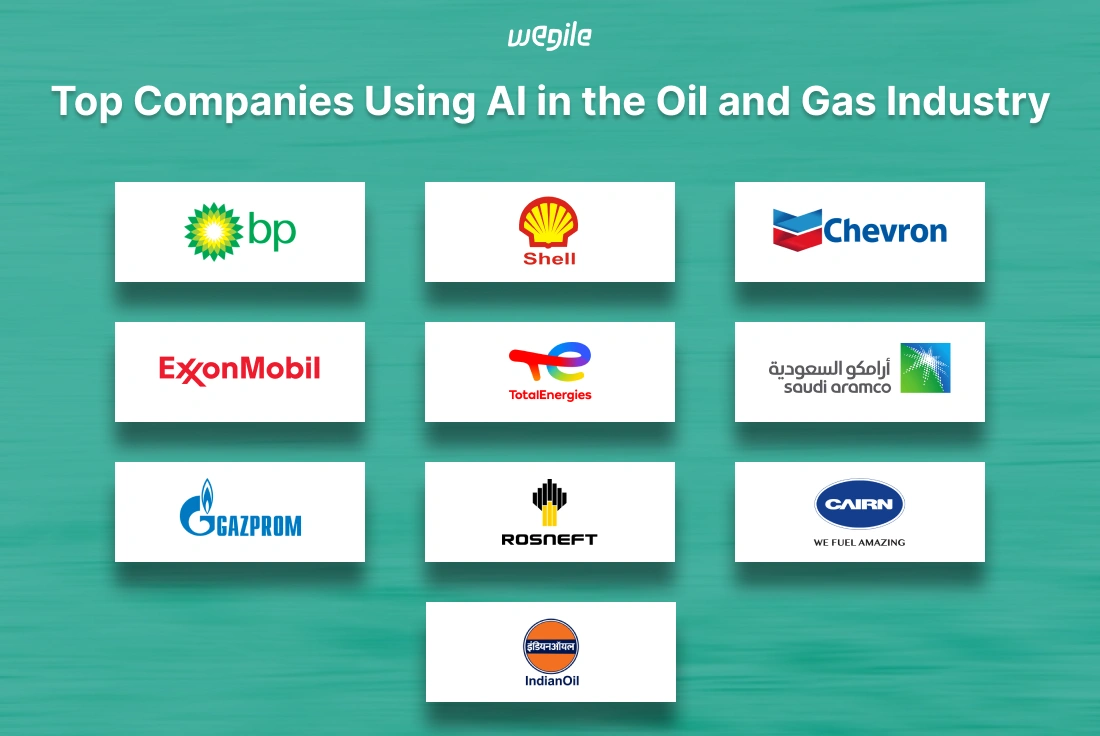
1. BP
BP is leading the oil and gas AI revolution in predictive maintenance and operational efficiency.
Using AI, BP analyzes its equipment in real time to prevent costly breakdowns. This proactive
approach lowers downtime and increases the lifespan of gear throughout their global operations. BP’s
AI-driven system helps them save on maintenance costs and increase overall efficiency by making sure
drilling rigs and refinery operations stay on schedule. This illustrates how AI is changing oil and
gas operations
2. Shell
Shell has embraced AI to optimize one of the trickiest parts of the business: exploration. Shell
analyzes vast amounts of seismic data with AI to find the best locations for drilling. The company
relies on AI, which is faster and more precise than traditional methods. This helps Shell find
resources faster and reduce the environmental impact of their operations. The company is pushing
industry limits with AI-based seismic analysis and exploration optimization.
3.
Chevron
For better exploration and equipment maintenance, Chevron uses AI in the oil and gas industry. Their
AI technologies evaluate geological data to accurately identify prime drilling spots. Chevron also
monitors equipment with predictive analytics to prevent breakdowns and boost operational uptime.
Chevron uses AI to improve subsurface imaging and decrease downtime, which helps them make better,
data-driven judgments. This allows them to remain ahead in the cutthroat oil and gas industry
4. ExxonMobil
ExxonMobil is using AI to improve drilling and energy efficiency. AI-driven initiatives streamline
the company’s exploration operations, ensuring every well drilled is successful. AI also helps
ExxonMobil save energy during production, making it more sustainable. This shows how AI is changing
the oil and gas industry by improving drilling precision and energy use.
5.
TotalEnergies
TotalEnergies is another major player pushing the boundaries of AI in the Oil and Gas Industry. They
leverage AI-powered predictive analytics to optimize refining and production processes.
TotalEnergies reduces downtime and optimizes resource extraction by predicting difficulties before
they arise. These AI solutions improve operations and save costs, enabling the corporation to lead
the oil and gas industry to a smarter and more sustainable future.
Must Read: Developing Custom AI Models:
Challenges and Solutions
6. Saudi Aramco
Saudi Aramco pioneers AI-optimized hydrocarbon finding and predictive maintenance. The startup uses
AI to accurately identify hydrocarbon reserves, speeding up discovery and lowering costs. Aramco
also uses AI for predictive maintenance to monitor assets in real time and avert costly equipment
failures. Their extensive network of resources runs smoothly and sustainably thanks to their savvy
approach to asset management and operational efficiency.
7. Gazprom
Gazprom, a major energy company, employs AI to optimize operations and manage resources. Gazprom uses
AI to forecast faults before they become significant, decreasing unexpected downtime along with
operational inefficiencies. In addition to optimizing its large network, AI helps the organization
reduce expenses, improve operations, and maximize resource use. Thus, Gazprom relies on AI to be
competitive and lead the global energy market.
8. Rosneft
Rosneft uses AI to compete in the oil and gas industry. Rosneft boosts decision-making and
operational efficiency by integrating AI into its exploration and production process. AI helps the
company find suitable drilling sites faster, reduce exploratory risks, and boost production. This
advanced use of AI in exploration allows Rosneft to maximize resource extraction while reducing
environmental effects. In short, AI is helping Rosneft maintain its competitive edge in the Oil and
Gas Industry.
9. Cairn
(Vedanta)
Vedanta’s Cairn uses AI-powered process digital twins to transform its gas and offshore operations.
Cairn uses these digital twins to model operational situations and optimize gas production and
offshore facility management. AI has helped Cairn reduce flaring and fuel gas usage, making
operations more efficient and ecologically friendly. In an evolving sector, Cairn stays agile and
efficient by using AI to refine operations.
10. Indian Oil
Corporation (IOC)
AI is helping Indian Oil Corporation (IOC) manage its huge operations. Leveraging AI in the oil and
gas industry, IOC has introduced GenAI for tasks such as project delay analysis, legal queries, HR
functions, and even customer sentiment analysis. IOC makes smarter, faster decisions using
historical data and AI-driven insights, minimizing delays and enhancing operational efficiency.
Further, AI is helping IOC maintain its energy sector leadership by streamlining internal processes
and improving customer satisfaction.
Must Read: The
Blueprint
for Constructing
Your Machine Learning Model
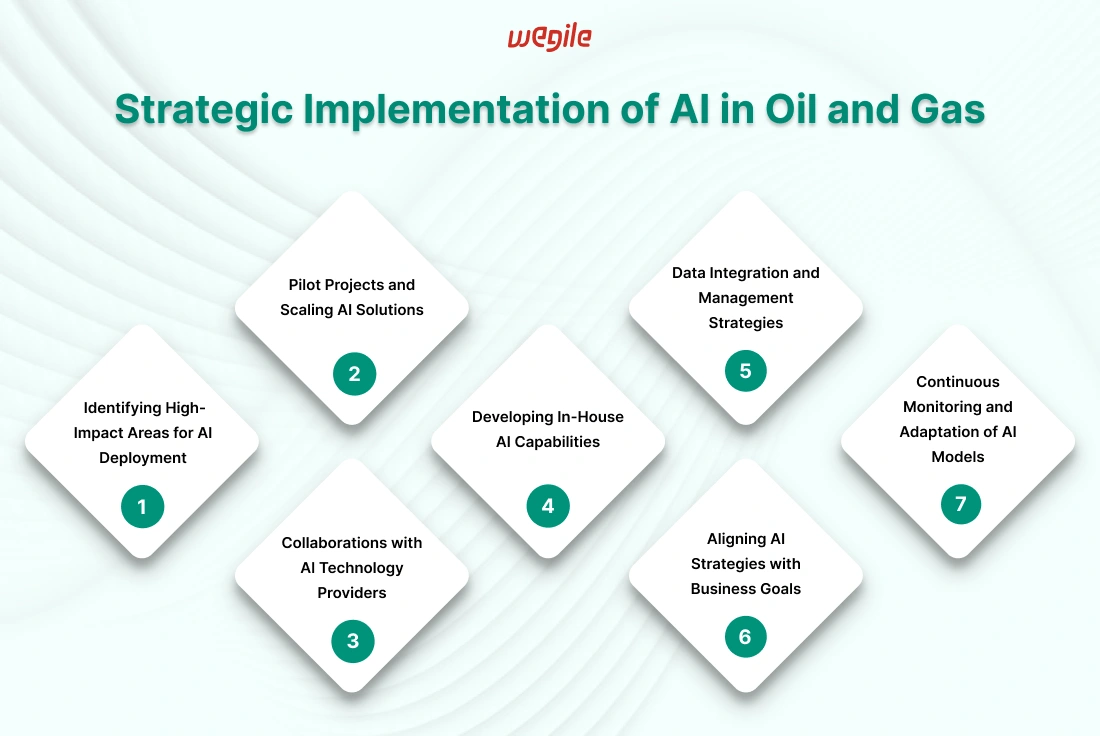
Strategic Implementation of AI in Oil and Gas
1.
Identifying High-Impact Areas for AI Deployment
Finding where AI can make the most effect in the oil and gas industry is the crucial initial step.
Companies must prioritize exploration, production, and maintenance, where AI can deliver real value.
By analyzing seismic data, AI can speed up oil-rich site exploration. It improves production
workflows and resource extraction. On the maintenance side, AI can predict equipment failures,
saving time and money. Identifying these high-impact areas ensures that AI deployments bring the
most bang for the buck.
2. Pilot Projects
and Scaling AI Solutions
Start small when it comes to implementing AI in oil and gas. Before deploying AI solutions, pilot
projects are a good approach to test them. This allows companies to test AI in real-world
situations, fix problems, and evaluate results. After
these pilot initiatives succeed, spreading AI solutions across the enterprise makes sense. This
reduces risks, ensures technology works, and builds stakeholder confidence.
3.
Collaborations with AI Technology Providers
Oil and gas companies that want to stay ahead should partner with AI technology companies. These
providers provide cutting-edge solutions and experience to streamline operations and solve
complicated problems. Collaborations can bring in AI technologies for predictive maintenance, data
analytics, and exploration optimization. Working with a seasoned AI app development company like
Wegile speeds up the learning curve, allowing companies to implement AI faster and more efficiently.
The oil and gas business benefits from
the
latest innovations, while AI vendors learn
from industry-specific use cases. This creates a
win-win situation.
4. Developing
In-House AI Capabilities
Companies that want to fully adopt AI must build in-house AI capabilities. This requires employing
data scientists, training staff, and building AI
infrastructure. Companies can customize and regulate
AI use when they invest in internal AI talent. It also reduces reliance on external vendors. AI can
be better integrated into in-house operations and customized to match goals. This approach creates a
culture of innovation and sets the stage for long-term success with AI.
5.
Data Integration and Management Strategies
Data is the lifeblood of AI, especially in the oil and gas sector. However, collecting data from
sensors, machines, and historical records is just the beginning. AI requires good data integration
and management. Companies must keep data clean, accessible, and organized. Centralized data hubs and
solid data governance standards help firms promote AI ambitions. AI systems can improve operations
by making faster, more accurate judgments when data flows smoothly.
6. Aligning AI
Strategies with Business Goals
AI in the oil and gas industry only works best when matched with business goals. This means
organizations should carefully plan their AI strategy to complement existing goals. AI initiatives
must help production efficiency, cost reduction, and sustainability goals. Petroleum companies can
ensure that AI projects are not merely tech experiments but vital tools for growth,
innovation, and long-term success by aligning
AI with their strategy.
7. Continuous
Monitoring and Adaptation of AI Models
The job continues once AI systems are installed. AI models should be monitored and adjusted to
continue to be effective as business needs change. Demand, laws, and technology change quickly in
the AI in the Oil and Gas Industry. AI models must be updated often to adapt to these changes. Over
time, performance monitoring and feedback help AI systems stay relevant, reliable, and ready to
tackle new challenges.
Must Read:
6
Ways Telecommunication
Operators Are Using AI to Boost Customer Experience
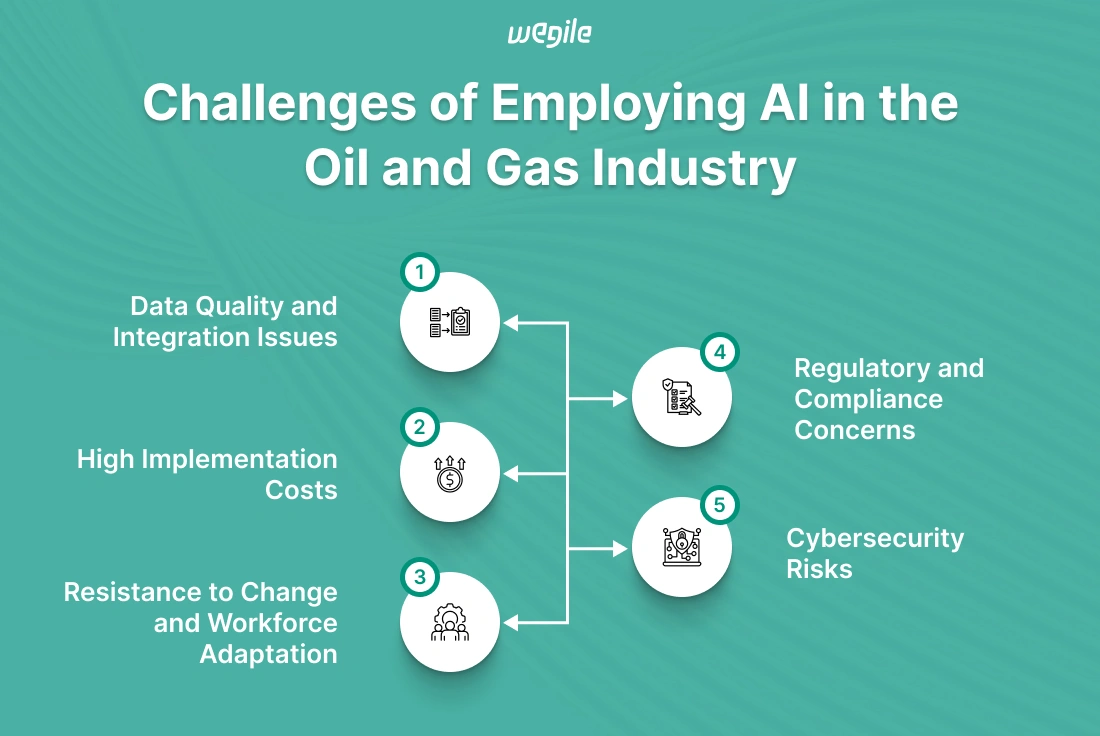
Challenges of Employing AI in the Oil and Gas
Industry
1. Data
Quality and Integration Issues
AI thrives on data, but oil and gas industries often struggle with poor data quality. When data is
cluttered, incomplete, or stored in silos, AI systems struggle to succeed. Integrating data from
industrial sensors, historical records, and operational databases is also difficult. Without clean,
well-organized data, AI models cannot provide correct insights, which can cause inefficiency.
Solving this challenge requires a focus on data governance. This ensures all inputs are reliable,
accessible, and properly integrated.
2. High
Implementation Costs
Implementing AI is expensive. Purchasing technology, upgrading infrastructure, and training staff can
quickly add up. AI solutions in the oil and gas business require expensive hardware, servers, and
software. Additionally, companies need to allocate money for ongoing maintenance and updates.
Long-term AI
benefits
include increased productivity and lower costs, but
the upfront investment might be difficult for smaller organizations with fewer budgets.
3.
Resistance to Change and Workforce Adaptation
In oil and gas, where personnel are habituated to traditional procedures, AI implementation typically
causes opposition. Employees may fear that AI will replace jobs or make their skills obsolete.
Overcoming this resistance requires a cultural shift and a strong focus on workforce adaptation.
Companies should fund training programs that teach people about AI, its benefits, and how to work
with it. Creating a collaborative environment where humans and AI can work together is key to easing
the transition.
4.
Regulatory and Compliance Concerns
Regulations and regulatory constraints complicate oil and gas AI implementation. Environmental
safety, labor practices, and data privacy are strictly regulated in this business. These
restrictions apply to AI systems, especially those using real-time sensor data and automated
decision-making. AI solution regulatory compliance can be complicated and time-consuming, requiring
close engagement with legal teams and regulatory agencies. Taking this step prevents compliance
issues.
5. Cybersecurity Risks
AI and IoT are becoming more integrated into oil and gas processes, increasing cybersecurity threats.
Chances of cyberattacks increase As more devices and systems become interconnected. Hackers can
target AI-powered systems to steal data or disrupt operations. Encryption, firewalls, and threat
monitoring are needed to secure AI systems. Balancing innovation with security is
key to
using AI for its many benefits without
exposing vulnerabilities that could cause severe damage.
Must Read: Implementing
Generative AI for
Business Process Automation
Wrapping Up
The oil and gas business is entering a new era where AI is transforming how we perceive, comprehend,
and interact with the world beneath our feet. AI is enabling the unthinkable, from smart sensors
that can predict problems to intelligent systems that make real-time judgments. Need an AI solution
tailored to your operations? We have your back. We’re not just another tech company; we’re your
partner in bringing these AI-powered ideas to life. Our AI
app development company can help you create custom apps that offer productivity and smarter
ways of working. So, why wait? Let’s take your operations to the next level. Get in touch with
Wegile to create a smarter, more inventive business future!
Leave a Reply