Have you ever noticed how some businesses always seem to be one step ahead? These organizations use
profound AI
analytics to identify trends and make wiser judgments. Amid the game changing innovations
like generative AI, predictive analytics is giving a competitive edge to businesses looking to
conquer the future. AI-driven analytics is helping organizations make sense of the vast amounts of
data faster than ever, from customer behavior to supply chain optimization. Picture this: Instead of
trying to interpret data afterward, you get real-time insights as events unfold. AI analytics offers
that kind of agility. It’s like having a superpower that turns raw data into actionable insights
that help organizations take risks confidently. Ready to see how AI analytics can shift the way your
business operates? Explore the use cases and
advantages that are already driving industry
success. Your next great breakthrough may just be a few ideas away!
Key Use Cases of AI Analytics in Business
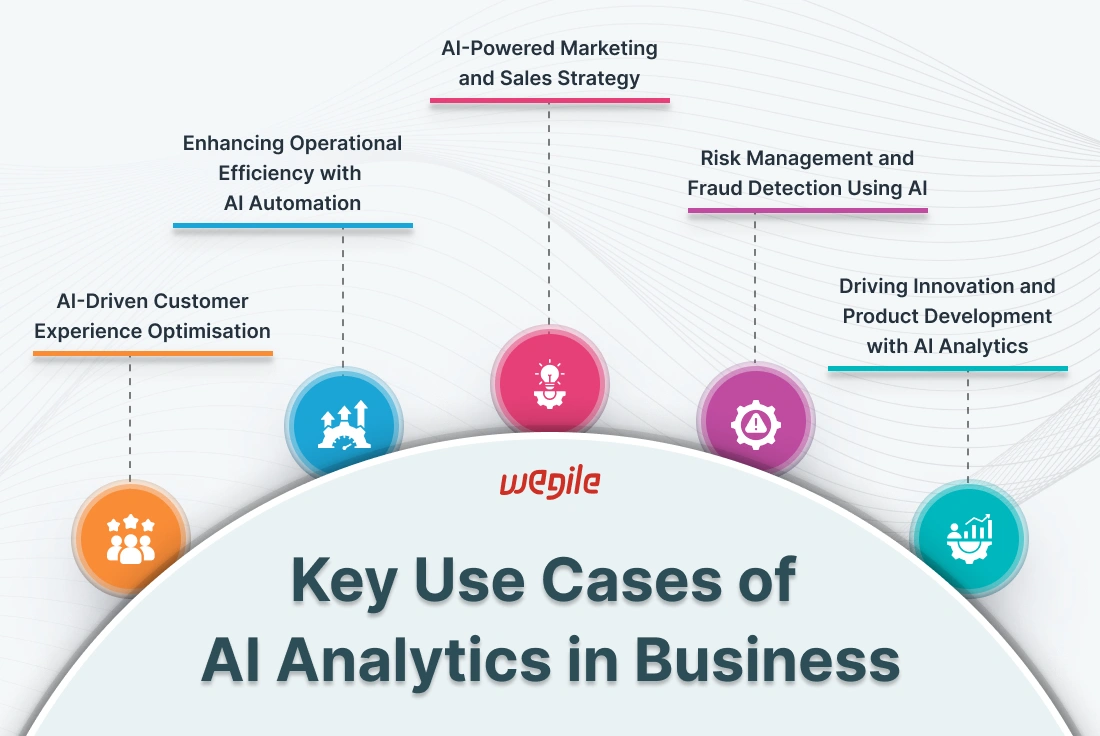
Use Case 1: AI-Driven Customer Experience Optimization
Personalized customer experiences are essential in today’s fast-paced corporate landscape. AI
analytics helps companies better understand customer preferences and habits. Companies can leverage
AI to evaluate massive volumes of data, from purchase history to browsing patterns, to generate
highly tailored interactions. This increases customer satisfaction and loyalty over time.
For example, retail stores can employ AI to forecast consumer preferences. AI can make shopping
easier by proposing relevant products based on past purchases and browsing habits. Further, AI
analytics lets firms monitor real-time feedback from customers to identify pain points and optimize
the customer journey. Companies can anticipate and meet client demands before they realize they need
them by mapping out their whole journey from initial interaction to post-purchase. Ultimately, AI
improves client interactions by making them more intuitive and rewarding.
Use Case 2: Enhancing Operational Efficiency with AI Automation
Businesses are becoming smarter, faster, and more efficient using AI analytics. AI lets teams focus
on more complicated, value-added jobs by automating routine chores. For example, employees can avoid
repeated activities by automating data entry with AI. It can even monitor equipment or systems to
spot flaws before they become costly. Machine-dependent sectors benefit from predictive maintenance,
as AI can predict when parts require repair or replacement, reducing downtime.
Further, AI reduces operational expenses by minimizing human error and speeding up operations. For
example, AI in logistics can optimize delivery routes in real time, making shipments faster and
cheaper. This saves fuel, time, and work. In addition, AI-powered analytics can continuously monitor
corporate operations to discover inefficiencies and offer solutions. In short, AI streamlines,
changes, and makes
enterprises more agile, responsive, and cost-efficient.
Must Read:
What
Every CEO Must Know About
Generative AI?
Use
Case 3: AI-Powered Marketing and Sales Strategy
Business in today’s highly competitive marketplace requires data as well as instincts. AI analytics
helps companies optimize marketing and sales tactics. AI helps organizations target individual
customers with personalized advertising by evaluating customer behavior and interests. AI ensures
that every ad is tailored to the right audience at the right time instead of relying on blanket ads
that miss the mark.
But it doesn’t stop at advertising. AI helps sales teams prioritize leads by scoring them based on
their potential. It prioritizes conversion-ready leads above cold leads. It also predicts sales
patterns by examining prior data and assisting organizations to remain ahead of market changes. One
of the main advantages of using AI is that it can spot early signs of customer churn. This makes
data-driven marketing and sales smarter and more effective.
Use Case
4: Risk Management and Fraud Detection
Using AI
Operating a business involves risk, but AI analytics makes it easier to manage it. AI is excellent at
finding data anomalies that humans might miss. It can detect inconsistencies in financial
transactions and questionable user account behavior in real-time. Businesses can avoid major
financial losses by detecting fraud faster and more accurately. Predictive models from AI help firms
estimate risks beyond fraud detection.
These algorithms predict supply chain disruptions and market downturns using historical and real-time
data. The major benefit here is that AI helps organizations prevent risks by providing insights
before they occur. This kind of real-time monitoring and predictive risk assessment is essential in
sectors like banking, healthcare,
and retail. Thus, businesses can protect assets and
reduce risks with AI.
Use Case 5: Driving Innovation and
Product Development with AI Analytics
Businesses looking to stay competitive need innovation, and AI analytics contribute to it like never
before. AI analyzes industry trends and customer input to help firms create goods that engage with
their audience. AI makes product creation data-driven, guaranteeing organizations build
customer-wanted solutions.
AI helps organizations find market gaps and new product opportunities by researching market patterns
and competition activity. In fields like R&D, AI speeds up processes and offers deep insights
that
humans would take longer to find. AI guides innovation, whether that means improving an existing
product or creating a new one. Simply put, AI helps companies innovate and develop products faster
to help stay ahead of the curve.
Must
Read:
What Programming Language is
Used in Generative AI: Top 5 Choices
The
Benefits of AI Analytics for Businesses
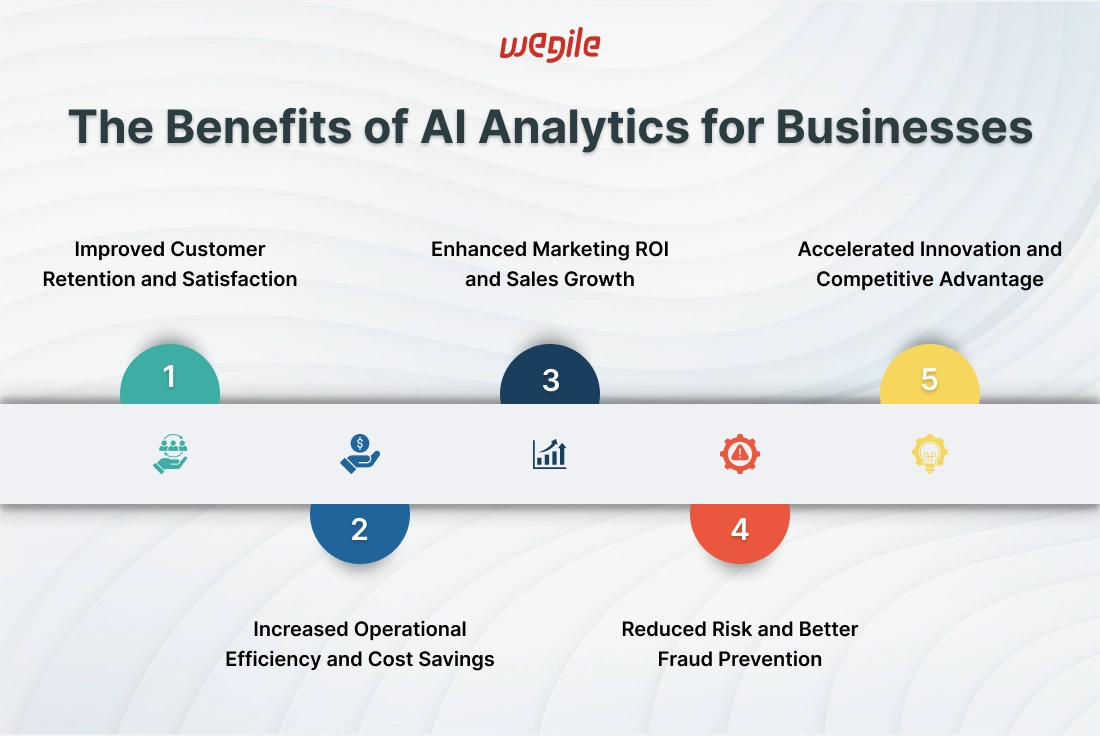
Benefit 1:
Improved Customer Retention and
Satisfaction
AI analytics improves customer retention and satisfaction by personalizing experiences at scale.
Businesses can learn about client preferences, purchase trends, and pain points by analyzing
customer behavior with AI. This allows companies to adjust their services to each customer’s
demands, making interactions more relevant and satisfying.
For example, e-commerce companies can
utilize AI to recommend products based
on a customer’s past purchases, making shopping easier and more fun. Predicting what customers want
before they do delivers a seamless experience that keeps them coming back. But it’s not just about
personalization. AI helps organizations recognize signals of dissatisfaction, such as reduced
engagement or delayed responses, and address them before customers decide to leave.
Predictive analytics help organizations re-engage with at-risk customers with tailored offers or
better service, reducing churn. This combination of personalization and prompt intervention turns
one-time consumers into repeat customers. In short, AI makes customer retention easier and
data-driven. This leads to better relationships and higher satisfaction.
Benefit 2: Increased Operational Efficiency
and Cost Savings
AI analytics makes organizations smarter, more efficient, and more profitable. It reduces manual
labor, errors, and expenses by automating routine processes and improving resource allocation. One
of the biggest advantages of AI is its ability to minimize downtime. For example, in manufacturing,
AI-powered predictive maintenance can detect equipment faults, helping companies avoid costly
breakdowns.
AI also excels at resource management. AI analytics can better predict demand, ensuring businesses
have the right amount of inventory or manpower. This cuts down the waste and boosts productivity.
For instance, in logistics, AI can optimize delivery routes and save fuel and time. This results in
significant cost reductions.
Automation of error-prone tasks like data entry and scheduling with AI lowers human error. This
improves accuracy and frees up personnel to work on key tasks that benefit
the
company. AI also improves productivity and profit
margins by streamlining operations and reducing disruptions. Thus, AI-driven automation makes
businesses more nimble, cost-effective, and productive.
Must Read: 6 Things
To
Consider While
Building Generative AI Applications in 2024
Benefit 3: Enhanced Marketing ROI and Sales Growth
Consider converting every marketing dollar into a well-aimed dart that hits the target. AI analytics
provides that. It helps companies design innovative marketing tactics by analyzing client data. AI
identifies the most likely target audience for your ads instead of hoping for the best. This ensures
consistent marketing success.
Further, AI analytics boosts conversion rates by identifying the most effective channels and messages
that resonate with your audience. It continuously monitors consumer behavior, helping firms to adapt
and remain ahead of trends. Actionable insights from AI assist sales teams pick leads and streamline
the sales process.
Moreover, AI’s capacity to forecast sales trends lets organizations anticipate demand fluctuations
and adjust strategy. This proactive
approach optimizes every campaign to
boost sales and marketing ROI. With AI analytics, marketing, and sales work together to advance your
organization with precision and agility.
Benefit 4: Reduced Risk and Better Fraud Prevention
AI analytics is like a 24/7 super-smart watchdog in business. Artificial intelligence-powered risk
management technologies constantly monitor your data for signs of fraud or other dangers. This
real-time detection means potential issues are spotted and addressed before they can escalate into
costly problems. AI makes fraud prevention easy by quickly and accurately analyzing large amounts of
data.
For instance, AI immediately alerts organizations to suspect financial transactions or online account
activity. This reduces financial losses and protects the company’s reputation. Beyond fraud
detection, AI analytics builds predictive models based on past data and current patterns to estimate
risk. This proactive approach lets firms prevent and manage these hazards. AI helps you make
informed decisions and protect your organization from uncertainty by managing supply chain
disruptions, market volatility, and regulatory compliance. Thus, AI makes risk management easier and
more strategic.
Benefit 5: Accelerated Innovation and
Competitive Advantage
Modern businesses need ongoing innovation, and AI analytics is the gasoline that keeps them going. AI
finds hidden trends and insights in massive data sets that are not visible to humans. This wealth of
data allows companies to create new goods that fit client requirements and tastes, keeping their
products relevant and in demand. AI also supercharges the R&D process. Businesses can leverage
AI to
provide data-driven recommendations and speed up innovation instead of spending hours brainstorming
and testing. This allows new goods to launch faster and pivot rapidly when market conditions change.
Moreover, AI analytics helps organizations foresee and respond to market trends faster than
competitors. AI helps firms make strategic decisions to stay ahead by recognizing trends, optimizing
product features, and improving customer
experiences. In short, AI analytics makes innovation a
data-driven and dynamic process. Businesses can lead their markets and survive in an ever-changing
world by using AI to keep up with the competition and set the pace.
Must Read: Generative AI for Startups in 2024: 8 Key Benefits
Wrapping Up
Businesses that wish to succeed in a data-driven environment need AI analytics. We understood how AI
enhances customer experiences and internal procedures. Businesses can now automate
creative work
and
provide customized solutions using their
dedicated AI solutions. Are you looking to build custom AI solutions? Wegile can help you leverage
the potential of AI for your business. We’re a top AI
app development company that can help with smarter AI solutions to improve the efficiency of
your business solutions. Our team is ready to turn your AI vision into reality. Let’s create
something incredible together!
Leave a Reply