Artificial intelligence (AI) and machine learning (ML) are no longer concepts of the future but are
the reality where almost all aspects of business functioning are impacted. From predictive
maintenance to customer interactions, AI & ML’s useful cases are remoulding industries. In this
blog, we will review the most promising AI & ML business applications in various industries. It
highlights examples of how these technologies are being deployed by companies to create new
processes, cut costs, and differentiate themselves from the competition.
Top 8 Use Cases of AI
& ML
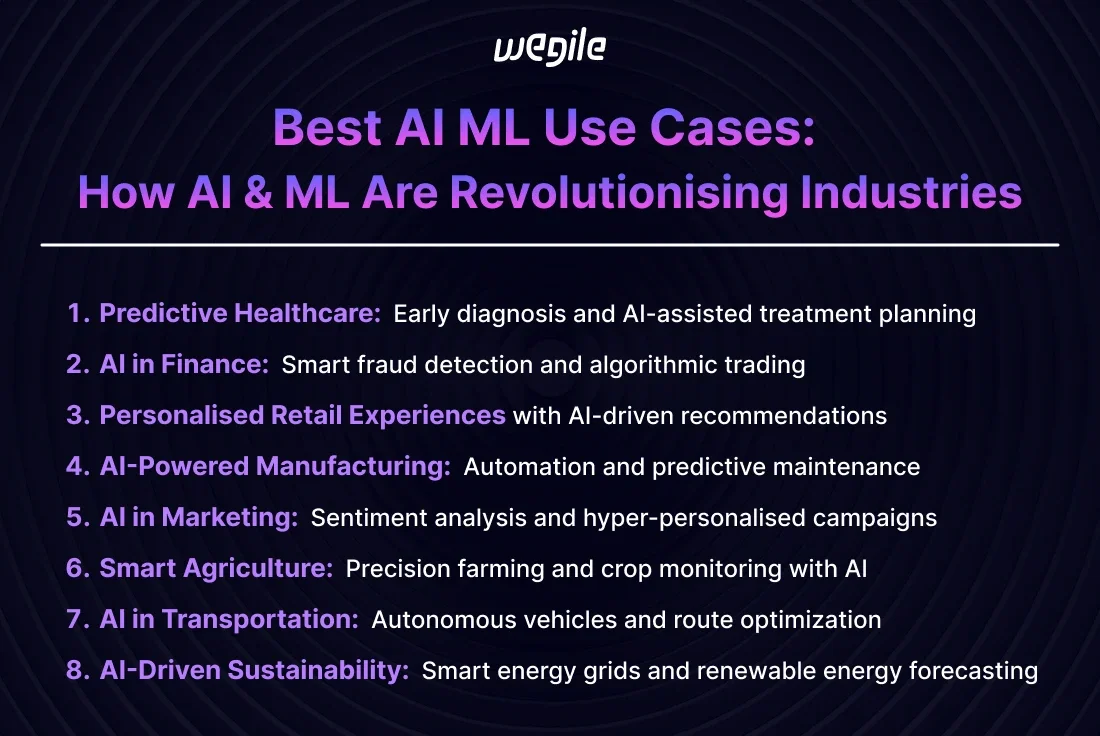
Here are the most promising use cases of Artificial Intelligence and Machine Learning proving why these
technologies are the finest creations in the technological domain:
1. AI
and ML in Healthcare: Enhancing Diagnostics and Treatment
Healthcare is one of the top sectors reaping the benefits of AI and ML. These technologies have
enabled more accurate diagnostics. They support personalized treatment plans and improve
administrative processes. The most appealing use cases of these technologies in healthcare realm
are:
-
Predictive Diagnosis
AI algorithms analyze medical history, genetics, and lifestyle factors. They predict
potential diseases, enabling early intervention. -
Medical Imaging
ML models trained on thousands of X-rays and MRIs identify abnormalities faster and more
accurately than human radiologists. -
Drug Discovery
AI accelerates drug discovery by analyzing vast datasets. It identifies potential drug
candidates and reduces the time-to-market by years. -
Virtual Health Assistants
Chatbots powered by AI provide round-the-clock assistance. They answer patient queries,
schedule appointments, and even offer medical advice.
2. AI and ML in Finance: Driving
Smart Decisions
The finance industry relies heavily on data which makes it perfect for AI and ML adoption. These
technologies are enhancing risk management and fraud detection. Let us decode how exactly AI and ML
back the finance domain:
-
Fraud Detection
AI systems detect unusual transaction patterns. This helps reduce fraud risks in real time.
-
Algorithmic Trading
ML models analyze historical market data and news sentiment. They execute high-frequency
trades with better accuracy. -
Credit Scoring
AI-based models consider a wider range of data points and this makes loan approvals faster
and fairer. -
Personalized Financial Advice
Robo-advisors utilize ML algorithms to recommend highly precise personalized investment
portfolios. They do this by considering an individual’s risk tolerance and goals.
3. AI and
ML in Retail: Enhancing Customer Experience
In retail, AI and ML business use cases focus primarily on two areas : personalization and inventory
management. They mainly offer following perks:
-
Personalized Product Recommendations
ML models analyze customer browsing behavior and purchase history. They suggest products most
likely to interest users. -
Dynamic Pricing
AI algorithms determine optimal pricing by analyzing competitor prices. They also comprehend
other elements such as demand patterns and stock levels. -
Inventory Management
ML models predict demand for various products. It promises better stock management and
reduces wastage. -
Customer Sentiment Analysis
AI tools strategically analyze reviews and deliver feedback.
4. AI and ML in Manufacturing:
Driving Automation and Efficiency
AI & ML use cases stress on predictive maintenance and process optimization in manufacturing regions.
Here is how they precisely aid the manufacturing domain:
-
Predictive Maintenance
ML models analyze data from sensors on machinery. They predict when a machine is likely to
fail and help in reducing downtime and maintenance costs. -
Quality Control
AI-powered vision systems inspect products for defects. They do so with greater precision
than human inspectors. -
Supply Chain Optimization
AI algorithms forecast demand and manage supplier risks. They are also there to optimize
logistics. It leads to cost savings and increased efficiency. -
Robotics and Automation
AI-driven robots are used in assembly lines for repetitive tasks. They improve productivity
and safety.
5.
AI and ML in Marketing: Enhancing Campaign Effectiveness
Marketing teams are using AI & ML use cases to design smarter campaigns and deliver personalized
experiences. Here is how these technologies reinforces the marketing niche:
-
Customer Segmentation
ML models segment customers based on behavior, demographics, and preferences. This supports
targeted marketing campaigns. -
Content Optimization
AI tools analyze the performance of different content types. They suggest improvements for
better engagement. -
Chatbots
AI-powered chatbots provide real-time assistance to customers. They improve satisfaction and
reduce the load on human support teams. -
Sentiment Analysis
AI tools analyze social media and online reviews. They help marketers
examine brand perception and react accordingly.
6.
AI and ML in Agriculture: Revolutionizing Food Production
Agriculture is undergoing a massive change with AI and ML solutions. These aim at increasing yield
and reducing costs in following ways:
-
Precision Farming
ML models help analyze soil conditions and crop health.
-
Crop Monitoring
TDrones equipped with AI-powered cameras gather high-resolution images of fields. This
assists early detection of diseases or pests. -
Yield Prediction
AI systems predict crop yields based on various environmental factors. It further helps
farmers plan their harvests better and with utmost precision. -
Supply Chain Optimization
AI algorithms enhance supply chain efficiency. They predict demand and minimize food waste.
7.
AI and ML in Transportation: Powering Smart Mobility
The transportation sector has seen mighty improvements in safety and user experience. All the credit
goes to AI and ML business use cases. Here is how these technologies portray their wonder in
transpiration:
-
Autonomous Vehicles
Self-driving cars rely on AI models to make split-second decisions. It promises remarkable
safety and ultimate efficiency. -
Predictive Maintenance
ML models in transportation predict vehicle maintenance needs which reduces downtime.
-
Route Optimization
AI algorithms analyze traffic patterns. They suggest the fastest routes, reducing travel time
and fuel consumption. -
Passenger Experience
Chatbots and AI-driven systems enrich passenger experience. They provide real-time updates
and personalized recommendations.
8.
AI and ML in Energy: Enhancing Efficiency and Sustainability
The energy sector is adopting AI and ML. These technologies improve grid management, optimize energy
consumption, and level up sustainability. The main applications of these technologies in enriching
sustainability are:
-
Smart Grids
AI systems analyze data from smart meters. They predict energy demand and prevent grid
overloads. -
Energy Optimization
ML models help industries optimize energy usage. It lessens costs and environmental impact.
-
Predictive Maintenance of Power Plants
AI tools predict potential failures in power plants. It helps provide uninterrupted energy
supply. -
Renewable Energy Forecasting
ML models forecast the availability of renewable energy sources like wind and solar. It
allows seamless integration into the grid.
Unique and
Emerging AI ML Use Cases
Here are more unique and solving use cases of AI and ML:
1. AI
and ML in Ethical Supply Chain Management
While supply chain optimization is a common use case, few companies focus on ethical supply chains.
These provide responsible sourcing and sustainability in following ways.
-
Ethical Sourcing Verification
ML models analyze supplier data, certification documents, and audit reports. They verify that
materials are sourced ethically. -
Carbon Footprint Monitoring
AI tracks carbon emissions across the supply chain. It submits real-time insights to
businesses striving to complete sustainability goals. -
Risk Scoring for Suppliers
AI scores suppliers on parameters like compliance and environmental impact. It further helps
companies make better sourcing decisions.
2. AI and ML in Behavioral
Economics
Behavioral economics concentrates on understanding how psychological factors influence
decision-making. AI and ML analyze human behavior deeply to design better products and policies.
-
Decision Bias Detection
AI systems identify cognitive biases in large datasets. It helps businesses refine marketing
strategies or pricing models. -
Personalized Behavioral Nudges
ML algorithms suggest tailored nudges to users. These encourage healthier habits, better
financial decisions, or sustainable consumption. -
Policy Impact Analysis
Governments and organizations use AI to simulate how policy changes may affect human
behavior. It helps design strategic and effective interventions.
3. AI and
ML in Cognitive Load Management
Cognitive load management is a new frontier. AI helps reduce mental fatigue in workplaces,
educational institutions, and digital platforms.
-
Intelligent Workload Distribution
AI tools monitor employee performance. They suggest optimal task distribution to cut down
burnout and maximize productivity. -
Intelligent Workload Distribution
ML models in e-learning platforms detect when learners experience cognitive overload. They
adjust content difficulty accordingly. -
AI-driven Break Recommendations
Wearable devices use ML to track stress levels. They recommend optimal breaks or mindfulness
exercises to improve focus.
4. AI and ML in Urban Wildlife
Conservation
Urbanization disrupts local ecosystems but AI and ML are there to protect wildlife habitats and
reduce human-wildlife conflict in urban areas. They assist in following ways:
-
AI-powered Animal Movement Tracking
ML models analyze footage from cameras and drones. They monitor wildlife movement patterns
and help design safer urban layouts. -
Smart Noise Pollution Control
AI systems measure noise levels. They predict areas where noise may negatively impact local
wildlife, enabling corrective actions. -
Predictive Habitat Mapping
ML algorithms predict how urban expansion will affect local biodiversity. It helps
conservationists plan protective measures.
5.
AI and ML in Creative Process Augmentation
AI supports fields like content creation and design. Here are the precise use cases of these
technologies:
-
AI-assisted Ideation
ML tools analyze vast datasets and they suggest unique concepts for product design, marketing
campaigns, or storytelling -
Collaborative Art Creation
Artists use AI as a co-creator. It generates novel art forms blending human creativity with
machine intelligence. -
Generative Music Composition
ML models trained on various music genres generate original compositions. These inspire
musicians and sound designers.
6.
AI and ML in Emotional Well-being
AI is playing a vital part in emotional well-being as it bestows tools to enrich mental health and
emotional intelligence. Here is how it helps:
-
AI-driven Empathy Coaches
ML models analyze tone, language, and facial expressions during conversations. They offer
real-time feedback to improve empathy. -
Emotional State Prediction
Wearables combined with AI predict emotional states. They analyze physiological data like
heart rate variability and skin conductivity. -
Virtual Companions
AI-driven virtual companions offer empathetic interactions. They help users manage loneliness
or stress, unlike typical chatbots.
7.
AI and ML in Advanced Materials Discovery
AI and ML are driving the development of next-generation materials. These could revolutionize
industries from construction to electronics.
-
Predictive Material Synthesis
AI models predict how different compounds behave under specific conditions. It speeds up the
discovery of new materials. -
Self-healing Materials
ML algorithms help design materials that repair themselves when damaged. These have
applications in aerospace and infrastructure. -
Sustainable Material Alternatives
AI systems analyze the properties of existing materials. They suggest sustainable
alternatives that meet the same performance criteria.
Final Thoughts
In recent times, as business organs continue to open up to embracing the “digital revolution,” the
use of AI and ML technologies is rapidly growing. The AI-ML use cases outlined in this blog indicate
the possibilities of these technologies to change industries in a big way. They do this by improving
efficiency, optimising customer satisfaction, and promoting innovation. Whether it is Healthcare,
Finance, Retail, or Manufacturing, AI & ML business use cases are helping businesses become the best
in the present market.
When you want to start with AI and ML, do not go into it blind; try to find areas where to start.
These are the areas that must be accurately predicted, analyzed, and handled to maximize the added
value of a data solution. By investing in the right AI solutions, businesses can enhance operational
efficiency and stay ahead in an evolving market. With top AI app development companies driving innovation, those
leveraging advanced AI-ML capabilities are shaping the future of intelligent business operations.
Leave a Reply