
Introduction
In the evolving landscape
of language models, two prominent names are Claude and ChatGPT. Claude
is a next-generation AI assistant based on Anthropic’s research into training helpful, honest,
and harmless AI systems. ChatGPT is a powerful language model developed by OpenAI. Understanding
the nuances and distinctions between these models excel in generating human-like text but
possess unique features and applications that set them apart.
In this article, we will delve into a comprehensive comparison of Claude Instant and ChatGPT,
exploring their context window, output results, suitability for data science tasks,
reinforcement learning training, performance and cost considerations, proficiency in mathematics
and coding, and more. By the end, you will have a clear understanding of what is the difference
between Claude Instant and ChatGPT and whether Claude is more powerful than ChatGPT. So, let’s
dive in and explore the fascinating world of Claude Instant and ChatGPT.
Claude Instant vs. ChatGPT
To answer your questions: Is Claude more powerful than ChatGPT? Which AI is better than ChatGPT?
Is Claude better than GPT4? We need first to answer the question, What is the difference between
Claude Instant and ChatGPT, to understand both AI tools deeply? Let us dive deep into Claude vs.
ChatGPT, from pricing to generation speed; we’ll answer them all.
Pricing | Claude vs. ChatGPT
Below is the comparison of Claude Model Pricing and ChatGPT Pricing in a table format:
| Model | Features | Price | |
|---|---|---|---|
| Claude Instant | Prompt | Low latency, high throughput use cases | $1.63/million tokens |
| Completion | $5.51/million tokens | ||
| Claude 2 | Superior performance on complex reasoning tasks | $11.02/million tokens | |
| Prompt | Best-in-class | ||
| Completion | $32.68/million tokens | ||
| ChatGPT Free | Access to GPT-3.5 | Standard response speed | Free |
| Model | Regular model updates | ||
| ChatGPT Plus | Upgrade | Access to GPT-4, the most capable model | $20/mo |
| Faster response speed | |||
| Exclusive access to beta features like Browsing, Plugins, and Code Interpreter |
Additionally, here is the pricing for ChatGPT API:
| Model | Context | Plan | Price (per 1K tokens) |
|---|---|---|---|
| GPT-3.5 Turbo | 4K context | Prompt | $0.0015 |
| Completion | $0.002 | ||
| 16K context | Prompt | $0.003 | |
| Completion | $0.004 | ||
| GPT-4 | 8K context | Prompt | $0.03 |
| Completion | $0.06 | ||
| 32K context | Prompt | $0.06 | |
| Completion | $0.12 |
Comparison for Pricing, Is Claude better than GPT4?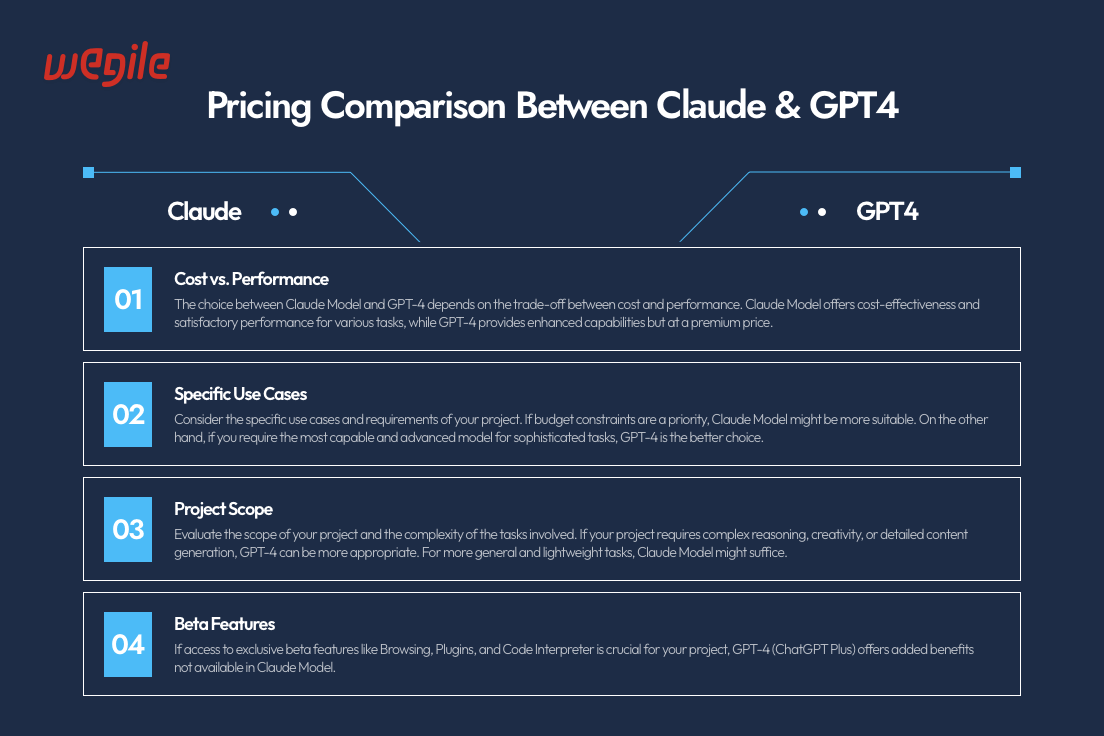
-
1. Cost vs. PerformanceThe choice between Claude Model and
GPT-4
depends on the trade-off between cost and
performance. Claude Model offers cost-effectiveness and satisfactory performance for
various tasks, while GPT-4 provides enhanced capabilities but at a premium price. -
2. Specific Use CasesConsider the specific use cases and
requirements of your project. If budget constraints
are a priority, Claude Model might be more suitable. On the other hand, if you require
the most capable and advanced model for sophisticated tasks, GPT-4 is the better choice. -
3. Project ScopeEvaluate the scope of your project and the
complexity of the tasks involved. If your
project requires complex reasoning, creativity, or detailed content generation, GPT-4
can be more appropriate. For more general and lightweight tasks, Claude Model might
suffice. -
4. Beta FeaturesIf access to exclusive beta features like
Browsing,
Plugins, and Code Interpreter is
crucial for your project, GPT-4 (ChatGPT Plus) offers added benefits not available in
Claude Model. -
5. In conclusionThe decision between Claude Model and GPT-4
(ChatGPT Plus) should be based on your
specific needs, budget constraints, and the level of performance and capabilities
required for your project. Both models have their strengths and cater to different use
cases, offering a range of options to suit various user requirements.
Context Window and Information
Retrieval | Claude vs. ChatGPT
One key difference between Claude Instant and ChatGPT lies in their context window and how they
handle information retrieval. The context window is the amount of text that an LLM can access
when generating text. Claude boasts a significantly deeper context window, allowing it to
consider up to 100K tokens of text. Whereas Claude 2 has been trained to have a further expanded context window of 200K tokens, corresponding to
roughly 150,000 words. This extensive context window enables Claude to have a broader
understanding of the provided information and generate responses that are more coherent and
contextually relevant.
On the other hand, ChatGPT 4 has limitations on its context window, typically around
8192 tokens, which means it can only consider
a smaller portion of the conversation history.
This limitation may sometimes result in ChatGPT being less aware of past interactions and
potentially generating less accurate or contextually appropriate responses. Therefore, if you
require a language model that can leverage a larger context window for improved information
retrieval, Claude would be the preferred choice.
Suitability for Data
Science Tasks | Claude Instant vs. ChatGPT

When it comes to data science tasks, both Claude vs. ChatGPT offers unique strengths and
considerations. Claude is purposefully designed to excel in data science-related tasks, making
it an excellent choice for projects that heavily involve data analysis and manipulation. With
Claude Instant, you can expect specialized support and a time-saving experience when dealing
with data-centric projects.
On the other hand, ChatGPT may not come pre-packaged with the same level of built-in data science
capabilities as Claude Instant, but it shines in its robust natural language processing (NLP)
abilities. While using ChatGPT, you can still interact with it using data science-related
queries and receive meaningful responses. However, for more intricate data manipulation or
advanced analysis tasks, you may need to integrate external data science libraries and perform
some additional programming to get the desired functionality from ChatGPT.
Is Claude more powerful than ChatGPT?
If your primary focus is on data science tasks, Claude Instant is your go-to option due to its
tailored and efficient built-in features. It’s well-suited to provide the specialized assistance
you need. On the other hand, if you’re seeking more generalized NLP capabilities and are okay
with integrating external data science tools, ChatGPT can be a valuable asset in your data
science workflow.
Proficiency in Mathematics
and Coding
Claude
-
1. Claude exhibits a higher degree of competency in mathematical and coding domains when
compared to ChatGPT. -
2. It has undergone targeted training across diverse mathematical concepts and coding
languages, rendering it well-suited for data science tasks and queries. -
3. Claude demonstrates proficiency in handling intricate mathematical computations,
encompassing statistical analysis, probability theory, linear algebra, and calculus. -
4. Moreover, it provides comprehensive assistance and guidance in coding using widely
adopted languages such as Python and R, prevalent in data science applications. -
5. Users can rely on Claude’s expertise to comprehend and implement various algorithms, data
manipulation techniques, and statistical models.
ChatGPT
-
1. While ChatGPT possesses some degree of understanding in mathematics and coding, its
proficiency is comparatively limited when compared to Claude. -
2. ChatGPT is capable of handling fundamental mathematical operations and providing
responses to straightforward mathematical inquiries. -
3. It may also possess rudimentary knowledge of coding languages; however, its capabilities
are less extensive compared to Claude. -
4. ChatGPT can offer general programming advice and assist with basic coding issues, but it
may not provide intricate guidance on complex algorithms or advanced coding techniques.
Training Data Recency | Claude
vs. ChatGPT
Claude
Claude models benefit from a training dataset sourced from a proprietary blend of publicly
available information, licensed datasets from third-party businesses, and data shared by users
or provided by crowd workers. Notably, some of the human feedback data utilized for Claude’s
fine-tuning was released publicly during their RLHF and red-teaming research.
Significantly, Claude 2’s training data extends until early 2023, ensuring a relatively more
recent corpus of information compared to other models. While approximately 10 percent of the
data included is non-English, Claude’s training dataset is regularly updated and optimized for a
broad range of applications.
ChatGPT
In contrast, GPT-4’s training data has a significant cut-off point, limiting its knowledge to
events that occurred primarily before September 2021. This lack of recent data can potentially
hinder GPT-4’s ability to stay up-to-date with current events and developments.
Furthermore, GPT-4 does not learn from its own experience, leading to instances where it may make
simple reasoning errors or be overly gullible in accepting false statements from users. It is
also prone to encountering challenging problems, such as introducing security vulnerabilities
into the code it generates, similar to how humans may struggle with complex issues.
Which AI is better than ChatGPT in terms of Training Data Recency?
Based on the data recency aspect alone, Claude holds a clear advantage over ChatGPT, ensuring a
more current and relevant understanding of the world and the ability to deliver accurate and
informed responses.
Ethical Considerations | Claude
Instant vs. ChatGPT
Claude’s primary research objective is to train its models to prioritize helpfulness, honesty,
and harmlessness. To achieve this, a Constitution is implemented as a set of ethical and
behavioral principles that guide the model’s output generation. By incorporating the
Constitution into its training process, Claude ensures that its models receive specialized
training to prevent the generation of outputs containing sexist, racist, or toxic content.
Additionally, the models are intentionally programmed to refrain from facilitating any illegal
or unethical activities during human interactions.
ChatGPT, developed by OpenAI, also incorporates ethical considerations in its design and
deployment. While the specific technical details of ChatGPT’s ethical guidelines may vary,
OpenAI has implemented measures to address ethical concerns. ChatGPT has undergone a moderation
process to filter out explicit, offensive, or otherwise harmful content. This helps ensure that
the model adheres to acceptable community standards and prevents users from receiving
inappropriate responses.
It’s important to note that both Anthropic Claude and ChatGPT strive to be responsible AI
systems. They are designed to prioritize user safety, adhere to legal and ethical standards, and
prevent the dissemination of harmful or inappropriate content. However, the specific details and
implementation may vary between the two models.
Creativity | Claude vs.
ChatGPT
In terms of creativity, both Claude Instant and ChatGPT demonstrate impressive capabilities, but
there are distinctions in the specific creative tasks they excel at:
Claude
-
Claude Instant has a strong performance in various tasks, including general open-ended
conversations, search, writing, editing, outlining, and text summarization. -
The model showcases proficiency in coding tasks, making it a valuable resource for
programming-related inquiries. -
It offers helpful advice across a wide range of subjects, indicating its versatility in
providing insights and guidance. -
Claude Instant is particularly well-suited for supporting creative or literary use cases.
Users can direct the model’s tone and “personality,” allowing for personalized and engaging
interactions. -
Users have described Claude Instant as feeling steerable and conversational, further
enhancing its appeal for creative writing and storytelling applications.
ChatGPT
-
ChatGPT boasts strong natural language processing capabilities, excelling in generating
creative and imaginative content. -
Users frequently leverage ChatGPT for creative writing, story generation, idea
brainstorming, and other tasks that require innovative responses. -
The model’s ability to produce contextually relevant and imaginative content has garnered
significant recognition. -
While ChatGPT is proficient in various tasks, its standout feature is its creativity in
generating text and responses, making it a popular choice for creative applications.
Which AI is better than ChatGPT in
terms of Creativity?
-
Claude Instant is a well-rounded model that performs exceptionally well in various tasks,
including data science, coding, and providing helpful advice. Its creative strengths lie in
supporting literary and innovative use cases, with users having the ability to steer its
tone and personality. On the other hand, ChatGPT’s remarkable strength lies in its natural
language creativity, making it a preferred option for users seeking imaginative and
contextually relevant content generation for creative writing and other creative
applications. -
In conclusion, the comparison between Claude Vs. ChatGPT highlights the fascinating
advancements in conversational AI. These two systems offer distinct approaches and
capabilities to respond to user queries and engage in conversations. With its reinforcement
learning (RL) training, Claude demonstrates the power of exploration in acquiring a wide
range of conversational experiences, enabling it to handle diverse user inputs effectively.
On the other hand, ChatGPT leverages its pre-trained knowledge to exploit patterns and
generate coherent responses. -
So, Is Claude more powerful than ChatGPT? / Is Claude better than GPT4? Hopefully, you’ve
got your answer with this indepth blog on What is the difference between Claude and ChatGPT
by Wegile. Each use case will vary the response, as both ChatGPT and Claude have their own
set of strengths and weaknesses, and with AI technology constantly advancing, who knows what
incredible models we’ll see next? The future looks exciting!
Frequntly
Asked Questions
(FAQ)
consider their performance in
different areas. GPT-4, which is ChatGPT’s latest version, achieved
impressive scores, scoring
75 percent on the bar exam, surpassing the 68 percent
average, and placing in the 90th percentile. Moreover, it obtained
an
80 percent score on the GRE quantitative and an outstanding 99
percent on the GRE Verbal section. On the other hand, Claude
2, an improved version of Claude, scored
76.5 percent on the multiple-choice section of the bar exam,
and it performed remarkably well, reaching the 90th percentile in
the reading and writing portion of the GRE. In terms of coding
skills, Claude 2 outshined its predecessor, scoring 71.2 percent on
a Python coding test.
of technical prowess in
mathematics and coding, particularly tailored for data
science-related tasks. On the other hand, while ChatGPT possesses
some understanding of these domains, its technical proficiency is
more limited, making it better suited for general knowledge
inquiries and basic coding assistance.
Claude. ChatGPT offers free
access to GPT-3.5 with standard response speed, while Claude Instant
Prompt costs $1.63/million tokens for low latency, high throughput
use cases. Furthermore, ChatGPT Plus is available for $20/month,
providing faster response speed and exclusive access to GPT-4, the
most capable model.
Leave a Reply