Generative AI is revolutionizing the business world by automating complex tasks and generating
innovative content across various industries. From pharmaceuticals to automotive, generative AI
enhances operations and introduces new product possibilities. For example, it accelerates drug
discovery in pharmaceuticals by analyzing complex molecular data. In the automotive sector, it
improves user interactions through intelligent virtual assistants.
The impact of generative AI extends across industries. It allows the creation of innovative services
and features, boosting efficiency, and personalizing customer interactions. As this technology
advances, it presents a strategic opportunity for businesses to stay competitive in a digital-first
economy.
Dive deeper into how generative AI can transform your industry by unraveling our detailed blog:
What is Generative AI?
Generative AI represents a terrific shift in artificial intelligence. It moves beyond static,
rule-based systems to dynamic models. These models can create new, original content. This type of AI
uses complex machine-learning algorithms and profound learning networks. It analyzes vast datasets
to learn underlying patterns. Thus, it can generate realistic text, images, audio, and other media
that resemble human-generated content. Generative AI can also innovate, producing unique outputs
like novel artwork or music compositions.
How is
it different from Traditional AI?
Generative AI differs from traditional AI in several key ways. Traditional AI, often called symbolic
or rule-based AI, operates under predefined rules. It excels at executing tasks with high precision
where parameters are clearly defined. It is deterministic, consistently producing the same output
from the same input, making it reliable in controlled scenarios. In contrast, generative AI does not
rely on explicit programming. Instead, it uses patterns learned from data to generate outputs. It
allows one to handle ambiguous or complex scenarios without clear answers. Generative AI’s
adaptability makes it useful in fields like content creation, personalized customer interactions,
and complex problem-solving, where creativity and flexibility are required.
Five
Benefits of Generative AI for CEOs
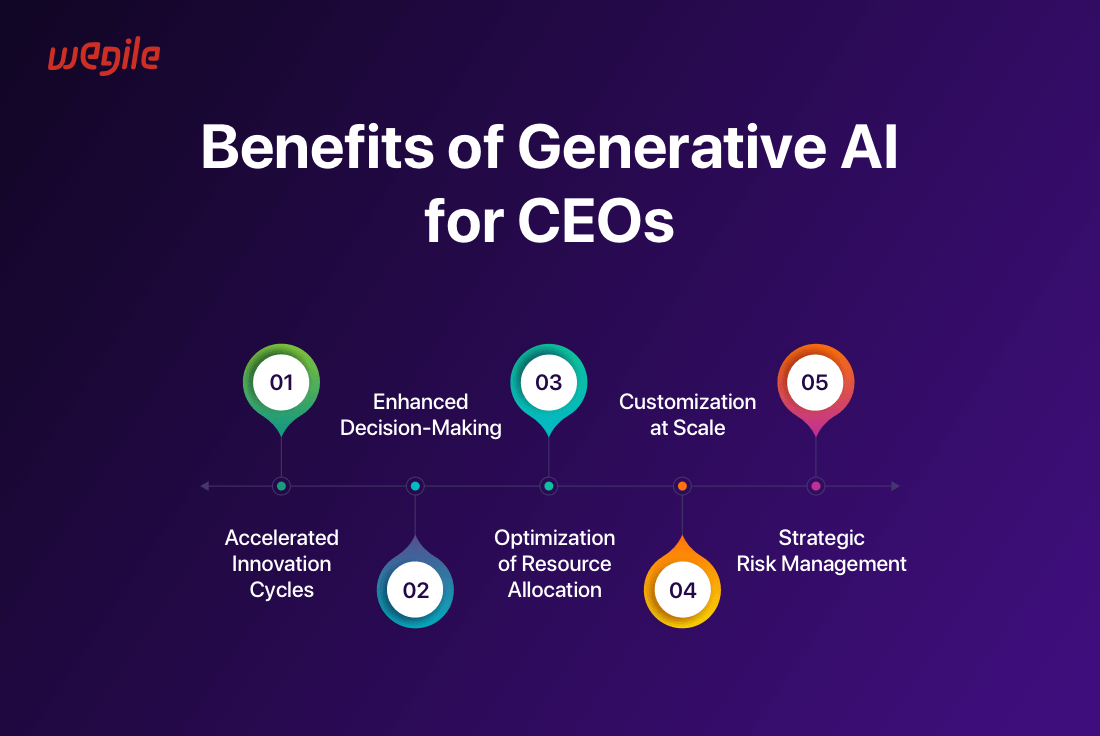
Accelerated Innovation Cycles
Generative AI significantly enhances the pace of product development and innovation. It offers CEOs
a
strategic tool that reshapes how companies approach new markets and upgrade existing products.
Generative AI simulates and predicts numerous possible outcomes from vast datasets by leveraging
advanced machine learning techniques. This acts as a virtual testing ground, enabling rapid
prototyping. Companies can iterate on design and functionality much faster than traditional methods.
For instance, in the technology sector, where product lifecycles are increasingly shortened,
AI-driven simulations can predict how new technologies will perform under various conditions before
they are physically produced. Similarly, in consumer goods, AI can forecast market reactions to
different product variations. This provides insights that can refine product offerings to meet
consumer demands better. This not only speeds up the innovation process but also significantly
reduces the time and resources typically required for research and development. Maintaining a
company’s competitive edge in rapidly changing markets is crucial.
Enhanced Decision-Making
Generative AI transforms decision-making for CEOs by providing a depth of analysis and synthesis of
information that surpasses human capabilities. This technology integrates data from multiple
sources: market trends, consumer behavior analytics, and operational metrics. It uses sophisticated
algorithms to uncover patterns and insights that may not be immediately obvious. For CEOs, this
means having access to a comprehensive, 360-degree view of their business landscape. This enables
them to make decisions that are not only reactive but also predictive. For example, by analyzing
current consumer data alongside historical market trends, generative AI can help predict future
consumer behaviors. It allows CEOs to tailor market strategies proactively. This enhanced
decision-making capability also helps in risk management. It identifies potential pitfalls and
opportunities in the business strategy. This allows leaders to allocate resources more effectively
and avoid costly missteps. The ability to quickly and accurately make informed decisions is a
critical advantage in today’s data-driven business environment. The ability to swiftly adapt and
respond to changes can define a company’s success.
Optimization of Resource Allocation
Generative AI’s predictive capabilities revolutionize how resources are managed and allocated across
various business operations. By harnessing AI’s ability to analyze vast amounts of data and predict
future conditions, CEOs can optimize essential aspects of their operations. This includes supply
chain logistics and energy consumption in production processes. This optimization leads to a more
streamlined operation, where resources are used more efficiently, reducing waste and minimizing
costs. For instance, AI can predict demand surges, allowing companies to adjust their inventory and
production levels accordingly. It can also foresee supply chain disruptions, enabling proactive
adjustments to suppliers or routes to maintain operations smoothly. Additionally, AI-driven
predictions of maintenance needs can prevent costly downtime and extend the lifespan of critical
machinery. By leveraging these predictive insights, CEOs can achieve higher operational efficiency
and lower overall costs, providing their companies with a significant competitive advantage.
Customization at Scale
Generative AI offers powerful customization capabilities that are transforming how businesses
interact with their customers. This technology enables the personalization of products, services,
and communications to individual customer preferences at a scale previously unattainable without
significant resources. In retail, for example, AI can analyze customer data to offer personalized
shopping experiences, recommending products based on past purchases or browsing behaviors. In
finance, AI-driven tools can tailor banking and investment advice to individual financial goals and
risk profiles. In services, personalized communication can be automated to address individual
customer inquiries and concerns, enhancing engagement and satisfaction. This high degree of
personalization fosters greater customer loyalty and can significantly enhance overall customer
satisfaction, making it a crucial strategy for businesses looking to stand out in crowded markets.
Strategic Risk Management
Generative AI plays a critical role in strategic risk management by equipping CEOs with the tools to
identify and address potential risks before they develop into significant problems. This proactive
approach is made possible by AI’s continuous analysis of data patterns and its ability to predict
potential failures or market shifts. For instance, in financial services, AI can detect unusual
transaction patterns that may indicate fraud, allowing for immediate intervention. In manufacturing,
AI can predict equipment failures before they occur, minimizing downtime and maintenance costs.
Additionally, by analyzing market trends and consumer behavior, AI can help predict shifts that may
affect a company’s market position, providing CEOs with the foresight needed to devise effective
strategies. This capability not only helps in mitigating financial and operational risks but also in
protecting the company’s reputation by ensuring smoother operations and customer interactions.
Generative AI, therefore, is an essential tool for CEOs looking to maintain robust, proactive risk
management systems in their organizations.
What
are CEOs saying about generative AI?
CEOs worldwide are recognizing the transformative potential of generative AI. They view it as
pivotal
for achieving competitive advantage and driving operational efficiencies. Their focus on integrating
generative AI across various business processes underscores a broader strategy. They aim to harness
its disruptive capabilities for innovation and growth.
Adoption and
Integration
Leading executives are not just exploring generative AI; They are actively embedding it into the
fabric of their corporate strategies. For instance, companies like NVIDIA are incorporating generative AI to revolutionize
graphical processing. This leads to more efficient rendering of complex images and simulations.
Another example is Salesforce, which integrates generative AI to enhance customer relationship
management systems. It facilitates personalized customer interactions at scale. This widespread
adoption emphasizes a shift from traditional operational methods to more dynamic AI-driven
approaches. The commitment is reflected in investment shifts, with many CEOs reallocating
significant portions of their technology budgets toward generative AI projects.
Success Stories
The practical applications of generative AI span various industries. Each showcases significant
improvements in efficiency and innovation. In the pharmaceutical industry, companies like Pfizer are
using generative AI to accelerate drug discovery processes. It reduces the time and cost associated
with bringing new drugs to market. In the automotive sector, Tesla is leveraging AI to enhance its
Autopilot and Full Self-Driving capabilities. It improves safety and vehicle performance. These
examples not only demonstrate the versatility of generative AI but also its potential to redefine
industry norms and drive substantial business value.
Strategic Perspectives
CEOs view generative AI as a strategic asset that can drive long-term growth and innovation. They
anticipate it will enable personalized customer experiences, optimize manufacturing processes, and
unlock new revenue streams through innovative product and service offerings. The strategic
deployment of generative AI is seen as crucial for maintaining relevance and leadership in rapidly
evolving markets. For example, Amazon uses generative AI to optimize its logistics and supply chain
operations. This enhances delivery efficiency and reduces operational costs. Similarly, Google
employs AI in its search algorithms to better understand user intent and deliver more relevant
search results. This improves user satisfaction and engagement.
What worries CEOs the most about generative AI?
CEOs are welcoming Generative AI but they are also facing a range of challenges and concerns as they
integrate generative AI into their business strategies. These can be broadly categorized into
technical and ethical challenges, as well as business and operational concerns.
Technical and Ethical Challenges
-
1. Data Privacy and Security: As generative AI systems process vast amounts
of
data, they raise significant privacy concerns. There’s a risk that sensitive information
input
into these systems could be inadvertently exposed or misused. -
2. AI Bias and Fairness: Generative AI models can inadvertently perpetuate
or
amplify biases present in their training data. This is particularly concerning in
applications
that affect people’s lives directly, such as hiring or law enforcement. -
3. Model Reliability and Explainability: These AI models often lack
transparency
in how decisions are made, which can be problematic in sectors where understanding AI’s
decision-making process is crucial, such as in healthcare or financial services.
Additionally,
the inconsistency in AI responses, known as model “hallucination,” can lead to unreliable
outputs. -
4.Regulatory Compliance: Navigating the emerging regulatory landscape
around AI
is another significant challenge. Laws and regulations around data use and AI are evolving,
requiring CEOs to continually adapt their AI strategies to comply with legal standards.
Business and
Operational Concerns
-
1. Impact on Workforce: The integration of generative AI can lead to
significant
changes in workforce dynamics. While it can enhance productivity and create new
opportunities,
there is also a risk of job displacement and the need for significant upskilling of
employees
to sustain their jobs. -
2. Operational Workflow Changes: Implementing generative AI can disrupt
existing
workflows. It requires significant changes to how businesses operate. These changes can be
challenging to manage and may lead to initial inefficiencies as systems and employees
adjust. -
3. Over-dependence on Technology: There is a risk that companies may become
too
reliant on AI technologies, which can be problematic if these systems experience downtime or
other failures. This over-dependence could leave businesses vulnerable in critical areas.
These challenges necessitate a thoughtful and strategic approach to AI integration. CEOs need to
engage with these technologies not just from a technological standpoint but also from a broader
organizational and ethical perspective. It guarantees sustainable and responsible AI deployment.
Strategic Implementation of Generative AI in Business
Strategic implementation of generative AI in business settings involves a comprehensive approach. It
focuses on building AI competency and creating value through targeted applications.
Building AI Competency
Developing an AI-savvy workforce is crucial for harnessing the potential of generative AI. It
includes more than just technical skills. Employees also need to have strong design skills,
contextual understanding, and collaboration capabilities. For instance, McKinsey highlights the
importance of diverse skills. These include design thinking and forensic skills for troubleshooting
and anticipating outcomes in generative AI applications.
Training and development programs are essential for effective AI use. These programs should not only
focus on “learning on the job” but also on structured training that evolves with market demands.
According to McKinsey, rapid skill development in areas like generative AI is increasingly
recognized. Platforms like GitHub are seeing a significant rise in generative AI projects.
Creating Value with AI
Identifying high-impact areas for AI implementation is key to creating value. Generative AI can
deliver broad productivity gains across an enterprise and transform business functions such as
customer service, marketing, and product development. BCG reports that companies implementing
generative AI tools have seen efficiency gains ranging from 30% to 50% in various processes.
Real-world examples of generative AI driving business innovation and efficiency include Enbridge and
CarMax. Enbridge utilized a centralized data marketplace to fuel AI-driven tools that enhance
operational efficiency and customer service. Similarly, CarMax employs generative AI to synthesize
vast amounts of customer reviews into concise, informative summaries for potential buyers, enhancing
the shopping experience.
Case Studies: CEOs Pioneering Generative AI
Implementation
Sam Altman- CEO, OpenAI
Sam Altman heads OpenAI, the company behind some of the most advanced generative AI models like
GPT-3
and DALL-E. Under his leadership, OpenAI has transitioned
from a non-profit to a capped-profit entity. Altman has been instrumental in directing the company’s
focus toward ethical AI deployment, ensuring these powerful tools are used responsibly. His work
demonstrates the potential of AI in augmenting human capabilities and transforming communication and
creative industries.
Jensen Huang- CEO, NVIDIA
Jensen Huang’s NVIDIA has pioneered the development of graphics processing units (GPUs) that are
crucial for training AI models. Under his guidance, NVIDIA has developed AI-specific hardware like
the DGX systems that are optimized for machine learning and deep learning applications. His
foresight into the AI landscape has positioned NVIDIA at the forefront of AI research and
development, providing the necessary hardware to power a wide range of AI applications from
automotive to healthcare.
Ginni Rometty- Former CEO, IBM
During her tenure at IBM, Ginni Rometty pushed the company deeper into the AI space with Watson,
IBM’s suite of enterprise-ready AI services, applications, and tooling. Watson has been used in
diverse fields such as healthcare, where it assists in patient care management and insights, and in
business, to enhance customer service through AI-powered assistants. Her vision was for IBM to lead
in the cognitive computing space, which is reflected in Watson’s extensive use in complex,
data-intensive industries.
Marc Benioff- CEO, Salesforce
Marc Benioff’s Salesforce has integrated AI into its customer relationship management (CRM) systems,
notably through Salesforce Einstein. This AI platform automatically discovers relevant insights,
predicts future behavior, proactively recommends best next actions, and automates tasks. Benioff has
championed the role of AI in enhancing the efficiency of CRM tools, thereby improving the
productivity of sales and marketing teams across various industries.
Sundar Pichai- CEO, Google
Under Sundar Pichai’s leadership, Google has incorporated AI across all its products, enhancing
search algorithms and pioneering new AI-driven platforms like Google Assistant. Pichai has
emphasized AI’s role in driving innovation, leading to developments in natural language processing
and autonomous technology. His strategic focus on AI and its ethical use has not only advanced
Google’s technology but also set industry standards for responsible AI usage.
The Future
Outlook of Generative AI
The landscape of generative AI is continuously evolving, with significant developments anticipated
in
model optimization, deployment flexibility, and customized applications. Businesses are leveraging
smaller, more efficient AI models to maximize performance without extensive infrastructure demands.
Techniques such as Low-Rank Adaptation and Quantization are enhancing the speed and efficiency of
these models. It makes advanced AI tools accessible to even smaller entities, not just to large
corporations.
In terms of applications, we are seeing a push towards more sophisticated virtual agents. These
agents go beyond basic customer service roles. These developments are not only transforming how
businesses interact with customers but also reshaping internal operations and decision-making
processes.
Predictions about Future Developments in AI
Technology
The future of AI promises further integration into diverse business functions. These functions range
from customer experience enhancements to more dynamic supply chain management solutions.
Organizations are expected to increasingly tailor AI tools to specific business needs. They are
utilizing proprietary data to drive industry-best practices. Plus, as AI technology continues to
mature, its integration across various sectors, such as legal, healthcare, and finance, is
anticipated to grow. These sectors will benefit from bespoke models that cater to sector-specific
requirements.
Preparing for Tomorrow
To stay ahead in the rapidly changing AI landscape, businesses need to adopt a strategic and
proactive approach. This involves not only keeping abreast of technological advances but also
preparing the workforce through continuous learning and adaptation strategies. Developing a flexible
technology strategy that can quickly adapt to new AI advancements and regulatory changes is
crucial. As the AI regulatory environment evolves, companies will need to navigate increased
oversight and adapt to new laws. These laws may affect how AI technologies are deployed and used.
It will require a strong focus on governance and ethical AI use to ensure compliance and maintain
public trust.
Importance of Continuous Learning and Adaptation
The pace of AI development necessitates a culture of perpetual learning and agility within
organizations. Emphasizing ongoing training and development is essential to ensure that employees
can leverage AI tools effectively and ethically. As AI becomes more embedded in business operations,
the ability to adapt to and anticipate technological shifts will be key to sustaining competitive
advantage and driving innovation.
Final Words
Generative AI is swiftly transforming the business landscape. It is automating intricate tasks and
spawning novel content across a multitude of industries. It not only streamlines operations but also
sparks new product innovations, exemplified by its role in accelerating pharmaceutical drug
discovery through complex molecular data analysis and enhancing automotive user interactions with
intelligent virtual assistants. The far-reaching impact of generative AI stimulates the creation of
innovative services and features, elevates efficiency, and personalizes customer interactions,
presenting businesses with strategic opportunities to remain competitive in a digitally driven
economy. As this technology progresses, it demands a proactive approach from businesses, emphasizing
continuous learning and adaptability to navigate the digital landscape successfully.
To discover how generative AI can uniquely elevate your business, consider tapping into our
specialized Generative
AI App Development Services. Learn more about what we offer and how we can assist you in
harnessing the power of generative AI to transform your operations!
Leave a Reply