Did you know?
-
According to a report by McKinsey
& Company, companies using AI for personalization can see revenue increases of
5-15%
and
cost savings of 10-30%. -
The global
AI in the travel and tourism market size is expected to reach USD 1.2 billion by
2026,
growing at a compound annual growth rate (CAGR) of 9.7%. -
Over a fifth
(22%) of global travelers have used ChatGPT or similar AI chatbots to plan travel.
The travel industry has evolved significantly over centuries, driven by technological advancements
and shifts in consumer behavior. Innovations have transformed travel from the late 18th century’s
steam-powered transportation to the mid-20th century’s commercial air travel. Travel times have
drastically decreased, and accessibility has improved. Notably, the bullet train and commercial jets
have played crucial roles. For instance, a trip from London to New York now takes just over seven
hours, a stark contrast to the days-long journeys of the past.
The late 20th century saw another major shift with the advent of the internet. Online booking
platforms like Expedia and TripAdvisor revolutionized how we plan and book travel, moving much of
the industry to digital interfaces. Today, we are seeing artificial intelligence, especially
Generative AI, integrate into the travel industry. This trend is reshaping how travel experiences
are designed, personalized, and delivered.
What is Generative AI?
Generative AI is artificial intelligence that can generate new content, from text and images to music
and code, based on learned data patterns. Generative AI involves models that generate novel data
outputs resembling their training data. In the travel industry, this technology is crucial as
companies aim to provide personalized experiences at scale, automate operations, and enhance
customer interactions.
Critical Characteristics of Generative AI
Technologies
-
Adaptability: Generative AI models quickly learn from new data and adjust
outputs based on feedback. -
Scalability: These models handle increasing data and complexity without
performance loss, which is essential for data-rich industries like travel. -
Creativity: Generative AI can produce creative solutions to problems, such
as
crafting unique travel itineraries or generating promotional content.
Examples of
Generative AI Tools
-
GPT (Generative Pre-trained Transformer): This tool generates human-like
text
based on input. It is helpful when traveling by powering customer service chatbots or
interactive travel guides. -
DALL-E: This AI program generates images from textual descriptions. It is
helpful when creating promotional materials or virtual previews of destinations.
5
Benefits of Generative AI in the Travel Industry
-
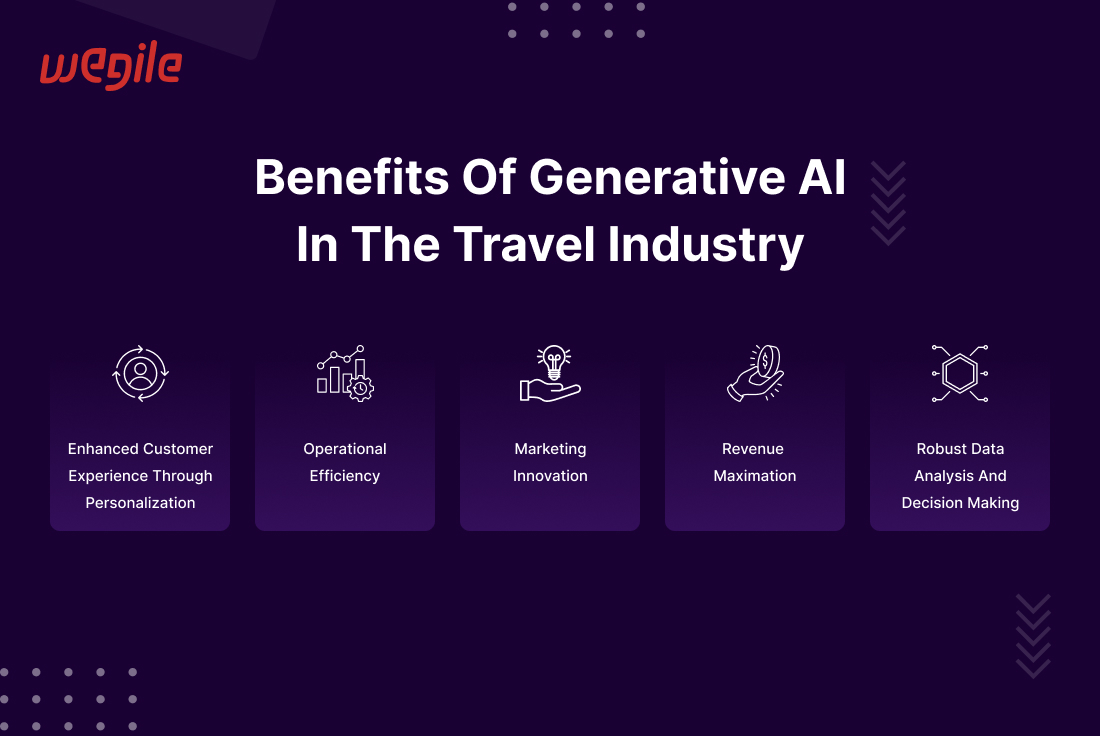
Enhanced Customer Experience Through
PersonalizationGenerative AI excels in creating highly personalized travel experiences by analyzing vast
amounts of data to understand each customer’s unique preferences and behaviors. It allows
travel companies to offer tailor-made recommendations, such as customized travel itineraries
and targeted promotions. It eventually enhances customer satisfaction and engagement. -
Operational
EfficiencyBy automating routine tasks such as data entry, customer inquiries, and booking processes,
generative AI significantly reduces the workload on human staff. This streamlining of
operations cuts costs and speeds up response times, allowing staff to focus on more
strategic and customer-centric activities. -
Marketing
InnovationGenerative AI’s ability to analyze customer data and predict trends enables travel companies
to design highly effective marketing campaigns. By understanding customer preferences and
behavior, AI can help tailor marketing messages more likely to resonate with potential
travelers. It ultimately leads to better engagement and conversion rates. -
Revenue
MaximizationGenerative AI improves revenue management by dynamically pricing services based on demand,
competition, and other market variables. During peak times, it can optimize pricing to
ensure maximum profitability, while during slower periods, it can attract more bookings with
strategic discounts. -
Robust
Data Analysis and Decision Making
With its advanced predictive analytics capabilities, generative AI allows travel businesses
to make informed decisions. It provides insights into market trends, customer satisfaction,
and future booking patterns. This deep understanding helps companies optimize their
offerings and stay ahead in a competitive market.
Top 7
Generative AI Applications in Travel
Generative AI has a myriad of use
cases in various
spheres. Here are its top-notch uses in travel sector:
-
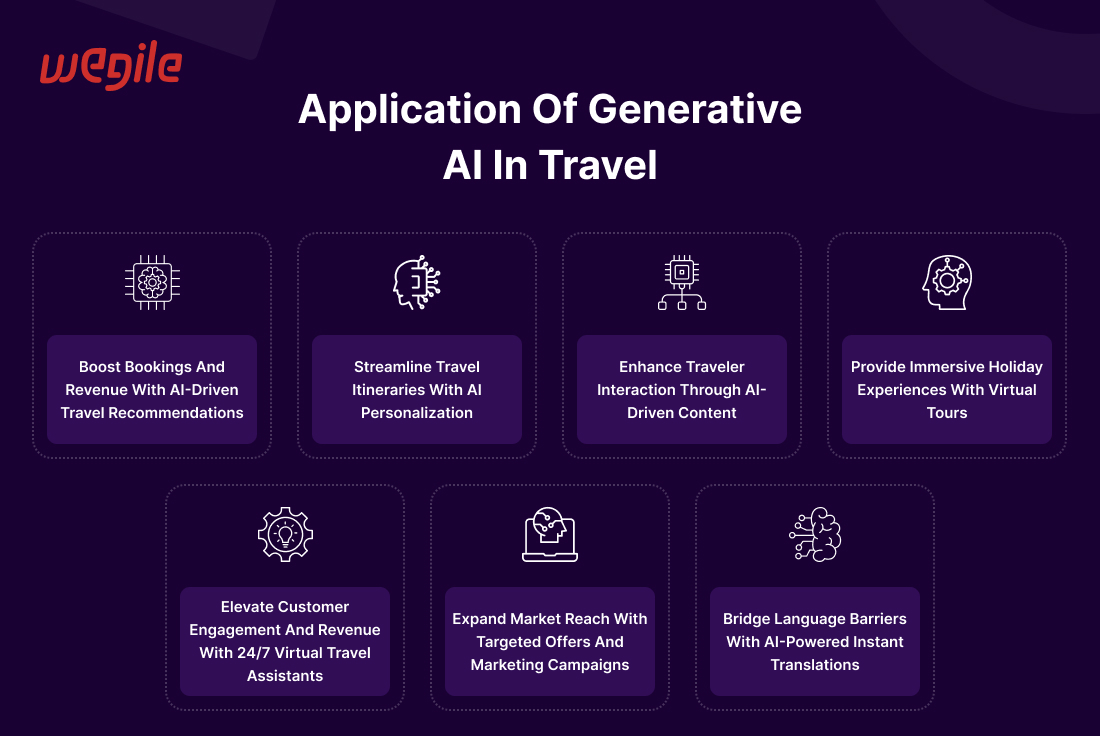
1. Boost Bookings and Revenue with
AI-Driven Travel RecommendationsGenerative AI is transforming how travel companies engage with customers, enhancing both the
booking process and revenue generation. These systems utilize machine learning algorithms to
sift through vast amounts of data. This includes past bookings, customer preferences, and
social media interactions. The goal is to provide hyper-personalized travel suggestions.
Such targeted suggestions increase booking likelihood and improve the customer experience by
offering travel options that closely match individual preferences.For example, AI can identify a customer’s preference for eco-friendly accommodations and
recommend destinations known for sustainable tourism. This precise personalization meets
customer needs and boosts conversion rates. Travelers are more likely to book trips that
perfectly match their interests. -
2. Streamline Travel Itineraries with AI
PersonalizationThe traditional one-size-fits-all approach to travel planning is being replaced by
AI-powered
personalized itineraries that cater to each traveler’s unique tastes and preferences. AI
systems consider various factors such as preferred travel dates, budget constraints, and
specific interests to craft detailed, custom itineraries. This might involve selecting the
best flights, accommodations, and local experiences that align with the traveler’s
expectations. For example, for a culinary enthusiast, AI might include a mix of top-rated
restaurants and hidden local food gems in their travel plan, ensuring an enriching
gastronomic journey. This level of personalization not only enhances the travel experience
but simplifies the planning process, making it more efficient and enjoyable for the
customer. -
3. Enhance Traveler Interaction Through
AI-Driven ContentGenerative AI significantly enhances how travel companies create and manage content, leading
to deeper and more meaningful interactions with travelers. By utilizing AI to generate
dynamic and engaging content, companies can effectively communicate with their audience,
providing valuable and relevant information that enhances their travel experience. For
example, AI-driven platforms can produce vivid descriptions, engaging articles, and
compelling reviews that inform travelers and inspire them to explore new destinations. AI
can personalize content based on individual preferences, dramatically improving the
information’s relevance and impact. For instance, a traveler interested in culinary
experiences could receive customized content highlighting the best food tours, local
cuisine, and must-visit restaurants tailored to their tastes. -
4. Provide Immersive Holiday Experiences
with Virtual ToursGenerative AI is also transforming how travelers explore potential destinations through
virtual tours. These AI-enhanced virtual experiences allow travelers to virtually visit
destinations from their homes, offering a 360-degree view and detailed insights into
attractions, which can significantly influence their booking decisions. For instance,
AI-powered virtual tours can simulate walking tours through historic districts or panoramic
views of scenic landscapes, providing a taste of what travelers can expect to experience.
Such technologies help boost travelers’ confidence in their destination choices and enhance
their excitement and anticipation for the trip. The immersive quality of virtual tours
ensures that potential travelers get a detailed preview, which helps build a connection with
the destination before they even arrive. This is particularly effective in today’s digital
age, where consumers appreciate and expect engaging and interactive content. -
5. Elevate Customer Engagement and
Revenue
with 24/7 Virtual Travel AssistantsVirtual travel assistants powered by generative AI are revolutionizing the travel industry.
They provide 24/7 customer service, enhance user engagement, and significantly boost sales.
These AI-driven chatbots manage various tasks, from booking flights and accommodations to
offering personalized travel advice round the clock. This meets the modern traveler’s demand
for instant service and captures potential bookings that might otherwise be missed during
off-hours.The integration of chatbots in travel services enables seamless interaction. Every customer
query becomes an opportunity for upselling and personalized engagement. For instance, if a
customer enquires about a flight to a tropical destination, the AI can suggest additional
services. These might include sea-view room upgrades, adventure tours, or travel insurance,
thus increasing the average booking value. Automating these interactions ensures that each
customer feels cared for, enhancing their overall experience and loyalty. This is crucial
for securing repeat business and fostering long-term revenue growth. -
6. Expand Market Reach with Targeted
Offers and Marketing CampaignsAI’s ability to analyze vast amounts of data enables travel companies to implement highly
targeted marketing campaigns. By understanding individual customer preferences and behavior,
AI can help craft more appealing personalized offers and promotions. This improves the
effectiveness of marketing efforts and helps build a more personal connection with
customers. For example, generative AI can predict when customers are most likely to book
specific trips and suggest special promotions or discounts at the right time. Whether it’s a
last-minute deal on a dream resort or a discount on a popular city tour, AI-driven campaigns
ensure that offers are timely and relevant to the individual’s interests. This strategic
approach enhances customer satisfaction and significantly boosts conversion rates. It
eventually increases the customer base and overall sales. -
7. Bridge Language Barriers with
AI-Powered Instant TranslationsAI-powered language translation is transforming the travel industry. It enables real-time,
cross-cultural communication and enhances the travel experience for global tourists. The
technology’s ability to instantly translate languages empowers travelers by breaking down
linguistic barriers. These barriers have historically hindered full engagement with diverse
cultures and geographies.Advancements in AI technologies, like Google’s Neural Machine Translation and other deep
learning models, have dramatically improved translation speed and accuracy. These tools can
translate various forms of content, including spoken and written text, in real-time. For
instance, Google Translate and similar apps can now support conversations in multiple
languages. They provide translations through text and spoken outputs. This is particularly
useful in everyday situations travelers face. Examples include reading menus, asking for
directions, or making purchases in foreign countries. Overcoming language barriers with AI
enhances personal experiences. It also boosts operational efficiency in the travel and
hospitality sectors.
What Are AI Travel Assistants and How Are They
Revolutionizing Travel?
AI travel assistants are cutting-edge applications designed to enhance the travel experience by
providing automated, personalized services. These digital tools employ artificial intelligence to
handle tasks that traditionally required human intervention, such as booking flights, suggesting
accommodations, and creating itineraries. The rise of AI-driven applications has been facilitated by
machine learning and natural language processing advancements. It allows these systems to understand
and anticipate user needs effectively.
What Can AI Travel Assistants Do?
AI travel assistants offer a wide array of functionalities that streamline the travel planning
process:
-
Itinerary Planning: Tools like Junea and Abhi automate the creation of
detailed
travel itineraries based on user input. It adjusts plans according to preferences and any
changes in travel conditions. -
Language Translation: These assistants can translate signs, menus, and
other
written or verbal communications. -
Local Recommendations: Based on a traveler’s location and preferences, AI
travel assistants suggest local dining, entertainment, and sightseeing options, often
uncovering
hidden gems. -
Booking and Reservation Services: Integrated booking systems allow
travelers to
book flights, hotels, and activities directly through the AI platform, often at competitive
prices. -
Real-Time Updates and Alerts: Travelers receive up-to-the-minute updates on
flight schedules, weather conditions, and even local events. It ensures they can make
informed
decisions on the go.
How
Are Leading Travel Companies Utilizing Generative
AI?
Leading travel companies like Expedia, eDreams, and Kayak are at the forefront of integrating
generative AI into their services. These companies use AI to enhance user interactions, making them
more conversational and personalized using historical travel data and current search criteria. For
example, Expedia has integrated ChatGPT into its app to help users plan trips by providing
recommendations and saving options directly within the app.
Expedia and Kayak have significantly advanced by incorporating AI to assist users in planning and
organizing travel details more efficiently. It includes automated suggestions for hotels and
activities based on user preferences. It enhances the overall planning experience. eDreams has
partnered with Google to use its generative AI technology to enhance productivity and customer
engagement. These companies continually experiment with new AI capabilities to improve their service
offerings. It helps them make travel planning more integrated and user-friendly.
Challenges and
Considerations of Generative AI in the Travel Industry
-
Data Privacy and Security: One of the primary concerns with deploying
generative AI in the travel industry is data privacy and security. Since generative AI
systems
require vast amounts of data to function effectively, there is a risk of mishandling or
exposing
sensitive personal information to cyber threats. Ensuring that data is collected, used, and
stored securely while complying with global data protection regulations is crucial for
maintaining customer trust and legal compliance. -
Ethical Considerations: The use of generative AI also raises significant
ethical questions. For example, there are concerns about bias in AI algorithms, which can
lead
to unfair treatment of particular groups of people. Plus, as AI systems take on tasks
traditionally performed by humans, there is the potential for job displacement, raising
ethical
considerations about the impact on employment within the travel industry. -
Integration with Existing Systems: Integrating generative AI with existing
systems presents several technical and organizational challenges. Compatibility issues June
arise, as older systems June not be equipped to communicate effectively with advanced AI
technologies. Moreover, integrating AI requires substantial investment in updating and
adapting
current IT infrastructures. The complexity of existing systems can make the integration
process
lengthy and costly, potentially disrupting ongoing operations.
Future Trends: How Will Generative
AI Continue to Evolve in the Travel Industry?
Generative AI is expected to keep transforming the travel industry by enhancing personalization and
streamlining operations. As AI technology becomes more sophisticated, it is likely to be integrated
more deeply into travel planning platforms. This will offer more intuitive and interactive
experiences. AI’s capability to generate dynamic content and personalized recommendations will
advance further, improving the accuracy and relevance of the information provided to travelers.
Emerging Technologies and Their Impact
Emerging technologies like virtual reality (VR) and augmented reality (AR) are poised to collaborate
with generative AI. This collaboration aims to create more immersive travel planning experiences.
For example, travelers could virtually explore destinations before booking or use AR to enrich their
travel experience. Additionally, integrating AI with blockchain technology could enhance the
security and transparency of travel transactions and customer data management.
The future of generative AI in the travel industry appears promising. It has the potential to
greatly
improve both the efficiency of travel-related services and the personalization of customer
experiences. As these technologies develop, they are expected to establish new standards for
designing, marketing, and delivering travel products.
Wrapping Up
We’ve explored some fascinating insights into the incredible power of generative AI within the
travel
industry. The potential is vast, from enhancing personalized travel experiences and improving
operational efficiency to pioneering marketing innovations and navigating the challenges of data
privacy, ethical use, and system integration. The industry stands at the cusp of a new era where AI
optimizes the present and redefines the future of travel.
To all travel industry leaders and innovators, this is your moment to embrace generative AI. It’s
not
just about keeping up with trends; it’s about being a trendsetter in a digitally evolving world. By
adopting AI, you’re stepping into a realm of sustainable growth and boundless innovation, ensuring
that every journey your customers embark on is nothing short of extraordinary. Let’s harness AI’s
power to meet and exceed the expectations of the modern traveler, ensuring a prosperous and dynamic
future for the travel industry.
As we venture further into the digital era, the transformative potential of generative AI in the
travel industry is undeniable. Now is the time for travel leaders and innovators to step forward and
harness the power of AI to redefine the future of travel.
Choose Wegile, a premier Generative
AI App
Development Company, as your trusted partner in this journey. At Wegile, we specialize in
crafting bespoke AI solutions that not only meet the unique needs of the travel industry but also
set new standards in innovation and efficiency. Don’t just keep pace with technology- lead the way
with Wegile. Connect with us today to revolutionize your travel offerings and create unforgettable
experiences for your customers.
Leave a Reply