The scope of generative AI development today is rapidly expanding due to its transformative
benefits.
The market size of the generative AI sector is projected to reach an impressive US$36.06 billion in
2024. This market is expected to exhibit a significant annual growth rate (CAGR 2024-2030) of
46.47%,
resulting in a staggering market volume of US$356.10 billion by 2030. This substantial growth shows
how businesses across various industries are increasingly turning their focus towards the adoption
of generative AI technologies. For businesses to take advantage of generative AI, it is crucial to
build solutions that are tailored to meet specific business needs. However, it involves a
comprehensive understanding of both the technical and practical aspects to leverage generative AI’s
full capabilities for a competitive edge. In this blog, we will learn how to build generative AI
apps.
Scope of
Generative AI Development
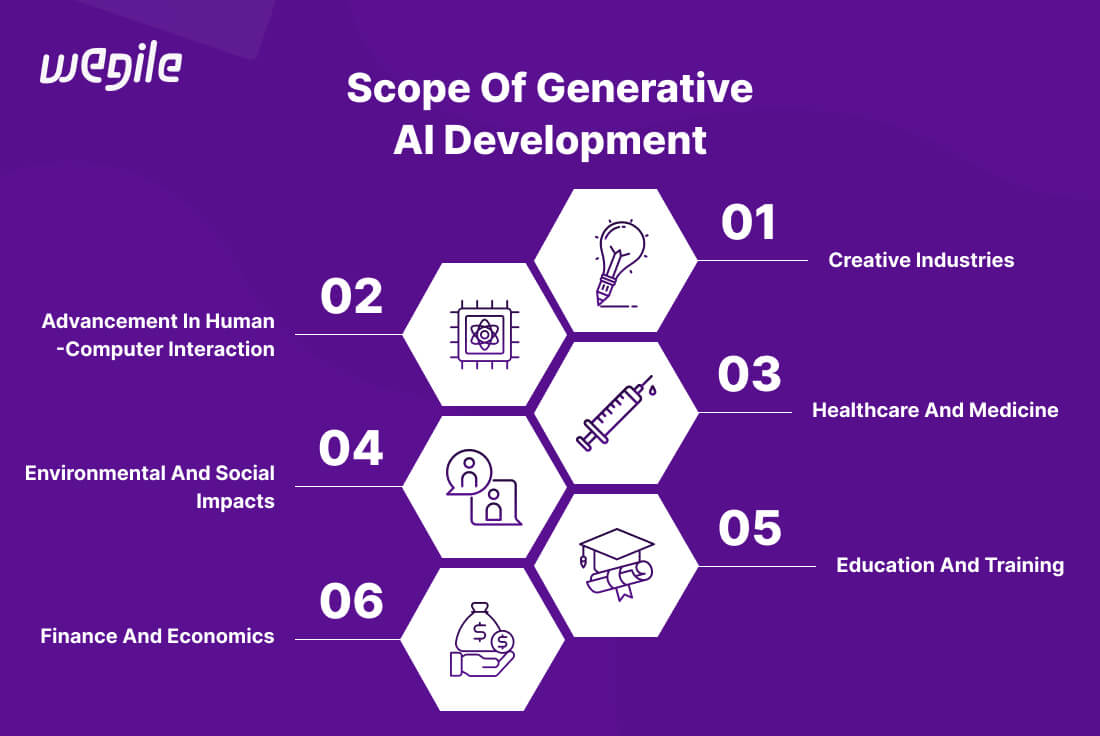
First, before understanding the intricacies of how to build generative AI apps, it’s important to
understand the scope of generative AI development. This field is vast and continually expanding,
driven by advancements in machine learning, increasing computational power, and the growing
availability of data. Let’s understand how technological transformation is reshaping industries and
creating new possibilities.
-
1. Creative
IndustriesGenerative AI is revolutionizing the creative industries by enabling the production of fresh
content with minimal human intervention. This technology is being harnessed to generate art,
music, and even entire virtual worlds.-
Art and Design: Artists and designers use generative AI to create
unique artworks and designs. AI algorithms can generate patterns, textures, and even
entire compositions that push the boundaries of traditional art forms. This fusion
of human creativity and AI capabilities leads to innovative and unexpected artistic
expressions. -
Music Composition: In the music industry, AI models are composing
original pieces, blending different genres, and even creating music tailored to
specific moods or events. These AI-generated compositions can serve as an
inspiration for musicians or be used directly in various media applications. -
Content Creation: Generative AI is also making significant progress
in content creation, generating articles, stories, and scripts. These AI-generated
texts can be used to draft initial versions of written content, save time for
writers, and provide new ideas and perspectives.
-
-
2.
Healthcare and MedicineThe healthcare industry is leveraging generative AI to improve patient outcomes, streamline
medical research, and enhance diagnostic processes.-
Drug Discovery: AI models are being used to generate new molecular
structures, accelerating the drug discovery process. By simulating how different
compounds interact with biological targets, generative AI can identify promising
drug candidates more quickly and cost-effectively. -
Medical Imaging: In medical imaging, generative AI algorithms
enhance image resolution, fill in missing data, and even generate synthetic images
for training diagnostic models. This improves the accuracy and efficiency of medical
diagnoses and treatments.
-
-
3. Education
and TrainingGenerative AI is reshaping the education sector by creating customized learning experiences
and developing advanced training tools.-
Personalized Learning: AI models can generate personalized
educational content based on individual learning styles and progress. This ensures
that each student receives tailored instruction that addresses their specific needs
and paces. -
Virtual Tutors: Generative AI powers virtual tutors that can
provide
real-time assistance, generate practice problems, and offer explanations in multiple
languages. These tutors enhance the learning experience by making education more
accessible and interactive. -
Simulation-Based Training: In fields like medicine, aviation, and
engineering, generative AI can create realistic simulation environments for training
purposes. These simulations allow trainees to practice complex procedures and
scenarios in a safe, controlled setting.
-
-
4. Finance
and EconomicsThe role of generative AI
in financial services is huge. It is transforming how data is analyzed, predictions
are made, and decisions are executed.-
Algorithmic Trading: AI-driven trading algorithms generate
strategies based on vast amounts of financial data, identifying patterns and trends
that may be invisible to human traders. These algorithms are capable of executing
trades with unparalleled speed and efficiency, surpassing what humans can achieve. -
Risk Management: Generative AI models simulate various financial
scenarios to predict and manage risks. This helps financial institutions prepare for
potential market changes and develop strategies to mitigate adverse outcomes. -
Fraud Detection: By generating synthetic data that mimics
fraudulent
activity, AI models can train on more comprehensive datasets, improving the accuracy
of fraud detection systems.
-
-
5.
Environmental and Social ImpactGenerative AI is being used to address some of the most crucial environmental and social
challenges.-
Climate Modeling: AI models can generate detailed climate
predictions, helping scientists understand the potential impacts of climate change
and develop strategies to mitigate its effects. These models consider a wide range
of variables and scenarios, providing more accurate and actionable insights. -
Sustainable Design: Generative AI plays a crucial role in
architecture and urban planning, enabling the creation of sustainable buildings and
cities that prioritize energy efficiency, resource utilization, and minimizing
environmental impact. These AI-generated designs can lead to more sustainable and
livable environments. -
Social Good: Generative AI is used in various social good
initiatives, such as generating synthetic
data to
improve privacy while enabling research, creating educational content for
underserved communities, and developing tools for humanitarian aid and disaster
response.
-
-
6.
Advancements in Human-Computer InteractionGenerative AI is at the forefront of enhancing human-computer
interaction (HCI), making technology more intuitive and responsive to human needs.-
Natural Language Processing (NLP): AI models generate human-like
text and speech, improving the capabilities of chatbots, virtual assistants, and
language translation services. This leads to more natural and effective
communication between humans and machines. -
Augmented and Virtual Reality (AR/VR): Generative AI creates
immersive virtual environments and augmented reality experiences. These technologies
are used in gaming, training, and remote collaboration, enhancing how people
interact with digital content. -
User Interface Design: AI generates adaptive user interfaces that
adjust to user preferences and behaviors. This personalization improves user
experience by making software applications more intuitive and user-friendly.
The scope of generative AI development is continually expanding, offering innovative
solutions across various industries. Now that we have thoroughly examined the broad nature
of generative AI development, let’s look into how to build generative AI apps. -
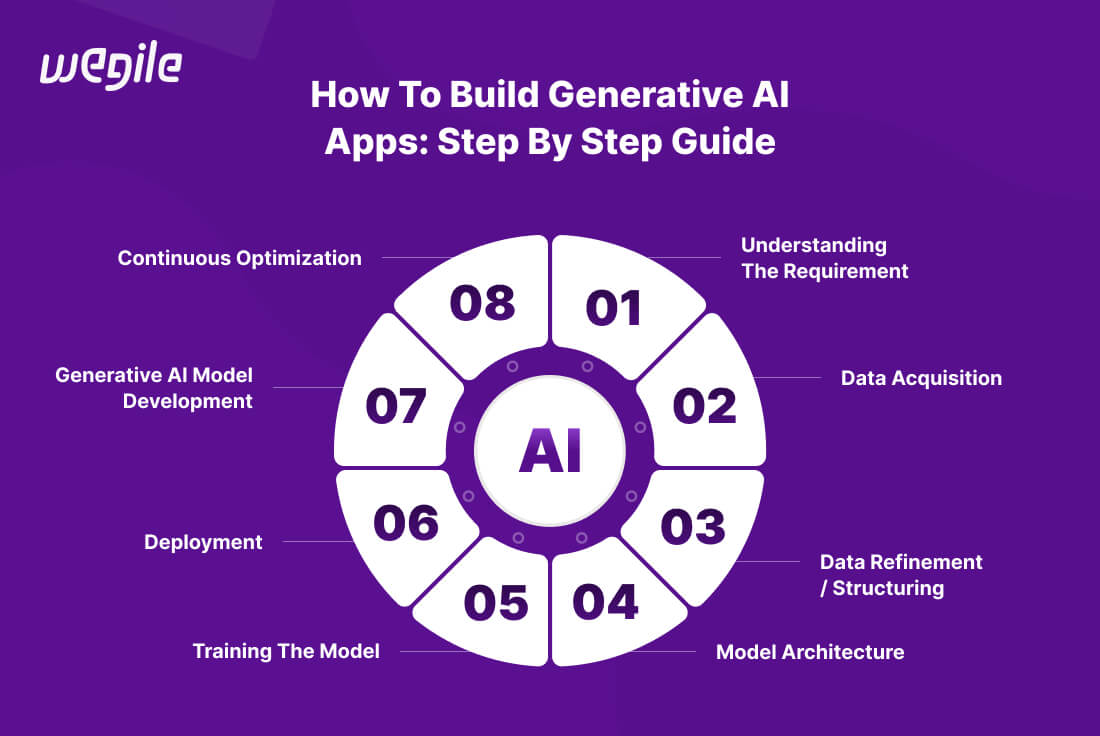
How to
Build Generative AI Apps: Step By Step Guide
-
#Step 1: How to Build Generative AI
Apps: Understanding the RequirementUnderstanding the requirement is the foundational step in the generative AI development
process. This involves several critical activities to ensure the project’s alignment with
the goals and needs of stakeholders.-
Defining the Problem: The first task is to clearly define the
problem that the generative AI application aims to solve. This involves engaging in
detailed discussions with stakeholders to understand their pain points and the
specific outcomes they are looking to achieve. A well-defined problem statement
guides the entire development process, ensuring the solution is focused and
effective. -
Use Case Selection: Identifying the appropriate use case for
generative AI is crucial. Generative AI can be applied in various domains,
such as image generation, code generation, predictive analysis, content creation,
virtual assistants, synthetic data generation, and more. Depending on the specific
needs and objectives, the use case is selected. This ensures that the development
efforts are directed towards creating a solution that provides maximum value. For
example, if the aim is to automate creative tasks, an image generation use case
might be selected, whereas predictive analysis could be the focus for improving
business decisions. -
Setting Goals and Outcomes: Establishing clear, measurable goals
and
expected outcomes is essential. These goals serve as benchmarks for success and help
in tracking progress throughout the development process. Goals might include
improving user engagement, increasing automation efficiency, or generating
high-quality creative content. Having well-defined outcomes ensures that the
development stays aligned with the desired results and provides tangible benefits to
the users.
-
-
Step 2: How to Build Generative AI Apps:
Data AcquisitionData acquisition is a pivotal step in developing a generative AI application. This phase
involves collecting and storing large volumes of data, which are fundamental for training AI
models.Data Collection
-
Source Identification: The process of data collection
begins
with
identifying various data sources relevant to the chosen use case. Data can
come
from
public datasets, proprietary databases, web scraping, social media feeds,
and
user-generated content. The quality and relevance of the data are critical
to
the
success of the AI model. A diverse dataset helps the model generalize better
across
different scenarios. -
Data Variety: Ensuring the data encompasses various
scenarios
and
variations is vital. This diversity enhances the model’s ability to perform
well
in
different contexts. For instance, if the use case is image generation, the
dataset
should include different images under different conditions and styles. -
Data Volume: Accumulating a sufficient volume of data is
crucial for
effective model training. More data typically leads to better performance,
provided
it is relevant and high-quality. Employing automated and manual data
collection
methods helps to amass comprehensive datasets that support robust model
training.
Data Storage
-
Scalability: Given the potentially vast amount of data, scalable
storage solutions are necessary. Cloud storage provides the flexibility to scale up
as the data volume increases, ensuring efficient data management and access. This
scalability is crucial for handling the extensive datasets required for training
generative AI models. -
Reliability: Reliable storage solutions ensure that the data is
always accessible and secure. High reliability and uptime are essential for
continuous development and model training processes. Robust data management
practices, including regular backups and redundancy, safeguard the data against loss
and ensure its integrity. -
Data Management: Effective data management is key to handling large
datasets efficiently. This involves organizing the data into structured formats,
implementing access controls, and monitoring data usage. Proper data management
ensures that the data is readily available for model training and other development
activities, enhancing the overall efficiency of the process.
-
-
Step 3: How to Build Generative AI Apps:
Data Refinement / StructuringOnce data is collected, the next critical phase in the generative AI development process
involves refining and structuring this data to make it usable for model training. This step
ensures that the data is clean, organized, and ready to deliver optimal results.Data Cleaning and Structuring
-
Data Cleaning: Raw data often comes with various issues,
such
as
noise, errors, and inconsistencies. The process begins with meticulous data
cleaning, where these issues are addressed to enhance data quality. This
includes
handling missing values, correcting erroneous entries, and removing
duplicates.
Ensuring that the data is accurate and reliable sets the foundation for
robust
AI
model performance. -
Data Structuring: After cleaning, the data often needs to
be
organized into a structured format. This involves transforming unstructured
data
into a format that is easily processed by AI models. For instance, text data
might
be tokenized for natural language processing tasks, numerical data might be
normalized, and categorical data might be labeled appropriately. Proper
structuring
streamlines the training process and significantly improves the efficiency
and
effectiveness of the model.
Through rigorous data refinement and structuring, the dataset is prepared to ensure it is
optimized for the next stages of AI development, ultimately leading to better model
accuracy and reliability. -
-
#Step 4: How to Build Generative AI
Apps: Model Architecture-
The architecture of the generative AI model is a critical component of the
development process, tailored to meet the specific needs of each project.
The
appropriate
Large Language Models (LLMs) will be selected according to the use
case.
For
example, if the objective is to generate recommendations, dedicated LLM
models
designed for recommendation tasks will be chosen. Each use case, whether it
involves
text generation, image generation, predictive analysis, or other
applications,
demands a specific model that excels in the given area. -
After that, initial queries are run on both the clean data and the specific
ML
file
to generate preliminary output files. This is a crucial step to verify that
the
model and data are correctly aligned and that the setup is functioning as
expected.
The output from these initial queries provides valuable insights into any
potential
issues or adjustments that might be necessary.
This process is certainly not a one-time activity but rather a continuous and ongoing
one. The initial results are analyzed and used to fine-tune the model. Queries are run
multiple times, each iteration helping to refine the output further. This repetitive
querying and refining process is essential to achieve optimal performance and
high-quality results. By continuously iterating, the model learns and adapts, ensuring
that the final outputs meet the desired standards and expectations. -
-
#Step 5: How to Build Generative AI
Apps: Training the ModelTraining the model is a pivotal phase in the generative AI development process, where the
selected AI model learns from the refined data to perform the desired tasks accurately. This
stage involves multiple iterations to ensure the model’s effectiveness and precision.Training the AI model begins by feeding it the cleaned and structured data. The model
processes this data to identify patterns, relationships, and features that are essential for
generating accurate outputs. This initial training phase involves running numerous
iterations where the model adjusts its parameters based on the data it encounters. The goal
is to minimize errors and improve the model’s generalization
ability from the training data to new, unseen data.However, simply running queries and processing data is not enough for the model to achieve
high accuracy. Rigorous training is required, which involves fine-tuning the model’s
parameters and structure. This fine-tuning process is crucial for enhancing the model’s
performance and ensuring it meets the specific requirements of the use case. It often
requires running large-scale queries multiple times, each time making slight adjustments to
the model to improve its output.During this phase, the model’s performance is continuously monitored and evaluated using a
validation
dataset. This separate set of data, which is not used in training, helps assess how
well the model generalizes to new data. The evaluation metrics guide the adjustments needed
in the model’s parameters and architecture. By iterating through this training and
evaluation cycle, the model gradually improves, becoming more accurate and reliable.Fine-tuning continues until the model’s output matches the desired outcomes. This iterative
process ensures that the AI model, apart from being functional, is optimized for
performance, providing high-quality results that align with the project’s goals. -
#Step 6: How to Build Generative AI
Apps: DeploymentOnce the model is thoroughly trained and fine-tuned, the next step is deployment. Deploying
the AI model involves setting it up in a production environment where it can be accessed and
utilized by end-users. This stage ensures the model is operational and can deliver its
intended functionality in real-world scenarios.The deployment process begins by finalizing the trained model and preparing it for
integration with the application’s backend. This involves configuring the model to handle
real-time data inputs and generate outputs accordingly. The model is then set up on a server
or cloud environment that supports scalability and reliability, ensuring it can handle
varying loads and user demands. -
#Step 7: How to Build Generative AI
Apps: Custom Generative AI Model DevelopmentAfter deploying the AI model, the next phase focuses on developing the generative AI model,
making it accessible and usable through an interactive interface. This involves creating
both frontend and backend components to facilitate seamless user interactions with the AI
system.-
Frontend Development
The frontend development phase involves designing and building a user interface (UI)
that allows users to interact with the generative AI model. Depending on the project
requirements, this could be a web dashboard, a mobile app, or a desktop application.The frontend allows users to input their data or queries, which are then processed
by
the backend system that interacts with the deployed AI model. The UI should be
intuitive, user-friendly, and designed to meet the specific needs of the target
audience.For instance, if the AI model is designed to generate text or images, the frontend
interface collects the user’s input, sends it to the model via API calls, and
displays the generated output to the user.The frontend design should prioritize user-friendly functionality, allowing for
seamless data input, result viewing, and the option for additional queries. The UI
should offer precise guidance and prompt responses to assist users in comprehending
how to engage with the AI model efficiently. -
Backend Integration
In the backend, robust systems are developed to handle API calls to the AI model.
This involves setting up servers, databases, and other infrastructure components
that support the real-time processing of user queries.The backend system ensures that the user inputs are correctly formatted and sent to
the AI model, and the generated outputs are returned to the front end for display.At the backend, API calls are made to the AI model to retrieve responses based on
the
user inputs. These APIs facilitate seamless communication between the frontend
interface and the AI model, ensuring that the interaction is smooth and efficient.For example, if the AI model generates images, the backend will process the user’s
input, send it to the AI model, retrieve the generated image, and send it back to
the frontend for the user to view. This process needs to be optimized for speed and
reliability to provide a smooth user experience. -
API Development
APIs (Application Programming Interfaces) are developed to facilitate communication
between the front end and the AI model. These APIs handle requests and responses,
ensuring that data flows seamlessly between the user interface and the AI backend.
They also manage authentication, authorization, and other security measures to
protect user data and ensure secure interactions with the AI model.By combining a well-designed frontend with a robust backend and efficient APIs, the
generative AI model becomes fully operational and accessible to users. This
development phase ensures that the AI system is fully efficient yet also intuitive,
providing an engaging and effective experience for end-users.
-
-
#Step 8: How to Build Generative AI
Apps: Continuous OptimizationThe process of generative AI app development does not end here! Continuous optimization is
essential to ensure that the generative AI solution remains relevant and performs optimally
over time. This involves regularly updating the model, refining its outputs, and adapting to
new data and user requirements.-
Monitoring and Maintenance
Continuous monitoring of the AI model’s performance is crucial. This involves
tracking key metrics such as accuracy, response time, and user satisfaction. Regular
maintenance checks help identify any issues or areas for improvement, ensuring the
model remains reliable and effective.For example, if the AI model’s performance degrades due to new types of input data,
adjustments can be made to the model or the training data to restore its accuracy.
Automated monitoring tools can alert the development team to any significant changes
in performance, allowing for timely interventions. -
Model Updates
As new data becomes available, the AI model needs to be retrained to incorporate
this
data and improve its predictions and outputs. This continuous learning process
ensures that the model stays current with evolving trends and user behaviors.
Regular updates help the model adapt to new challenges and provide better results
over time. -
User Feedback Integration
User feedback is invaluable for continuous optimization. Collecting and analyzing
feedback from users helps identify pain points and areas for enhancement. This
feedback can be used to fine-tune the model, improve the user interface, and add new
features that enhance the overall user experience. -
Iterative Improvement
The optimization process is iterative, involving cycles of testing, feedback, and
refinement. Each iteration aims to enhance the model’s performance, reliability, and
user satisfaction. This approach ensures that the generative AI solution
continuously evolves to meet the changing needs of its users and the dynamic
landscape of AI technology.By implementing continuous optimization practices, the generative AI solution
remains
at the forefront of innovation, delivering consistent value and high-quality results
to its users. This commitment to ongoing improvement ensures long-term success and
relevance in the rapidly evolving field of AI technology.
-
Crucial Considerations While Building Generative AI
Apps
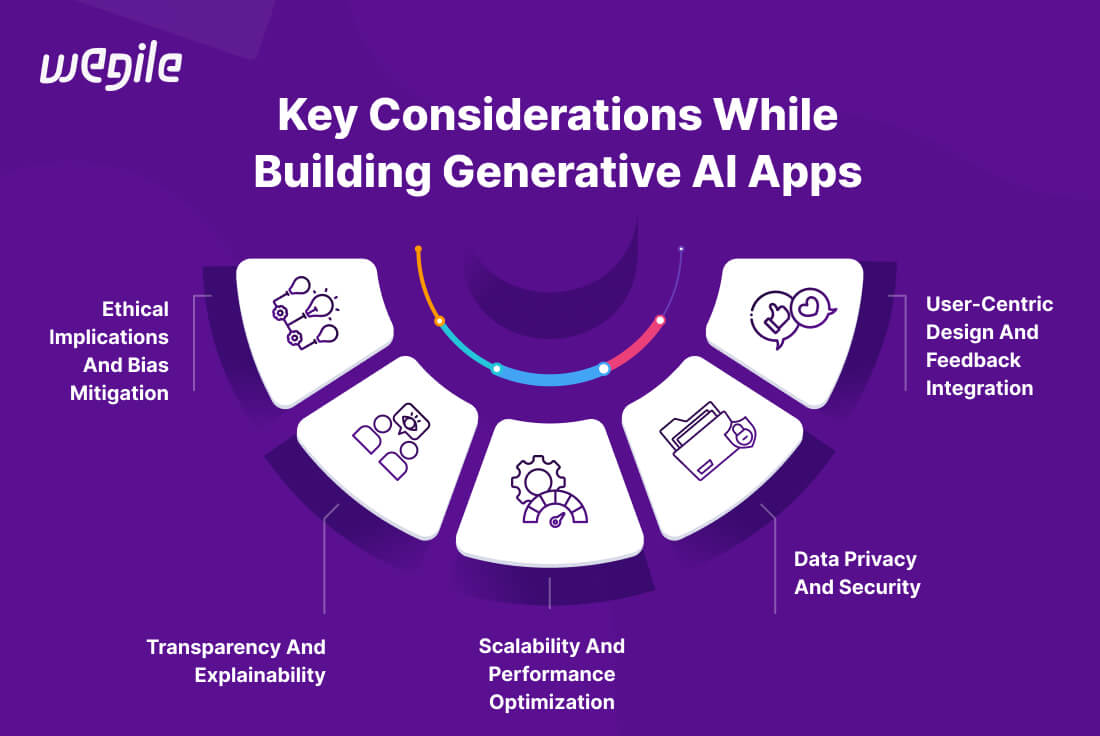
Building generative AI applications involves several critical considerations that go beyond the
typical technical aspects often discussed by many in the industry. These considerations ensure that
the final product is technically sound, ethically robust, user-friendly, and sustainable.
-
1.
Ethical Implications and Bias
MitigationOne of the foremost considerations is the ethical implications of deploying generative AI
applications. These systems can inadvertently learn and propagate biases present in the
training data, leading to unfair or discriminatory outcomes. It is important to implement
strategies to identify and mitigate these biases throughout the development process.Techniques to Mitigate Bias:
-
Diverse Training Data: It is crucial to ensure the training data
represents a wide range of conditions and individuals. This helps in reducing
inherent biases that may arise from imbalances in representation. -
Algorithmic Fairness: Using fairness-aware algorithms designed to
minimize bias is essential. Techniques such as reweighting
data, adjusting model parameters, or post-processing outputs can help achieve more
equitable results. -
Regular Audits: Conducting regular audits of the AI model to detect
and address biases is crucial. This includes automated checks and human oversight to
ensure fairness in the model’s predictions and outputs.
-
-
2.
Transparency and ExplainabilityGenerative AI models, particularly complex ones like LLMs, can often act as ”
black boxes,”
making it difficult to understand how they arrive at specific decisions or
outputs. Enhancing transparency and explainability is crucial for building trust with users
and stakeholders.Enhancing Explainability:
-
Model Interpretability Tools: It is crucial to prioritize the
implementation of tools and techniques that enhance the interpretability of AI
models. Examples include SHAP (SHapley Additive exPlanations) and LIME (Local
Interpretable Model-agnostic Explanations), which help in understanding the
contribution of each input feature to the output. -
User-Friendly Explanations: Providing clear, concise explanations
of
how the AI model works and why it produces certain results is necessary. This is
especially important in user-facing applications where trust and transparency are
paramount. -
Documentation and Reporting: Maintaining comprehensive
documentation
detailing the model’s development, training data, and evaluation metrics is
essential. This documentation should be accessible to stakeholders to promote
transparency.
-
-
3.
Scalability and Performance
OptimizationGenerative AI applications often require significant computational resources, especially
during the training and deployment phases. Ensuring that these applications can scale
efficiently while maintaining high performance is a critical consideration.Strategies for Scalability:
-
Efficient Resource Management: Utilizing cloud-based solutions that
offer scalable resources on demand is beneficial. This allows for flexibility in
scaling up or down based on the computational needs at different stages of
development and deployment. -
Model Optimization Techniques: Implementing optimization techniques
such as model pruning, quantization, and distillation to reduce the model’s size and
computational requirements without compromising performance is important. -
Load Balancing: Deploying load balancing strategies to distribute
computational load evenly across multiple servers or nodes ensures consistent
performance even during peak usage periods.
-
-
4. Data
Privacy and SecurityProtecting user data and ensuring privacy is paramount when developing generative AI
applications. These applications often process large volumes of sensitive data, making
robust data privacy and security measures essential.Ensuring Data Privacy:
-
Data Anonymization: Implementing techniques to anonymize user data
before using it for training is crucial. This involves removing personally identifiable information
(PII) and ensuring that individual users cannot be re-identified from the data. -
Secure Data Storage: Using encrypted storage solutions to protect
data at rest and in transit is important. Ensuring that access to sensitive data is
restricted and monitored helps prevent unauthorized access. -
Compliance with Regulations: Adhering to relevant data protection
regulations such as GDPR is essential. Regularly
reviewing and updating privacy policies to ensure compliance with the latest legal
requirements is necessary.
-
-
5.
User-Centric Design and Feedback
IntegrationA successful generative AI application is one that meets the needs and expectations of its
users. Incorporating user feedback and focusing on user-centric design principles is
essential for creating applications that are both effective and engaging.Implementing User-Centric Design:
-
User Research: Conducting thorough user research to understand the
needs, preferences, and pain points of the target audience is critical. This informs
the design and development process, ensuring the application meets user
expectations. -
Iterative Design Process: Adopting an iterative design process that
involves prototyping, user testing, and refinement is beneficial. Regularly
gathering user feedback and making necessary adjustments improves usability and user
experience. -
Personalization: Implementing personalization features that tailor
the application’s outputs to individual user preferences enhances user engagement
and satisfaction by providing more relevant and personalized results.
-
Wrapping Up
Building generative AI apps is a complex but rewarding endeavor that combines various aspects of
data
science, machine learning, and software development. From understanding the specific requirements to
continuous optimization, each step requires meticulous planning and execution. Opting for reliable
generative AI
development services is crucial to leverage the full potential of AI technologies. Such
partnerships provide access to specialized expertise and advanced resources to accelerate
development and enhance the final product’s quality. Get in touch with Wegile and unleash the
transformative power of generative AI for your business. Let us help you innovate, optimize, and
achieve unparalleled success in your AI journey!
FAQs
-
What programming language is used in generative AI?
Python is popular among various
programming languages, apart from R, Julia, and many
others. Libraries such as TensorFlow, PyTorch, and Keras are frequently utilized to
build and train generative models. -
What are generative AI applications?
Use cases for generative AI span across
various domains such as art generation,
image synthesis, text generation, data augmentation, drug discovery, product design,
recommendation systems, and many more. -
How to develop a generative AI app?
Step 1: Understanding the Requirement
Step 2: Data Acquisition
Step 3: Data Refinement / Structuring
Step 4: Model Architecture
Step 5: Training the Model
Step 6: Deployment
Step 7: Generative AI Model Development
Step 8: Continuous Optimization
-
How do I build my own AI app?
Partnering with a tech firm like Wegile
can be a better option than building a
Generative AI app on your own. Building an app by yourself requires a lot of
technical consideration and expertise in Generative AI, which can be less practical.
Moreover, considering us will allow you to leverage our expertise and resources,
which can save you time and effort while ensuring a high-quality Generative AI app. -
How is generative AI built?
Generative AI is built using various
techniques and technologies, primarily relying
on machine learning algorithms. It follows a step-by-step process of understanding
the requirement, acquiring data, refining/structuring the data, designing the model
architecture, training the model, deploying it, developing the Generative AI model,
and continuously optimizing it.
Leave a Reply