In today’s digital age, AI tools have become increasingly prominent, revolutionizing various sectors
and transforming business operations. Among the broad spectrum of AI solutions available, generative
AI stands out for its ability to create, innovate, and optimize processes across multiple
industries. Generative AI has benefited businesses in numerous ways, from enhancing creative media
and entertainment processes to streamlining complex healthcare and finance procedures. The future of
generative AI is promising, and for businessmen and entrepreneurs aiming to scale their ventures,
adopting this revolutionary technology is becoming imperative. While generative AI is gaining
popularity, many still need to be made aware of its diverse applications and potential impacts. So,
how generative AI can be used in the real world, if this question is on your mind, stay tuned! In
this blog, we will understand how generative AI can be used in the real world.
Real-Life Application of AI’s Subset: Is Generative
AI Really Worth It?
Generative AI is undoubtedly the talk of the technological world due to its innovative capabilities
and transformative potential. But the question remains: is it truly impactful? To determine its true
worth, let’s dive into some compelling stats and figures that highlight the current and future
landscape of generative AI:
-
The market size for generative AI is projected to reach approximately $36.06
billion by 2024, reflecting its growing adoption and importance across industries. -
Chatbots, one of the popular applications of generative AI, help businesses save an average
of
2 hours and 20 minutes
per
interaction. -
A 2023 survey of marketers in the United States revealed that 73%
of
respondents utilize generative AI tools, such as chatbots, within their company’s
operations. -
According to a report by Accenture,
AI technologies have the potential to boost labor productivity by over 40% by the year 2035. -
The market size for generative AI is anticipated to exhibit a compound annual growth
rate (CAGR)
of 46.47%
from 2024 to 2030, leading to a market volume of $356.10 billion by 2030. -
A survey conducted by Boston Consulting Group found that 71%
of
business leaders plan to increase their tech investments in 2024, up from 60% in 2023,
with an
even higher percentage (85%) planning to boost their spending on AI and generative AI
technologies. -
In a global comparison, the United States is expected to hold the largest market share,
with an
estimated size of $11.66
billion in 2024.
The statistics mentioned above underscore generative AI’s significant and growing impact on various
sectors. Given the projected market growth and widespread adoption, it’s clear that generative AI is
more than just a technological fad. As we continue to explore real-world applications of AI’s
subset, the evidence strongly suggests that generative AI holds immense value and potential for the
future.
How Generative AI Can Be Used in the Real World?
After discussing the growing popularity and potential of generative AI, it’s time to address the
crucial question: how generative AI can be used in the real world? Generative AI is more than just a
theoretical concept! The practical use
cases for generative
AI span across various industries, revolutionizing how businesses operate, innovate, and
compete. Below, we will explore how generative AI is being utilized in different sectors:
-
1. Media
and EntertainmentGenerative AI is making notable progress in the media and entertainment industry,
transforming content creation, production, and distribution processes.-
Content Creation and Enhancement
Generative AI algorithms can create realistic images, videos, and even music. Tools
like DALL-E and
DeepArt leverage AI to generate
artwork and visual content for advertising, film production, and digital media.
These tools enable creators to produce high-quality visuals at a fraction of the
time and cost traditionally required. -
Personalized Content
RecommendationsAI-driven recommendation systems, such as those used by Netflix and Spotify, utilize
generative AI to analyze user preferences and viewing habits. Generative AI systems
allow these platforms to generate personalized content suggestions, enhancing user
experience and engagement. By understanding patterns in user behavior, generative AI
can predict what content a user is likely to enjoy, thereby increasing satisfaction
and retention rates.
-
-
2. Healthcare
The healthcare industry is experiencing a transformation with the integration of generative
AI, which is being used to improve diagnostics, treatment planning, and patient care.-
Medical
Imaging and Diagnostics
Generative AI models, such as those developed by Google’s DeepMind, can analyze medical images with
exceptional accuracy. These AI systems assist radiologists by highlighting potential
areas of concern in X-rays, MRIs, and CT scans, leading to earlier detection of
diseases like cancer. The ability to generate and interpret complex medical images
aids in providing more accurate diagnoses and personalized treatment plans. -
Drug
Discovery and Development
Generative AI is revolutionizing the pharmaceutical industry by accelerating the
drug
discovery process. AI models can simulate molecular structures and predict their
interactions, significantly reducing the time and cost involved in developing new
medications. Companies like Insilico
Medicine use generative AI to identify potential drug candidates and
optimize chemical compounds, leading to faster and more efficient drug development
pipelines.Must
Read: How Can Generative AI Help In Application Development?
-
-
3. Finance
Generative AI is becoming a powerful tool in the financial services industry, enhancing
various aspects of financial operations and customer interactions.-
Fraud Detection and Risk
ManagementThe role of generative
AI in financial services is particularly impactful in fraud detection and
risk management. Advanced AI algorithms can analyze large volumes of transaction
data to identify unusual patterns and potential fraudulent activities in real time.
By generating synthetic
data, AI systems can simulate numerous scenarios, helping financial
institutions to understand risks better, and develop robust mitigation strategies. -
Algorithmic Trading and
Investment StrategiesGenerative AI is also transforming algorithmic trading by enabling the development
of
advanced trading algorithms that can predict market movements with higher accuracy.
AI-driven systems can generate multiple trading strategies based on historical data
and market trends, allowing traders to make informed decisions quickly. This
enhances the efficiency and profitability of trading activities, giving financial
institutions a competitive edge.
-
-
4.
Real Estate and Urban PlanningIn the real estate industry, generative AI has reshaped property development and urban
planning by optimizing various aspects.-
Smart City Planning
Generative AI is used to design and plan smart cities, focusing on sustainability,
efficiency, and livability. AI models can simulate different urban development
scenarios, considering factors such as traffic flow, energy consumption, and
environmental impact. This helps urban planners to create more efficient and
sustainable city layouts that improve the quality of life for residents. -
Property Valuation and Market
AnalysisGenerative AI assists in property valuation by analyzing vast amounts of data,
including market trends, property features, and location specifics. AI systems can
generate accurate property valuations and market forecasts, helping investors make
informed decisions. Additionally, AI-driven market analysis tools provide real
estate professionals with insights into market dynamics, enabling them to identify
opportunities and risks more effectively.
-
-
5.
Marketing and AdvertisingGenerative AI is revolutionizing the marketing and advertising industry by enabling highly
personalized and efficient campaigns that drive engagement and conversions.-
Personalized Content Generation
Generative AI algorithms can create tailored marketing content, including text,
images, and videos, based on individual user preferences and behaviors. This level
of personalization helps brands to connect with their audience more effectively,
increasing engagement rates and customer loyalty. AI-driven tools like
Copy.ai and
Jasper
are already helping marketers craft
compelling ad copy and social media content at scale. -
Enhanced Customer Insights
AI systems can analyze vast amounts of data from various sources, such as social
media, customer interactions, and purchase history, to generate deep insights into
customer behavior and preferences. These insights allow marketers to formulate
targeted campaigns that resonate with specific audiences they’re dealing with.
Additionally, AI can predict upcoming trends as well as future consumer needs,
allowing businesses to plan for changing demands and meet them.
-
-
6. Automotive
IndustryGenerative AI is driving significant advancements in the automotive industry, particularly
in
the areas of design, manufacturing, and navigation.-
Innovative Vehicle Design
Generative AI is transforming vehicle design by enabling the creation of innovative
and efficient designs that optimize performance and aesthetics. AI algorithms can
simulate and evaluate thousands of design variations, considering factors such as
aerodynamics, material strength, and fuel efficiency. This process accelerates the
development of new vehicle models and helps manufacturers stay competitive in a
rapidly evolving market. -
Intelligent Navigation Systems
Generative AI enhances navigation systems by providing real-time solutions for
complex driving scenarios. AI-driven navigation can adapt to dynamic road conditions
such as accidents, construction work, traffic congestion, and poor weather. These
systems generate optimal routes by continuously analyzing data from various sources,
ensuring drivers receive the safest and most efficient travel guidance. Companies
like Ford,
TomTom,
etc, are incorporating generative AI to improve the accuracy and reliability of
their navigation tools.
-
-
7. Retail
The retail industry is harnessing the power of generative AI to enhance customer
experiences,
streamline operations, and drive sales.-
Personalized Shopping
ExperiencesGenerative AI enables retailers to create highly personalized shopping experiences
by
analyzing customer data and predicting preferences. AI-driven recommendation engines
suggest products tailored to individual tastes, increasing customer satisfaction and
boosting sales. Retail giants like Amazon and Alibaba use generative AI to enhance
their recommendation systems, providing customers with a more engaging and
personalized shopping journey. -
Inventory Management and Demand
ForecastingGenerative AI is revolutionizing inventory management by predicting demand more
accurately and optimizing stock levels. AI algorithms analyze sales data, market
trends, and seasonal variations to forecast demand, helping retailers maintain
optimal inventory levels and reduce waste. This leads to improved efficiency and
cost savings. Companies like
Walmart
and Target
are leveraging AI-driven demand forecasting to streamline their supply chain
operations and meet customer demands more effectively.
-
-
8.
Manufacturing IndustryGenerative AI is transforming the manufacturing industry by optimizing production processes,
enhancing product design, and improving operational efficiency.-
Optimized Production Processes
Generative AI algorithms can analyze vast amounts of production data to identify
inefficiencies and suggest improvements. By simulating various production scenarios,
AI can optimize workflows, reduce waste, and increase overall efficiency. This leads
to cost savings and higher productivity. Companies like
Siemens
and General Electric are leveraging AI to streamline their manufacturing processes
and maintain a competitive edge. -
Enhanced Product Design
Generative AI is revolutionizing product design by enabling engineers to create
innovative and efficient designs that meet specific performance criteria. AI
algorithms can generate numerous design iterations, considering factors such as
material properties, load conditions, and manufacturing constraints. This
accelerates the design process and leads to the development of superior products.
Automotive and aerospace industries, for example, use generative AI to design
lightweight yet strong components, improving fuel efficiency and performance.
-
-
9. Educational
SectorGenerative AI is making significant strides in the educational sector by personalizing
learning experiences, automating administrative tasks, and providing innovative teaching
tools.-
Personalized Learning
ExperiencesGenerative AI enables educators to create personalized learning paths for students
based on their individual needs and learning styles. AI-driven platforms can analyze
student performance data to identify strengths and weaknesses, offering tailored
recommendations and resources. This personalized approach enhances student
engagement and improves learning outcomes. Tools like
Carnegie Learning and Knewton use generative AI to adapt educational content in real
time, providing a customized learning experience for each student. -
Automated Administrative Tasks
Generative AI can automate various administrative tasks like grading, scheduling,
and
student record management. AI-driven systems can evaluate student assignments and
provide instant feedback, saving educators time and ensuring consistent and
objective grading. Additionally, AI can optimize class schedules and manage student
records, allowing educational institutions to operate more efficiently. Universities
and schools are increasingly adopting AI-powered administrative tools to streamline
their operations and focus more on teaching and learning.
-
How Wegile
Can Help with Generative AI Solutions
Generative AI is transforming industries by introducing innovative solutions and enhancing
efficiency. For businesses looking to leverage this powerful technology, partnering with a company
that has extensive expertise in AI development is crucial. At Wegile, we offer comprehensive
generative AI solutions tailored to meet diverse industry needs. Here’s how we can help your
business harness the full potential of generative AI:
-
1.
Customized AI SolutionsWe specialize in developing customized generative AI solutions that cater to specific
business requirements. By understanding your unique challenges and goals, our team of
experts can design and implement AI systems that deliver optimal results.-
Tailored AI Solutions
Our AI specialists create bespoke AI solutions that address your specific needs.
Whether it’s improving product design, optimizing supply chain logistics, or
enhancing customer engagement, we ensure that our AI solutions are perfectly aligned
with your business objectives. -
Industry-Specific Applications
With extensive experience across various industries, we develop industry-specific
generative AI applications. From healthcare and finance to retail and manufacturing,
we provide AI-driven solutions that cater to the distinct demands of each sector.
-
-
2.
Integration and ImplementationImplementing generative AI solutions requires seamless integration with existing systems and
processes. We ensure a smooth transition by offering end-to-end support throughout the
integration process.-
System Integration
Our team ensures that the generative AI solutions integrate seamlessly with your
current IT infrastructure. We work closely with your IT department to ensure
compatibility and optimal performance, minimizing disruptions to your operations. -
Continuous Support and
MaintenanceWe provide ongoing support and maintenance to ensure that the AI solutions continue
to function optimally. This includes regular updates, troubleshooting, and
performance monitoring to address any issues that may arise.
-
-
3.
Enhancing Business OperationsGenerative AI can significantly enhance various aspects of business operations, and we are
equipped to help you realize these benefits.-
Process Automation
Our generative AI solutions can automate repetitive and time-consuming tasks,
freeing
up your workforce to focus on more strategic activities. This leads to increased
productivity and operational efficiency. -
Data-Driven Decision Making
By leveraging generative AI, we enable businesses to make informed decisions based
on
data-driven insights. AI algorithms can analyze vast amounts of data, identifying
patterns and trends that can inform strategic planning and decision-making.
-
-
4.
Innovation and Competitive EdgeAdopting generative AI can give your business a significant competitive advantage. We help
you stay ahead of the curve by driving innovation and enabling you to leverage the latest
advancements in AI technology.-
Continuous Improvement
We are committed to continuous improvement and innovation. Our team stays abreast of
the latest developments in generative AI to ensure that our cutting-edge solutions
provide maximum value to your business. -
Strategic Partnerships
We collaborate with leading AI research institutions and technology providers to
deliver the most advanced generative AI solutions. These strategic partnerships
ensure you have access to the latest AI technologies and innovations.
-
Wrapping Up
Generative AI is not just a technological advancement; it is a catalyst for innovation across
various
industries. From enhancing product design to optimizing business operations, the possibilities of
how generative AI can be used in the real world are vast and continually expanding. At Wegile, our
generative AI
development services are designed to help businesses harness this transformative power. By
providing customized AI solutions and seamless integration, we enable companies to optimize
processes, make data-driven decisions, and stay ahead of the curve. Partner with us to explore the
full potential of generative AI and drive your business forward!
FAQs
-
What programming language is used in generative AI?
Python is popular among various
programming languages, apart from R, Julia, and many
others. Libraries such as TensorFlow, PyTorch, and Keras are frequently utilized to
build and train generative models. -
What are generative AI applications?
Use cases for generative AI span across
various domains such as art generation,
image synthesis, text generation, data augmentation, drug discovery, product design,
recommendation systems, and many more. -
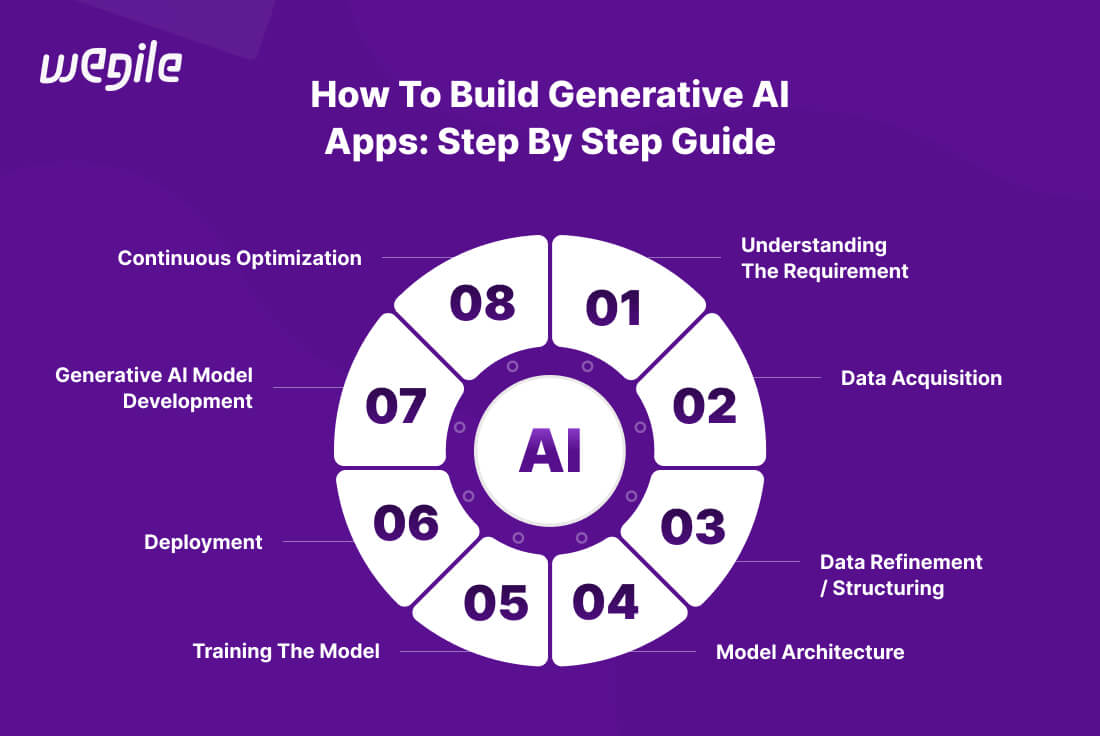
How to develop a generative AI app?
Step 1: Understanding the Requirement
Step 2: Data Acquisition
Step 3: Data Refinement / Structuring
Step 4: Model Architecture
Step 5: Training the Model
Step 6: Deployment
Step 7: Generative AI Model Development
Step 8: Continuous Optimization
-
How do I build my own AI app?
Partnering with a tech firm like Wegile
can be a better option than building a
Generative AI app on your own. Building an app by yourself requires a lot of
technical consideration and expertise in Generative AI, which can be less practical.
Moreover, considering us will allow you to leverage our expertise and resources,
which can save you time and effort while ensuring a high-quality Generative AI app. -
How is generative AI built?
Generative AI is built using various
techniques and technologies, primarily relying
on machine learning algorithms. It follows a step-by-step process of understanding
the requirement, acquiring data, refining/structuring the data, designing the model
architecture, training the model, deploying it, developing the Generative AI model,
and continuously optimizing it.
Leave a Reply