Have you ever wondered how artificial intelligence is revolutionizing industries around the globe?
From smart assistants to self-driving cars, AI is a key driver of digital transformation. It’s great
at many tasks, but how does it handle creative writing, forecasting, or decision-making? Welcome to
the world of generative AI.
What exactly is generative AI? It’s a sophisticated AI that doesn’t just analyze data, it creates
new
data and models. This technology is transforming everything from healthcare to entertainment. But
what about its impact on real estate?
In real estate, a sector long dependent on human insight, generative AI is starting to make its
mark.
Stay tuned as we dive into the exciting impact of generative AI in real estate. Ready to see what
the
future holds? Let’s begin!
What is Generative AI?
Generative AI goes beyond the traditional AI which analyzes and responds to the stored data it
creates. It does more than just interpret data, and it does not copy your content. Just like a
historian who decrypts ancient texts, or even an artist who paints new masterpieces!
The Technologies Behind the Curtain: Machine
Learning and Neural Networks
The root of generative AI lies in two pivotal technologies: machine learning and neural networks.
Machine learning provides the backbone, enabling the AI to absorb and learn from extensive data sets
without being explicitly programmed to look for specific things. It’s like learning through
experience rather than instruction.
Neural networks bring
an additional layer of sophistication. Designed to emulate the human brain’s complicated network of
neurons, these networks process information through layers of algorithms, learning and adapting from
each data interaction. This capability is enhanced through deep learning, a subset of machine
learning that deeply explores data, identifying patterns far beyond human capabilities.
With such advanced technologies at its core, generative AI holds the promise of revolutionizing
industries by not just enhancing existing processes but also by creating new ways to envision and
interact with the world. As we stand on the brink of this new era, one question remains: How will
our world transform when machines begin not just to ‘think,’ but to ‘create’?
Revolutionizing Real Estate with Generative AI
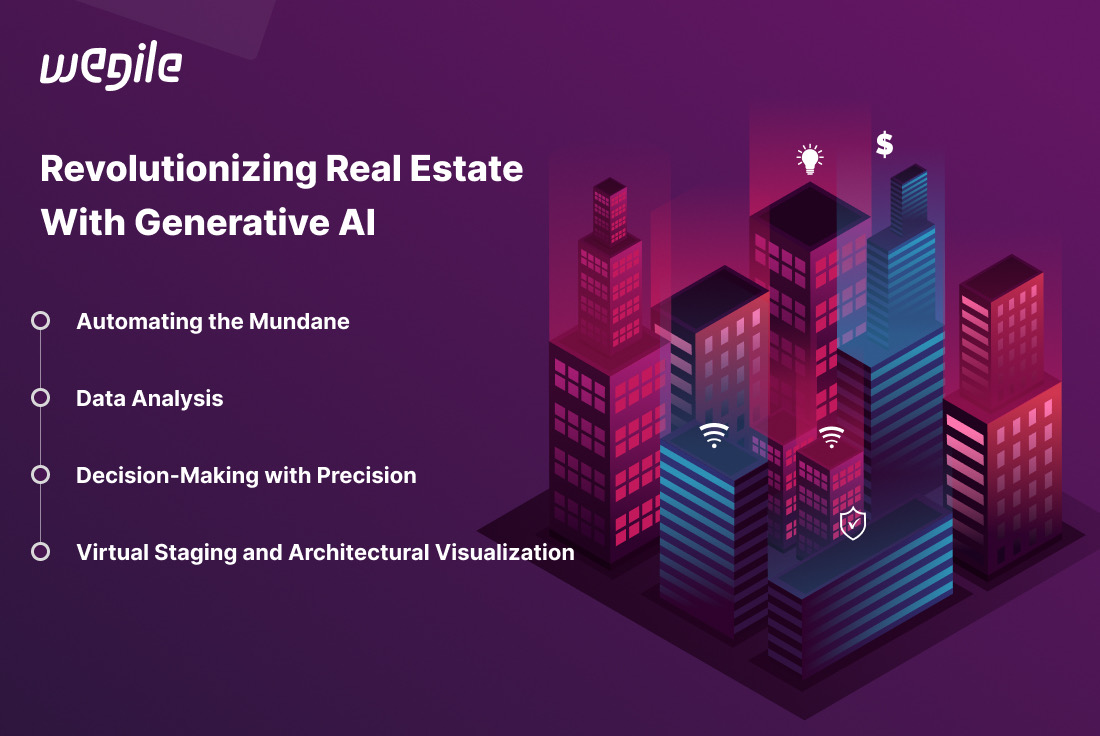
One of the most immediate impacts of generative AI in real estate is its ability to automate tasks
that are traditionally repetitive and time-consuming. Consider the endless paperwork, from contracts
and leases to reports and listings. Generative AI can swiftly handle these tasks, freeing up human
agents to focus on more strategic activities that require a personal touch. But it doesn’t stop at
paperwork. AI algorithms are also streamlining property management tasks like scheduling repairs,
tracking rent payments, and even managing tenant queries, which can now be handled through AI-driven
chatbots that provide instant, 24/7 responses.
Data Analysis: The Crystal Ball of Real Estate
Data analysis in real estate isn’t new, but the depth and accuracy that generative AI brings to the
table are groundbreaking. Real estate markets are influenced by a myriad of factors, from economic
indicators to local events. Generative AI dives deep into this data, identifying patterns and trends
that might not be apparent even to seasoned professionals. For instance, AI can predict neighborhood
trends based on upcoming infrastructure projects, demographic shifts, or changes in local business
landscapes. This isn’t just data processing; it’s predictive power that can inform smarter
investment decisions and improve market strategies.
Enhancing Decision-Making with Precision
Decision-making in real estate can be highly complex, involving numerous variables that can be
difficult to balance. Generative AI simplifies this complexity by simulating different scenarios and
outcomes based on historical and real-time data. Want to know the impact of a new metro line on
property values? Or how a market might react to a sudden economic downturn? Generative AI can model
these scenarios, providing real estate professionals with a detailed analysis that can guide more
informed decisions. This capability is not only about avoiding risks but also identifying potential
opportunities that might not be visible without the depth of analysis that AI provides.
Virtual Staging and Architectural Visualization
Ever walked into an empty space and tried imagining it as a bustling office or a cozy home?
Generative AI is making this imagination a tangible reality through virtual staging and
architectural visualization. AI algorithms can generate lifelike images and 3D models of how a space
could look after renovation or with different styling. This technology is not only helping real
estate agents sell properties faster by creating compelling visual stories but also assisting buyers
in visualizing their future homes.
Remaking Real Estate with Generative AI: Practical
Examples
Immersive Virtual Property Tours
Imagine stepping inside a home or office building halfway across the world from the comfort of your
living room. Generative AI makes this possible through the creation of immersive 3D tours and
realistic images generated from simple blueprints. These AI-generated visualizations are so detailed
that potential buyers or tenants can virtually walk through properties, exploring every corner and
visualizing the space with various furnishing options. This not only enhances the buyer’s experience
but also catapults the reach of real estate marketing beyond geographical limitations.
Revolutionizing Property Valuations
Determining the right market value of a property can be intricate, involving numerous factors like
location, market trends, and property condition. Generative AI simplifies this complexity by
analyzing vast datasets to predict accurate market values. By leveraging historical data, current
market conditions, and comparative market analysis, AI models provide valuation insights that are
precise and timely. This not only aids in fair pricing but also ensures transparency in the buying
and selling process, building trust and efficiency in real estate transactions.
Streamlining Lease Management and Revenue
Optimization
Lease management can often be a juggling act of terms, conditions, and tenant relations. Generative
AI steps in as a powerful tool for landlords and property managers by automating and optimizing
lease administration. From setting optimal rent prices based on market conditions to analyzing lease
agreements for maximum revenue potential, AI’s capability to process and analyze lease data en masse
allows for smarter, data-driven decisions that maximize profitability while maintaining competitive
pricing.
Enhancing Building Maintenance with Predictive
Insights
Maintaining property conditions can be both costly and challenging, especially when unexpected
repairs arise. However, with generative AI, property managers and owners can anticipate maintenance
needs before they become urgent issues. AI algorithms analyze patterns from maintenance records,
sensor data from building systems (like HVAC and lighting), and
even weather conditions to predict when and where repairs will be needed. This predictive
maintenance not only helps in extending the lifespan of property assets but also significantly
reduces the downtime and cost associated with reactive maintenance.
These examples highlight the impact of generative AI in real estate, illustrating how it’s not
merely
enhancing existing practices but creating new standards of efficiency, accuracy, and client
engagement. As generative AI continues to evolve, its potential to innovate further within the real
estate sector is boundless. With each of these applications, generative AI is proving to be an
indispensable asset in the modern real estate toolbox. Are you ready to explore the possibilities it
offers? The future of real estate, powered by AI, is here and now!
The Strategic Edge of Generative AI in Real
Estate
The adoption of generative AI in real estate offers a strategic edge, enhancing operational
capabilities, ensuring precision in critical financial assessments, and revolutionizing client
interactions. As we move forward, the role of AI in real estate looks set to grow, continually
pushing the boundaries of what’s possible in this industry. For professionals and clients alike,
embracing this wave of technological advancement could mean the difference between staying ahead of
the curve or being left behind. The question now is, how ready are we to harness the full potential
of generative AI in transforming real estate into a more efficient, accurate, and customer-centered
industry? The future is here, and it is AI-powered!
Navigating the Complexities of Generative AI in Real
Estate
Ethical Concerns and Algorithmic Biases
A significant challenge with deploying generative AI in real estate or any sector, for that matter,
is the potential for inherent biases in AI algorithms. These biases can stem from skewed data sets
from which the AI learns, potentially leading to unfair outcomes or discrimination. For example, if
an AI system is trained on historical market data that reflects past inequalities, it might
perpetuate these biases in its predictions or property valuations. Addressing these concerns
involves rigorous testing and continuous refinement of AI models to ensure fairness and
impartiality. There’s an imperative to cultivate ethical AI development that consciously avoids
reinforcing societal biases, striving instead for equity and justice in automated systems.
The Imperative for Transparency in AI Decisions
Transparency is another cornerstone in the ethical use of AI in real estate. As AI systems make more
decisions, from property recommendations to loan approvals, the processes behind these decisions
must be clear to all stakeholders. Why did an AI reject a loan application, or how did it determine
the price of a property? Stakeholders, especially clients and regulatory bodies, demand
understandable explanations. Ensuring transparency not only builds trust but also allows for the
accountability of AI systems. This makes it easier to identify and correct errors or biases.
Legal and Regulatory Frameworks
The integration of AI in real estate also brings to the fore several legal and regulatory
considerations. Different jurisdictions may have varying laws regarding data use, privacy, and AI
deployments, which can complicate the development and application of AI technologies. For example,
the use of personal data in AI models for predicting buying behaviors or creditworthiness must
comply with privacy laws such as GDPR in Europe or CCPA in California. Moreover, real estate
regulations might need updates to accommodate AI’s role in transactions and management, ensuring
that these innovations align with existing legal frameworks to avoid potential conflicts.
Charting the Course Forward
Addressing these challenges requires a collaborative effort among AI developers, real estate
professionals, legal experts, and regulators. Developing standards and practices that ensure ethical
usage, transparency, and legal compliance is crucial. As the industry progresses, these concerted
efforts will not only mitigate the risks associated with AI but also maximize its benefits, leading
to a more efficient and equitable real estate market.
Welcoming generative AI in real estate offers a wealth of opportunities but also demands careful
consideration of its broader impacts. As we stand on the brink of this technological revolution, the
real challenge lies in steering this powerful tool towards outcomes that are beneficial and just for
all. How we meet these challenges will ultimately define the future of real estate in an AI-driven
world.
Visioning
the Future: Generative AI and Real Estate
Advancements on the Horizon
The trajectory of generative AI in real estate points towards increasingly sophisticated
applications. Imagine AI systems that can not only generate realistic property visuals based on
minimal input but also adapt these visuals in real-time according to viewer preferences. Future AI
might also be capable of conducting negotiations, managing complex financial transactions, or even
designing entire urban landscapes optimized for sustainability and livability. The potential for AI
to further enhance predictive analytics and market forecasting is also tremendous, promising even
greater accuracy and depth in understanding market trends and customer behavior.
Synergy with IoT and Blockchain
The integration of generative AI with other cutting-edge technologies like the Internet of Things
(IoT) and blockchain could lead to a synergy that transforms real estate processes. With IoT, smart
buildings equipped with sensors can collect data on their usage and environment, feeding AI systems
with real-time information to optimize energy use, maintenance, and even tenant comfort. Blockchain
technology could work in tandem with AI to create transparent, efficient, and secure transactions.
Blockchain’s immutable ledger, combined with AI’s processing power, could handle property sales,
leases, and records with unparalleled efficiency and reduced risk of fraud.
Wrapping Up: The AI-Driven Real
Estate Revolution
As we conclude, it’s evident that generative AI is not just a fleeting trend in real estate; it’s a
formidable force reshaping the industry. From automating mundane tasks and enhancing property
valuations to improving customer engagement and predictive maintenance, AI’s benefits are profound
and multifaceted. The challenges, although significant such as addressing AI biases, ensuring
transparency, and navigating legal frameworks are not insurmountable and offer opportunities for
growth and improvement.
For stakeholders in the real estate sector, the message is clear: embracing AI innovations is not
optional but essential for staying competitive and relevant in this rapidly evolving landscape. The
future belongs to those who recognize the potential of AI to not just incrementally improve but
radically transform real estate. As we stand at the cusp of this technological revolution, let’s
gear up to navigate this new era with foresight, adaptability, and enthusiasm.
The journey into the AI-enhanced future of real estate is just beginning. Are you ready to be a part
of this exciting revolution? Welcoming these technologies could redefine what we think is possible
in real estate, paving the way for a smarter, more efficient, and more sustainable industry.
Ready to leverage the full potential of generative AI in your real estate endeavors? Contact Wegile
today for top-tier Generative AI
Development Services. Let us help you use the power of AI to transform your real estate
business. Explore our services and see how generative AI can become your competitive advantage.
Leave a Reply