Imagine your computer writing like Shakespeare, painting like Van Gogh, or even composing music that
stirs the soul. The answer to how this is possible lies in the revolutionary world of Generative
Artificial Intelligence.
Generative Artificial Intelligence is the most powerful yet creative tool of this age. It has
enormous applications in the real
world. But with great power comes great responsibility. How do we scale these solutions
effectively? What are the best practices to ensure these technologies are used ethically and
efficiently? How do companies incorporate these innovations seamlessly into their workflows? What
ethical considerations must be taken into account to prevent misuse? Stay with us as we explore
these critical questions, offering insights and guidance on managing the exciting yet challenging
landscape of generative AI.
What Exactly is
Generative AI?
Generative AI involves algorithms capable of creating new content, whether text, images, music, or
even code based on the data they’ve been trained on. This branch of artificial intelligence doesn’t
just understand or interpret information; it uses learned insights to generate novel outputs without
explicit human direction at every step. Although, Generative AI is a subset of Artificial
Intelligence but there are stark differences between AI
and Generative AI.
The journey of generative AI began with simpler forms, such as rule-based systems that could
generate
structured data. As technology advanced, so did the complexity of these models. The introduction of
neural networks brought a significant leap, leading to more sophisticated models like Generative Adversarial
Networks (GANs) and Variational
Autoencoders
(VAEs). These technologies have evolved from crafting basic patterns to producing detailed and
diverse outputs that can often pass for human-generated content.
Generative AI in Action: Applications Across
Industries
Generative AI’s flexibility allows its use in many industries which showcases its wide-ranging
appeal
and usefulness.
-
Content Generation: In the media and entertainment sectors, generative AI
helps
create written content, video game environments, and even novel scripts, pushing creative
boundaries. -
Design: Architects and graphic designers use these tools to render visual
concepts and experiment with innovative design prototypes much faster than traditional
methods. -
Healthcare: Remarkably, generative AI is being used to synthesize medical
data
and images for training and research purposes, aiding in treatments by predicting molecular
structures. -
Fashion and Retail: From generating new clothing patterns to personalizing
shopping experiences, AI is becoming a stylist for the digital age. -
Education: Customized learning materials and interactive content are being
created using AI, providing tailored educational experiences that adapt to the unique needs
of
each student.
Top Generative AI
Solutions
Leading Generative AI Models and Tools
Powerful models and tools populate the landscape of generative AI, each designed to excel in
different creative arenas. Here’s a closer look at some of the top solutions.
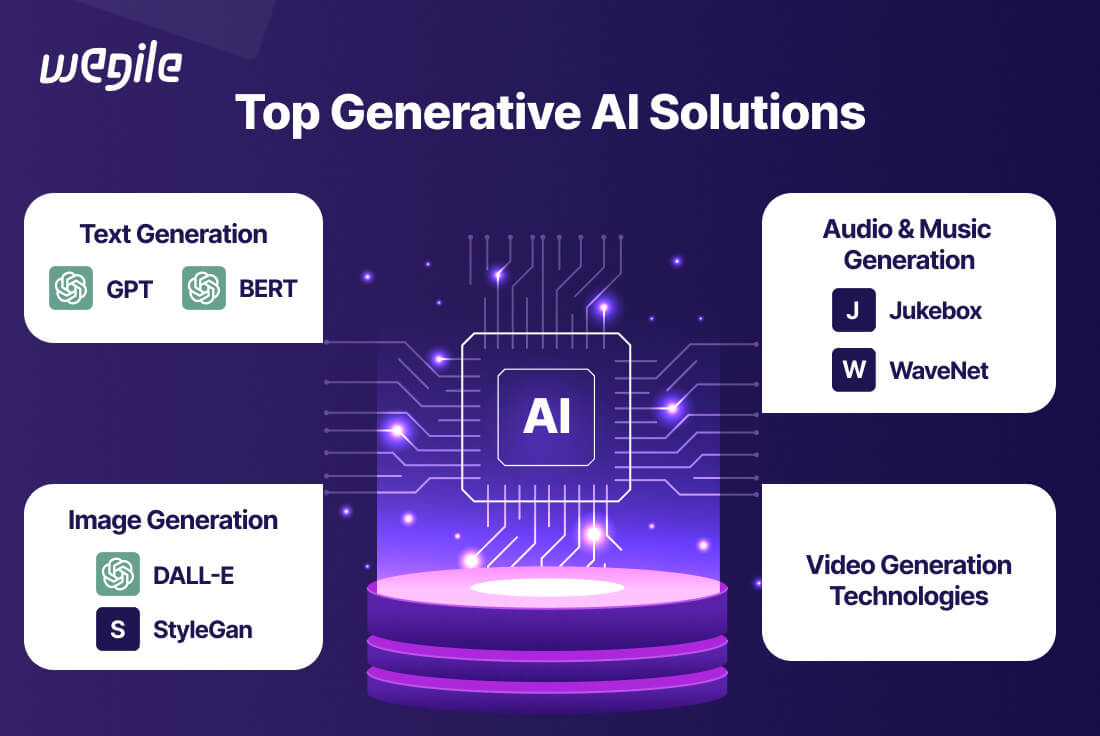
Text Generation: GPT and BERT
GPT (Generative Pre-trained Transformer) models are renowned for their ability to produce coherent
and contextually appropriate text based on the input they receive. From writing essays to generating
code, GPT models like GPT-3 have revolutionized content creation. Similarly, BERT (Bidirectional
Encoder Representations from Transformers) excels in understanding the context of words in
sentences. It enhances search engines and language understanding tasks.
Image Generation: DALL-E and StyleGAN
DALL-E, a variant of GPT tailored for images, generates novel images from textual descriptions. It
can merge concepts, and styles, and even create new visuals that don’t exist in the real world.
StyleGAN, another influential model, is known for its ability to produce high-resolution,
photorealistic images of faces, landscapes, and more. It has become a staple in the field of digital
art and design.
Audio and Music Generation: Jukebox and WaveNet
Jukebox by OpenAI can generate music in various genres and styles, complete with lyrics and melodies
that resonate with human compositions. WaveNet is developed by DeepMind and it synthesizes the human
voice with remarkable accuracy. It powers some of the most responsive and natural-sounding voice
assistants and speech generation systems.
Video Generation Technologies
Video generation AI is a frontier being explored with technologies that can create lifelike
animations and scenes. These systems analyze existing footage and generate new content that
maintains continuity in style, motion, and expression.
Features and Capabilities
Each of these solutions boasts unique features that make them stand out. Text generators handle
multiple languages and styles. Image generators offer unprecedented creative control over visual
content. Audio tools can replicate or invent music, offering compositions that are both original and
appealing. Video generation technologies push the boundaries of film and animation, crafting scenes
that are both complex and engaging.
Scaling
Generative AI Solutions
Challenges in Scaling Generative AI Models
-
Increased Computational Demand: As models increase in complexity and size,
they
require exponentially more computational power. This can lead to significantly higher
operational costs and increased energy consumption. -
Quality and Reliability Concerns: Scaling up can potentially degrade the
quality and reliability of the AI’s outputs. This degradation can diminish user trust and
reduce
the overall effectiveness of the AI system. -
Complex Data Management: Handling larger datasets becomes increasingly
complicated. It requires more sophisticated systems capable of maintaining both speed and
accuracy in data processing. This complexity necessitates advanced solutions for data
storage,
retrieval, and management to ensure efficient operation.
Strategies for Effective Scaling of Generative
AI
To overcome the challenges associated with scaling generative AI models, organizations implement
several strategic approaches:
-
Simplifying Model Architecture: By streamlining the architecture of AI
models,
organizations can scale more efficiently without sacrificing performance. It refers to
designing
models that achieve the desired outcomes with fewer computational resources. -
Pruning and Quantization:
-
Pruning: This technique involves removing non-essential parameters
from
neural networks. It helps in reducing the model’s complexity and the computational
load.
It makes the model lighter and faster during the training and inference phases. -
Quantization: This approach reduces the precision of the numerical
parameters used within the model. By using lower-precision formats, the amount of
data
the model needs to process decreases, which can significantly speed up computation
and
reduce memory usage. -
Distributed Computing:
-
Implementing distributed computing involves dividing the AI workload across
multiple hardware units, which may include different machines or cloud-based
resources. This method is particularly effective for handling larger models
and
datasets. It enhances the model’s ability to process large volumes of data
more
quickly and efficiently by leveraging parallel processing capabilities.
-
-
Hardware Considerations
Choosing the right hardware is also crucial for effectively scaling generative AI models. Here are
key components to consider:
-
GPUs (Graphics Processing Units):GPUs are highly favored for their
capability
to perform complex matrix and vector
calculations rapidly. This feature is essential for training deep learning models, as it can
significantly accelerate learning and synthesizing large datasets. -
TPUs (Tensor Processing Units):Designed specifically for tensor
computations,
TPUs offer even faster processing speeds
compared to GPUs. They are particularly efficient for tasks that involve large-scale neural
networks. TPUs enhance the performance of AI models by speeding up both the training and
inference phases.
Software Optimizations
Software is equally critical in the effective scaling of AI models. Here are the primary areas where
software plays a key role:
-
Choosing the Right Frameworks:
-
Frameworks like TensorFlow and PyTorch are vital
for
scaling AI applications. They are designed to support large-scale operations and are
continually updated to handle the increasing complexities of AI models. -
These frameworks efficiently utilize GPUs and TPUs, maximizing the hardware’s
capabilities to speed up computations.
-
-
Distributed Task Management:Both TensorFlow and PyTorch offer tools that
facilitate the distribution of tasks across
multiple hardware instances. This ability is crucial for scaling, as it allows for parallel
processing, significantly speeding up the training and deployment of models. -
Efficient Data Handling Libraries:
-
Libraries and tools that aid in data loading, augmentation, and preprocessing are
essential for maintaining high performance. Efficient data management ensures that
the
AI models can be trained and run without delays caused by data bottlenecks. -
Examples of such libraries include Pandas for data manipulation,
NumPy for numerical data handling, and OpenCV for
image processing tasks. These tools help streamline data preparation and enhance the
efficiency of AI systems.
-
Data Management and Efficiency
Proper data management is crucial for scaling AI models effectively. Here are several strategies to
enhance data management:
-
Optimizing Data Storage and Retrieval:
-
Improving the storage and retrieval processes is essential to handle larger volumes
of
data. This optimization ensures quicker access and more efficient processing, which
are
vital for training larger models. -
Techniques such as indexing, caching, and choosing the right database systems can
drastically reduce latency and improve throughput.
-
-
Implementing Robust Data Pipelines:
-
Developing robust data pipelines is critical to ensure that data flows efficiently
from
storage to the models without bottlenecks. This includes setting up automated
workflows
for data ingestion, validation, transformation, and loading. -
Tools like Apache Kafka for data streaming and Apache Airflow for workflow
automation
can help maintain a smooth and efficient pipeline.
-
-
Data Sharding Techniques:
-
Data sharding involves partitioning data into smaller, more manageable pieces that
can
be processed in parallel across multiple systems. This method enhances scalability
and
decreases processing time by distributing the workload. -
Sharding can be particularly effective when combined with distributed databases and
cloud storage solutions, allowing for scalable and flexible data management.
-
Best Practices for Implementing Generative AI
Ethical Considerations and Biases
When implementing generative AI, it’s crucial to address ethical considerations and biases:
-
Assessing and Eliminating Bias: Generative AI systems often reflect the
biases
present in their training data. It is vital to rigorously assess datasets for inherent
biases
and implement strategies to mitigate these biases before training models. This can involve
diversifying the data sources or using techniques that identify and reduce biased data. -
Transparency and Accountability: Maintaining transparency in how AI models
are
developed and used is key to building trust with users. This involves documenting the data
sources, model decisions, and methodologies. Ensuring that there is accountability for the
outcomes of AI implementations, including a thorough understanding of how decisions are made
by
AI systems, is essential for ethical practice.
Maintaining Data Privacy and Security
Protecting the privacy and security of data used in AI systems is another critical best practice:
-
Implementing Robust Security Measures: It’s essential to adopt
comprehensive
security measures to protect data against unauthorized access and breaches. This includes
using
encryption, secure data storage solutions, and rigorous access controls. -
Privacy by Design: Integrating privacy into the design phase of AI
development
is crucial. This approach ensures that privacy considerations are embedded within the
architecture of AI systems, rather than being added on as an afterthought. Techniques such
as
data anonymization and differential privacy can be employed to protect individual identities
without compromising the utility of the data. -
Regular Audits and Compliance Checks: Conducting regular audits of AI
systems
helps ensure they comply with both internal policies and external regulations regarding data
privacy. Staying updated with changing privacy laws and standards is necessary to maintain
compliance and safeguard user data effectively.
Ensuring Model Reliability and Stability
Guaranteeing the reliability and stability of AI models is fundamental
-
Thorough Testing and Validation: It’s crucial to conduct comprehensive
testing
and validation to ensure AI models perform consistently under various conditions. This
includes
stress-testing models to see how they handle edge cases or unexpected inputs. -
Regular Monitoring and Maintenance: Continuous monitoring of model
performance
in real-world applications helps identify any issues of reliability or stability as they
arise.
Implementing routine maintenance schedules can address these issues promptly, preventing
them
from affecting users. -
Version Control: Employ version control for models to manage different
iterations effectively. This allows developers to roll back to stable versions if newer
updates
cause instability.
Continuous Learning and Updates
Keeping AI models relevant and effective requires continuous learning and updates:
-
Implementing Feedback Loops: Setting up mechanisms to incorporate real-time
feedback into AI models can significantly enhance their accuracy and relevance. These
feedback
loops allow models to adapt and improve continuously based on new data. -
Scheduled Model Retraining: Regularly retraining models with updated
datasets
ensures they remain effective as conditions change. This retraining can be triggered by
performance metrics falling below a certain threshold or on a predetermined schedule. -
Staying Informed on AI Advancements: Keeping up-to-date with the latest
research and developments in AI can provide insights into new techniques and approaches for
improving model performance.
Integration with Existing IT Infrastructure
Seamlessly integrating AI models into existing IT infrastructure is critical:
-
Compatibility and Interoperability: Ensure that the AI solutions are
compatible
with the existing IT systems. This might involve using APIs or middleware that facilitates
communication between different systems and platforms. -
Scalable Architecture: Design the integration to be scalable so that it can
grow with the demands of the business. This means considering not only the current
requirements
but also potential future needs. -
Training and Support for Staff: Provide comprehensive training and support
to
IT staff and end-users. Understanding how to use and troubleshoot the integrated AI systems
is
vital for smooth operation and maximizing the benefits of AI.
Future Trends and Innovations in Generative AI
Potential Future Developments in Generative AI
The trajectory of generative AI continues to point towards more sophisticated and diverse
applications:
-
Improved Generative Models: Advances in neural network architectures and
learning techniques are likely to produce more powerful and efficient generative models.
These
improvements could lead to AI systems that better understand and replicate human nuances in
creative tasks. -
Enhanced Personalization: As generative AI continues to evolve, its ability
to
tailor content and responses to individual preferences and contexts will significantly
improve.
This could revolutionize areas like personalized education, customized shopping experiences,
and
even individual health recommendations. -
Cross-modal Generative Systems: Future developments may include AI systems
capable of seamlessly generating content across different modalities. For instance, an AI
could
take a piece of text and convert it into a relevant video, image, or audio file, enhancing
multimedia content creation.
Impact of Quantum Computing on Generative AI
Quantum computing promises to be a game-changer for generative AI by providing unprecedented
processing power:
-
Speeding Up AI Training: Quantum computers can potentially perform
calculations
at speeds unachievable by classical computers, drastically reducing the time required for
training complex AI models. -
Handling Complex Variables: Quantum computing could enable generative AI to
manage more variables at once, increasing the models’ accuracy and the quality of the
generated
outputs, especially in fields like drug discovery and materials science. -
Enhancing Creativity and Complexity: With quantum computing, generative AI
could create content that is not only more complex but also more creative, opening up
possibilities in digital art, music, and design that are currently hard to imagine.
Predictions for New Applications and Industries
As generative AI technologies mature, they are set to transform a variety of new applications and
industries:
-
Legal and Ethical Advisement: AI could generate legal documents or provide
ethical advice based on a vast database of law and precedent, aiding decision-making in
legal
professions. -
Architectural Design and Urban Planning: Generative AI could be used to
simulate and visualize urban development projects, taking into account multiple variables
like
traffic flow, environmental impact, and human behavior. -
Sustainable Practices: In environmental sectors, generative AI might be
used to
model and predict the outcomes of sustainable practices, helping to plan and implement more
effective environmental policies and technologies. -
Interactive Entertainment: In the entertainment industry, generative AI
could
lead to fully interactive and personalized media experiences, where content adapts in real
time
to the preferences and reactions of the user.
Wrapping Up
In this exploration, we’ve looked at leading generative AI solutions, their capabilities, and
strategies for scaling them. We’ve learned the importance of choosing the right hardware and
software, managing data well, and ensuring AI models are reliable, continuously learning, and
well-integrated into IT systems.
Equally important are the ethical considerations, data privacy, and security measures that must
accompany the deployment of generative AI technologies. As we look to the future, the potential
enhancements in generative AI, coupled with the advent of quantum computing, promise to propel this
technology into new and exciting territories. Applications across diverse sectors like legal
advisement, urban planning, and personalized media stand to be revolutionized.
At Wegile, we understand the transformative power of these technologies. Our Generative AI App
Development Services are designed to help you navigate this complex landscape and leverage
the full potential of generative AI to drive innovation and efficiency in your operations. Whether
you are looking to enhance your existing applications or build new solutions from the ground up, we
are here to guide you every step of the way.
Ready to revamp your business with cutting-edge AI solutions? Contact us at Wegile, and let’s create
something amazing together. Your future in the innovative world of generative AI starts here!
Leave a Reply