
Technology is indeed a game-changer in many fields, but it’s making a huge splash in healthcare.
What’s leading the charge? Generative AI. This technology isn’t just another IT trend; it’s a
revolutionary approach that can create new data, simulate scenarios, and make decisions that used to
require human input. Generative AI has an extensive and expansive role in the real world. Envision a computer not just providing
information but also creating it to solve complex health problems. That’s generative AI for you!
Why
Should We Care About Generative AI in Healthcare?
Imagine a world where every medical challenge, from global pandemics to managing the health of aging
populations, is tackled not just by doctors and nurses but also by intelligent technologies.
Generative AI is stepping up as that brilliant tech hero. It’s transforming everything from how we
talk to our doctors to how new medicines are discovered.
And, the numbers are just as impressive; analysts predict that AI in healthcare, worth about $11
billion in 2021, could soar to $188 billion by 2030. That’s huge!
But there’s more to it than money. Generative AI might boost the global economy by up to 7% in the
next decade. It isn’t just about better healthcare, it’s about creating a smarter, more efficient
world.
In this blog, we’ll uncover the top five ways generative AI makes waves in healthcare. Get ready to
see how this tech is changing the game in medicine and paving the way for a future where healthcare
is smarter, more personalized, and, above all, more efficient.
Let’s explore these exciting developments together!
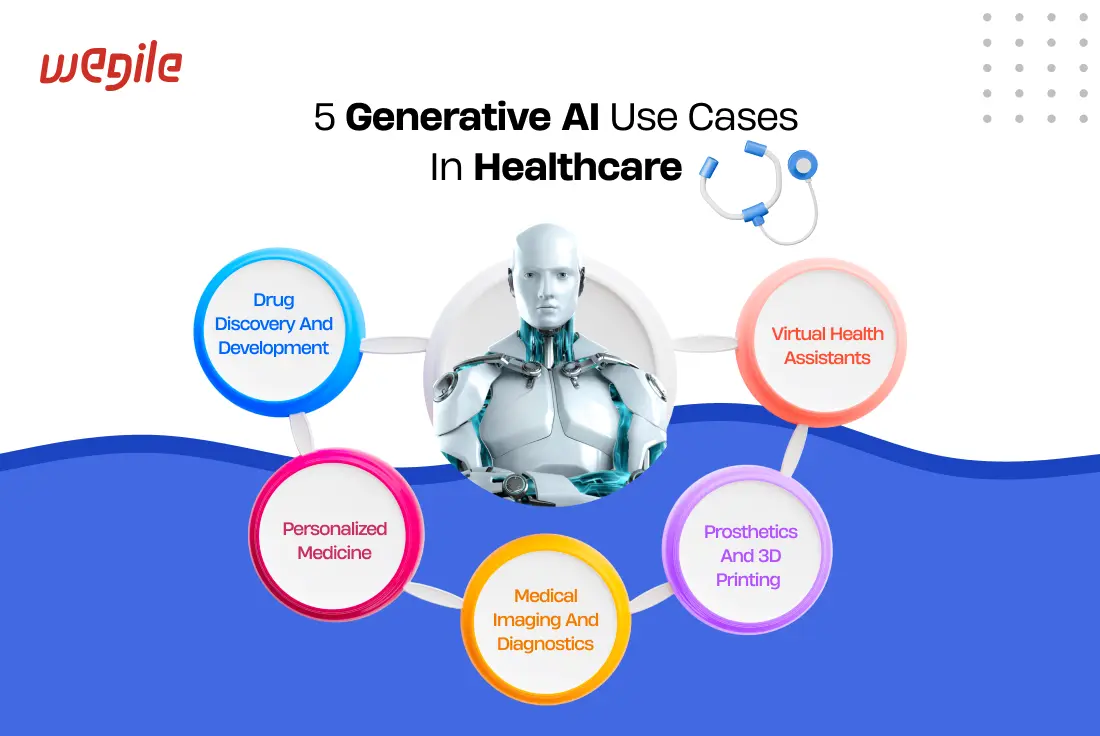
1. Generative AI is Revolutionizing Drug
Discovery and Development
Generative AI is making waves in drug discovery by significantly speeding up the process.
Traditionally, developing a new drug could take over a decade and cost billions of dollars, with a
high failure rate. However, with the help of Generative AI, these timelines and costs are
dramatically reduced. For instance, generative AI can simulate the behavior of drug molecules in the
body, predict how they interact with biological targets, and even help design new molecules with
desired properties. It speeds up the experimental phase and allows researchers to bypass some of the
initial trial and error typically associated with drug development.
Case Studies and Successe
One notable success story is INS018_055, a drug developed using generative AI that
entered human trials in less than three years, a record time compared to traditional methods. This
drug, aimed at treating idiopathic pulmonary fibrosis, showed promising results in early trials and
has already progressed to Phase 2 clinical testing.
Another example is the collaboration between Deloitte and NVIDIA, where they employed AI to enhance
the drug discovery process, integrating vast amounts of data from various sources to streamline the
development of new drugs.
Drug Repurposing
Beyond discovering new drugs, generative AI also finds new uses for existing medications. IBM’s
research, for example, has successfully used AI to identify new therapeutic uses for existing drugs.
This not only extends the lifecycle of these drugs but also speeds up the availability of treatment
options to patients. It highlights the versatile potential of AI in enhancing the efficiency and
scope of pharmaceutical research.
Generative AI is transforming the drug discovery and development landscape by making it faster, more
cost-effective, and more efficient. As this technology evolves, it holds great promise for advancing
the treatment of complex diseases, unlocking new possibilities for healthcare and medicine that were
previously unattainable. This ongoing evolution of AI technology in the pharmaceutical industry
continues to open up new horizons for better patient outcomes and streamlined drug development
processes.
2.
Personalized Medicine and the Role of
Generative AI
Personalized medicine is a tailored approach to healthcare, where medical decisions and treatments
are customized to the individual patient. This approach is important as it allows for more precise
and effective treatments based on a patient’s genetic makeup, lifestyle, and other personal factors.
Generative AI is revolutionizing personalized medicine by enabling the analysis of vast amounts of
genetic data. This technology helps predict how patients might react to different treatments,
allowing for highly tailored therapies that are more effective and have fewer side effects.
For example, AI-driven platforms like Microsoft Azure OpenAI are being used to enhance healthcare
delivery by integrating vast datasets to personalize patient care plans significantly.
Benefits of Generative AI in Developing
Personalized Medicine:
-
1. Improved Accessibility and Customization: Companies like Kry use AI to
improve
accessibility and personalize patient care. By integrating AI into their services, they can
offer healthcare in over 30 languages, making it accessible to a broader range of patients
globally. This approach not only improves patient outcomes but also enhances the efficiency
of
healthcare delivery. -
2. Enhanced Remote Patient Monitoring: AI algorithms embedded in wearable
devices
can continuously collect and analyze vital health data. They provide real-time monitoring of
patient conditions. This capability allows for early detection of potential health issues,
timely medical interventions, and reduced hospital readmissions. -
3. Streamlining Clinical Operations: Generative AI can automate many
tedious
administrative tasks in hospitals, such as generating discharge summaries or synthesizing
care
coordination notes. This saves time and reduces the administrative burden on healthcare
providers, potentially decreasing burnout.
Generative AI is making personalized medicine more practical, efficient, and accessible, paving the
way for a future where healthcare is more tailored to individual patient needs. This technology
promises to transform the landscape of medical treatment, making it as personalized and precise as
possible.
3.
Medical Imaging and Diagnostics with
Generative AI
Generative AI is making significant strides in medical imaging, which is crucial in diagnosing and
treating various diseases. This technology enhances the analysis of medical images by detecting
subtle anomalies that the human eye might miss. It’s not just about interpreting existing images,
generative AI can also create detailed, synthetic images for training and research purposes, thus
enriching the tools available to healthcare professionals.
Role of Generative AI in Medical Imaging and
Diagnostics with Generative AI
-
Enhancing Image Quality from Incomplete Data: One of the groundbreaking
capabilities of generative AI is its ability to improve the quality of medical images, even
from
incomplete data. Technologies like Generative Adversarial Networks (GANs) and diffusion models are at
the
forefront here. They can generate high-quality images that can be used for more accurate
diagnostics. For example, in cases where parts of an image are missing or unclear, these AI
models can reconstruct the missing elements, providing clinicians with better resources to
make
accurate diagnoses. -
Predicting Disease Progression: Generative AI’s impact extends to
predicting
the progression of diseases through medical imaging. This is particularly notable in
neurodegenerative diseases like Alzheimer’s, where early and accurate detection is crucial
but
challenging. AI models are being trained to recognize early-stage signs of Alzheimer’s from
images that might not yet show apparent symptoms to the human eye, enabling earlier
interventions that can alter patient care and outcomes.
Case Studies of Generative AI in Medical Imaging
and Diagnostics with Generative AI
-
University Hospital Essen, Germany: This institution integrates generative
AI
into daily medical practice, especially in radiology. AI models assist by enhancing the
detection and segmentation of image data, which is crucial for accurate diagnosis and
treatment
planning. This integration shows how AI can support the work of radiologists by improving
image
quality and diagnostic accuracy. -
Siemens Healthineers: This company utilizes AI to generate diagnostic
reports
and prioritize them dynamically based on importance. Their systems improve the workflow in
radiology departments by automating and enhancing image evaluation processes, which supports
radiologists in their day-to-day decision-making
The use of generative AI in medical imaging and diagnostics not only improves the accuracy and
efficiency of medical evaluations. It also holds the potential to transform how medical care is
delivered by providing more profound, more accessible insights into patient health. As these
technologies continue to develop, they promise to unlock even more sophisticated tools for medical
professionals worldwide.
4.
Prosthetics with Generative AI and 3D
Printing
The integration of generative AI with 3D printing technology is transforming the field of
prosthetics
by enabling highly customized prosthetic solutions. This synergy allows for the creation of
prosthetic limbs that are functionally effective and tailored to the individual’s physical and
biomechanical needs.
For example, Limbitless Solutions has used this technology to allow children to
personalize their prosthetic arms, incorporating designs inspired by video games and movies, which
helps enhance children’s connection with their prosthetics.
Personalization of Prosthetics
Using AI algorithms, prosthetic limbs can be designed to fit the exact dimensions of the user’s
residual limb, accounting for unique contours and biomechanical movements. It guarantees not just a
snug fit but also optimizes the limb’s functionality for everyday tasks, significantly improving
users’ comfort and overall life quality.
For example, the company Ocupeye Ltd., in collaboration with the Fraunhofer Institute, has applied
this technology to produce prosthetic eyes that are anatomically accurate and aesthetically matched
to the patient’s other eye.
Enhancing Functionality and Comfort
The use of generative AI in designing prosthetics extends beyond aesthetics, enhancing functionality
and comfort. Advanced algorithms analyze a vast amount of data to predict optimal prosthetic
performance under various conditions, allowing for adjustments in the design that cater to different
activities or lifestyle needs. This approach has been instrumental in developing prosthetic eyes at
the Fraunhofer Institute. AI-driven designs now enable quicker production and a better fit, reducing
patient adaptation period and enhancing comfort.
These advancements indicate a promising future for prosthetic technology, where personalization and
functionality merge to create solutions that are deeply integrated with the user’s life, improving
mobility, personal identity, and confidence.
5.
Generative AI-Powered Virtual Health
Assistants
AI-powered virtual health assistants (VHAs) are innovative tools transforming the healthcare
landscape. These digital assistants leverage artificial intelligence to interact with patients,
offering 24/7 access to healthcare services, managing appointments, and providing personalized
health advice. By understanding and processing natural language, these VHAs can perform various
tasks that traditionally require human interaction, thereby enhancing the efficiency and
accessibility of healthcare services.
Capabilities of Virtual Health Assistants
VHAs utilize advanced AI technologies, including natural language processing and machine learning,
to
deliver tailored healthcare services. They can schedule appointments, answer frequently asked health
questions, remind patients to take their medications, and even provide critical health information
during public health emergencies.
For example, during the COVID-19 pandemic, virtual assistants were employed extensively to
disseminate accurate health information and manage public inquiries efficiently.
These assistants can also monitor patient health and manage chronic conditions by analyzing patient
data and providing actionable advice. This proactive approach helps in early detection and
management of potential health issues, leading to better patient outcomes.
Case Studies
-
Babylon Health: This platform utilizes AI-powered VHAs
to
offer personalized health advice and perform symptom checks. It helps patients understand
their
health conditions better and manage their care more effectively. -
Clara by CDC: Developed by the Centers
for Disease Control and Prevention, Clara is a healthcare virtual assistant who played a
significant role during the COVID-19 pandemic, providing users with reliable information and
emotional support.
Integrating VHAs in healthcare is expected to reduce healthcare professional’s workload. By
automating routine tasks and patient interactions, VHAs free up medical staff to focus on more
complex and urgent care needs. These assistants improve patient engagement by providing continuous
support and personalized interaction, crucial for chronic condition management and overall patient
satisfaction.
As the technology continues to evolve, the role of VHAs is expected to expand further, incorporating
more advanced AI capabilities to offer even more personalized and proactive healthcare solutions. It
will enhance patient care and streamline healthcare operations, making the system more efficient and
responsive to patient needs.
Challenges and Ethical Considerations in AI
Healthcare
It’s not all smooth sailing when we talk about artificial intelligence in healthcare. There are
quite
a few bumps along the road that need careful navigation. Let’s dive into some of these challenges
and ethical considerations.
Data Privacy
One of the biggest challenges is protecting patient data. With AI, heaps of data are analyzed to
improve healthcare services. But imagine if this sensitive information got into the wrong hands.
Scary, right? Ensuring that patient data is secure and only accessible to authorized personnel is
crucial. Healthcare providers must adhere to strict privacy laws and regulations, ensuring that all
AI systems are watertight regarding data security.
Algorithmic Bias
Here’s another hiccup: AI is only as good as the data it learns from. If this data is biased, the
AI’s decisions will be too. This can lead to unfair treatment decisions or diagnostic conclusions,
particularly affecting minorities or underrepresented groups. AI systems need to be trained on
diverse, inclusive datasets to prevent this. Ongoing monitoring is essential to ensure these systems
remain unbiased and fair.
Need for Robust Training Data
AI models thrive on quality data. The more accurate and comprehensive the data, the better AI can
perform. However, gathering such robust training data is a challenge. It involves large quantities
and high-quality, well-labeled data sets that genuinely represent the real-world scenarios in which
they will operate. Ensuring the data’s relevance and breadth is vital for the effectiveness of AI
applications in healthcare.
Ethical Considerations
Now, onto the ethical side of things. Implementing AI in healthcare, a field dealing with human
lives
raises significant moral questions. For instance, how much should we rely on AI to make critical
healthcare decisions? There’s also the issue of transparency, patients and providers must understand
how AI comes up with its recommendations. And let’s not forget about the potential for AI to
perpetuate existing healthcare disparities. Ensuring ethical deployment of AI involves rigorous
standards, clear guidelines, and a commitment to equitable healthcare outcomes.
Conclusion: Embracing the Future with
Generative AI in Healthcare
As we’ve explored the vast possibilities of generative AI in healthcare, it’s clear this technology
isn’t just a passing trend, it’s a major force reshaping the future of medicine. From speeding up
drug discovery to personalizing patient care and enhancing diagnostic accuracy to revolutionizing
prosthetics and virtual health assistance, generative AI is at the forefront of medical innovation.
The potential for generative AI to enhance and transform healthcare is immense. It promises more
efficient and effective treatments and a more personalized approach to patient care. As the
technology continues to develop, it will unlock new possibilities once thought impossible, providing
hope and improved patient outcomes worldwide.
However, the journey has its challenges. Data privacy, algorithmic bias, and the ethicaAI’s ethical
implications in medicine must fully realize the benefits while safeguarding patient interests. By
navigating these challenges thoughtfully, the healthcare sector can ensure that generative AI serves
as a beneficial tool, enhancing the capabilities of medical professionals and improving patient
care.
As we look to the future, the role of generative AI in healthcare is only set to expand, offering
exciting prospects for a healthier, more efficient world. Get all the benefits by connecting with a
generative AI app development company and explore our blog to
see
how they
are pioneering changes in healthcare with cutting-edge solutions.
Leave a Reply