Generative AI is transforming how industries create and translate content by offering unprecedented
speed and cost efficiency. From streamlining operations in media and entertainment to enhancing
precision in financial services, this technology sets new standards. But what exactly are the
tangible benefits? How are companies leveraging AI to cut costs and gain a competitive edge in their
respective markets?
How substantial are the cost savings when media companies leverage generative AI for content
creation
and translation? What percentage of marketing and advertising firms now employ generative AI to
enhance content personalization and consumer engagement? And how much faster can software
development cycles become with the aid of generative AI in code generation and testing? Finally, to
what extent can AI-driven translation services expand a company’s global reach while ensuring
cultural accuracy?
Join us as we explore these questions and more, uncovering the power of generative AI in the real world across various
industries.
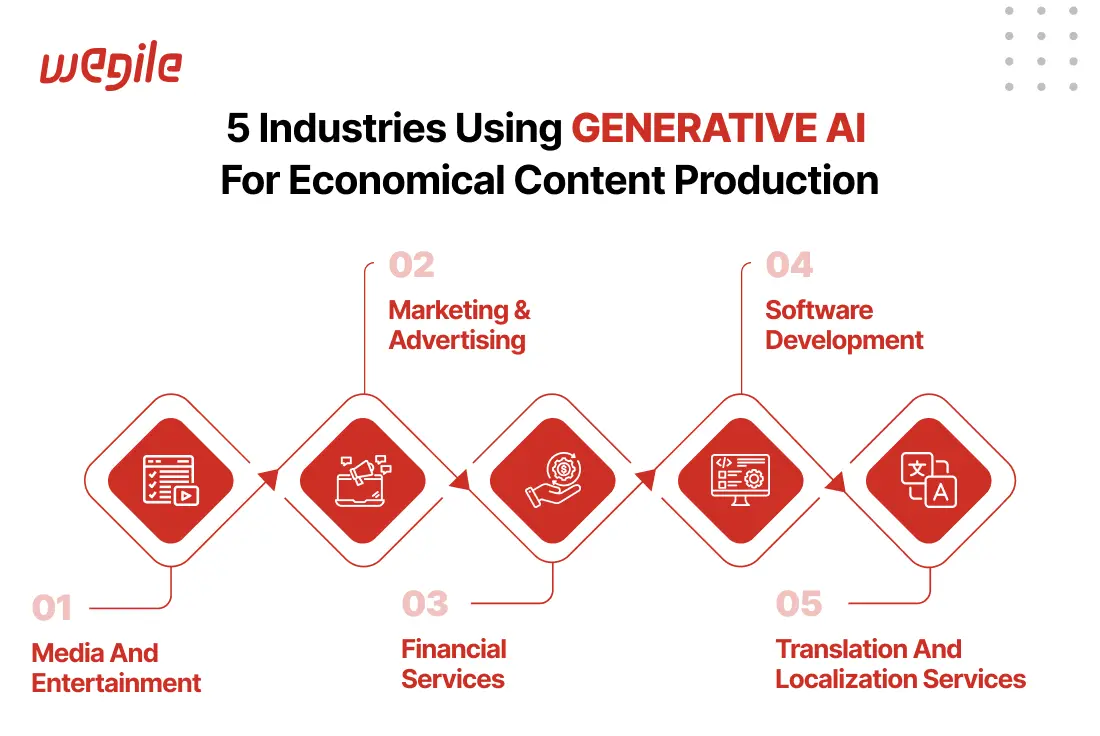
1. Media and
Entertainment
Generative AI is revamping the media and entertainment landscape by making the creation and
translation of content not just faster but also more cost-effective. This innovative technology
automates the generation of diverse content forms, from captivating articles to engaging scripts.
Explore by reading further about this digital revolution where creativity knows no bounds, and find
out how generative AI sets the stage for a more connected and expressive world.
Content Creation
Generative AI is the modern-day muse for content creators. It effortlessly conjures everything from
catchy tunes to engaging blog posts and even the initial drafts of film scripts. Tools like OpenAI’s
GPT (Generative Pre-trained Transformer) and Google’s BERT (Bidirectional Encoder Representations
from Transformers) are revolutionizing how content is created. This technology enables smaller teams
to dream big and produce a diverse array of content quickly. Numerous
use cases exist for
generative AI, but it is nothing short of a magic wand for the content creation industry.
For example, imagine a small indie game studio using AI to generate dynamic dialogues for
characters,
making each player’s experience unique without needing an army of writers. This isn’t just
efficient; it’s incredible. It enables storytellers to craft rich, immersive worlds that might have
been out of reach due to resource constraints.
Editing and Post-Production
In post-production, where the devil is in the details, generative AI acts like a meticulous yet
lightning-fast assistant. Tools like Adobe’s Sensei use Generative AI to power features that
automate tasks like object selection and audio balancing, speeding up the editing process.
Generative AI can sift through hours of footage to tag and organize clips, drastically cutting down
the time editors spend on preliminary tasks. Generative AI is stepping into roles that require a
keen eye for detail, such as color grading and sound editing. For example, imagine a documentary
filmmaker using AI to enhance the color in sunset scenes or to balance the audio levels between
dialogue and background music, ensuring the final product is beautiful and clear. It allows creative
professionals to focus on the art of storytelling, knowing the tedious bits are in capable hands.
2. Marketing and
Advertising
In marketing and advertising, generative AI plays a pivotal role in transforming how marketing
strategy is created, personalized, and optimized. It leads to significant cost reductions and
efficiency improvements. Let’s explore how this technology is reshaping the industry with real-world
examples:
Enhanced Consumer Insights
AI doesn’t just create content; it’s incredibly savvy at understanding consumer behavior. By
analyzing vast amounts of customer data, AI can identify patterns and preferences, enabling
marketers to craft targeted strategies that speak directly to the desires of their audience. For
example, Netflix employs AI to analyze viewing patterns, which helps them create highly targeted
marketing campaigns that increase viewer engagement and subscription retention by suggesting content
that aligns closely with user preferences.
Efficiency in A/B Testing
Generative AI elevates A/B testing by allowing marketers to generate numerous content variations to
see which performs best quickly. Companies can continually refine their advertising strategies and
content delivery. It ensures optimal engagement and effectiveness. Sephora, for example, uses
generative AI to test different promotional emails, quickly determining which offers or messages
drive the best customer response. It assists Sephora in optimizing their marketing efforts, and
increasing conversion rates.
Dynamic Personalization at Scale
Generative AI also takes personalization to new heights. It can dynamically adjust marketing
messages
and images in real time to suit individual user profiles, significantly enhancing the relevance and
impact of marketing campaigns. This level of personalization ensures that each consumer feels
uniquely addressed, increasing the likelihood of engagement and conversion. A prominent example is
Coca-Cola’s use of AI to create personalized advertising campaigns where digital billboards display
ads tailored to the time of day, weather, and passing traffic, creating a more engaging and
contextually relevant experience for consumers. This not only boosts consumer interaction but also
maximizes the efficiency of marketing spend by targeting the right message at the right time.
3. Financial Services
Generative AI is making significant strides in the world of financial services. It reshapes how
businesses interact with customers, comply with regulations, and offer personalized financial
advice. Let’s immerse into how this technology is enhancing efficiency and cutting costs in the
sector:
Advanced Fraud Detection
Generative AI significantly enhances the ability to detect and prevent financial fraud. By using
complex algorithms and vast datasets, AI systems can identify unusual patterns and potentially
fraudulent activities with higher accuracy and speed than traditional methods. For example, banks
like HSBC use generative AI to monitor transactions in real time. This AI technology can detect
subtle, irregular behaviors that often indicate fraud, such as unusual transaction amounts or
patterns that deviate from a customer’s typical activity. By doing so, Generative AI not only helps
protect financial assets but also boosts consumer confidence in security measures, maintaining trust
and satisfaction in financial services. This proactive approach to fraud detection enables financial
institutions to react swiftly. It minimizes potential losses and enhances across-the-board financial
security.
Customer Service
AI-driven chatbots are revolutionizing customer service in financial services by providing
round-the-clock assistance without expanding staff numbers. These chatbots can swiftly and
effectively handle various customer inquiries, from basic account questions to complex transaction
issues. For example, Bank of America’s chatbot, Erica, helps customers manage their accounts, track
spending, and even make payments, all through simple voice or text commands. It enhances customer
satisfaction by offering immediate responses and reduces operational costs by automating routine
tasks.
Regulatory Compliance
In an industry where compliance is of immense importance, Generative AI is a game-changer. It
monitors and reports on regulatory changes, ensuring that all financial advisories and publications
align with the latest laws. This proactive approach helps prevent costly legal violations and keeps
firms at the forefront of compliance without the need for large legal teams. A practical example is
JPMorgan Chase, employing AI to review commercial loan agreements. If done manually, this process
would typically take hours, ensuring accuracy and adherence to changing regulations within minutes.
4. Software Development
Generative AI has a pivotal role in application development. In the software development
domain, generative AI is like having a supercharged coding assistant that enhances productivity. It
cuts down on errors, and streamlines collaboration in multilingual environments. Here’s how AI is
transforming the way developers write, translate, and test code, making the whole process more
cost-effective:
Code Generation
Generative AI is revolutionizing how developers work by assisting in writing and optimizing code.
This technology can suggest code snippets, complete blocks of code, and even optimize existing code
to make it more efficient. This accelerates development cycles and reduces the need for in-depth
programming knowledge, making software development more accessible to a broader range of people. For
example, GitHub Copilot, powered by OpenAI, offers suggestions for whole lines or blocks of code. It
learns from the context of existing code, thus speeding up the development process and reducing the
cognitive load on developers.
Automated Testing
Generative AI in automated testing is changing the game by generating and running tests
automatically, identifying potential issues much faster than traditional methods. It speeds up the
testing phase and reduces the time developers spend on manual testing. Generative AI can simulate
various user interactions and quickly pinpoint bugs or performance issues, leading to higher-quality
software and faster deployment cycles. Tools like Testim and Mabl use AI
to create and run sophisticated test
scenarios, adapting to changes in the app without needing constant updates from developers, thus
reducing maintenance overhead and increasing efficiency.
Enhanced Debugging
Adding to these capabilities, generative AI also offers advanced debugging features. Based on
historical data, AI can predict where bugs will likely occur and suggest fixes to developers before
the testing phase. This proactive approach to bug fixing saves time during development and helps
maintain a cleaner, more efficient codebase. Tools like DeepCode
use AI to scan code and provide insights and suggestions, making it easier for developers to address
potential issues early in the development cycle.
5.
Translation and Localization Services
In translation and localization services, generative AI is becoming an indispensable tool. It makes
the entire process faster, more economical, and culturally attuned. Here’s a closer look at how
generative AI is reshaping this field:
Enhanced Accuracy and Consistency
Generative AI maintains high accuracy and consistency, which is crucial for translating specialized
legal, technical, and medical documents. AI-powered tools can ensure that specific terminology and
jargon are used consistently across multiple documents and translations, eliminating common errors
that can occur with human translators, especially under tight deadlines. This consistency is vital
in industries where even minor errors, such as legal contracts or medical instructions, can have
significant consequences. For example, AI-powered translation tools can cross-reference an entire
corpus of legal documents to ensure terms are used correctly and consistently, saving time and
reducing the risk of costly mistakes.
Scalability
Generative AI translation tools dramatically increase scalability. It allows businesses to handle
large volumes of content across various language pairs without a corresponding increase in human
resources. This scalability is especially beneficial for global companies operating and
communicating across multiple countries. By using generative AI, these companies can quickly roll
out new products and services worldwide. They can ensure all supporting materials are accurately
translated and localized, thus maintaining brand consistency and message clarity at a fraction of
the traditional cost and time.
Cultural Nuance Preservation
One of the most significant advantages of generative AI in translation and localization is its
ability to preserve and adapt cultural nuances. AI models can be trained to recognize idiomatic
expressions and artistic references, adjusting content to be culturally appropriate and resonant
with the target audience. This sensitivity is crucial for effective localization, which goes beyond
straightforward translation to embed the content naturally into the local culture. For example,
marketing campaigns that resonate well in one country might need adjustments in their humor or
storytelling to connect with audiences in another. AI can automate this adaptation process, ensuring
content feels local and relevant.
Wrapping Up
Generative AI is making a monumental impact across a broad spectrum of industries. It is proving to
be more than just a technological advancement; it is a strategic advantage reshaping the economic
landscape of content production and translation. From media and entertainment to financial services
and beyond, this technology is streamlining workflows and enhancing the reach and relevance of
content across global markets. As businesses continue to explore the potential of generative AI,
they find it indispensable for staying competitive in a digitally-driven world.
Are you ready to leverage the transformative power of generative AI within your organization?
Discover how our Generative AI App Development Services can catapult
your business into a new era of digital excellence. At Wegile, we specialize in crafting tailored
generative AI solutions that align perfectly with your strategic goals. It ensures that you stay
ahead in the competitive market.
Contact Wegile today and discover how our expert team can help you innovate and excel with our
state-of-the-art generative AI app development services. Convert your ideas into reality and
redefine what’s possible in your industry.
Leave a Reply