Are you ready to jump into the thrilling world of generative AI solutions and uncover the
cutting-edge advancements shaping our future? As we stand on the brink of 2024, the landscape of
artificial intelligence is not just evolving, but it’s revolutionizing at an unprecedented pace. Did
you know the latest models, like GPT-4, now operate with over a trillion parameters? What does this
mean for the future of technology and our interaction with the digital world?
Imagine a world where AI can converse with you and predict and adapt to your preferences in
real-time. From creating breathtaking artworks to generating predictive models that could foresee
market trends, generative AI is no longer just a tool; it’s becoming ubiquitous across multiple
industries. But what’s truly exciting about this technology as we approach 2024?
How can AI now assist in designing everything from your next favorite gadget to predicting the next
big fashion trend? And what about its role in crucial sectors like healthcare, where AI-generated
models propose new compounds for lifesaving drugs?
In this blog, we’re exploring the latest advancements in generative AI, examining the exciting
opportunities, ethical considerations, and challenges they present. Are you prepared to see how deep
this rabbit hole goes? Join us to discover the exciting advancements in generative AI that everyone
should know about today!
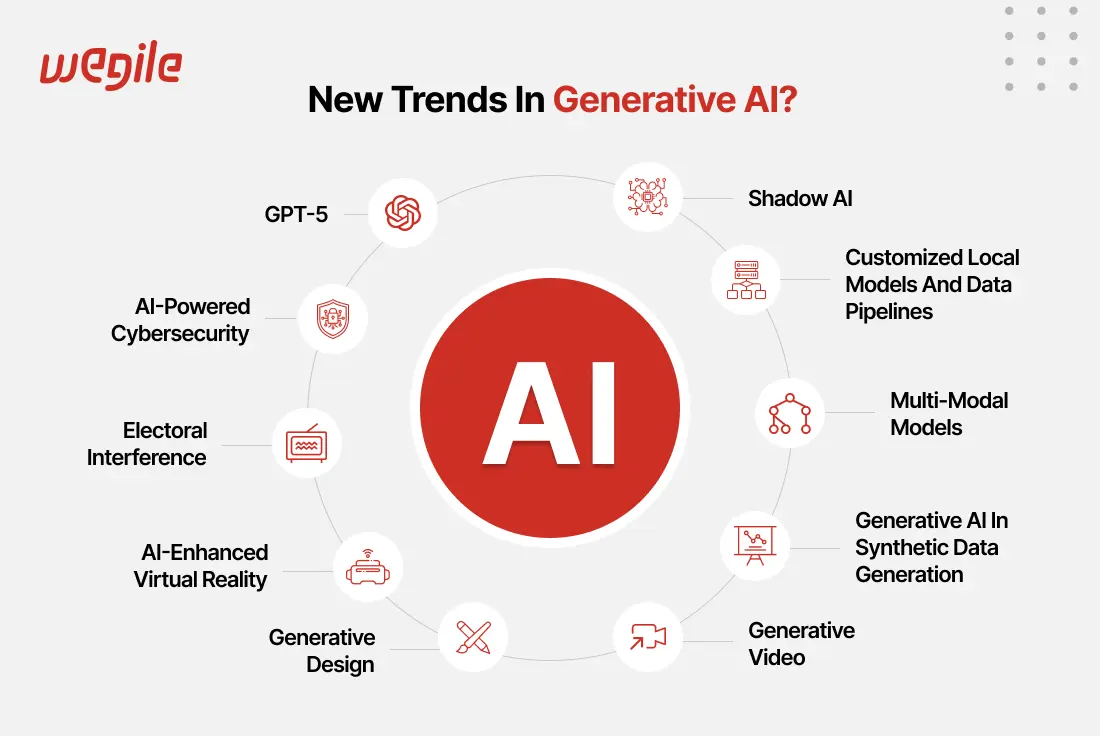
1. GPT-5: The Next Giant
Leap
As the tech world buzzes with anticipation, the upcoming release of GPT-5 is a monumental milestone
in the evolution of generative AI. Building on the colossal framework of GPT-4, which already boasts
over a trillion parameters, GPT-5 is expected not just to step up the game but to redefine it
entirely. But what does this mean in the world of artificial intelligence, and why should we keep
our eyes peeled for its debut?
The Scale and Scope of GPT-5
GPT-4 amazed us with its understanding and response capabilities, setting a new standard for what AI
can achieve. Now, imagine an even more powerful model. Early whispers suggest that GPT-5 could
dramatically expand on the number of parameters, diving deeper into the complexities of human
language and interactions. But it’s not just about size. The real magic lies in utilizing these
parameters for more data, learning, and significantly more nuanced interactions.
Unprecedented Processing Power
The leap to GPT-5 isn’t just adding more data; it requires incredible processing power. This power
enables the AI to analyze and generate responses at speeds and accuracies we’ve never seen before.
For tech enthusiasts and industry professionals, this means watching AI perform tasks in seconds
that would take humans hours or even days. But how is such speed feasible? Thanks to advancements in
computing infrastructure and optimization techniques that allow these massive models to operate
efficiently without compromising on speed.
Enhanced Accuracy and Contextual Understanding
One of the standout features expected in GPT-5 is its enhanced accuracy and deeper contextual
understanding. Where previous models might have faltered with ambiguity or complex sentence
structures, GPT-5 aims to navigate these with unprecedented finesse. This isn’t just about
understanding words in a vacuum; it’s about grasping nuances, cultural references, and even
emotions, transforming how we interact with AI across various platforms, from customer service bots
to personal assistants.
Diverse Applications Across Industries
Generative AI finds diverse applications in the real world and the implications of GPT-5’s
capabilities are also going to be vast and varied across different sectors. In healthcare, imagine
AI that can sift through medical research at lightning speeds to offer diagnosis support or
treatment recommendations. In education, personalized learning assistants could adapt to each
student’s learning style, pace, and needs, revolutionizing educational accessibility and
effectiveness.
In creative industries, the enhanced model could assist in scriptwriting, music composition, and
game
development. It offers tools that spark human creativity rather than replace it. In business, the
applications range from advanced data analysis and decision-making support to creating dynamic and
engaging marketing content that resonates with diverse audiences.
Looking Ahead
As we edge closer to the release of GPT-5, the excitement is palpable, not just for the
technological
advancements it promises but for the new horizons it opens up. This isn’t just about a more powerful
tool; it’s about setting a new benchmark for what AI can achieve and how it can be integrated into
our daily lives and work. In this era of rapid technological advancement, GPT-5 is more than a new
model; it’s a forerunner of the future. It is signaling endless possibilities and inviting us to
reimagine what we expect from technology. So, let’s stay tuned, for the best is undoubtedly yet to
come!
2. AI-Powered
Cybersecurity
With cyber threats growing complex daily, the need for robust cybersecurity measures has never been
more critical. Here comes generative AI, a game-changer in digital security, poised to revolutionize
how we protect and defend our most sensitive data and systems. The convergence of AI with
cybersecurity enhances existing protocols and creates new digital defense paradigms.
AI as the New Cyber Guardian
Generative AI is stepping into cybersecurity with capabilities that seem straight out of a sci-fi
novel. Imagine a system that not only understands the tactics of cyber attackers but can also
predict and counteract them before they inflict harm. Generative AI models are trained on vast
datasets of security incidents and threat patterns, and are beginning to function as proactive
defenders. They are constantly learning from new data and adapting to evolving threats.
Simulating Cyber Attacks to Fortify Defenses
One of the most potent capabilities of AI in cybersecurity is its ability to simulate sophisticated
cyber attacks. These AI-driven simulations, often called “red teaming” exercises, involve the AI thinking
like a hacker, identifying potential vulnerabilities in a system and attempting to exploit them.
This is not about causing real damage but about testing the resilience of current security measures.
By doing so, AI helps organizations identify weaknesses before they can be exploited maliciously.
Automating Defensive Responses
Beyond just identifying threats, generative AI is also advancing its ability to automate responses
to
security breaches. When a potential threat is detected, AI systems can instantly generate defensive
measures such as patching vulnerabilities, isolating affected systems, or even deploying
countermeasures to neutralize ongoing attacks. This rapid response capability is crucial in a
landscape where human response times can be the difference between a minor security breach and a
catastrophic data loss.
Continuous Learning and Adaptation
What sets generative AI apart in cybersecurity is its capacity for continuous learning. Every
attempted attack, whether successful or thwarted, becomes part of the learning matrix for the AI,
enabling it to perform better in future encounters. This aspect of generative AI enhances its
effectiveness and ensures that security systems evolve faster than threats, a crucial advantage in
an ever-changing threat landscape.
Looking Ahead
Looking forward, the role of AI in cybersecurity is expected to expand significantly. We are moving
towards a future where AI-powered systems will not only defend against attacks but also help draft
laws, create ethical hacking guidelines, and set global standards for cybersecurity. The potential
for AI to create a safer digital world is immense but not without challenges, especially concerning
the ethical use and potential biases in AI models.
As we explore the complexities of cybersecurity in our connected world, integrating generative AI
into our digital defenses offers exciting new possibilities. With its ability to simulate attacks,
automatically respond to threats, and learn from each challenge, AI is quickly becoming more than
just a tool; it’s becoming a central part of our strategy for digital protection.
We are just starting to uncover what this technology can do, and the potential for enhancing
security
in both public and private sectors is enormous. Cybersecurity is no longer just about defending weak
spots; it’s about building a more innovative and more robust system with every challenge it faces.
As we move forward, let’s welcome the power of AI to not only react to threats but also to
strengthen
and adapt our digital defenses proactively. This journey is about resisting attacks and evolving
with them to become more resilient than ever.
3. Electoral Interference
Have you ever imagined elections meeting AI? With generative AI, this isn’t just a possibility; it’s
the newest trend and is happening right now.
Positive Impacts of AI in Elections
One of the great benefits of AI in elections is through the personalization of campaigns. Political
parties and candidates can use AI to analyze large amounts of voter data, such as their interests
and past voting behavior. It allows them to tailor their messages to specific groups or even
individual voters, making their communications more relevant and engaging. For example, if data
shows that voters care deeply about environmental issues, AI can help craft messages or choose
advertisements highlighting a candidate’s commitment to these issues.
AI can also help streamline and improve the efficiency of the electoral process. For example, AI can
manage and analyze voter data, helping to ensure that voter rolls are up-to-date and people are
registered properly. This can lead to smoother elections with fewer administrative problems.
Negative Impacts of AI in Elections
However, the power of AI in elections isn’t without risks. One of the biggest concerns is the
potential for spreading misinformation. AI can generate realistic-looking news articles, videos, and
audio recordings that might mislead voters about candidates or issues. These tools can create fake
content that looks very real, known as “deepfakes,”
which
can spread false information
quickly and widely across social media and other platforms.
Another risk is using AI to micro-target voters with tailored messages to manipulate their opinions
or discourage them from voting altogether. This can be particularly divisive, as it might exploit
sensitive or controversial issues to stir up emotions and influence voter behavior.
Looking Ahead
As we progress, governments, tech companies, and watchdog groups must monitor how AI is used in
elections. There needs to be a balance between harnessing AI for positive developments in the
democratic process and preventing its misuse. Policies and regulations may need to be updated or
created to govern the use of AI in political campaigns, especially concerning misinformation and
voter manipulation.
While Generative AI holds fantastic potential to transform electoral processes by making campaigns
more personalized and elections more efficient, careful oversight is also necessary to prevent
misuse. Ensuring that elections remain fair and transparent in the AI age is beneficial and
essential for maintaining trust in the democratic process.
4. AI-Enhanced
Virtual Reality (VR)
Generative AI is starting to play a significant role in virtual reality (VR), making VR experiences
even more exciting and authentic. This technology is helping create virtual worlds that are not just
static backdrops but dynamic environments that can interact with you in real-time. Imagine putting
on a VR headset and stepping into a world that changes based on what you say and do; that’s the kind
of immersive experience AI brings to VR.
Making Virtual Environments More Realistic
One of the main ways AI enhances VR is by making the environments more realistic and interactive. AI
can generate detailed, lifelike scenes that respond to your actions. For example, if you’re in a VR
game and you knock on a virtual door, AI can generate the sound of crashing and even have a
character inside the game respond by opening the door. This makes the VR experience feel more like
stepping into another world.
Training Simulations
In the field of training and education, AI-enhanced VR is a game-changer. It’s used to create
realistic simulations for jobs requiring hands-on practice. For instance, medical students can use
VR to practice surgeries in a risk-free environment. The AI part comes in by adjusting the
difficulty of the procedure or responding to the student’s actions with realistic outcomes. It means
students can learn from their mistakes without any real-world consequences.
Virtual Tours
Virtual tours are another area where AI-enhanced VR is making a significant impact. Museums,
historical sites, and even real estate agents can use Generative AI powered
VR to allow people to explore places from their homes. AI makes these tours interactive; for
example, if you’re taking a virtual museum tour and spend a lot of time looking at a particular
painting, AI can offer you more information about that artwork or show you similar pieces.
Entertainment
In entertainment, AI-enhanced VR creates more engaging games and interactive stories. In VR movies,
for instance, the story could change based on where you look or how you react to characters. AI can
control characters that adapt to your game style, making the game more challenging and fun.
Looking Ahead
As AI technology improves, the possibilities for AI-enhanced VR are almost limitless. We could see
VR
worlds that evolve, virtual characters that remember you and your preferences, or educational
programs that adapt entirely to your learning speed and style.
Generative AI is making VR more than just a way to view excellent graphics; it’s turning it into an
interactive experience that can be used for learning, exploring, and having fun in ways we’ve only
just begun to explore. The blend of AI and VR is changing how we see and interact with virtual
worlds.
5. Generative Design
Generative design is an exciting way that AI is helping people create new things, from cars to
buildings. This process uses AI to quickly generate many design options based on rules and goals set
by a human designer. It’s like having a super-powered brainstorming partner that can come up with
hundreds of ideas in the time it takes you to draw one.
How Generative Design Works
Imagine you’re designing a new chair. You tell the AI what you need the chair to do (like hold a
certain weight, be easy to stack, or use only a certain amount of material). The AI then uses these
instructions to create many different designs. You can look through these and pick the best or
combine elements from several designs. This way, AI helps you explore options you might not have
thought of alone.
Enhancing Creativity and Efficiency
Generative design is excellent because it lets designers be more creative and get work done faster.
Instead of starting from scratch every time, designers can use AI to generate many ideas and then
refine the best ones quickly. It saves time and lets designers experiment with more daring,
innovative ideas without wasting too much time or resources.
Applications in Automotive and Architecture
Companies like General Motors have used generative design to create new car parts in the automotive
industry. For example, they used it to design a seat bracket that was not only stronger but also
lighter than the usual kind. They started with a solid block in the AI software, set their
requirements (like weight and strength), and let the AI propose different shapes. The final design
looked unusual but met all their needs. It was made from a single piece instead of eight,
simplifying manufacturing.
In architecture, generative design helps architects develop innovative building structures and
layouts. A famous example is the work done on the Beijing National Stadium, where generative design
was used to optimize the placement of steel beams. This made the structure strong and gave it a
unique, eye-catching appearance that looked like a bird’s nest, which matched the architect’s vision
and functional needs of the building.
Looking Ahead
As AI technology improves, generative design is expected to play a bigger role in many fields. We
might see it used for cars and buildings and designing everyday items like clothing or furniture. It
could make the design process more accessible to inexperienced designers, allowing more people to
bring their ideas to life.
Generative design is a powerful tool that combines human creativity with AI’s processing power to
create better, more innovative products faster. It’s already changing how we design everything from
car parts to skyscrapers, and as AI continues to advance, its impact will only grow. This blend of
AI and design is not just about making things different but improving them.
6. Generative Video
Generative video tools are transforming the way we create videos, making it easier and faster to
produce content that looks professional. These tools use AI to help with various aspects of video
production, from editing to adding special effects, which traditionally require a lot of skill and
time. Even someone without a video editing background can quickly make high-quality videos.
How Generative Video Tools Work
These AI tools can automatically cut and edit footage, create realistic animations, and even
generate
human-like characters that can speak or act in videos. For example, if you’re making a tutorial
video, you can use these tools to add captions, highlight essential features, and clean up any
mistakes in your footage, all with just a few clicks.
Making Professional Content More Accessible
The big advantage of these tools is that they make professional-grade video production accessible to
more people. Whether you’re a small business owner, a teacher, or just someone with a story, you can
now produce videos that look like a professional studio made them. This levels the playing field
because you no longer need expensive equipment or software; you’re good to go with a basic setup and
generative video tools.
Impact on Media Production and Advertising
In media production and advertising, generative video tools are a game-changer. They allow companies
to create more content in less time. They helps them keep up with the constant demand for new,
engaging videos. This is especially important in today’s fast-paced world, where content quickly
becomes outdated. Advertisers can also use these tools to personalize video ads for different
audiences, making the ads more relevant and effective.
Personal Content Creation
These tools are precious for personal content creators like YouTubers and social media influencers.
They can help creators produce more content without sacrificing quality, which is crucial for
building and maintaining an audience. Personal content creators can experiment with different styles
and formats without needing extra help or spending lots of money, allowing them to express their
creativity and stand out in a crowded space.
Looking Ahead
As these tools continue to improve, we’ll likely see even more impressive features, like Generative
AI, that can understand the context of a video and suggest edits or effects that match the mood or
message. This could further simplify the video creation process and open new possibilities for
customized content.
Generative video tools are not just making video production more accessible; they’re changing who
can
produce videos and what those videos can look like. As these tools become more advanced and
accessible, we can expect a surge in creative and diverse content, reshaping the media landscape,
advertising, and personal expression. This is a thrilling time for anyone involved in video creation
as the barriers to making great content continue to fall, paving the way for a new wave of
innovation and creativity.
7.
Generative AI in Synthetic Data Generation
Generative AI is becoming quite influential in creating synthetic data, a type made from scratch by
algorithms to simulate accurate data. This is particularly useful when actual data is hard to get,
too sensitive to use, or might not represent everyone fairly. Synthetic data helps solve these
problems by training other AI models without using real and personal data.
How Synthetic Data Is Created
Generative AI uses patterns it learns from real data to create new data that looks similar but
doesn’t directly reflect any real individual’s information. This process is like an artist who
learns to paint portraits by studying many pictures of people and then starts creating completely
new faces that don’t exist.
Benefits for Sensitive Industries
In industries like healthcare and finance, where privacy is crucial, synthetic data is precious. For
example, in healthcare, AI needs vast amounts of data to learn how to diagnose diseases or predict
patient outcomes. However, using real patient data raises concerns about privacy and security.
Synthetic data allows researchers and developers to train AI models without exposing real patient
data, ensuring people’s health information stays private.
Similarly, companies in finance can use synthetic data to develop AI systems that detect fraud or
manage risk without accessing customer data. This reduces the risk of sensitive financial
information being leaked or misused.
Challenges and Limitations
While synthetic data is a powerful tool, it’s not perfect. The quality of the artificial data
heavily
depends on the quality of the real data used to create it. If the original data has errors or
biases, these can also be reflected in the synthetic data. Therefore, it’s crucial to ensure that
the process of generating synthetic data is carefully managed and constantly improved.
Looking Ahead
As more industries recognize the benefits of synthetic data, its use is likely to grow. This will
help advance AI technologies in sectors where data sensitivity is a high priority and promote more
ethical use of data by ensuring privacy and reducing bias.
Generative AI in synthetic data generation offers a promising solution to data privacy challenges
and
availability in training AI systems. By providing a way to use valuable data without compromising
individual privacy, synthetic data is set to play a crucial role in the development of more capable
and trustworthy AI applications across various fields.
8. Multi-Modal Models
Multi-modal models in generative AI are exciting advancements that allow Generative AI to understand
and use different types of information together, such as text, images, sounds, and even videos. This
means AI can get a fuller picture of the world, much like humans do, by combining what it sees,
hears, and reads.
What Are Multi-Modal Models?
In simpler terms, multi-modal models are like super-smart programs that can handle more than one
data
type at a time. For example, while earlier AI might only understand text, multi-modal AI can look at
a picture, read the associated text, and listen to any sounds or speeches related to it all at once.
This allows it to make better, more informed decisions and responses because it’s not just relying
on one type of information.
Innovations and Applications
Tech giants like Google, Apple, and Microsoft are leading the way in pushing this technology
forward.
For example, Google’s AI can now understand videos by analyzing the images and sounds in them
together rather than separately. This helps it understand the context better, like knowing that a
scene in a movie is sad because of the sad music and the actors’ expressions.
One of the most popular applications of multi-modal models is in virtual assistants like Siri and
Alexa, which are now better at understanding commands involving different input types. For example,
you could show a picture to Alexa and ask, “What’s in this photo?” and it would be able to tell you
about it, thanks to multi-modal AI.
Enhancing User Interactions
These models don’t just make AI smarter; they also make interacting with AI more natural and
intuitive for us. Since the AI can understand multiple types of information, you can interact with
it more flexibly, using your voice and visuals, much like you would with another person.
Advancements in Customer Service
Another area where multi-modal models are making a significant impact is in customer service.
Companies use generative AI to provide better support by holistically understanding customer
queries. For instance, when a customer sends a complaint through email with a picture attached, the
AI can analyze both the text and the image to understand the problem better and provide a more
accurate response.
Looking Ahead
The future of multi-modal models looks promising as they continue to evolve. We can expect even more
interactive and immersive AI experiences, such as in education, where a learning app could respond
to students through text, diagrams, and spoken explanations, all adapted to the student’s needs in
real time.
Multi-modal generative AI represents a significant step in making machines understand the world more
than humans do. By combining different types of data, AI can become more functional, versatile, and
capable of handling complex tasks that involve seeing, hearing, and reading. This opens up new
possibilities for using technology in our everyday lives, making our interactions with AI smoother,
more natural, and ultimately more human-like.
9.
Customized local models and data pipelines
Customized local models and data pipelines are becoming a significant trend in generative AI,
representing a shift towards more personalized and localized AI applications. This approach tailors
AI systems to specific regions, cultures, or user groups, making the technology more relevant and
effective for individual needs.
What Are Customized Local Models?
Customized local models are AI systems designed to cater to the specific requirements of a
particular
area or community. Instead of one-size-fits-all solutions, these models consider local languages,
customs, and behaviors. For example, an AI that recommends restaurants in New York would need to
understand the local cuisine preferences, peak dining times, and even typical traffic patterns to
make valuable suggestions.
Why Localize?
Localizing AI makes it much more useful and user-friendly. People are more likely to use technology
that feels familiar and relevant to them. This is especially important in regions with diverse
cultures and languages, where a generic AI might not perform well. By adjusting AI to fit local
contexts, businesses can provide better services, and users enjoy more tailored experiences.
Building Data Pipelines for Local Models
Creating these customized models requires specialized data pipelines. A data pipeline is a process
that gathers, organizes, and analyzes data to feed into AI models. These pipelines specifically
collect local data for local models, from regional speech patterns in voice recognition systems to
area-specific consumer behavior for marketing analytics.
Innovations in Local AI Applications
Many tech companies are starting to develop these localized AI models. For example, in e-commerce,
AI
can predict which products will be popular in different regions and adjust inventories accordingly.
In media, streaming services use localized AI models to recommend movies and shows based on regional
viewing preferences and cultural nuances.
Benefits Across Industries
Local models can be especially beneficial in industries like healthcare, where understanding local
health trends and patient data is crucial. AI systems tailored to specific populations can help
predict outbreaks, manage hospital resources, and even tailor health communication to the patient’s
cultural context.
Challenges and Considerations
While the benefits are significant, there are challenges in creating effective local models.
Collecting enough accurate local data to train these models can be difficult, especially in areas
where data is not readily available or is privacy-protected. Additionally, ensuring that AI doesn’t
reinforce local biases or inequalities is critical.
Looking Ahead
The trend toward more localized and customized AI models will likely grow as technology evolves.
This
approach enhances the effectiveness of AI applications and makes them more accessible and acceptable
to diverse populations worldwide. In the future, we might see even more sophisticated local AI
models seamlessly integrating into every aspect of daily life, from personalized learning and
healthcare to local business analytics and community services.
The move towards customized local models and data pipelines in generative AI transforms technology
development and deployment. By focusing on local contexts’ specific needs and nuances, AI can become
more useful, inclusive, and integrated into our everyday lives.
10. Shadow AI
Shadow AI is emerging as a significant trend in generative AI, which refers to using AI systems
within organizations without explicit approval or oversight from central IT or data governance
teams. This can happen when departments or individuals independently decide to use AI tools to solve
problems or enhance productivity without going through official channels. While Shadow AI can lead
to innovation and quick solutions, it also presents significant risks and challenges, especially
regarding security and compliance with regulations.
Understanding Shadow AI
Shadow AI emerges in environments where the official processes for adopting technology are seen as
slow or burdensome. Eager to take advantage of the latest AI tools to increase efficiency or gain
insights, employees might start using these technologies without waiting for official approval.
Examples might include using AI for data analysis, automating repetitive tasks, or enhancing
customer interactions.
Risks Associated with Shadow AI
While Shadow AI can demonstrate the potential of AI tools in real-world applications, it can also
lead to several risks:
-
Security Vulnerabilities:AI tools used without proper oversight might not
comply with the organization’s security standards, potentially exposing sensitive data to
breaches. -
Data Inconsistency:Without centralized control, different teams might use
different AI tools that produce conflicting results, leading to confusion and inefficiency. -
Regulatory Compliance:AI applications must often adhere to specific
regulations
like data protection laws. Unauthorized use of AI could lead to non-compliance, resulting in
fines and legal issues.
Corporate AI Policies
Many companies are developing comprehensive corporate AI policies to manage and mitigate the risks
associated with Shadow AI. These policies are designed to govern the use of AI within the
organization, ensuring that all AI applications are secure, compliant with regulations, and aligned
with the company’s goals.
Components of Effective AI Policies
Effective corporate AI policies include:
-
Clear Guidelines:Providing specific criteria for selecting, testing, and
deploying AI solutions. -
Approval Processes:Establishing a streamlined process for approving AI
projects
encourages compliance while not stifling innovation. -
Training and Awareness:Educating employees about AI’s potential risks and
benefits and training them on how to use AI responsibly. -
Monitoring and Auditing:Regularly reviewing AI tools, ensuring they meet
security and compliance standards, and assessing their impact on business processes.
The Future of Shadow AI and Corporate Policies
As Generative AI continues to evolve, organizations will need to refine their strategies to embrace
the benefits of AI while controlling its risks. This means creating policies that prevent
unauthorized AI use and fostering a culture where innovation is supported and managed through proper
channels.
Shadow AI highlights the need for better corporate governance and management of AI technologies. By
establishing and enforcing thoughtful AI policies, organizations can harness the power of AI safely
and effectively, turning potential risks into opportunities for growth and innovation. This trend in
generative AI underscores the balance between innovation and control, a critical aspect as AI
technologies become more deeply integrated into everyday business processes.
Final Words
As we explore the frontier of generative AI, the anticipation for what’s next is palpable. From the
soon-to-be-unveiled GPT-5, expected to transform our interaction with digital worlds, to the deep
dives into AI-driven cybersecurity, the fabric of our digital and physical realities is being
rewoven. But what truly makes this journey through the landscape of generative AI exhilarating? It’s
the promise of a future where AI complements and enhances every facet of our lives, from
personalized healthcare and dynamic educational tools to smarter, more responsive cities.
Are you ready to welcome this transformative wave? As we stand at the threshold of monumental
advancements, the potential to use these powerful tools beckons us to rethink what’s possible. Let’s
not just be spectators but active participants in shaping this technology, ensuring it evolves in
ways that enrich rather than encroach, that empower rather than exclude. The future is not just
happening; it’s ours to design. Join us at Wegile, where we pioneer the development of generative AI
applications, crafting solutions that are not only innovative but integral to navigating this new
era. Discover how Wegile’s Generative AI App Development Services can
revolutionize your business and personal life today and tomorrow.
Leave a Reply