
What does it truly mean to transform a business in today’s digital-first world? Digital
transformation goes beyond just adopting new technology, it’s about fundamentally altering how
businesses operate and deliver value to customers. In a time where 70% of companies are either
crafting or implementing a digital transformation strategy, adapting is key to survival.
Enter Artificial Intelligence (AI) and Machine Learning (ML), the powerhouse duo driving this
digital
revolution. But what role do they play in digital transformation? AI and ML aren’t just for
automating tasks; they’re crucial for unlocking insights, enhancing decision-making, and evolving
customer interactions. Interestingly, companies integrating AI have seen productivity boosts by up
to 40%.
So, how can businesses utilize the potential of AI and ML to not just survive but thrive? This blog
will provide practical tips to revolutionize your digital transformation strategy through the
strategic use of AI/ML.
We’ll immerse ourselves in how these technologies can redefine your business processes, making them
more intelligent, efficient, and impactful.
Continue reading to unlock the full potential of AI and ML in your digital transformation journey.
Understanding AI and ML
in the Context of Digital Transformation
As we go deeper into the digital age, the terms “Artificial Intelligence” (AI) and “Machine
Learning”
(ML) pop up everywhere. But what do they mean when transforming your business significantly?
Artificial Intelligence (AI) is like giving your computer a brain that thinks, learns, and makes
decisions. It’s the broader concept of machines being able to carry out tasks in a way that we would
consider “smart.”
Machine Learning (ML), a subset of AI, allows these machines to learn and improve from experience
without being explicitly programmed. Think of it as teaching your computer to improve at a task by
feeding it data and letting it learn over time, much like how we learn from our own experiences.
How Can AI/ML Enhance Digital Transformation?
Integrating AI and ML into your business isn’t just about keeping up with technology trends; it’s
about fundamentally improving how your company operates:
-
1. Efficiency and Automation: AI can automate complex and time-consuming
tasks,
allowing your team to focus on more strategic activities that require human touch. -
2. Data Insights: ML can analyze massive amounts of data to uncover
patterns
and
insights that were previously hidden. This can lead to better decision-making and even
foresee
future trends. -
3. Personalization: AI enhances customer interactions by enabling
personalization
at scale. Imagine offering every customer a tailor-made experience that meets and
anticipates
their needs.
Key Areas Impacted by AI/ML
-
1. Customer Service: AI-driven chatbots and virtual assistants can handle
inquiries and solve problems around the clock efficiently and with a personalized touch for
each
customer. -
2. Operations: ML can optimize supply chains and improve logistics by
predicting
and mitigating potential disruptions before they occur. This keeps everything running
smoothly
and can save a lot of money and time. -
3. Marketing: AI tools can analyze customer behavior and craft marketing
campaigns
that speak directly to the needs and desires of your audience. They can test different
strategies and quickly adapt based on what works best.
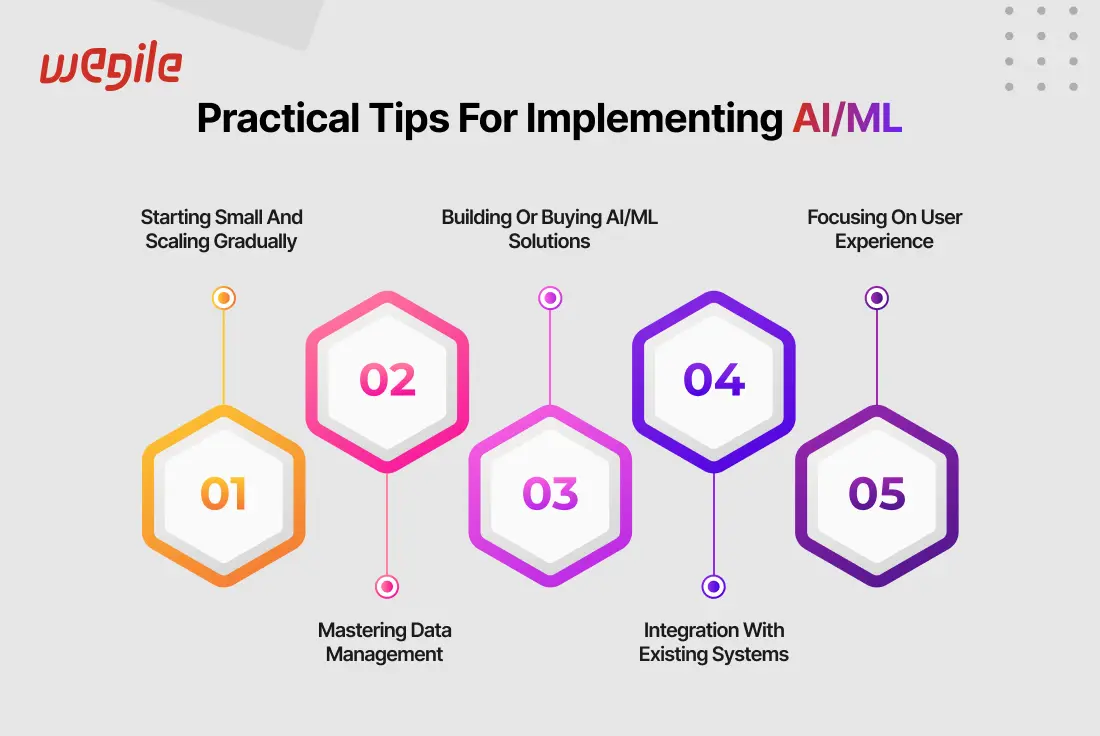
Practical Tips for Implementing AI/ML
1. Starting Small and Scaling Gradually: A
Strategic Approach to AI Implementation
Embarking on integrating Artificial Intelligence (AI) into your business processes can be as
daunting
as exciting. To navigate this landscape effectively, adopting a “start small and scale gradually”
approach can be your key to unlocking success without overwhelming your resources. Let’s break down
how this strategy works in two simple steps:
1. Starting Small and Scaling Gradually: A
Strategic Approach to AI Implementation
-
Choose the Right Project: Starting small means selecting a pilot project
that
is manageable and impactful enough to deliver measurable outcomes. For example, consider
deploying an AI system to handle initial customer inquiries through your website’s chat
service.
This task, while straightforward, plays a crucial role in shaping the customer’s first
impression of your business. -
Set Clear Objectives: Define what success looks like for your pilot
project. Is
it reducing the response time for customer inquiries? Or perhaps increasing the accuracy of
information provided? Having clear goals will help you accurately measure your AI
implementation’s effectiveness. This not only boosts AI efficiency but also enhances
generative
AI applications. While there are distinct differences between traditional AI and generative AI, this approach works
effectively for both.
2. Evaluate and Iterate Based on Outcomes
-
Monitor Performance: Once your pilot is live, keep a close eye on its
performance against your goals. Are your customers satisfied with the AI-enhanced services?
Is
the AI system integrating well with your existing tech infrastructure? -
Gather Feedback: Users’ Direct feedback can provide insights you might not
have
considered. Engage with your customers and employees to learn about their experiences with
the
new AI features. What do they like? What could be improved? -
Iterate and Optimize: Use the feedback and performance data to tweak and
refine
your AI system. For example, if the AI is not as accurate in understanding customer queries
as
expected, you might need to enhance its natural language processing capabilities. -
Scaling Up: Armed with the knowledge and success of your pilot project, you
can
confidently expand AI applications into other areas of your business. This might mean
exploring
AI for inventory management or implementing machine learning for predictive analytics in
sales.
Mastering Data Management: The Backbone of
Effective AI/ML Implementation
In Artificial Intelligence (AI) and Machine Learning (ML), data isn’t just a resource; it’s the fuel
that powers these advanced technologies. But not all fuel is created equal. The data must be clean,
accurate, and meticulously managed for AI and ML to function optimally and deliver impactful
results. Let’s explore how to achieve this through two critical data management components.
Ensuring Quality Data Collection and Processin
-
Start with High-Quality Data: Before AI can transform your data into
insights,
the information must be up to par. This means it should be relevant to your questions and
free
from errors. Begin by setting up systems to ensure the data collected is as accurate and
comprehensive as possible. -
Continual Cleansing and Validation: Data quality isn’t a one-time fix; it
requires ongoing attention. Implement processes that regularly check and clean the data: for
example, removing duplicates, correcting inaccuracies, and updating outdated information.
This
routine maintenance prevents the degradation of data quality over time. -
Tailor Data for Specific AI Applications: Different AI applications might
require different data formats or details. For example, if you’re using AI to predict
customer
behavior, you’ll need detailed customer interaction data from various touchpoints across
your
business. Ensuring this data is meticulously collected and accurately processed means your
AI
tools can make more precise predictions.
2. Importance of Data Governance
-
Establish a Strong Governance Framework:Data governance involves overseeing
the
availability, usability, integrity, and security of the data used in an organization. By
establishing a robust governance framework, you can ensure that your data handling practices
comply with legal and ethical standards and align with your business strategy. -
Focus on Accessibility and Consistency:Data should be accessible to those
who
need it and consistent across different parts of the organization. This uniformity is
crucial
for AI systems, which rely on standardized data to generate reliable outputs. -
Secure Sensitive Information:Protecting sensitive information is paramount.
Effective data governance includes implementing strong security measures to prevent data
breaches and ensuring privacy protections that comply with regulations like
GDPR
or CCPA.
Building or Buying AI/ML Solutions: Navigating
the Choices
When adopting AI and ML in your business, one of the first big decisions you’ll face is whether to
build a custom solution from scratch or buy an off-the-shelf product. Each option has its perks and
considerations:
Building Custom Solutions
Pros:
-
Tailored Fit:A custom AI solution is designed specifically for your
business
needs, ensuring that every feature is aligned with your operations. -
Competitive Edge:Custom solutions can provide unique capabilities that
differentiate you from competitors using standard products.
Cons:
-
Higher Cost:Developing a custom solution can be expensive, requiring
significant time and resources. -
Longer Timeframe:Building a bespoke solution takes time from design to
deployment.
Buying Off-the-Shelf Products
Pros:
-
Cost-Effective:Purchasing existing solutions is less costly upfront than
developing them. -
Quick Deployment:Off-the-shelf software can be deployed quickly, allowing
you
to benefit from AI capabilities sooner.
Cons:
-
Less Flexibility:These products may not perfectly fit your specific needs
or
integrate seamlessly with your existing systems. -
Dependence on Vendors:You rely on the vendor for updates, support, and
customization, which can sometimes limit your control over the solution.
Partnering with Technology Providers
Choosing the right technology partner is crucial. Look for providers who:
-
Understand Your Industry:They should have expertise in your sector and a
clear
understanding of its challenges. -
Offer Scalable Solutions:Your AI needs will evolve as your business grows.
Ensure the provider can scale the solution accordingly. -
Support and Training:They should offer your team strong customer support
and
training.
Integration with Existing Systems: Ensuring a
Smooth Transition
Integrating new AI technologies with your existing systems can be challenging but is crucial for
maximizing benefits:
Seamless Integration
-
APIs and Middleware:Use APIs (Application Programming Interfaces) or
middleware
to facilitate smooth communication between new AI solutions and existing software. -
Custom Integration Solutions:Sometimes, bespoke integration solutions may
be
necessary, especially if off-the-shelf products don’t align perfectly with your current
systems.
Overcoming Compatibility Issues
-
Upgrading Existing Infrastructure:Ensure your current infrastructure can
support new AI technologies, which may involve hardware or software upgrades. -
Data Compatibility:Standardize data formats across your systems to prevent
data
silos and ensure that AI systems can access and interpret data correctly.
Focusing on User Experience: How AI Can Delight
Your Customers
Incorporating AI into your business isn’t just about crunching numbers faster or automating routine
tasks, it’s also about enhancing the overall experience for your users. A great user experience (UX)
can significantly boost customer satisfaction, loyalty, and your bottom line. Here’s how you can use
AI not just to meet but exceed user expectations:
Designing AI Tools to Enhance User Experience
-
Intuitive Interactions:AI should make life easier, not more complicated.
Design AI interfaces that are intuitive and simple to use. For example, chatbots should
understand and respond to natural language queries without requiring users to learn specific
commands -
Personalization:AI excels at personalizing experiences. Analyzing user
data, AI can tailor content, recommendations, and services directly to individual
preferences. Imagine a shopping app that learns your style over time and suggests outfits
that fit your
taste and budget. -
Accessibility:AI can also make your services more accessible to all users,
including those with disabilities. Features like voice commands and content that adapt to
different accessibility needs can open up your services to a broader audience, ensuring
everyone benefits from your offer.
Establishing Continuous Feedback Loops with
End-Users
-
1. Real-Time Adjustments:AI systems can be designed to adapt in real-time
based on
user interactions. This dynamic adjustment process ensures that the system continuously
evolves
and improves based on how users use it. For example, if users frequently correct certain
types
of responses from a virtual assistant, the AI can learn to offer more accurate reactions
over
time. -
2. User Feedback:Direct user feedback is invaluable. Encourage users to
provide
their thoughts on their interactions with your AI systems. This feedback can be gathered
through
surveys, user forums, or direct outreach. What do they like? What frustrates them? This
information is gold dust for refining your AI tools. -
3. Analytics:Use analytics tools to track how users interact with your AI.
Which
features are they using most? Where do they seem to struggle? Data analytics provide a
clear,
unbiased view of user behavior, helping you make informed decisions about which areas of
your AI
need improvement.
Case Studies: Successful AI/ML Implementations
Case Study 1: AI in Retail for Personalized
Customer Experiences
Company: Amazon
-
Implementation:Amazon has long been at the forefront of using AI to enhance
customer experiences. One of their standout AI features is the recommendation system used on
their shopping platform. This system analyzes user behaviors, purchase history, and items
frequently bought together to personalize product suggestions. -
Impact:Amazon’s AI-driven recommendation engine reportedly drives 35% of
total
sales. By presenting tailored options, Amazon increases the likelihood of purchases and
enhances
user satisfaction by making shopping more accessible and relevant. -
Lesson Learned:Amazon’s AI implementation’s success shows data’s importance
in
crafting personalized experiences. Accurate data collection and analysis lead to precise
recommendations, which are crucial in retail, where customer preferences vary widely.
Case Study 2: ML in Manufacturing for Predictive
Maintenance
Company: General Electric
-
Implementation:GE has implemented ML across its manufacturing processes to
predict when machines will likely fail or need maintenance. This approach uses sensors and
ML
algorithms to monitor equipment performance continuously and anticipate potential breakdowns
before they occur. -
Impact:By adopting predictive maintenance, GE has reduced unplanned
downtime by
up to 20% and increased their machines’ lifespan. This not only saves on maintenance costs
but
also improves overall operational efficiency. -
Lesson Learned:GE’s experience highlights the value of ML in reducing costs
and
enhancing manufacturing productivity. The key to success lies in integrating comprehensive
sensor data with robust ML models to foresee and prevent equipment failures.
Key Takeaways from These Implementation
-
Data is King Both Amazon and GE demonstrate that having robust,
high-quality
data is crucial for the success of AI and ML applications. The accuracy of your input data
directly influences the effectiveness of your AI solutions. -
Integration with Business Objectives: AI and ML technologies yield the best
results when they are directly aligned with specific business goals, whether improving
retail
customer satisfaction or enhancing manufacturing efficiency. -
Continuous Improvement: AI and ML implementations are not set-and-forget
solutions. Constant monitoring, feedback, and adjustments are necessary to keep the systems
adequate and relevant.
Conclusion
As we’ve navigated through the essential strategies for leveraging AI and ML in digital
transformation, it’s clear that these technologies offer transformative potentials for any business
ready to innovate and lead. Whether you’re just starting with a pilot project or looking to enhance
existing processes, AI and ML can drive significant advancements.
Ready to take the next step in your digital transformation journey? Discover how Wegile’s
Generative AI App Development Services can
tailor AI solutions to your unique business needs. Imagine unleashing the full potential of your
business with tools that predict, automate, and engage at levels that set industry standards. With
Wegile’s Generative AI App Development Services, this isn’t just a possibility; it’s your next giant
leap. Why settle for playing catch-up when you can lead the pack? Elevate your business with
solutions that are as dynamic as the market itself.
Leave a Reply