The advent of generative AI has sparked a paradigm shift across various industries, with drug
discovery emerging as one of its most promising frontiers. By harnessing the capabilities of
generative algorithms, researchers are revolutionizing the development of new drugs, significantly
enhancing efficiency, reducing costs, and improving success rates. Compared to traditional methods
that are often hindered by high expenses and low probabilities of success, generative AI leverages
advanced machine learning models to predict effective drug compounds, thereby streamlining the
entire drug discovery pipeline.
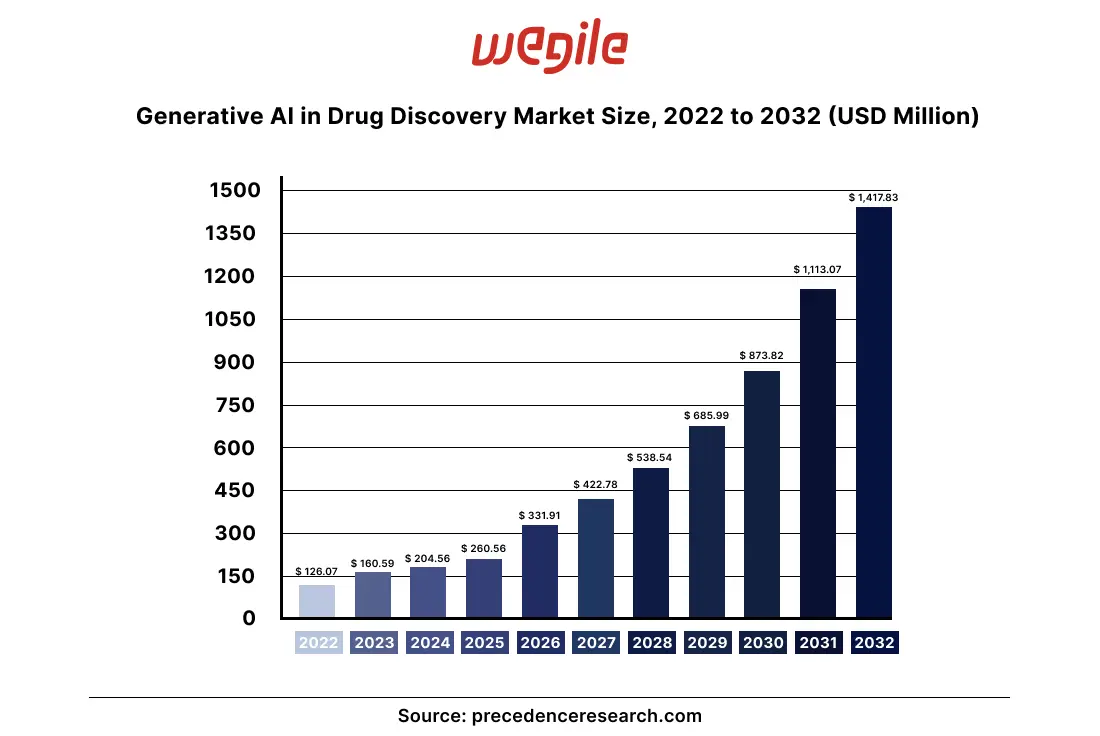
The impact of generative AI on drug discovery is underscored by its rapidly growing market. In 2022,
the global market for generative AI in drug discovery reached approximately $126.07 million. This
market is expected to expand dramatically, projected to soar to around $1,417.83 million by 2032,
with a compound annual growth rate (CAGR) of 27.38%
from
2023 to 2032. This exponential growth reflects the
transformative potential and increasing adoption of generative AI technologies in the pharmaceutical
industry. In this blog, we will understand the role of generative AI in drug discovery.
Traditional Drug Discovery Challenges
The traditional drug discovery process is complex and filled with various obstacles that hinder its
efficiency and effectiveness. One of the primary obstacles is the high cost associated with bringing
a new drug to market. The average expenditure can reach billions of dollars, driven by extensive
research, development, and clinical trial phases. This financial burden becomes worse by the long
timelines involved, which can often stretch over a decade from the initial discovery to the final
approval.
Moreover, the success rates in traditional drug discovery are alarmingly low. For every thousands of
compounds tested, only a handful make it through to clinical trials, and an even smaller fraction
receives regulatory approval. This low probability of success is largely due to the trial-and-error
nature of conventional methods, which rely heavily on iterative testing and refinement.
A less frequently discussed challenge is the bottleneck created by data analysis. The vast amounts
of
biological and chemical data generated during drug discovery require sophisticated analysis tools
and expertise. Traditional methods often fall short in efficiently processing and interpreting this
data, leading to delays and missed opportunities. In addition, traditional drug discovery cannot
adapt rapidly to emerging threats, such as pandemics. The inflexibility of conventional approaches
means that developing treatments for new diseases can be slow and reactive rather than proactive.
Must Read: How To Build
Generative AI Apps:
A Comprehensive Guide
What is
the Role of Generative AI in Drug Discovery?
Generative AI is playing a pivotal role in revolutionizing drug discovery, bringing unparalleled
efficiencies and innovations to the field. One of the most significant contributions of generative
AI is its ability to accelerate the research and development process. By leveraging advanced
algorithms, generative AI can rapidly generate and evaluate potential drug candidates, drastically
reducing the time required to identify promising compounds. This is particularly crucial in
responding to emerging health threats, where speed is of the essence.
Another key advantage of generative AI is its potential to reduce costs. Traditional drug discovery
methods involve extensive and expensive laboratory work. In contrast, generative AI can perform many
of these tasks virtually, minimizing the need for costly physical trials. This cuts down on expenses
and allows for the exploration of a wider range of compounds that might otherwise be economically
unfeasible.
Generative AI also enhances the success rates of drug discovery. By using machine learning models
trained on vast datasets, generative AI can predict the efficacy and safety of drug candidates with
greater accuracy than traditional methods. This predictive power helps prioritize compounds that are
more likely to succeed in clinical trials, thereby increasing the overall efficiency of the drug
discovery pipeline.
Moreover, generative AI introduces innovative use cases for generative AI drug discovery that go
unnoticed. For instance, AI-driven platforms can simulate complex biological interactions and
predict how different compounds will behave in the human body. This capability allows researchers to
gain deeper insights into the mechanisms of action of potential drugs, facilitating the design of
more effective and targeted therapies.
Benefits of Generative AI in Drug Discovery
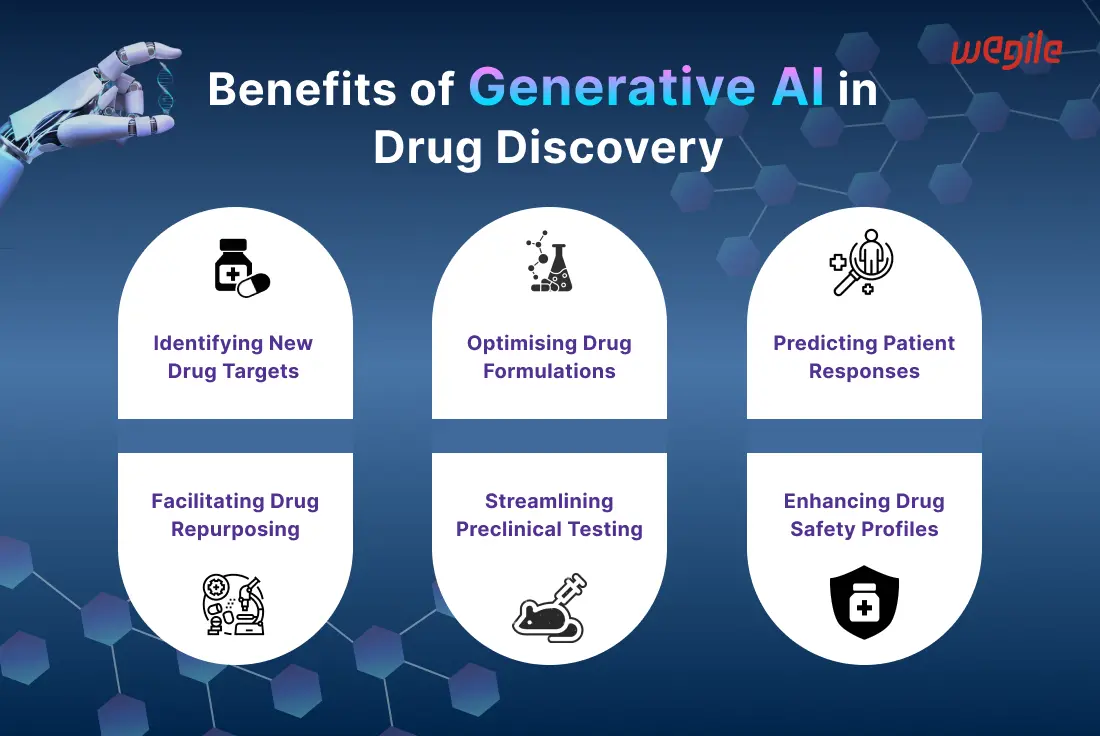
1. Identifying New Drug Targets
Generative AI is exceptionally adept at identifying novel drug targets. Traditional methods often
rely on known biological pathways and targets, which can limit the scope of discovery. Generative AI
can analyze complex biological data to uncover new targets that may not have been previously
considered. By mining vast datasets of genetic, proteomic, and metabolic
information, AI models can identify
potential targets for drug development that were previously avoided, offering new avenues for
therapeutic intervention.
2. Optimizing Drug Formulations
Generative AI plays a critical role in optimizing drug formulations. Beyond identifying potential
drug candidates, AI can refine the molecular structure of these candidates to improve their
effectiveness and reduce side effects. By simulating different molecular interactions and predicting
outcomes, AI can suggest modifications to the molecular structure that enhance the drug’s
properties. This capability allows for the development of drugs that are effective, safer, and more
easily administered to patients.
Must Read: How Generative AI Can Be Used In The Real World?
3. Predicting Patient Responses
One of the more innovative use cases for generative AI
in drug discovery is its ability
to predict patient drug response. AI models can analyze genetic and phenotypic data from patient
populations to predict how different groups of patients will respond to a particular drug. This
capability is crucial for developing personalized medicine, where treatments are tailored to the
genetic profile of individual patients. By predicting patient responses, generative AI can help in
designing drugs that are more effective for specific populations, thereby increasing the overall
success rates of new therapies.
4. Facilitating Drug Repurposing
Drug repurposing, the process of finding new uses for existing drugs, is another area where
generative AI excels. AI can analyze existing drugs and predict new therapeutic uses based on their
molecular structure and known interactions. This can significantly reduce the time and cost
associated with bringing a drug to market, as existing drugs have already undergone extensive safety
testing. Generative AI can identify potential new indications for these drugs, offering a faster
path to treatment for many conditions.
5. Streamlining Preclinical Testing
Generative AI can streamline the preclinical testing phase of drug development. Traditionally, this
phase involves extensive in vitro and in vivo testing,
which can be time-consuming and
costly. AI models can simulate these tests, predicting how a drug will behave in biological systems
before it is ever tested in the lab. This capability can help identify potential issues early in the
development process, reducing the likelihood of failure in later stages and making the entire
process more efficient.
6. Enhancing Drug Safety Profiles
Ensuring the safety of new drugs is a critical aspect of the drug discovery process. Generative AI
can enhance the safety profiles of drugs by predicting adverse effects and toxicities early in the
development process. By analyzing data from previous drug trials and known side effects, AI models
can identify potential safety issues with new drug candidates. This allows researchers to modify the
molecular structure of the drug or take other measures to mitigate these risks, ultimately leading
to safer drugs reaching the market.
Key
Technologies in Generative AI for Drug Discovery
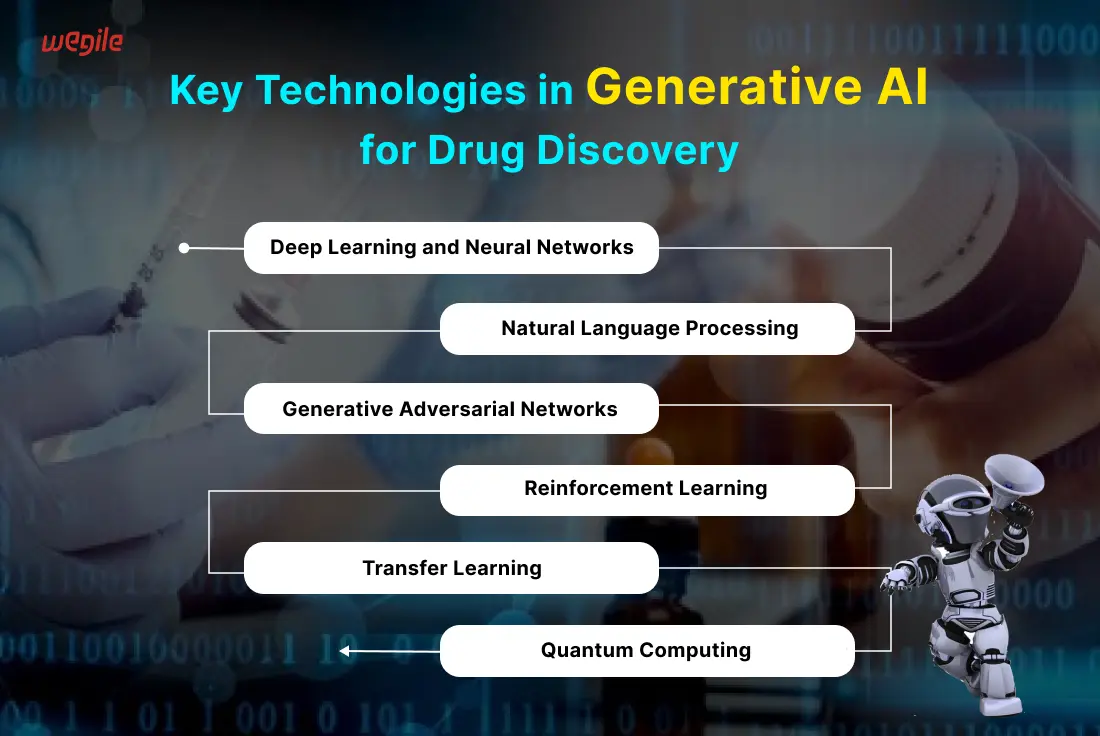
1. Deep Learning and Neural Networks
Deep learning
and neural
networks are fundamental technologies in generative AI that have significantly impacted
drug discovery. These models excel at handling large datasets and identifying complex patterns
within them. In drug discovery, deep learning algorithms can predict molecular properties, identify
potential drug candidates, and optimize lead compounds by simulating how they interact with
biological targets. A less frequently discussed application is their ability to model
polypharmacology, where a
single
drug affects multiple targets,
providing a more holistic approach to treatment development.
2. Natural Language Processing
Natural
Language Processing
(NLP) is a transformative
technology in generative AI that is often underappreciated in its application to drug discovery. NLP
can process and analyze vast amounts of scientific literature, patents, and clinical trial data to
extract valuable insights. For example, it can identify previously unnoticed connections between
biological pathways and potential therapeutic targets. Additionally, NLP algorithms can assist in
drafting detailed scientific documents and patents, speeding
3. Generative Adversarial Networks (GANs)
Generative Adversarial
Networks (GANs) are a groundbreaking technology in the realm of generative AI. GANs consist
of two neural networks—the generator and the discriminator—that work together to produce new data
samples. In drug discovery, GANs can generate novel molecular structures that fit specific criteria
for drug-like properties. This ability to explore uncharted chemical spaces allows researchers to
discover unique compounds that traditional methods might miss. Beyond generating new molecules, GANs
can also optimize existing drug candidates, enhancing their efficacy and safety profiles.
4. Reinforcement Learning
Reinforcement
learning is another powerful tool in the
generative AI arsenal for drug discovery. This approach involves training algorithms to make
decisions through trial and error, receiving rewards for actions that lead to desired outcomes. In
drug discovery, reinforcement learning can be used to optimize the drug design process by
continuously improving the properties of potential drug candidates based on feedback from simulated
biological environments. This iterative optimization can lead to the discovery of highly effective
and targeted therapies.
5. Transfer Learning
Transfer
learning is a technology that leverages pre-trained models on one task to improve
performance on a related task. In drug discovery, transfer learning can be utilized to apply
knowledge gained from studying one disease to another, accelerating the identification of drug
candidates for less-studied conditions. This approach can be particularly beneficial in rare
diseases, where limited data availability can hinder traditional machine-learning methods. By
transferring knowledge from well-studied diseases, generative AI can help bridge the gap and
expedite the drug discovery process.
6. Quantum Computing
Quantum
computing , though still in its nascent stages, holds
immense potential for drug discovery. Quantum computers can process and analyze data at
unprecedented speeds, solving complex problems that are currently intractable for classical
computers. In the context of generative AI, quantum computing can enhance molecular simulations,
enabling the accurate modeling of molecular interactions at a quantum level. This precision can lead
to the discovery of novel drug candidates
Must
Read:
Top Generative AI Solutions:
Scaling & Best Practices
Future Prospects
1. Integration with Quantum Computing
The future of generative AI in drug discovery looks promising, especially with the potential
integration of quantum computing. Quantum computers, which process data at unprecedented speeds, can
solve complex molecular simulations that are currently beyond the capabilities of traditional
computers. This could enable generative AI to model molecular interactions at a quantum level,
leading to the discovery of novel drug candidates with optimized properties. Such integration could
drastically reduce the time and cost associated with drug discovery, pushing the boundaries of what
is currently achievable.
2. Personalized Medicine
Generative AI is expected to play a pivotal role in the advancement of personalized medicine. By
analyzing an individual’s genetic profile, AI can predict how a patient will respond to various
drugs, enabling the development of personalized treatment plans. This tailored approach can enhance
the efficacy and safety of therapies, reducing adverse effects and improving patient outcomes. The
application of generative AI in personalized medicine represents a significant shift from the
traditional one-size-fits-all model to more customized healthcare solutions.
3. Real-Time Data Analysis
The future of drug discovery will likely see generative AI performing real-time data analysis,
allowing for immediate insights and decision-making. Currently, the analysis of biological and
chemical data can be a time-consuming process. Generative AI, combined with real-time data streaming
technologies, can analyze data as it is generated, providing instantaneous feedback to researchers.
This capability can accelerate the research and development process, making it more responsive and
dynamic.
4. Expansion into Rare Diseases
Generative AI holds the promise of expanding drug discovery efforts into rare and orphan diseases.
These conditions often receive less attention due to their smaller patient populations and the high
costs associated with research. AI-driven approaches can make the exploration of treatments for rare
diseases more feasible by reducing costs and accelerating discovery. This could lead to
breakthroughs in areas that have been historically underfunded and under-researched.
5. Collaborative AI Models
Future advancements may also see the development of collaborative AI models that integrate various
AI
systems to enhance drug discovery. These models could combine different AI technologies, such as
natural language processing, deep learning, and reinforcement learning, to provide a more
comprehensive approach. Collaborative AI models can pool insights from multiple sources, leading to
more robust and effective drug discovery processes.
6. Ethical and Regulatory Evolution
As generative AI continues to evolve, so too will the ethical and regulatory landscapes. The
implementation of AI in drug discovery raises questions about data privacy, algorithmic bias, and
the need for transparent and explainable AI models. Future prospects will involve the development of
robust ethical frameworks and regulatory guidelines to ensure that AI-driven drug discovery is
conducted responsibly and ethically. This evolution will be crucial in gaining public trust and
ensuring the safe application of AI in healthcare.
Conclusion
Generative AI is revolutionizing drug discovery by enhancing efficiency, reducing costs, and
increasing success rates. Its ability to democratize the field, predict off-target effects, and
simulate complex biological interactions offers profound benefits. To fully harness its
capabilities, it’s essential to seek reliable Generative AI
development
services. At Wegile, we excel in
incorporating advanced AI models into your research and development processes. Partner with us to
transform your approach to drug discovery, making it more efficient, cost-effective, and innovative.
Embrace the future of drug development with our cutting-edge AI solutions.
Leave a Reply