Generative AI has surged in popularity, revolutionizing how we create content and solve complex
problems. From generating realistic images and text to designing software and simulating scientific
phenomena, generative AI is being leveraged in the real
world
for various use cases. Industries
such as
healthcare,
finance ,
entertainment, travel ,
marketing, real estate
,
etc, are harnessing their capabilities to innovate
and stay competitive. Businesses are building generative AI
solutions to automate tasks, enhance
creativity, and derive insights from vast datasets. As companies dive into the world of generative
AI, one of the critical decisions they face is choosing the right programming language. This choice
impacts the development speed, performance, and scalability of their AI applications. With numerous
options available, selecting the best language can be challenging. But there’s no need to worry. In
this article, we’ve covered the top five programming languages for generative AI in 2024. Whether
you’re an investor or an AI enthusiast, this guide will help you navigate the choices and find the
best fit for your generative AI projects.
Criteria for Selecting Programming Languages for
Generative AI
Choosing the right programming language for generative AI development is more than just picking a
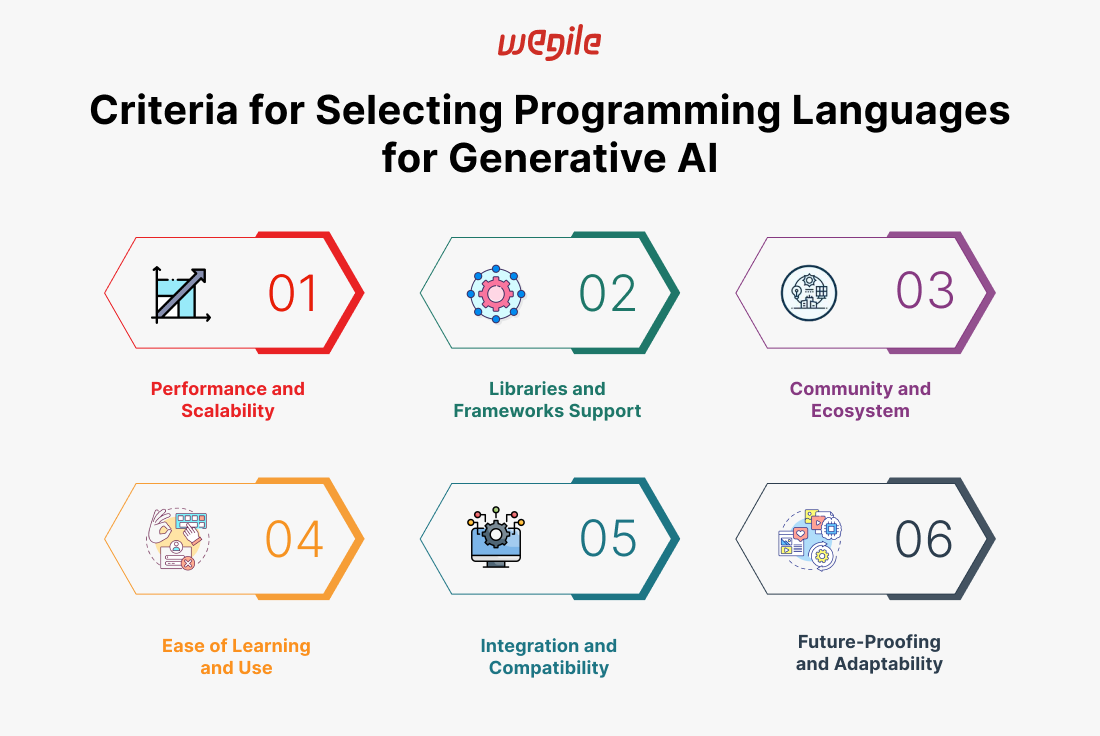
popular option. It involves a detailed analysis of several critical criteria to ensure the selected
language aligns with the project’s needs. Understanding these criteria can help in making an
informed decision that boosts efficiency and effectiveness.
1. Performance and Scalability
Performance and scalability are paramount in generative AI, where models can be computationally
intensive and large datasets. High-performance languages like C++ and Julia offer significant
advantages by allowing for fine-grained control over system resources and optimizing execution
speed. These capabilities are especially important in real-time applications and large-scale
deployments where every millisecond counts.
2. Libraries and
Frameworks Support
The availability of robust libraries and frameworks can dramatically reduce development time and
enhance functionality. Python, with its extensive ecosystem of libraries like TensorFlow, PyTorch , and
Keras, provides powerful
tools that streamline the development
of generative AI models. Meanwhile, JavaScript’s TensorFlow.js enables machine
learning models to run directly
in the browser, expanding the possibilities for web-based applications.
Must Read: Top
Generative
AI Tools By Use Case
3. Community and
Ecosystem
An active community and a rich ecosystem are invaluable for overcoming challenges and accelerating
development. A language with a strong community offers extensive documentation, shared code
repositories, and regular updates. Python and JavaScript are prime examples of languages with
vibrant communities that contribute to a wealth of resources, ensuring developers can find solutions
and support quickly.
4. Ease of
Learning and Use
The learning curve of a programming language can influence its adoption, especially among beginners
and interdisciplinary teams. Python is known for its readability and simplicity, making it
accessible to a wide range of developers. On the other hand, languages like Julia, designed with
mathematical and scientific computing in mind, provide a syntax that is both high-level and
expressive, reducing the complexity of coding for advanced applications.
5. Integration
and Compatibility
Generative AI applications often need to integrate with other systems, databases, and technologies.
Languages that offer seamless integration capabilities can simplify these processes. R, for
instance, excels in statistical analysis and data visualization, making it ideal for data-driven AI
projects that require extensive data handling and manipulation. Ensuring compatibility with existing
infrastructure and tools is crucial for smooth operations and scalability.
6.
Future-Proofing and Adaptability
The tech landscape evolves rapidly, and choosing a language that can adapt to future developments is
essential. Emerging languages like Julia are built with future needs in mind, offering performance
improvements and modern features that cater to the evolving demands of AI development. Keeping an
eye on the language’s development roadmap and industry adoption trends can provide insights into its
long-term viability.
Top 5 Programming Languages for Generative AI
1. Python
Python remains a dominant force in the realm of generative AI thanks to its versatility, simplicity,
and extensive ecosystem. Its popularity is due to its ease of use and the powerful libraries and
frameworks that support complex AI development. Python’s rise in popularity can be attributed to its
readability and straightforward syntax, which makes it accessible to both beginners and experienced
developers. It is widely adopted in academia and industry alike, creating a vast pool of resources
and community support. Python’s design philosophy emphasizes code readability and simplicity,
enabling developers to focus more on solving problems rather than wrestling with complex syntax.
Why Choose Python?
-
Extensive Libraries and Frameworks: Python boasts powerful libraries like
TensorFlow, PyTorch, and Keras, which simplify the development of complex AI models. -
Ease of Use and Readability: Python’s syntax is straightforward and
readable, making it accessible to beginners and allowing developers to focus more on solving
problems. -
Large Community and Support: An active and large community provides
extensive documentation, tutorials, and support, accelerating problem-solving and
development. -
Versatility: Python can be used for a wide range of applications beyond
AI,
including web development, data analysis, and automation, making it a versatile choice for
developers. -
Error Handling: Python’s built-in error handling mechanisms can help catch
and address issues during development. However, for robust generative models, developers
might need to implement additional error handling specific to the AI tasks. -
Dependency Management: Managing dependencies between various Python
libraries can become complex in large projects. This can introduce potential reliability
issues if version conflicts arise. Using tools like virtual environments helps mitigate
these issues.
2. JavaScript (Node.js)
JavaScript, traditionally known for web development, has emerged as a powerful language for
generative AI, especially with the advent of Node.js. Its ability to
run
on both the server and client-side
makes it a unique tool in the AI developer’s toolkit. JavaScript’s versatility stems from its
ubiquity in web development and its ability to execute in any modern web browser. This capability
makes it ideal for deploying AI models directly to users without the need for complex backend
infrastructure. With Node.js, JavaScript extends its reach to server-side applications, enabling
developers to create full-stack AI solutions using a single language.
Why Choose JavaScript?
-
Active and Supportive Community: JavaScript boasts a large and active
community. This translates to a wealth of resources, tools, and ongoing support for
developers building generative AI models with JavaScript. The community fosters continuous
improvement of libraries and frameworks, contributing to the overall reliability of the
JavaScript ecosystem for generative AI. -
Real-Time Deployment and Interaction: Libraries like TensorFlow.js enable
the building and running of generative models directly in the browser. This facilitates
faster deployment and real-time interaction for web-based AI applications, which is ideal
for projects where users need to interact with the generative model in real-time. -
Streamlined Development with Node.js: Node.js allows developers to use
JavaScript for both front-end and back-end development of generative AI applications. This
simplifies the development process by reducing context switching between languages, which
can lead to fewer errors. -
Library Maturity: While JavaScript has libraries like TensorFlow.js and
Brain.js,
they might be an evolving field compared to
established libraries in other languages. This can mean fewer resources for testing and
debugging, potentially impacting the reliability of complex generative models. For complex
AI projects, it’s important to assess the maturity of available JavaScript libraries and
their suitability for the task. -
Performance Limitations: JavaScript has improved in performance, but
computationally intensive generative models might encounter limitations. If your project
requires high-performance AI tasks, it’s important to explore alternative approaches within
the JavaScript ecosystem or consider other languages.
Must Read:
What
Every CEO Must Know About
Generative AI?
3. R
R is renowned for its powerful statistical and data analysis capabilities, making it a valuable
language for generative AI, especially in data-driven projects. R excels in statistical computing
and graphics, which makes it an excellent choice for projects that require extensive data
manipulation and visualization. Its vast library of statistical tools and functions allows for
sophisticated data analysis, a crucial aspect of many generative AI applications. R’s syntax and
data handling capabilities are designed specifically for statistical tasks, providing a robust
foundation for developing AI models that rely heavily on data analysis.
Why Choose R?
-
Strong Data Foundations: R excels in handling and manipulating large
datasets. This is crucial for training reliable generative models, as high-quality data is
essential for accurate outputs. R’s capabilities ensure the model is trained on clean and
accurate data, leading to more reliable results. -
Specialized Toolset: R offers a rich ecosystem of packages specifically
designed for machine learning and deep learning tasks in generative AI. Packages like
caret,
mlr,
and
tensorflow
provide well-established tools for
various aspects of model building. These well-tested and refined packages contribute to the
overall reliability of the development process. -
Active Community Support: A vibrant R community fosters knowledge sharing
and collaboration. This translates to readily available resources, troubleshooting
assistance, and code optimization techniques. By leveraging this community, developers can
identify and address potential issues before they impact model reliability. -
Comprehensive Documentation: R boasts extensive documentation that covers
not only the base language but also its many packages. This documentation provides
developers with clear guidance on using R’s functionalities for generative AI development.
Clear instructions help developers avoid errors and ensure reliable implementation of their
models.
4. Julia
Julia is an emerging language in generative AI, known for its high-performance capabilities and ease
of use for scientific computing. Julia stands out due to its impressive performance. It is designed
to handle high-performance numerical and scientific computing, making it an excellent choice for
generative AI tasks that require intensive computation. Julia’s syntax is straightforward and
user-friendly, but it includes features that cater to high-level mathematical operations and
algorithmic efficiency.
Why Choose Julia?
-
High-Performance Computing Power: Julia excels at computationally
intensive
tasks, similar to languages known for performance. This translates to reliable model
training and execution, especially for complex generative models with large datasets.
Developers can be confident that Julia can handle the demands of their AI projects. -
Clear and Maintainable Codebase: Julia’s syntax is designed to be
user-friendly and readable. This clarity helps reduce errors during development and
simplifies code maintenance in the long run. Clear code leads to more reliable models as
potential issues are easier to identify and fix. -
Advanced Generative AI Ecosystem: A growing ecosystem of Julia libraries
caters specifically to generative AI development. Flux.jl
provides a powerful framework for building neural networks, while Turing.jl offers tools
for probabilistic programming, a crucial area in generative AI. These libraries are actively
maintained by the Julia community, ensuring ongoing reliability through bug fixes and
improvements. -
Flexibility through Interoperability: Julia seamlessly integrates with
other programming languages. This allows developers to leverage existing, well-tested
codebases and tools written in different languages. By incorporating these external
resources, developers can enhance the project’s reliability by utilizing code with a proven
track record.
5. C++
C++ is a well-established language known for its performance efficiency and control over system
resources, making it a solid choice for performance-critical generative AI applications. C++ offers
unparalleled efficiency and low-level memory management, which are crucial for applications
requiring high performance and resource optimization. Its ability to execute complex algorithms
quickly and its fine-grained control over hardware resources make it suitable for generative AI
models that need to process large datasets or perform real-time computations.
Why Choose C++?
-
Efficiency and Speed: C++ offers unparalleled efficiency and control over
system resources, essential for performance-critical AI applications. -
Low-Level Memory Management: Fine-grained control over memory management
ensures optimal use of hardware resources. -
Robust Libraries: Frameworks like TensorFlow and Caffe provide
comprehensive tools for building and deploying high-performance AI models. -
Widely Used in Industry: C++ is extensively used in industry applications,
especially where performance and resource optimization are critical.
Wrapping Up
Choosing the right programming language is crucial for the success of generative AI projects. Each
language has its unique strengths and is suited to different types of tasks. By understanding the
strengths and applications of these languages, developers can make informed decisions that align
with their project’s specific needs. The right choice can lead to more efficient development
processes, better performance, and, ultimately, more innovative and effective AI solutions. At
Wegile, we specialize in Generative AI
development
services, leveraging our extensive
expertise to deliver cutting-edge solutions tailored to your unique needs. Explore our generative AI
development services to see how we can support your next project. With Wegile, you can be confident
that your generative AI solutions will be built on a solid foundation, utilizing the best tools and
practices
in the industry.
Leave a Reply