We are all witnessing the glorious wave of AI, and now, the main protagonist of this story is
Generative AI. But have you ever thought about what Gen AI can do for your business in the real
world? Have you ever wondered how this cutting-edge technology could streamline operations, boost
productivity, and revolutionize customer interactions? But what is so explosive and new
in Gen AI
that
is transforming industries across the globe?
Explore how this innovative technology is making significant strides in business process automation.
Continue reading this enlightening blog to uncover the capabilities of generative AI in transforming
your business processes.
What
is Generative AI for Business Process
Automation?
Generative AI for business process automation is a table-turner in the business world. Okay, envision
a technology so clever that it can generate emails, create blogs, formulate reports, design
graphics, and even chat with customers all on its own. That’s what generative AI brings to the
table. Generative AI is bliss for the business world, and every CEO must know this fact about
Generative AI.
This technology works by learning from loads of data about how to do specific tasks. Once it’s
learned enough, it can start doing these tasks without help. It’s like having a super-smart
assistant who knows exactly what you need before asking!
This means AI can handle a lot of the boring stuff in business. Need to draft a hundred personalized
emails? Generative AI tools
have got it covered. Want to analyze heaps
of data to find out what your customers like? Generative AI can do that, too. It’s all about making
things quicker and smoother and letting people focus on more challenging work.
For companies, this isn’t just cool; it’s beneficial. It reduces time and money spent on routine
tasks, reduces mistakes, and keeps things moving effortlessly. So, generative AI is more than just a
fancy tool. It is a reliable friend that helps a business run better than ever.
Simplifying Business Operations with Generative AI:
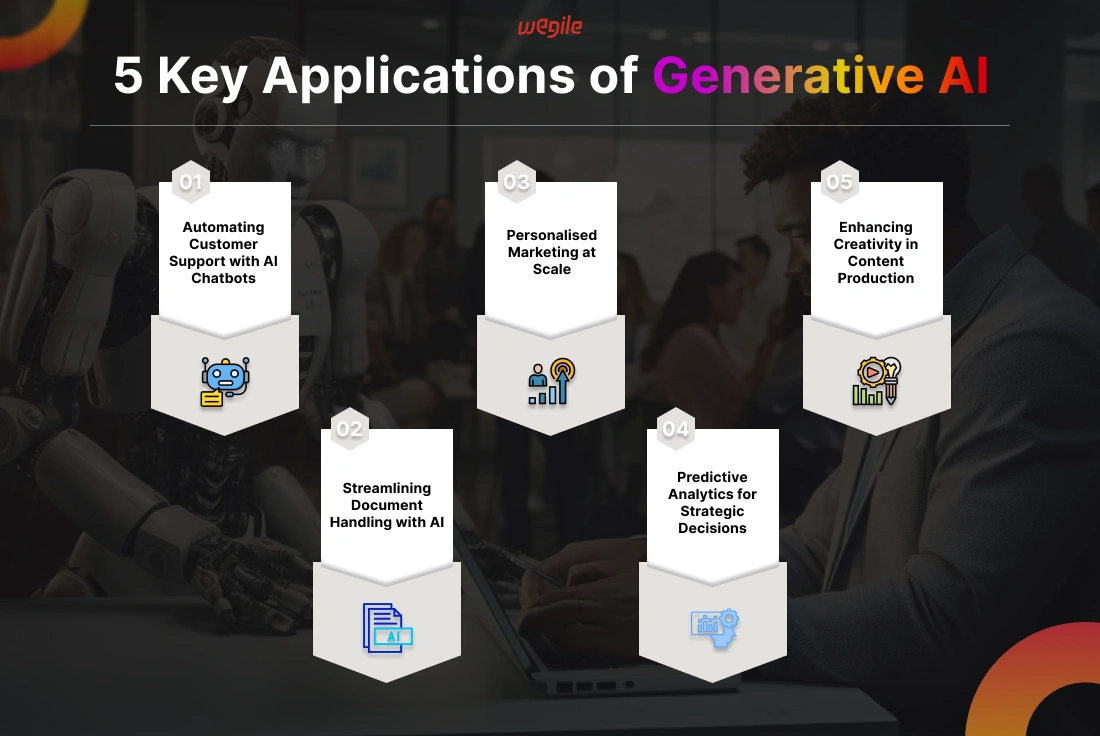
Five Key Applications
Automating
Customer Support with AI Chatbots
Businesses are enhancing customer experiences by integrating Generative AI chatbots. These bots
handle inquiries instantly by providing customized answers around the clock without breaks or
downtime. They learn from interactions to improve their responses. It makes every customer
interaction effective and personalized.
Streamlining Document Handling with AI
Generative AI steps into roles traditionally held by humans in document management. It automates the
creation, sorting, and processing of vast amounts of documents with precision. It also reduces
errors and saves valuable time. It lets employees focus on more strategic tasks.
Personalized Marketing at Scale
AI tools analyze customer data to craft personalized marketing messages. They adapt content to
individual preferences and behaviors. This makes sure that marketing campaigns are more relevant and
effective. It eventually results in higher engagement and increased sales conversions.
Predictive
Analytics for Strategic Decisions
Generative AI excels in analyzing trends and forecasting future market conditions. Businesses use
Generative AI-driven predictive analytics to make informed strategic decisions, from inventory
management to new market entries, ensuring they stay ahead of market shifts.
Enhancing Creativity in Content Production
In creative departments, AI is revolutionizing content production. It assists in generating initial
content drafts, video scripts, or design elements, which professionals can refine and finalize. This
collaboration between human creativity and AI efficiency speeds up production and boosts creativity.
How can generative AI be implemented to automate
business processes effectively?
Implementing generative AI to automate business processes offers excellent advantages. Success
hinges
on several key areas that effectively tap into the technology’s capabilities.
1.
Infrastructure Requirements
A robust infrastructure is fundamental to integrating top
generative AI solutions into your business processes.
Here’s what you need to ensure everything runs smoothly and efficiently.
-
Powerful Servers and Storage
At the heart of AI functionality are powerful servers that can process and analyze data at
incredible speeds. These servers should be equipped with ample storage to handle vast
amounts of information generated and used by AI systems. This setup is about power and
capacity, ensuring that your AI can operate without any hitches in data access or processing
delays. -
Cloud Services for Flexibility and Scalability
Cloud services provide the ease and flexibility to scale operations up or down based on your
present needs. This is incredibly valuable for managing costs and resources. More
importantly, cloud platforms can quickly adapt to the changing demands of AI applications.
They allow for seamless expansions or modifications without needing physical infrastructure
changes. -
Efficient Data Transfer Capabilities
Your network’s ability to handle large data transfers is critical. AI systems require the
movement of significant amounts of data at high speeds. Ensuring your network infrastructure
can support these demands is vital for the uninterrupted functioning of AI applications.
This means investing in robust networking hardware and optimizing your network architecture
for peak performance. -
Investment in High-Quality Hardware and Software
Put your money in the best hardware and software. Quality technology has additional upfront
costs but pays off in the long run. High-quality components last longer. They also perform
better and bring more reliability
2. Data Management
Successful implementation of generative AI in your business model depends on the data quality used.
Here’s how to ensure your data management practices are up to the mark, leading to better AI
performance and trustworthy outcomes.
-
Focus on Data Quality
The accuracy and completeness of your data are vital. High-quality data fuels Generative AI
systems and encourages them to generate reliable and effective outputs. Guarantee your data
collection methods capture detailed and accurate information. Regular audits and cleaning
processes help maintain the integrity of your data. It ensures that your AI systems always
work with the best possible information. -
Safeguarding Data Privacy
With the increasing importance of data in AI applications, protecting this data becomes
crucial. Implement robust privacy measures that comply with legal requirements and build
trust with your clients and users. Techniques such as encryption and using secure
environments for data processing protect sensitive information from unauthorized access and
breaches. -
Extensive Data Collection
For generative AI to be truly effective, vast amounts of data need to be learned from. The
more comprehensive your datasets, the better your AI system can understand and respond to
various scenarios. It includes collecting large volumes of data and providing that the data
covers a wide range of conditions. It ensures that data includes variables relevant to your
specific AI applications. -
Implementing Strong Access Controls
Access controls are vital to insulate your data from internal and external threats;
restricting who can access what data can cut down the risk of mishandling or exposing
sensitive information. Strong authentication processes, when combined with access logging
and monitoring, can assist you in maintaining tight control over your data resources. -
Commitment to Regular Updates and Maintenance
Look, data management is not a do-it-and-then forget-it task. It needs your attention and
requires adaptation to new challenges and technologies. Regular updates to your data
management systems and practices confirm they remain secure. It includes updating security
protocols. It also involves refining data collection methods plus continuously improving
data quality.
3. Algorithm Selection
Selecting the best AI model is crucial in automating your business processes effectively. Here’s how
to approach this decision to ensure your AI integration meets your business objectives and operates
efficiently.
-
Analyze Your Data and Tasks
Start by analyzing your data and apprehending the specific tasks you want to automate. Some
models might be better at recognizing speech. The others may excel at predicting consumer
behavior by relying on past purchases. Assess various models once you know what tasks you
want to automate and what your data looks like. Understand and comprehend how each model
performs tasks similar to those you need. Focus on deciding parameters such as accuracy,
processing speed, plus the ease with which the model can be combined into your existing
systems. -
Choose a Model That Matches Your Needs
Choosing an AI model that syncs closely with your business requirements is super important.
The model should not only be capable of performing the required tasks efficiently, it should
also be scalable and adaptable as your business grows and evolves. -
Test Different Algorithms
Before coming to your final decision, it’s wise to test various algorithms. Test them under
conditions that simulate actual business operations. This testing phase will demonstrate how
well each model handles real-world data sets and tasks. -
Continuously Review and Adapt
After determining a model, keep surveying its performance and make adjustments as necessary.
And, as your business environment and data undergoes modification, your AI model may also
need to improve and evolve.
4. Deployment Phases
-
Start Small to Learn Big
A pilot test acts as a trial run for your AI system. By applying Generative AI to a small
part of your business or a single process, you can understand how well it performs in a
controlled setting. It helps determine any mismatches between your expectations and the
actual capabilities of the AI. -
Evaluate and Proceed
If your pilot test is successful and achieves the desired outcomes, it’s a green signal to
move forward. This successful testing phase reassures you that the Generative AI system can
meet your needs. It confirms that your AI panel is ready for a broader roll-out. It’s an
encouraging sign that you are on the right track.
Impact Assessment of Generative AI in Business
Apprehending the impact is also crucial after integrating generative AI into business processes. It
involves exploring various aspects. The aspects vary from measuring its effectiveness and
efficiency. They also include analyzing the financial benefits and strategic gains over competitors.
-
Measuring Effectiveness and Efficiency: The first step in analyzing the
success of generative AI is through performance metrics. Businesses should focus on specific
indicators like accuracy and speed of task completion. They also keep an eye on the
reduction in human intervention required. Companies can effortlessly track improvements and
improve systems to maximize efficiency by setting clear benchmarks before AI implementation.
For example, if Generative AI is used for customer service, then the evaluation metrics can
include response time improvements and increased resolution rates. -
Analyzing Return on Investment (ROI): ROI from generative AI comes from two
main elements: cost savings and other productivity enhancements. Quantifying how much time
and resources are conserved due to Generative AI automation is essential. Plus, increased
revenue due to improved customer service or better-targeted marketing campaigns can impact
the ROI. -
Long-term Strategic Benefits: Beyond a few immediate financial metrics,
generative AI also brings long-term strategic benefits. These include staying ahead of
competitors by innovating faster. It involves adapting to market changes seamlessly.
Generative AI can also enrich a company’s reputation as a tech-savvy leader. It can help
attract better talent plus open new business opportunities. Evaluating these aspects also
requires a broader perspective of market dynamics and the company’s status within the
industry.
Final words
The potential of Generative AI App Development Services is immense and continues to grow as
technology progresses. Generative AI is not just about automating routine tasks. It’s about creating
smarter systems that can predict. It designs systems that can adapt and respond in ways that imitate
human intuition. It also does so with the efficiency and scalability of machine technology. By
incorporating generative AI into your business, you can effortlessly open the door to unprecedented
levels of efficiency. It opens avenues of new capabilities that can differentiate your company in
the market.
To see how our tailored solutions can move your business forward, visit Wegile today. Our team at
Wegile is proficient in curating updated generative AI applications. Know more about our
Generative AI App
Development Services and take the first step
towards enriching your business operations with Generative AI technology.
Leave a Reply