The digital marketplace is continually changing as new technologies are reshaping how consumers
shop and interact with brands. E-commerce has grown robust and thriving, especially after global
shifts encouraging online shopping. With a vast array of products and services just a click
away, businesses are vying to present better prices and superior customer experiences.
Generative AI is at the forefront of this technological push by providing tools that modify and
optimize customer interactions. It refers to artificial intelligence technology that constructs
new content based on the vast datasets it has been trained on. It comprehends existing datasets,
including text, images, or music, to curate similar but original outputs. This technology is
helpful in real world
environments where automation of creative tasks is
beneficial, such as e-commerce.
Generative AI’s adoption in e-commerce helps enormously in personalizing shopping experiences. It
helps intensify customer service by optimizing product offerings without overwhelming the
shopper. Both generative AI and
AI find diverse applications in the e-commerce
domain. The relevance of generative AI in enriching customer experience is immense, as it
bestows precise personalization. It caters to innovative solutions that engage customers in new
and inventive ways.
Read our full blog to learn how generative AI is revamping the e-commerce landscape. Let’s begin!
Top 5
Generative AI Applications in E-commerce
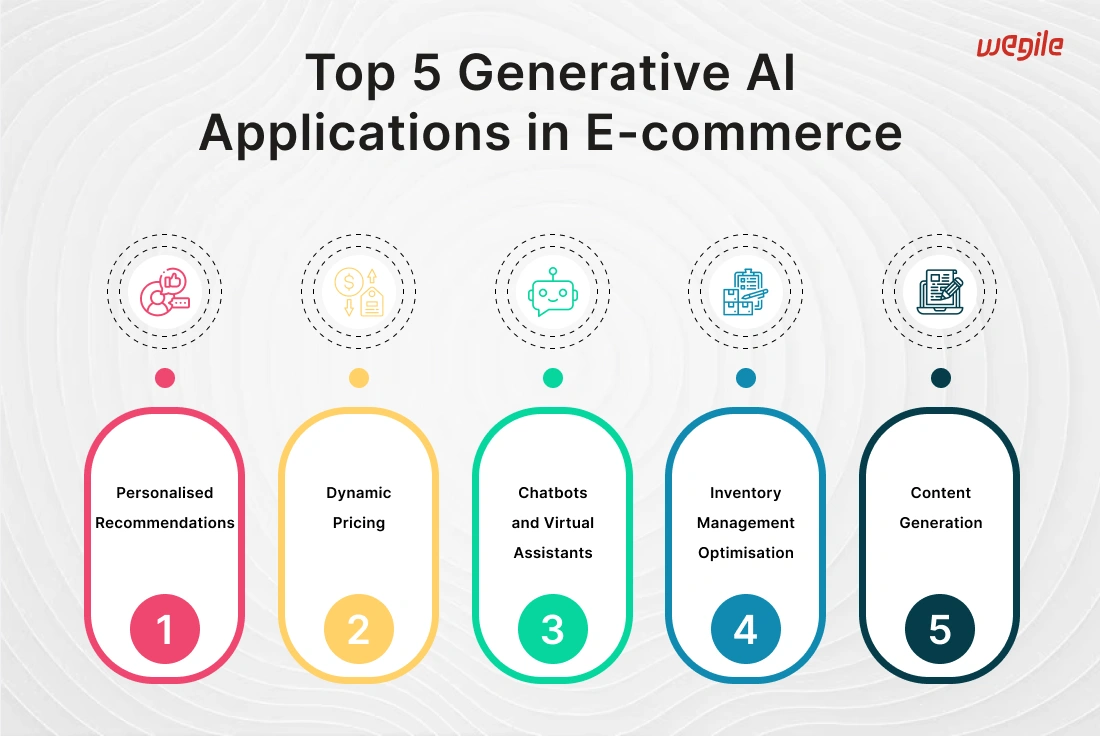
Personalized
Recommendations
Generative AI
solutions enrich online shopping by personalizing
the experience for each user. Machine learning algorithms employed in Generative AI analyze
customer data. They examine everything, like past purchases, search history, and browsing
behaviors. This helps them to understand individual preferences. For example, Amazon uses both
Generative AI and Traditional AI systems to suggest products customers might like based on what
they and others with similar tastes have bought or viewed. This customized approach helps create
a more engaging shopping experience and makes it easier for customers to find products they love
without searching through irrelevant options.
Personalized recommendations significantly impact customer satisfaction, acquisition, and
retention. By bestowing tailored suggestions, businesses can make shoppers feel understood and
valued. This, in turn, encourages repeat visits and loyalty. Netflix is a prime example, where
its recommendation engine keeps users engaged. Its generative AI-based algorithms accurately
predict and suggest shows and movies users will likely enjoy, leading to longer viewing times
and sustained subscriptions.
Dynamic Pricing
Generative AI also plays a crucial role in dynamic pricing strategies in e-commerce. This
includes adjusting real-time prices based on market demand, inventory levels, and consumer
behavior trends. Generative AI systems continuously gather and process data. They enable prices
to be optimized for maximum profitability and competitiveness.
For example, airlines like Delta use dynamic pricing models to adjust real-time fare prices. They
consider booking timings, flight popularity, and remaining seats.
The usefulness of dynamic pricing extends to both consumers and retailers. Consumers can benefit
from lower prices during off-peak times or special promotions tailored to their buying patterns.
Retailers also benefit from maximizing sales and profits by adapting prices based on current
market conditions. Uber’s surge pricing model is a clear example, where prices are adjusted
according to driver availability and passenger demand. This modified pricing model ensures
service reliability and profitability.
Chatbots and Virtual
Assistants
Generative AI-driven chatbots and virtual assistants have become integral in handling customer
inquiries and support. They assist by providing timely and efficient responses to users. These
tools utilize natural language processing to interpret and respond to user queries. Sephora’s
chatbot on Facebook Messenger offers a vivid example. It assists customers by providing product
recommendations using the power of Generative AI. It also customizes makeup tutorials and
reviews, greatly enriching user engagement and simplifying purchasing.
Effective Generative AI chatbots improve user engagement by providing instant support and
personalized communication. Domino’s Pizza uses its chatbot “Dom” to allow customers to order
pizza directly through Facebook Messenger. Dom is a model curated using AI models that help
provide a personalized experience to customers. The usage of the Dom chatbot makes the ordering
process both simple and interactive. It streamlines the experience and encourages repeat orders
due to the convenience and efficiency provided.
Inventory Management
Optimization
Generative AI also enhances inventory management in e-commerce by anticipating future product
demands with ultimate precision and accuracy. By keenly analyzing historical sales data, market
trends, and consumer behavior patterns, Generative AI models can forecast the quantity of each
product needed in upcoming seasons. This helps retailers manage their stock levels more
efficiently. It also aids in ensuring they have the right products available at the right time,
ultimately reducing overstock and stockouts.
For example, Walmart employs Generative AI-driven systems to optimize its inventory management.
It helps regulate inventories across thousands of stores and online platforms. This power-rich
technology improves product availability and cuts costs linked with excess inventory and
storage. By keeping stock levels closely aligned with actual consumer demand, retailers can
present a better shopping experience. It also helps avoid the frustration customers feel when
products are unavailable. This strategic application of Generative AI in inventory management
not only streamlines operations. It also supports sustainability by reducing waste associated
with unsold goods.
Content Generation
Generative AI produces accurate and appealing product descriptions, reviews, and promotional
content. For example, GPT-3, GPT-4, and now GPT 4o offer an advanced language generation model.
Companies rigorously employ them to generate creative product descriptions and content that
effectively capture the essence and appeal of products.
The role of Generative AI in enriching SEO and user engagement through crafted content is also
worth praising. Generative AI-generated content is optimized for search engines. It helps
businesses rank higher in search results in no time. Yoox Net-a-Porter Group utilizes Generative
AI to write unique product descriptions for thousands of items across its platforms. This
extraordinary ordinary feature has helped improve search engine visibility and drive more
traffic to its sites. This strategic use of Generative AI boosts SEO performance and engages
customers better. It eventually provides them with helpful information that aids in making
informed purchasing decisions.
Enhancing User Interfaces with Generative AI: Visual Configuration Tools
Generative AI-enhanced visual configuration tools are remodeling how customers interact with
products online. Through augmented reality (AR) and virtual reality (VR), Generative AI tools
allow users to visualize products in their own space. They also help refine and customize
features before making a purchase.
Augmented Reality (AR)
Generative AI-powered AR tools enable customers to see how a product might look in their home or
on themselves before buying it. For example: IKEA’s AR app and IKEA Place facilitates user’s
placing true-to-scale furniture models in their homes using their smartphones. This realistic
visualization helps make more informed decisions and reduces the likelihood of returns due to
unsatisfied expectations.
Virtual Reality (VR)
Generative AI-driven VR takes customization and interaction to a new level by immersing customers
in a virtual world. It intersects and connects them to a realm where they can interact with
products. Audi is a great example, offering a VR experience in its showrooms. In this setting,
customers can configure their new car and experience different features and modifications in a
natural setting. This empowers the customer experience and gives them a more pronounced sense of
the product. All these factors combine and lead to higher satisfaction rates and lower customer
churning rates.
Impact on Buying Decisions and Return Rates: The ability to visualize and
interact with products through these AI-powered tools has a profound impact on customer buying
decisions. Customers are more likely to purchase a product if they can see it in their space or
customize it to their liking, which enhances confidence in their purchase decisions. This
increased confidence reduces return rates as customers are more satisfied with the product they
receive, knowing it matches their expectations set during the virtual experience.
Voice Search
Optimization in E-commerce
Voice search optimization backed by Generative AI technology is becoming a key component in
e-commerce. It leverages voice recognition technology to enable hands-free shopping. This
integration allows customers to perform searches and execute purchases. It also helps them
interact with online stores through voice commands, which makes shopping more accessible and
convenient.
Integration of Voice
Recognition for
Hands-Free Shopping
Major e-commerce platforms incorporate Generative AI-powered voice-activated tools to enhance the
shopping experience. For example, Amazon’s Echo devices are equipped with Alexa, which allows
users to shop and place orders. They also help customers track shipments using just their voice.
This technology simplifies the buying process, making it more intuitive and user-friendly.
Enhancing
Accessibility and Convenience
Voice search powered by Generative AI innovates accessibility by making e-commerce platforms
more inclusive for individuals with disabilities or those who find traditional browsing
challenging. It also upgrades convenience by allowing busy customers to shop while doing other
activities, such as cooking or driving. Walmart’s integration of Google Assistant for voice
shopping provides a practical example of how users can manage grocery lists. It helps them order
products effortlessly by speaking naturally.
Final words
Generative AI is proving a boon in the world of eCommerce. It makes customers feel valued by
imparting personalized services to them. Generative AI App Development Services are at the heart
of modernizing customer experiences in e-commerce. They successfully enable businesses to
present more personalized and engaging shopping journeys. These technologies refine customer
interactions through tailored content and recommendations and streamline operations. They also
help enrich decision-making with dynamic pricing and AI-driven insights. As businesses continue
to use the mighty powers of generative AI to meet and exceed customer expectations, the promise
of Generative AI in e-commerce will evolve from a novelty to a necessity. This terrific and
innovative technology ensures that every digital touchpoint is an opportunity to impress and
retain customers.
Are you interested in revolutionizing your e-commerce platform with Generative AI? Wegile’s
expert team can tailor AI solutions to upgrade your brand’s digital experience. Connect with us
today to explore how our promising Generative AI App Development Services can advance your customer
interactions and operational efficiency. Let’s create unforgettable and personalized shopping
experiences together!
Leave a Reply