Guess what’s knocking on the classroom door? It’s Generative AI! Once a tech lab secret, it is now
set to transform how we teach and learn. Generative AI has stepped as a game changer in a time when
educators and learners are craving for more personalized, efficient, and engaging educational
experiences. This groundbreaking technology promises to redefine education’s future in ways we
couldn’t have dreamed of before. So, are you curious about how generative AI is shaking up the
education sector? Stay tuned as we dive into its potential to revolutionize classrooms, empower
educators, and enrich the global learning journey.
Benefits
of Generative AI in Education
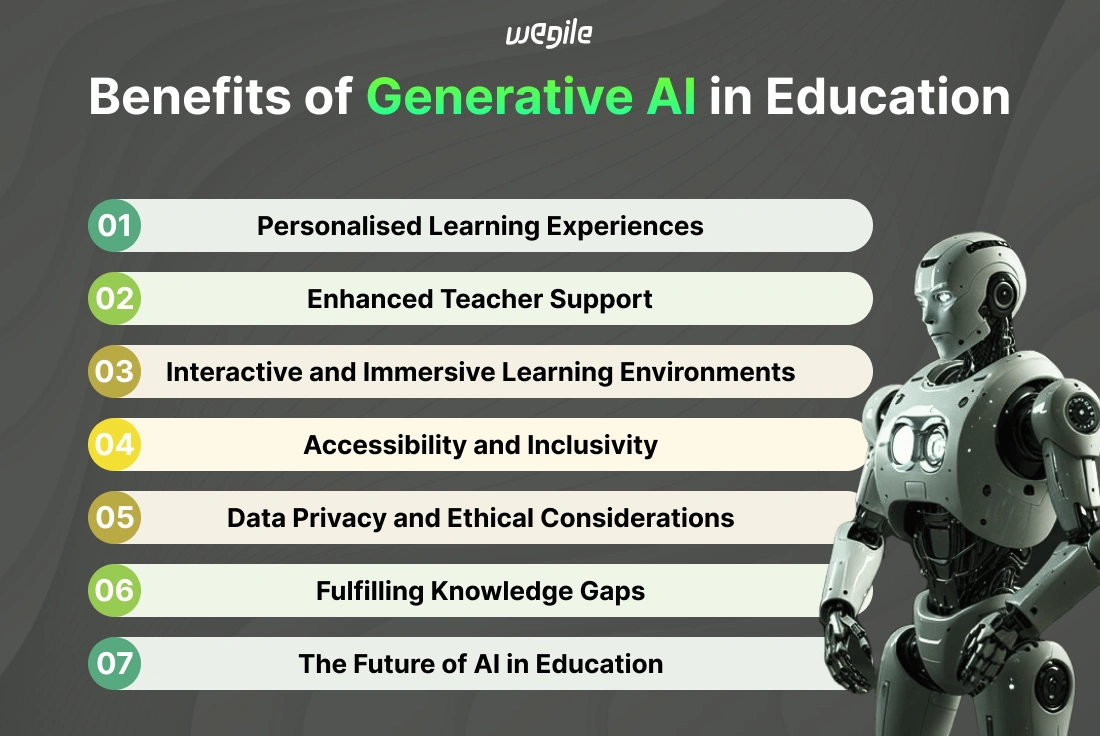
1.
Personalized Learning Experiences
-
Understanding Student Profiles
Imagine a classroom where each student gets a custom-tailored learning experience. Generative
AI makes this a reality. It gathers and analyzes a vast array of data points. This data
includes a student’s performance history, learning pace, preferences, and even behavioral
patterns. AI identifies unique learning needs and preferences by creating detailed student
profiles. This ensures that each student receives the right content at the right time. -
Adaptive Learning Pathways
Gone are the days of one-size-fits-all education. AI-based adaptive learning pathways
continuously monitor student’s progress and adjust the learning material accordingly.
Artificial intelligence keeps introducing more challenging content to a student when he
excels in a particular topic and keeps them engaged. Conversely, it provides additional
resources and simpler explanations for student’s struggles. This dynamic adjustment ensures
that every student progresses at their own pace. It also helps them master each concept
before moving on to the next. -
Real-time Feedback and Assessment
Feedback is crucial in the learning process, and generative AI excels at it. It assesses
students’ work in real-time as opposed to traditional methods that take days or even weeks.
AI evaluates the submission and offers immediate and personalized feedback no matter whether
it’s quizzes, an essay, a math problem, or personalized feedback. This helps students
understand their mistakes right away and keeps them motivated to improve continuously. The
instant nature of AI-based feedback makes learning a more interactive and engaging
experience.
2. Enhanced
Teacher Support
-
Automating Administrative Tasks
Teaching is a hectic job and a teacher spends much of their time on daily administrative
tasks such as grading papers, scheduling lessons, and managing student records. These duties
can overwhelm them. Generative AI can automate these repetitive tasks with remarkable
efficiency. It helps teachers in handling administrative work. This allows them to focus on
important tasks such as teaching and interacting with their students. Hence, this shift to
AI improves productivity and enhances the overall educational experience. -
Intelligent Lesson Planning
AI-powered tools and platforms are easing up daunting tasks such as creating engaging and
effective lesson plans. These intelligent systems analyze curriculum standards, student
data, and educational resources. This helps teachers in designing dynamic lesson plans
tailored to their students’ needs. AI provides invaluable support in lesson planning by
suggesting new teaching strategies. It also integrates multimedia resources and aligns
lessons with students’ learning styles. This ensures that educators can deliver high-quality
education with less effort and more creativity. -
Identifying At-risk Students
Identifying which students are struggling and who needs timely support can be one of the most
significant challenges teachers face. However, generative AI excels in providing the
necessary support in this area. It analyzes various data points to flag at-risk students. AI
can pinpoint early signs of struggle. This is done by monitoring academic performance,
engagement levels, attendance, and even social interactions. Teachers receive timely alerts
and insights about struggling students. This enables them to intervene promptly who need
dedicated support. This proactive approach helps ensure that no student falls through the
cracks and that every learner has the opportunity to succeed.
Must Read: Exploring Top 13 Use Cases For
Generative AI
3.
Interactive and Immersive Learning
Environments
-
Virtual Reality Classrooms
Picture that you’re stepping into a classroom that transcends physical boundaries. One where
history comes alive and science experiments unfold in 3D. Virtual
Reality(VR) is revolutionizing education by doing the same thing. It offers
immersive learning experiences that traditional methods cannot match. Donning VR headsets
allows students to explore ancient civilizations, dissect virtual organisms, or interact
with historical figures. This integration of VR in classrooms sparks curiosity and enhances
understanding through experiential learning. -
AI-driven Simulations
AI-driven simulations bring abstract concepts to life. It makes subjects like science and
history tangible and engaging. These simulations use AI algorithms to create realistic
scenarios where students can conduct virtual experiments, explore complex theories, or
relive historical events. AI simulations transform learning into an interactive journey of
discovery. It enables exploring concepts such as the human body’s inner workings, pivotal
moments in world history, etc. -
Gamification of Learning
Learning becomes an adventure when infused with game-like elements that challenge and
motivate students. AI-powered gamification transforms educational tasks into engaging
quests. Here, students earn points, unlock achievements, and compete against themselves or
classmates. Gamified learning adjusts difficulty levels and content based on each student’s
progress by leveraging AI’s adaptive capabilities. This ensures sustained engagement and
fosters a positive learning experience.
4.
Accessibility and Inclusivity
-
AI-powered Assistive Technologies
AI acts as a game-changer in creating inclusive learning environments. It offers assistive
technologies tailored to each student’s unique needs. Tools like speech recognition software
and AI-powered prosthetics help students learn more effectively. AI ensures that no student
is left behind, no matter the challenges they face. This is done by adapting and
personalizing learning resources. -
Multilingual and Cultural Inclusivity
AI helps bridge linguistic and cultural gaps to promote inclusive education. Generative AI
translation tools allow students to access educational content in their native languages
regardless of their linguistic backgrounds. This leads to better understanding and
engagement. Additionally, AI incorporates diverse perspectives to curate culturally relevant
learning materials that enrich the educational experience for all students. -
Bridging the Digital Divide
Access to technology should be a basic right, not a privilege. AI initiatives are aiming
towards reducing the digital divide. This ensures everyone has access to educational
resources and tools. Further, underserved communities are now getting access to
transformative learning opportunities due to affordable internet solutions and the rise of
AI-powered educational platforms. Also, democratizing access to AI-driven educational tools
has resulted in a more inclusive and equitable future in education.
5.
Data Privacy and Ethical Considerations
-
Student Data Protection
Student data is like a goldmine in today’s time, especially when it comes to enhancing
educational experiences. But with this treasure comes great responsibility. Here, it becomes
important to ensure the security and privacy of student data in AI systems. Educational
institutions must emphasize top-notch cybersecurity measures to keep sensitive information
safe from breaches. Remember, aspects such as encryption, regular security audits, and
strict access controls are non-negotiable. Thus, taking effective measures will result in
the creation of a safe learning environment, one where students’ personal information stays
confidential and secure. -
Ethical AI Use in Classrooms
Bringing AI into classrooms isn’t just about using cool tech; it’s about using it
responsibly. Ethical AI-based system in education needs clear guidelines and best
practices. This means ensuring AI algorithms are
bias-free to make certain that no student group is left at a disadvantage. Teachers need to
be clued up on AI’s limitations and potential biases. This helps them make smart choices
about its use. Plus, transparency in how AI works and makes decisions is key. It helps
students and parents understand how AI impacts their education. Hence, sticking to ethical
standards will help schools create an inclusive and fair learning environment for everyone. -
Transparency and Accountability
Transparency and accountability are the backbone of trustworthy AI in schools. Keeping clear
records of AI tool usage ensures transparency for everyone involved. Regular reports on AI’s
performance and impact build trust among students, parents, and educators. Further,
frameworks guarantee that there’s a clear line of responsibility for AI-related decisions
and outcomes. Thus, schools can ensure AI serves the best interests of all students by
upholding these principles. This guarantees the educational experience is both reliable and
beneficial.
6. Fulfilling
Knowledge Gaps
-
Detecting Knowledge Gaps
AI excels at identifying knowledge gaps that traditional methods might overlook. It can
analyze student performance data systems and further pinpoint areas where individual
students or entire classes struggle. These insights come from continuous assessment,
tracking patterns in quiz scores, homework, and classroom interactions. This data-driven
approach allows educators to understand precisely where students need extra help. It further
makes the learning process more targeted and efficient. -
Targeted Remedial Content
Once knowledge gaps are identified, AI can generate customized remedial content tailored to
each student’s needs. It includes interactive tutorials, practice exercises, and
personalized study plans. The beauty of AI-generated content is its adaptability; it evolves
based on the student’s progress. It ensures the learning material remains relevant and
challenging. This targeted approach helps students catch up and builds their confidence,
especially when it is about mastering difficult subjects. -
Continuous Learning Loop
AI creates a continuous learning loop where assessment and improvement go hand in hand. AI
systems continually monitor student progress once they have identified knowledge gaps and
provide remedial content. This ongoing evaluation ensures that any new gaps are quickly
detected and addressed. The result is a dynamic and responsive educational experience where
students are always supported in their learning journey. AI helps students achieve a more
comprehensive and lasting understanding of their subjects by fostering this continuous
learning loop.
Must Read: What
Is The Difference Between
Generative AI And AI?
7. The Future
of AI in Education
-
Emerging Technologies
Hold onto your hats, folks, as the future of education is about to get seriously cool!
Emerging AI technologies like NLP
,
AR, and VR are taking learning to the next level. They
provide immersive experiences that make lessons come alive. AI-driven platforms adapt
lessons to each student’s needs on the fly. It makes learning engaging and fun. The
classroom is evolving into a dynamic and interactive playground where curiosity meets
cutting-edge tech. -
Long-term Impacts on Education Systems
AI in education is more than a fleeting trend; it’s a transformative force that’s taking
learning to the next level. The education sector has taken a major shift towards
personalized learning with Generative AI. It’s now time to wave goodbye to the outdated idea
of one approach that fits everyone. Hybrid learning environments blend traditional teaching
with AI-powered tools. This makes education more flexible and tailored to individual
students. Further, AI is taking over mundane administrative tasks and allowing teachers to
focus on what they do best. This evolution is resulting in a more efficient, inclusive, and
effective educational system. -
Preparing Educators for the AI Future
With AI becoming a classroom staple, it has become important to equip educators with the
right tools and knowledge.
Teachers need to become proficient with
AI-based technologies. Plus, they need to understand its potential and limitations. For
this, professional development programs should be geared towards integrating AI into
teaching practices. Now, online courses, workshops, and collaborative learning communities
will be essential. Also, creating a culture of continuous learning among educators will
ensure they stay ahead of the curve. Further, empowering teachers with training and
resources allows them to take the lead in an AI-driven educational era.
Wrapping Up
And there you have it, folks! Our exploration of generative AI in education has come to an end. From
AI tutors jazzing up classrooms to virtual labs that adjust to each learner’s speed, the learning
landscape is evolving faster than ever. The smarter algorithms help deal with curiosity and nurture
creativity. Further, it is empowering educators to tailor learning experiences like never before.
Keep in mind that the future of education is more about building a community where innovation meets
inspiration. Stay updated with new inventions, no matter if you’re a tech buff, an educator, or
simply curious about AI in education. If you’re looking to build generative AI apps to
leverage their potential to transform your
educational offerings, Wegile is here to help. Our expertise in generative AI development services
will help you create tailored solutions that enhance learning outcomes and drive innovation in
education. Together, let’s pave the way for a future where learning breaks boundaries and where
generative AI continues to inspire and empower learners worldwide.
Leave a Reply