Generative AI is exciting! But let’s face it, building these AI models comes with its own set of
hurdles. You’ve got a great vision for
developing exceptional apps with Gen AI. However, there are a
lot of unforeseen obstacles that can slow you down or even halt you in your tracks when you’re
developing generative AI apps. Building generative AI
apps isn’t an easy feat, and any obstacle
you face could seem overwhelming. Dealing with aspects related to data quality, computational
resource management, and ethical use might make you feel like you’re always fighting fires. It’s
frustrating, right? But you don’t need to worry, as we’ve got your back! In this blog, we’ll break
down the 10 biggest challenges in generative AI. More importantly, we’ll present solutions on how to
overcome them. You’ll navigate the generative AI landscape with these practical tips and strategies
in our insightful blog like a pro. Ready to turn those roadblocks into stepping stones? Let’s dive
in!
Major
Challenges in Generative AI
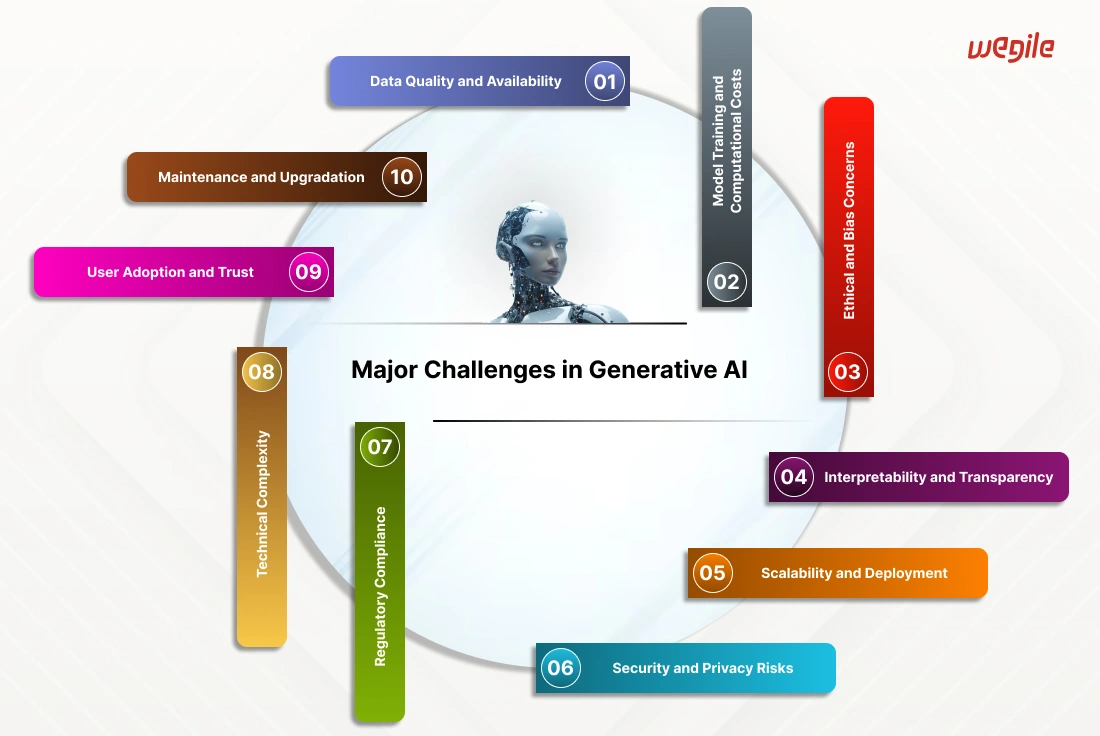
Generative AI holds immense promise, but its development is not without hurdles. Addressing these
challenges is crucial for harnessing its potential to transform industries and societies alike.
1. Data Quality and Availability
Data plays a pivotal role in shaping outcomes in generative AI. However, getting diverse,
high-quality datasets is still a huge hurdle. Imagine trying to teach an AI to paint without a rich
palette of colors or textures. It’s akin to training generative models without robust and varied
data. This scarcity can hinder the model’s ability to generalize and produce realistic outputs
across different scenarios. Moreover, ensuring data privacy and ethical sourcing adds layers of
complexity to data acquisition. It demands meticulous handling and transparency.
2.
Model Training and Computational
Costs
Training generative AI models demand substantial computational muscle. The sheer computational power
required to iterate and refine these models is staggering. It often requires cutting-edge hardware
and substantial financial investment. This intensive process is more than just crunching numbers;
it’s about optimizing algorithms and fine-tuning parameters to achieve desired outcomes. Balancing
performance with efficiency is key to managing these costs effectively and scaling generative AI
applications sustainably.
Must Read: Exploring Top 13 Use Cases For Generative AI
3.
Ethical and Bias Concerns
Concerns about the ethical implications and biases of generative AI are rising as it evolves. These
technologies have the potential to amplify societal biases or propagate misleading information if
not developed and deployed responsibly. There can be possibilities where generative AI inadvertently
reinforces harmful stereotypes in its output or perpetuates unfair practices. Major reasons for this
are biases in training data. Fairness, transparency, and accountability throughout the AI lifecycle
are needed to address these ethical issues. Building Gen AI that serves equally to society requires
dataset variety and thorough bias identification.
4.
Interpretability and
Transparency
Understanding how generative AI arrives at its conclusions can be as perplexing as deciphering
abstract art. The challenge lies in making these models transparent and interpretable. This is to
make certain that stakeholders(from developers to end-users) can trust and comprehend their outputs.
Now, picture this: You’re trying to explain the creative process of an AI-generated masterpiece
without clear insights into its inner workings. Achieving transparency means demystifying complex
algorithms and making their decision-making processes accessible and understandable. This fosters
confidence in their reliability and ethical use.
5.
Scalability and Deployment
Scaling generative AI from prototype to practical application
is like guaranteeing a blueprint for a single building that can construct a cityscape. The
scalability challenge involves optimizing models to handle larger datasets and diverse real-world
scenarios without sacrificing performance. Deploying
these models seamlessly across different platforms and environments requires robust infrastructure
and meticulous planning. Navigating deployment challenges from cloud-based solutions to edge
computing ensures generative AI can deliver consistent results in various operational settings.
Also, it further encourages its widespread adoption and impact.
6.
Security and Privacy Risks
Generative AI requires security and privacy precautions to navigate the digital world. Protecting
sensitive data from unauthorized access requires strong security. The interconnected nature of AI
systems amplifies risks. It makes it imperative to fortify defenses against cyber threats and ensure
compliance with data protection regulations.
Balancing innovation with stringent privacy protocols enhances trust in generative AI. This
safeguards its potential to drive positive change while mitigating risks to individuals and
organizations alike.
7.
Regulatory Compliance
It is crucial to adhere strictly to all rules and regulations to successfully navigate the
regulatory
landscape with generative AI. This is much like ensuring a vehicle meets road safety standards. The
challenge lies in interpreting and complying with evolving regulations that govern AI development
and deployment. From data privacy laws to ethical frameworks, staying compliant is essential to
mitigate legal risks and foster responsible innovation. Balancing innovation with regulatory
requirements ensures generative AI evolves responsibly and aligns with societal expectations and
legal standards.
8.
Technical Complexity
Developing generative AI involves orchestrating a complex puzzle of algorithms and data, not just
writing code. The technical complexity stems from fine-tuning models to achieve desired outputs
while optimizing performance and efficiency. Mastering complexity, ranging from neural network
architectures to algorithmic intricacies, requires deep expertise and iterative refinement.
Embracing innovative solutions and staying abreast of technological advancements are key to
overcoming these technical challenges and pushing the boundaries of generative AI capabilities.
9.
User Adoption and Trust
Gaining user trust with generative AI requires transparency, reliability, and demonstrated value. It
is similar to building credibility among your target audience. Convincing users of AI’s benefits and
ethics is difficult. To build trust and acceptance, data privacy, bias, and algorithmic transparency
must be addressed. Also, educating and designing for users improves usability and acceptance. This
paves the way for generative AI to make a meaningful impact in diverse applications.
10. Maintenance and Upgradation
Generative AI models are like high-performance engines. They require regular maintenance in the form
of fine-tuning often. This upgrade maximizes performance. The challenge involves managing model
performance over time, adapting to evolving user needs, and integrating new technological
advancements. Continuous monitoring, debugging, and upgrading are essential to sustain optimal
performance and relevance in dynamic environments. Investing in robust maintenance practices and
agile development methodologies ensures generative AI remains adaptive and effective.
Strategies to Overcome Challenges in Generative AI
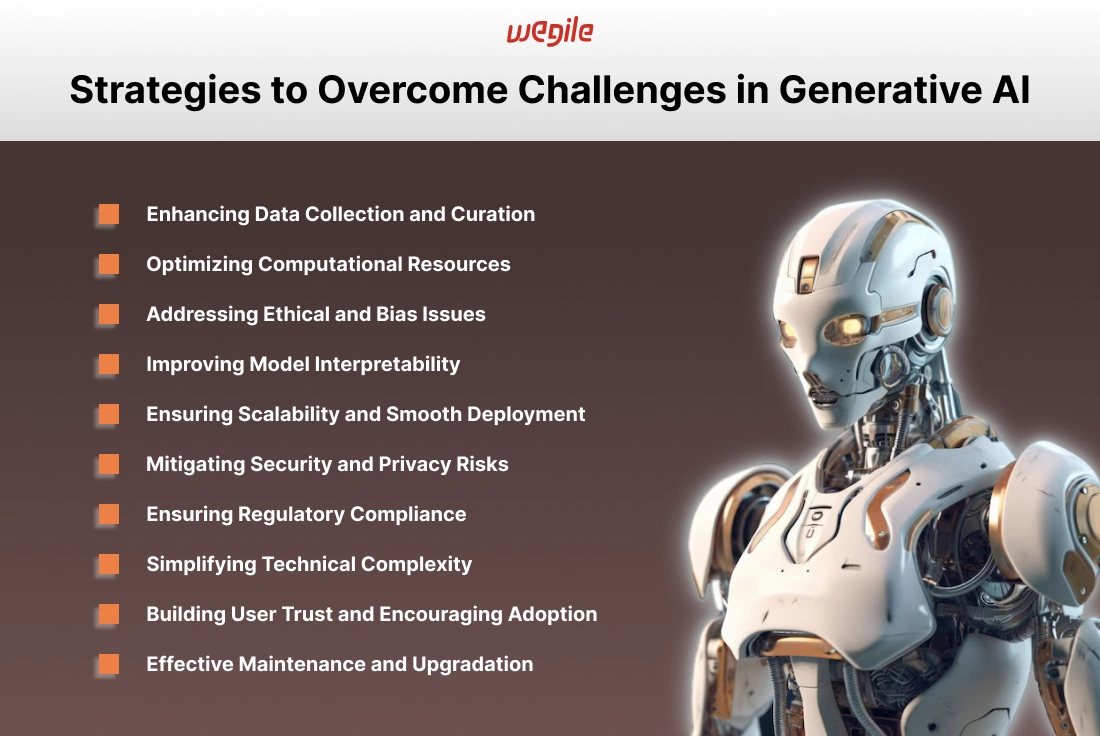
While the challenges in generative AI are significant, proactive strategies can effectively navigate
these complexities and foster innovation.
1.
Enhancing Data Collection and
Curation
Improving data collection and curation is fundamental to refining generative AI models. Methods like
data augmentation and synthetic data generation enrich datasets. These approaches ensure data
diversity and representativeness. It further enhances the model’s ability to learn and generate
accurate outputs across various contexts. Organizations lay a solid foundation for AI-driven
insights and innovations by investing in robust data practices that meet high standards of accuracy
and reliability.
2.
Optimizing Computational
Resources
Strategic resource optimization is necessary to tackle the heavy computing demands of generative AI.
Shifting to cloud-based solutions and efficient algorithms results in optimized processes, reduction
in operation cost, and boosts scalability. Managing AI workloads on the cloud has several
advantages, like more processing power, greater flexibility, and lower costs. Companies can use
these new technologies to advance their AI projects. This results in the achievement of sustainable
growth and impactful outcomes without compromising performance.
Must Read:
What Every CEO Must Know About
Generative AI?
3.
Addressing Ethical and Bias
Issues
Ensuring ethical integrity and minimizing biases are critical for responsible AI deployment. Similar
to fostering fair play in sports, implementing fairness-aware algorithms and promoting diverse data
representation mitigate biases in AI outputs. These measures uphold ethical standards and build
trust among stakeholders. This cultivates acceptance and ethical use of generative AI solutions.
Transparent practices and continuous monitoring of AI systems ensure alignment with ethical
guidelines. It further paves the way for inclusive innovation and positive societal impact.
4.
Improving Model Interpretability
Enhancing the interpretability and transparency of generative AI models is crucial for building
trust
and understanding. Techniques like explainable AI (XAI) methods and intuitive user interfaces
demystify complex algorithms. Stakeholders can confidently interpret and validate model decisions by
making AI outputs understandable and accessible. This creates greater trust and acceptance in
diverse applications.
5. Ensuring Scalability and Smooth
Deployment
Scaling generative AI models requires robust solutions and seamless deployment practices. It’s akin
to building scalable infrastructure for a growing city. Modular architectures and continuous
integration/continuous deployment (CI/CD) practices streamline deployment processes. It guarantees
consistent performance across different environments. This approach enhances scalability and
facilitates agile adaptation to evolving business needs, which further empowers organizations to
leverage AI capabilities efficiently and sustainably.
6.
Mitigating Security and Privacy
Risks
Protecting against security breaches and safeguarding data privacy is paramount in generative AI
development. It’s much like fortifying a fortress against intruders. Practices such as strong
encryption, safe data handling procedures, and frequent audits reduce risks and guarantee adherence
to strict security guidelines. Organizations can uphold the integrity and confidence of AI-driven
solutions by placing a high priority on proactive security measures and openness in data practices.
This safeguards sensitive information and mitigates potential threats effectively.
7. Ensuring
Regulatory Compliance
It’s crucial to adhere to all applicable regulations with the evolution of generative AI. To stay on
top of data protection and ethical standards, strategies include consulting with lawyers and
constantly checking for new regulations. Proactively resolving compliance concerns allows
organizations to reduce risks and establish confidence with stakeholders. The result is the
development of responsible AI and new innovations.
8.
Simplifying Technical Complexity
Managing the technical complexity of generative AI development is like streamlining a complex
operation with standardized protocols and automated tools. Using standardized frameworks and
leveraging automated solutions simplifies development processes. This results in enhanced efficiency
and reduced errors. Further, adopting systematic approaches and embracing technological advancements
will allow teams to navigate technical challenges effectively, accelerating the development and
deployment of AI solutions with confidence and precision.
9. Building User Trust and
Encouraging Adoption
Building user trust and encouraging the adoption of generative AI relies on transparency and
effective communication. It’s similar to gaining customer loyalty in a competitive market. Practices
such as transparent AI decision-making processes and clear communication of benefits to users.
Organizations can emphasize ethical use, privacy protection, and user empowerment to instill trust
and acceptance of AI-driven solutions. Engaging stakeholders through education and feedback channels
ensures alignment with user expectations. This drives widespread adoption and positive impact.
10.
Effective Maintenance and
Upgradation
Continuous maintenance and upgradation of generative AI models are essential for sustaining
efficiency and relevance over time. Solutions include proactive monitoring, timely updates, and
incorporating feedback to optimize performance and adapt to evolving needs. Organizations must
implement agile maintenance practices and leverage cutting-edge technologies to make certain AI
models remain adaptive, reliable, and capable of delivering enduring value in dynamic environments.
Future Trends and Directions in Generative AI
1. Advances in Generative Models
New developments in generative models are expanding the limits of possibility. The capacity to
generate new languages has been greatly enhanced by recent breakthroughs such as GPT-4. Models’
precision, originality, and adaptability are all improved by these generative AI developments. In
addition, it has provided fresh opportunities in domains as diverse as the arts and science.
Subsequently, it will be essential to stay updated with the latest advances if we want to fully
utilize generative AI in the future.
2.
Integration with Other
Technologies
Generative AI is increasingly integrating with other cutting-edge technologies. This is creating
synergistic effects. Envision the fusion of AI with blockchain to enhance data security or with IoT
to enable intelligent and automated systems. These integrations amplify the capabilities of
generative AI and allow it to address complex challenges in new and innovative ways. Organizations
can explore these intersections to unlock transformative solutions that drive efficiency and
innovation across multiple domains.
Must
Read: What Is The Difference Between
Generative AI And AI?
3.
Long-term Ethical Considerations
Long-term ethical considerations become increasingly important as generative AI continues to
advance.
It’s much like safeguarding the principles of fairness and justice in society. For this, ongoing
vigilance and regulation are needed to ensure responsible AI development. Addressing issues such as
bias, privacy, and the societal impact of AI technologies requires continuous effort and
collaboration. Prioritizing ethical frameworks and engaging in transparent practices will enable us
to navigate the complexities of generative AI with integrity and foresight. This ensures its
benefits are equitably distributed and its risks are mitigated.
Conclusion
You’ve made it to the end! Now you know the 10 biggest challenges in generative AI and how to tackle
them. From data quality issues to computational resource management, you have the tools to
navigate these hurdles like a pro. Never lose sight of
the fact that behind every obstacle lies a hidden treasure. You can transform challenges into
opportunities on your path to AI mastery if you remain proactive and flexible. Keep these strategies
in your toolkit and watch your generative AI projects thrive. Looking for expert guidance? A generative AI
development company like Wegile can help you
overcome these challenges with ease. You can confidently build and optimize your AI solutions with
our expertise and support. Ready to overcome any challenge that comes your way? We at Wegile are
here to support you every step of the way.
Leave a Reply