Are you a bit overwhelmed by the complicated realm of generative AI? You’re feeling a mix of
enthusiasm and uncertainty because you’re not quite sure about how to begin or which direction to go
in. Building a generative AI solution can appear daunting and filled with technical hurdles if you
don’t have clear guidance. It’s natural to have concerns about making mistakes, wasting time, or
overlooking important aspects that could greatly enhance your solution. Well, you don’t need to
worry! This blog will walk you through 6 essential things you need to know to build a successful
generative AI solution. Ready to turn your generative AI vision into reality? Let’s dive in and
simplify the journey!
Things
To Consider While Building Generative AI Apps
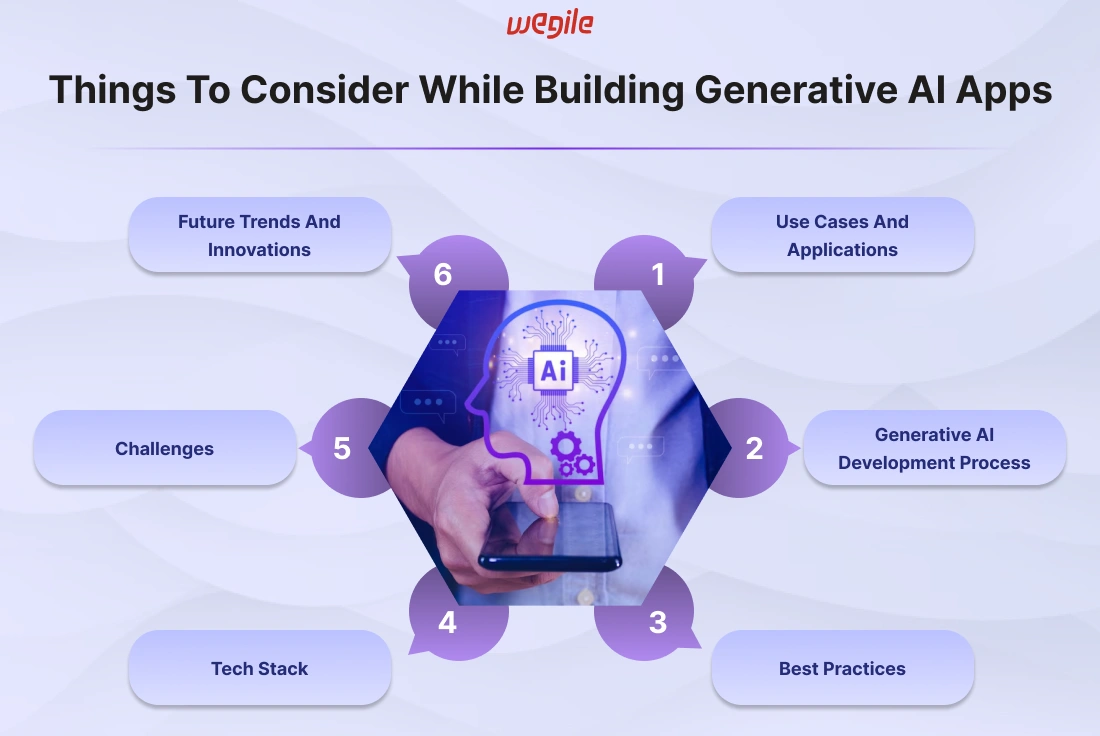
1. Use Cases and Applications
Generative AI is shaking things up in all sorts of industries. In healthcare,
it’s making strides by speeding up drug discovery
and personalizing treatments. Thanks to its ability to simulate molecular structures and predict
outcomes. In entertainment, generative AI is a game-changer that creates lifelike graphics, music,
and even scripts. This way, it gives the industry a whole new toolbox. Finance gurus
are using it to detect fraud and model risk with
synthetic data that mirrors real-life scenarios. Retailers are getting savvy, too. They’re using
generative AI to whip up personalized marketing content just for you. And let’s not forget
education. Generative AI is crafting custom learning experiences and adapting them to each student’s
unique needs. These examples show just how versatile and powerful generative AI can be, opening up
new opportunities everywhere. It’s important to get clarity on various applications of generative AI
before you start building your app. To explore the use of Gen AI in more detail, read our insightful
blog on its top use cases.
2. Generative AI Development Process
Building a generative AI solution is more than just a process—it’s an art and a science. It all
starts with solid planning and gathering the right data. From there, it’s about training models to
ensure they perform accurately and ethically. You need a good grasp of machine learning algorithms
and data processing techniques to craft a generative AI model. The process doesn’t stop there.
Continuous testing and tweaking keeps the model adaptable and effective. Looking to get an in-depth
guide on building generative AI apps? Dive into our insightful blog that breaks
down every step and offers practical tips
along with expert insights.
3. Best
Practices
Developing generative AI solutions is an exciting adventure, but sticking to best practices ensures
smooth sailing. Start with a clear problem statement to keep your project on target. Gather diverse,
high-quality data to train your models effectively. Ethics matter, and so make sure your AI pays
crucial attention to privacy and avoids biases. Collaborate with domain experts to gain valuable
insights and fine-tune your models. Test and validate your AI regularly to make certain it performs
well in real-world scenarios. Finally, keep your models updated with new data to maintain their
relevance and accuracy. Thus, following these best
practices will allow you to create generative AI solutions
that are both powerful and responsible.
4.Tech Stack
Choosing the right technology is crucial for your generative AI project. The tech stack impacts
everything from efficiency to scalability. Here’s a detailed rundown of what you need:
-
1. Frameworks and Libraries: TensorFlow, PyTorch, Keras, and Hugging Face
Transformers offer robust tools for model development and training. -
2. Development Environments and Tools: Jupyter Notebook, PyCharm, VS Code,
and
Anaconda make your development process smoother. -
3. Programming Languages: Python is the go-to programming language.
However,
Java, R, and Julia possess their own special capabilities. To explore the top 5 programming
languages, click here. -
4. Model Training: Rely on TensorFlow, PyTorch, Keras, Scikit-learn, and
XGBoost to whip your models into shape. -
5. Deployment: Docker is used to seamlessly deploy your models.
-
6. Cloud Platforms: AWS, Google Cloud Platform, Microsoft Azure, and IBM
Cloud
provide scalable computing resources as per needs. -
7. Data Management and Processing: Apache Spark, Apache Hadoop, Dask, and
Apache Kafka are ideal tools for handling massive datasets. -
8. Databases and Data Storage: MySQL, PostgreSQL, MongoDB, Redis, and
Amazon
S3 are essential tools for handling large datasets. -
9. Visualization Tools: Matplotlib, Seaborn, Plotly, Tableau, and Power BI
make your data look sharp and understandable. -
10. Version Control and Collaboration: Git, GitHub, GitLab, Jenkins,
CircleCI,
and Travis CI keep your project organized and your team on the same page. -
11. MLOps and Workflow Orchestration: MLflow, Kubeflow, Airflow, and
Prefect
streamline your machine learning operations. -
12. Hardware Acceleration: GPUs, TPUs, and FPGAs supercharge your model
training
and inference.
5. Challenges
Building generative AI solutions isn’t without its technical hurdles. Developers often face several
challenges along the way. One major hurdle to overcome is ensuring the accuracy and reliability of
the data we work with. If we input garbage, we can only expect to get garbage as output. Gathering a
wide range of reliable data can be challenging. Training these models can be a resource hog as it
requires robust hardware. Ethical concerns also loom large. It is critical to make certain your AI
doesn’t develop biases or invade privacy. Model interpretability is another tricky area. Grasping
and understanding AI decisions can pose a challenge. Lastly, staying abreast of fast-paced
technological advancements can be equivalent to keeping up with the latest smartphone releases. We
recommend reading our blog post on generative AI’s challenges
to better understand them. Here,
you’ll also get insights on how to overcome them.
6. Future Trends and Innovations
Generative AI is constantly evolving, and the future looks incredibly exciting. One hot trend is the
rise of multimodal AI. This combines text, image, and audio data to create richer and more versatile
models. Another innovation is
the
development of smaller and more efficient
models that can run on edge devices to bring AI closer to users. Ethical AI is also gaining
traction, with more focus on creating transparent and fair models. Additionally, the integration of
generative AI with other technologies like blockchain is opening up
new
possibilities. Another exciting
trend is creating more interactive and creative AI that can have complicated conversations and
create original content.
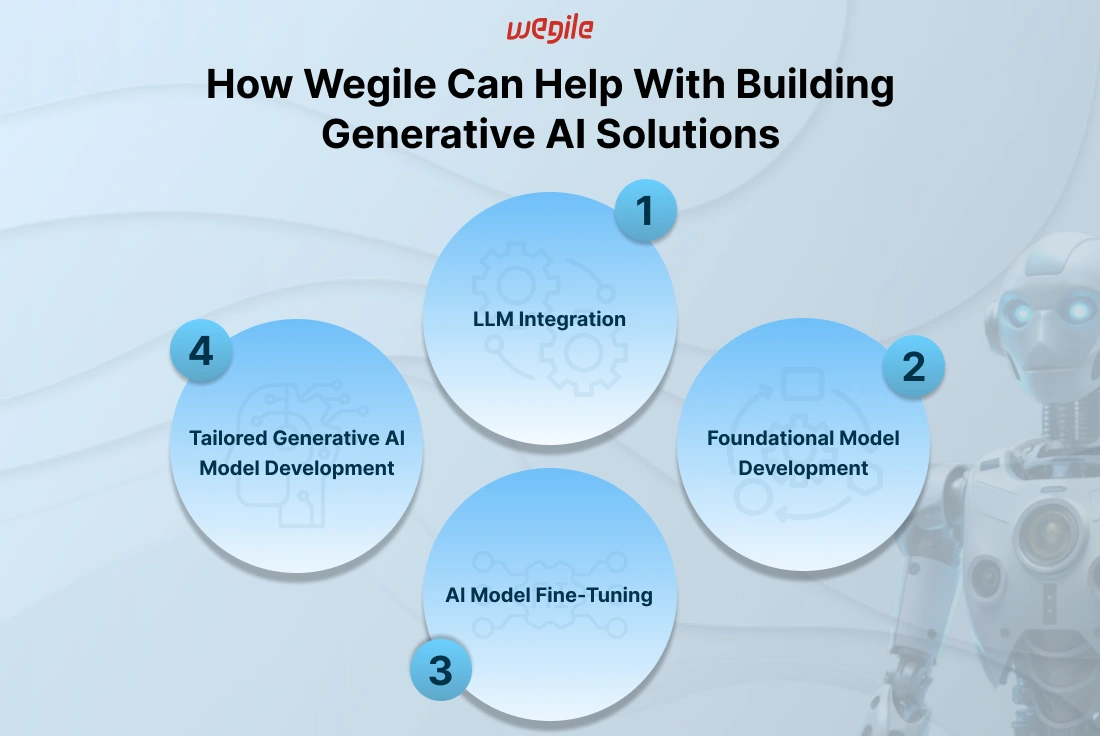
How Wegile Can Help With Building Generative AI
Solutions
Creating generative AI solutions isn’t just about tech; it’s about having the right team behind you.
At Wegile, we provide the expertise and support needed to transform your AI ideas into reality. Our
experienced professionals are here to guide you through each stage of development, ensuring your
project is a success from start to finish.
1. LLM
Integration
Imagine enhancing your system’s ability to understand and generate human language. That’s what Large
Language Models (LLMs) can do for you! With Wegile, you can seamlessly integrate these advanced
models into your AI solutions. This will improve user interactions and make communication more
intuitive. Our team ensures that the integration process is smooth to make certain that your
applications leverage the full power of LLMs to provide better user experiences
2.
Foundational Model Development
Think of foundational models as the bedrock of your AI projects. At Wegile, we help you build
strong,
reliable models that can support the scalability and innovation of your AI solutions. We develop
robust foundational models and set the stage for your AI systems to handle complex tasks and grow
with your business. Further, our expertise ensures that generative models are ready for whatever the
future holds, as we provide a solid base for continuous improvement.
3. AI
Model Fine-Tuning
Want your AI models to perform at their best? That’s where fine-tuning comes in. Wegile specializes
in optimizing models to ensure they operate with peak performance and precision. We adjust and
enhance your models to better fit specific tasks through meticulous fine-tuning. This results in
improved accuracy, faster processing times, and overall better performance in real-world
applications. It’s like giving your AI a tune-up to keep it running smoothly and efficiently.
4.Tailored Generative AI Model
Development
Artificial intelligence is a one-size-fits-all solution. That’s why Wegile customizes generative AI
models to address your unique business challenges. Our tailored solutions are designed to improve
operational efficiency and meet your specific needs. This ensures your AI models deliver real value.
We focus on your particular requirements to develop generative AI models that solve your specific
problems, enhance workflows, and drive innovation within your company.
Conclusion
And there you have it! We explored the 6 key things to know for building a successful generative AI
solution. You’ll navigate the complexities of generative AI with confidence and clarity by
considering all the things mentioned here. Embrace the excitement, stay curious, and continue to
explore new possibilities. Every step you take toward developing generative AI solutions will bring
you closer to unleashing its full potential to your advantage. So, let’s dive in towards creating
exceptional solutions, shall we? The world of generative AI is waiting for you to make your mark! If
you need expert guidance, Wegile’s generative AI
development
services are here to help. Let us
help you transform your vision into reality. Reach out to Wegile today and take the next step in
your generative AI journey!
Leave a Reply