Are you ready to level up your business endeavors with Intelligent Automation or IA? The future is
automated and the integration of powerful AI and machine learning technologies is already upgrading
how businesses operate. By streamlining processes, enriching decision-making, and driving
efficiency, IA is indeed setting the stage for massive growth across industries.
Experience and explore the powerful impact and benefits of IA which ranges from boosting
productivity
and decreasing operational costs to enormously improving customer satisfaction. These advancements
are not just about keeping up with trends in fact they are about staying ahead in this digital
business landscape.
Don’t miss out on this opportunity to use the full power
and potential of Intelligent Automation.
Read our blog to decode how IA can give your business a sharp edge in the present landscape and into
the future.
Welcome to the next level of strategic innovation and operational excellence.
Key Facts:
-
67% of
businesses
employ automation solutions to
enhance visibility across various systems from start to finish. -
Automation ranks among the quickest-growing software industries, currently valued at $6.1
billion and anticipated to expand by 200%. -
73%
of executives have initiated intelligent automation
projects that integrate AI and machine learning.
What is
Intelligent Automation?
Intelligent automation (IA) refers to the strategic integration of artificial intelligence (AI), machine
learning (ML)
models , and robotic
process automation (RPA). This powerful combination authorizes systems to not only perform
tasks automatically but also adapt and improve over time. It helps them in learning from data and
previous interactions to modify performance. The use of AI augments the capabilities of simple task
automation to encompass decision-making processes that require understanding and reasoning. It
further supports businesses in tackling complex operations that involve data analysis, natural
language understanding, and predictive decision-making.
The boons of intelligent automation are significant and range from increased efficiency and reduced
operational costs to enhanced customer and employee satisfaction. Intelligent Automation enwraps
numerous applications in AI
and
Generative AI. By automating routine and repetitive
tasks, companies can free up human workers to focus on more strategic and creative aspects of their
jobs. It eventually aids in enhancing innovation and productivity. Plus, intelligent automation can
lead to more accurate and timely decisions which reduce errors and improve outcomes in various
sectors such as healthcare, manufacturing, and finance.
How does
Intelligent Automation work?
Intelligent Automation (IA) operates by integrating multiple advanced technologies. IA involves the
combination of Robotic Process Automation (RPA) with Artificial Intelligence (AI). The other
technologies supporting it are Machine Learning (ML), Natural Language Processing (NLP), and
Computer Vision.
RPA deals with repetitive tasks such as data entry and invoice processing by employing software bots
that replicate human actions on digital systems. AI and ML come into play by encouraging these
systems to learn from data and past interactions. It further enhances their decision-making
capabilities. For example, ML algorithms analyze historical data to boost processes and predict
future outcomes. It continually helps in improving the system’s efficiency and accuracy.
NLP allows IA systems to comprehend and generate human language which enables them to support
complex
customer service functions and interact seamlessly with users through chatbots or voice assistants.
Computer vision technology facilitates the system to acknowledge and analyze images and videos.
These can be used in various applications such as quality control in manufacturing or processing
digital documents in offices.
The incorporation of these technologies not only speeds up operations but also reduces errors. They
help adapt to new information and frees up human workers to focus on more strategic tasks.
5
Benefits of Intelligent Automation for Enterprise
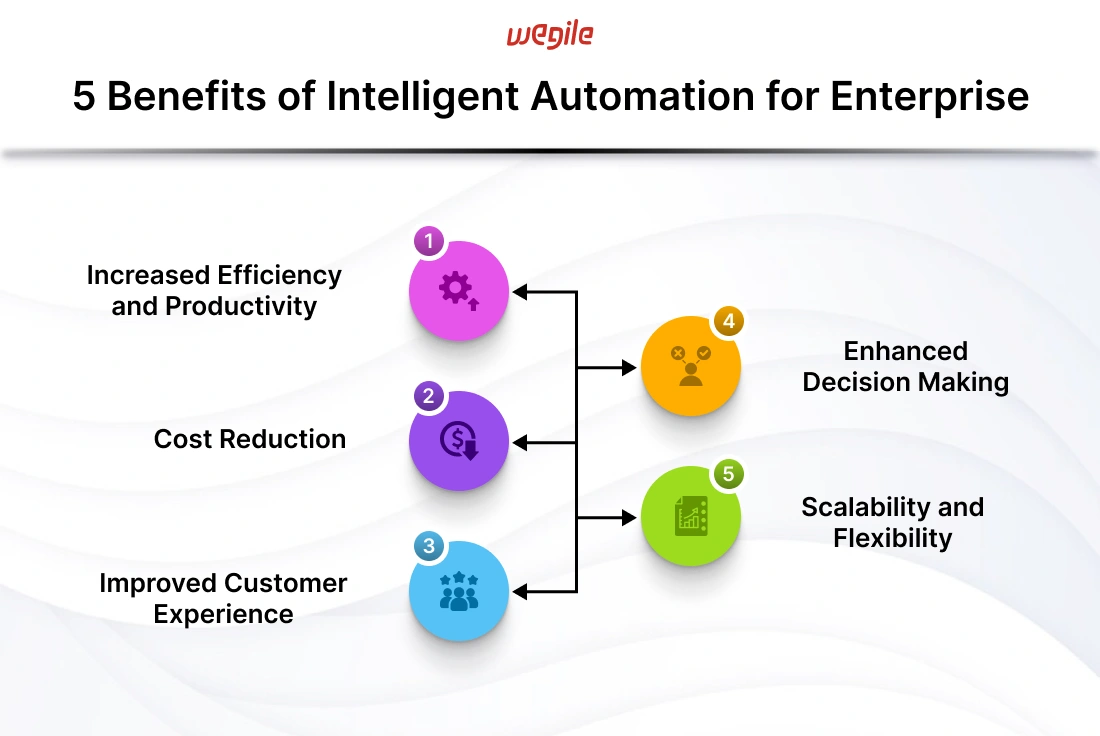
1. Increased Efficiency and Productivity
IA smartly automates routine and repetitive tasks. It allows employees to focus on more complex and
strategic activities. This shift not only speeds up processes but also cuts the likelihood of human
error. It leads to more consistent, creative and high-quality outputs. Automation can deal with
tasks faster than humans and can easily scale to meet fluctuating demands without any added human
resource costs.
2. Cost Reduction
By automating processes, companies can enormously cut labor costs. They help minimize errors that
lead to financial losses. Intelligent automation also allows organizations to streamline operations.
It helps them decrease the need for manual interventions, which can be pretty expensive.
3. Improved Customer Experience
IA encourages organizations to respond more quickly to customer inquiries and requests. It provides
a
higher quality of service. Automated systems can provide 24/7 customer support and handle routine
inquiries without fatigue which ensures customers receive timely and consistent responses.
4. Enhanced Decision Making
With the ultimate power to analyze large volumes of data rapidly, IA supports better business
decisions. It provides leaders with accurate and up-to-date information. This proficiency is
important for maintaining competitive advantage in an evolving marketplace.
5. Scalability and Flexibility
Intelligent automation systems are designed to scale and acclimate to transforming business needs.
This flexibility helps companies to respond swiftly to new opportunities and operational demands
without the necessity to expand resources or overheads.
Use
Cases of Intelligent Automation for Enterprises
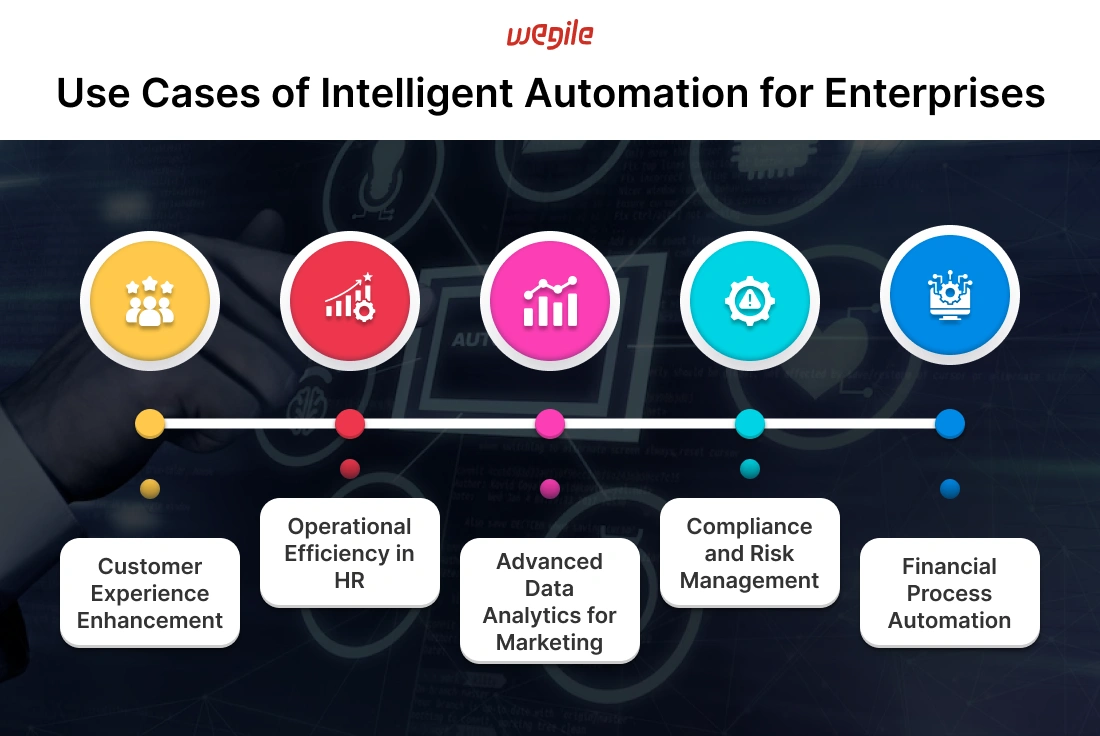
Customer
Experience Enhancement
IA significantly transforms customer interactions by using chatbots and virtual assistants. These
AI-driven tools can provide 24/7 customer support and efficiently handle inquiries. They also
help automate routine tasks and further augment the overall customer experience.
Operational Efficiency in HR
In human resources, IA streamlines processes such as employee onboarding and offboarding. It does
this by automating tasks like document processing and data entry. This automation not only revs
up the process but also guarantees accuracy and compliance with regulatory requirements.
Advanced Data Analytics for Marketing
IA is leveraged in marketing for predictive analytics. It also supports personalized advertising,
and customer behavior forecasting. For example, AI can examine vast amounts of customer data to
tailor marketing strategies. It also helps predict product demand and optimize inventory
management. This leads to more effective marketing campaigns and operations.
Compliance and Risk Management
In industries where compliance is crucial, IA automates and monitors compliance procedures. It
assures that all operations adhere to regulations and standards which reduces the risk of
compliance breaches and enhances the reliability of audits.
Financial Process Automation
Within financial services, IA has a climacteric role in processes like invoice management and
payments. It automates the extraction and processing of data from documents. It also speeds up
transactions, reduces errors, and enriches financial reporting accuracy
How Businesses Can Implement Intelligent Automation?
Implementing Intelligent Automation (IA) in a business involves several mindful steps. It ensures
its
success and integration across various functions of the organization. Here’s a brief guide based on
best practices from the industry:
1. Discovery and Assessment
Begin by identifying processes that are suitable for automation. Look for high-volume and repetitive
tasks that consume substantial resources. Assess these processes to understand their complexity,
data availability, plus the potential return on investment they offer.
2. Design and Planning
After pinpointing the target processes, lay out a comprehensive automation plan. It should include
mapping out each step of the process. It further involves defining the desired outcomes and then
selecting the appropriate automation tools and technologies. These potent technologies help match
the specific needs of each process.
3. Development and Implementation
Develop the automation solution by configuring robotic process automation (RPA) bots and
incorporating artificial intelligence models. The solution must be scalable, flexible, and competent
to adapt to changing business needs.
4. Testing and Validation
Execute rigorous testing in a controlled environment to guarantee the automation operates reliably
and accurately. Adjustments should be made based on the outcomes to sync with the initial goals.
5. Deployment and Monitoring
Once validated, deploy the automation into the live environment. It is important to continuously
monitor its performance to guarantee it meets efficiency gains, cost savings, and other key metrics.
This data will help in recognizing further optimization opportunities.
6. Continuous Improvement
You must view Intelligent Automation as an ongoing journey and not just a one-time project.
Regularly
update and scale up the automation processes based on new data and feedback from users plus the
evolving business requirements.
7. Change Management
Implementing intelligent automation (IA) is fundamentally a change management initiative. It
necessitates preparing the workforce by clearly communicating the advantages and providing training
on how to effectively use the new tools. This preparation helps smooth the transition and nurtures
adoption.
What to look for in an Intelligent Automation solution?
When going with an intelligent automation (IA) solution, businesses should note several crucial
factors. These parameters help make sure they select a system that is robust, scalable, and suitable
for their specific needs:
-
Advanced AI Capabilities: The solution should use powerful AI technologies
like machine learning and natural language processing to effectively administer complex
tasks. -
Scalability and Flexibility: It is important that the IA solution can
scale
according to business growth and merge smoothly with existing systems and processes. -
User-Friendly Interface: Go with a solution that offers an intuitive
interface that makes it easier for users to deploy, configure, and manage automation
workflows. -
Comprehensive Support and Training: Make sure that the vendor provides
extensive support and training to assist your team maximize the value of the IA solution. -
Security and Compliance: The solution should have strong security features
and compliance certifications to safeguard sensitive data and adhere to regulatory
standards. -
Proven Track Record: Go with a vendor with a solid history of successful
implementations and high customer satisfaction across various industries.
The Bottom Line
We are living in a world where efficiency is of immense importance. The demand for rapid, accurate,
and decision-making is also increasing and here intelligent automation (IA) stands as a leading
force for businesses. By incorporating artificial intelligence with machine learning and robotic
process automation, IA helps companies not only automate routine tasks but also enrich their
operational capabilities and strategic insights. The result? A significant uptick in productivity,
cost savings, and an agile and robust competitive edge in the market.
If you are looking to reap the power of intelligent automation to refine your business processes,
revamp customer satisfaction, and push innovation then it’s time to explore further. Discover the
full spectrum of opportunities IA offers and learn how to effortlessly implement these solutions
effectively within your organization.
So, are you all set to take your business to the next level with intelligent automation? Explore our
comprehensive generative AI app
development services to seamlessly integrate
these technologies to maximize efficiency and development. Join the future of business
transformation with Wegile, where we bring terrific solutions directly to your operational strategy.
FAQs
-
What are the key industries that benefit most from Intelligent Automation?
Industries such as finance, healthcare,
manufacturing, and retail see substantial
benefits from Intelligent Automation. These sectors benefit from IA’s power to
enrich process efficiency. It helps improve compliance and drive innovation by
automating routine tasks and data analysis. -
Can Intelligent Automation help in reducing operational costs?
Yes, Intelligent Automation can
immensely reduce operational costs. They cut
additional costs by smartly automating manual tasks. It also aids in the
modification and optimization of workflows. They also help cut the scope for errors.
It leads to decreased labor costs and enhanced productivity which makes operations
more cost-effective. -
How does Intelligent Automation integrate with existing IT infrastructure?
Intelligent Automation solutions support
seamless integration with present IT
infrastructures through APIs and middleware solutions. This integration capability
guarantees that businesses can adopt IA without the need for extensive modifications
to current systems. -
What are the security implications of implementing Intelligent Automation?
Implementing IA requires detailed
consideration of security and data protection
measures. IA solutions combine advanced security protocols, encryption, and
compliance standards to protect sensitive information and ensure privacy. -
How do businesses estimate the success of Intelligent Automation implementations?
Success is majorly measured by
improvements in efficiency, cost reduction, and error
reduction. It is also estimated by the return on investment (ROI) of the automation
implementation. Businesses also evaluate the scalability and flexibility of the IA
solutions to adjust to future needs as key indicators of long-term success.
Leave a Reply