
Are you facing severe challenges with accurate data labeling for your machine-learning projects?
Despite the critical importance, many developers find data labeling confusing and time-consuming.
They often deal with scattered resources that contradict each other or fail to cover essential best
practices. In this comprehensive guide, I’ll walk you through a streamlined process for effective
data labeling. This process can dramatically upgrade the accuracy of your machine-learning models.
From understanding fundamental concepts to implementing advanced techniques, let’s learn how to
scale your projects efficiently and reap remarkable results in machine learning. Let’s get started!
What do you understand by Data Labeling in Machine
Learning?
Data labeling in supervised machine learning is
a
fundamental process in which
raw data is annotated or tagged with informative labels. These labels make it usable for training
machine learning models. This step is crucial as it directly influences the accuracy and
effectiveness of the entire AI system. Be it images, texts, or sounds, data labeling involves
categorizing and marking the data. This way it helps machine learning algorithms learn from it and
make predictions.
The quality of data labeling often determines the success of machine learning projects. This
underlines its importance in developing robust, high-quality and precise models. This detailed
process requires a thorough understanding of the data and its context. It ultimately ensures that
the labels are accurate and consistently applied across datasets.
Main types of Data
Labeling
1.
LLM (Large Language Models)
Large Language Models (LLMs) like GPT (Generative
Pre-trained Transformer) need extensive datasets
labeled with accurate linguistic information to train effectively.
Techniques
-
Semantic Annotation: Labeling data with meanings right behind phrases and
sentences. -
Syntax Labeling: It helps in identifying grammatical structures. It further
helps in comprehending the language patterns.
2. Computer Vision
Computer vision aims to replicate the human vision
system using ML algorithms. It needs accurately labeled visual data to recognize and interpret
images and videos.
Techniques
-
Image Classification: Labeling entire images with specified categories or
tags. -
Object Detection: Annotating specific objects within the images with clear
bounding boxes. -
Semantic Segmentation: Labeling each pixel in the image to a distinct
class.
3.
Natural Language Processing
(NLP)
NLP uses advanced algorithms to understand and
manipulate human language. Accurate data labeling is crucial for training these models to execute a
good number of linguistic tasks.
Techniques
-
Sentiment Analysis: Labeling text data with sentiment scores which can
either be positive, negative, or neutral. -
Entity Recognition: Annotating named entities in text and it mainly include
person names, organizations, and locations.
4. Audio Processing
Techniques
-
Speech Recognition: Labeling audio files with definitive transcriptions.
-
Sound Classification: Categorizing sounds into predefined groups. These
groups may include urban, nature, and speech sounds.
5. Time-Series Data
Techniques
-
Event Detection: Labeling points and segments in time-series data where
events occur. -
Anomaly Detection: Recognizing and labeling anomalies in data which vary
from the majority of the data.
How does
Data Labeling in Machine Learning work?
-
1. Data Collection: The most important step is compiling the raw data that
needs to be labeled. This data can come from varied sources relying on the project’s
requirements. -
2. Pre-processing: Before labeling, data often needs cleaning and
formatting.
It may involve removing irrelevant information and correcting errors. It also includes
converting data into a usable format. -
3. Labeling: Trained human annotators or automated tools then tag the
pre-processed data with labels. Depending on the complexity of the data and the mandatory
accuracy, this procedure can be performed manually or semi-automatically with the help of AI
tools. -
4. Quality Assurance: After labeling, the data undergoes a quality check.
It
helps ensure that the labels are accurate and consistent. This step involves reviewing a
random sample of the labeled data and bringing in adjustments as necessary. -
5. Training the Model: Once the data is labeled and veted for quality, it
gains
usage in training machine learning models. The labeled data instructs the algorithms to
acknowledge patterns and make predictions. -
6. Evaluation and Iteration: Finally, the performance of the machine
learning
model is evaluated. It is estimated using a separate set of labeled data. Based on the
results, further adjustments in data labeling and model training are made to upgrade
accuracy.
8 Tools to
Perform Data Labeling
It’s time to explore the most efficient and powerful data labeling tools available to help you amp
up
your machine learning projects.
1. Amazon
Mechanical Turk (MTurk)
Amazon Mechanical Turk provides a flexible platform where developers can effortlessly access a large
workforce. These workforce are ready to execute tasks that require human intelligence and including
data labeling. This service is particularly useful for projects that need large volumes of data to
be processed in a practical pr real-world context.
2. Labelbox
Labelbox is a leading data labeling platform that delivers tools for creating, managing, and
operating data labeling projects. Its features include an intuitive interface and support for
various data types which are images, videos, texts. It also includes the integration capabilities
with machine learning models to continuously improvize the labeling process through active learning.
3.
CrowdFlower (now Figure Eight)
CrowdFlower supports AI and human-in-the-loop machine learning platforms. It helps with data
collection and enrichment tasks. Their technology guarantees that data labeling is done with high
accuracy by employing multiple contributors for each task and then validating the quality of their
work.
4.Google
Cloud AutoML
Google Cloud AutoML helps users to leverage Google’s state-of-the-art transfer learning and neural
architecture search technology. The tool is excellent for
projects that require labeling of complex datasets. It simplifies the process by automating much of
the workflow.
5. Prodigy
Prodigy is an annotation tool for machine learning developers. It is mainly designed to be
scriptable
and extensible with a Python API to meet specific project needs. Prodigy lets you train a model in
the loop and it actively learns from each action the user makes to improve the impact and quality of
your labeling process.
6. Supervisely
Supervisely is a master in handling video and image data. It provides tools for annotation, editing,
as well as smooth team collaboration. It is particularly valuable for projects in computer vision as
it supports various annotation types like polygons, cuboids, and keypoints.
7. Annotate.com
Annotate.com offers a simple and flexible tool for annotating text and images. It is designed to
uplift the efficiency of data labeling with features like automatic label suggestion and easy
collaboration options for teams.
8.
CVAT (Computer Vision Annotation
Tool)
CVAT is developed by Intel and is an open-source web tool for annotating digital images and videos.
It supports a wide range of annotation types. It is designed for efficiency and scalability with a
focus on automation features that can decrease the amount of manual work required.
Benefits of Data
Labeling
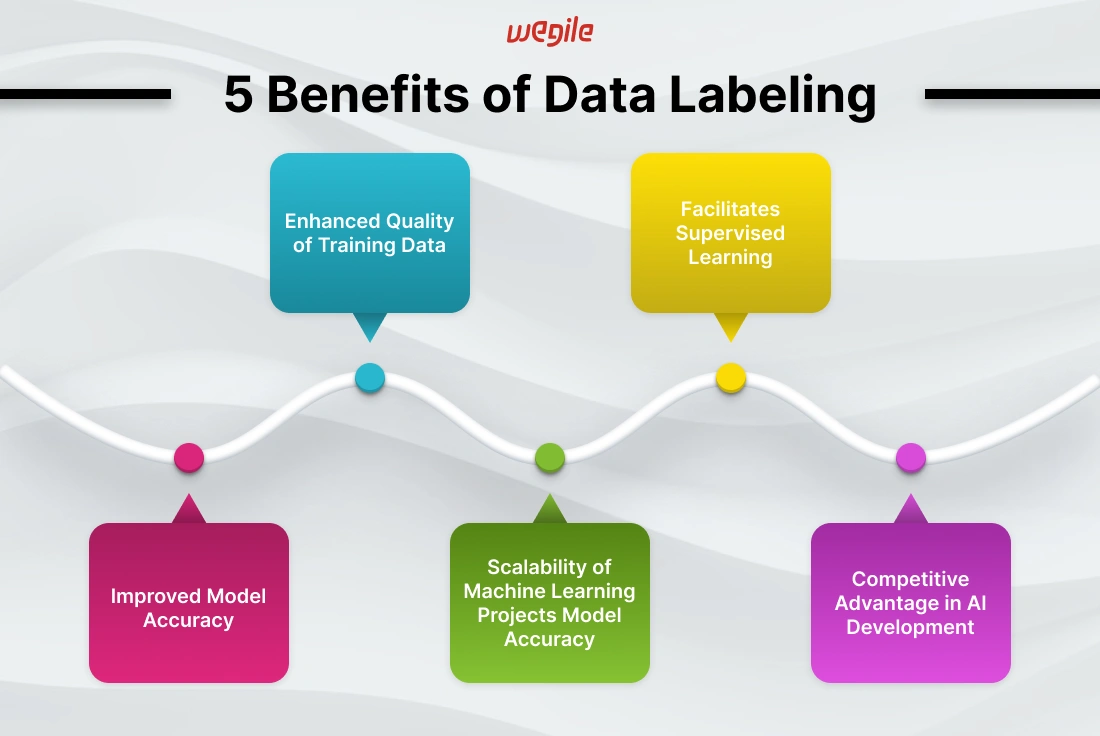
1.
Improved Model Accuracy
The primary benefit of precise data labeling is the high accuracy of machine learning models.
Accurately labeled data serves as a solid training set that teaches AI algorithms to identify
patterns and make decisions based on real-world inputs. This foundational training leads to models
that perform better. It helps in reducing errors in tasks such as image recognition, speech
recognition, and predictive analytics.
2. Scalability of Machine Learning
Projects
Data labeling upgrades the quality of training data. By precisely annotating data, inconsistencies
and errors can be minimized. It further ensures that the training phase of machine learning is based
on clean and well-organized data. High-quality training data is less prone to biases and anomalies.
It also refines the learning process and leads to flawless outputs.
3.
Facilitates Supervised Learning
Structured data labeling processes bolsters scalability in machine learning projects. Also, as the
demand for AI solutions grows, efficiently scaling data annotation to meet the needs of larger
datasets becomes even more essential. Effective labeling guarantees that as your data grows, your
models can develop without losing performance which makes large-scale deployment feasible and more
simple.
4.
Competitive Advantage in AI
Development
Data labeling is particularly beneficial in supervised learning contexts. Here, the model learns to
predict outcomes based on example inputs and outputs. Labeling provides the necessary framework of
labeled examples for supervised algorithms. It is pretty critical for training models that require
progressive levels of precision such as those used in medical diagnostics or autonomous driving.
5.
CVAT (Computer Vision Annotation
Tool)
Companies that invest heavily in high-quality data labeling processes get a competitive edge.
Accurate data labeling results in more impactful AI and Generative AI solutions. This can be a
differentiator in industries that rely heavily on data-driven decision-making. This advantage allows
companies to innovate faster. It helps offer more reliable, efficient, and advanced AI-driven
products and services to their customers.
Use Cases of Data
Labeling
1. Healthcare: Improving Diagnostic
Accuracy
In healthcare, data labeling is used to annotate medical images, such as X-rays, MRIs, and CT scans.
It further enables machine learning models to acknowledge patterns and anomalies. This assists
radiologists in diagnosing diseases with greater accuracy and speed. Plus, labeled data can help in
predictive analytics to forecast patient outcomes. It helps tailor treatments and manage hospital
resources effectively.
2. Autonomous Vehicles: Ensuring
Safety and Reliability
Annotated data from various sensors which majorly includes cameras and LiDAR helps
train
models that must accurately perceive and interpret the environment around them. It includes
recognizing
pedestrians and distinguishing between vehicles. It also includes understanding road signs and these
parameters all crucial for safe navigation.
3.
Retail: Enhancing Customer
Experience
In retail, data labeling helps in analyzing customer behavior through surveillance video data or
customer interaction data to enhance the shopping experience. By understanding patterns, retailers
can optimize store layouts. It also helps manage inventory more effectively and even personalize
marketing strategies to improve engagement and sales.
4. Finance: Fraud Detection and
Risk Management
Data labeling plays a vital role in the financial sector by helping in detecting fraudulent
activities and assessing risk. Annotated transaction data helps algorithms to recognize unusual
patterns that may indicate fraud. Labeled loan application data helps in predicting the likelihood
of defaults which thereby aids in better risk management.
5. Agriculture: Boosting Yield and
Efficiency
In agriculture, data labeling helps analyze drone and satellite images to assess crop health. It
also
aids in predicting yields and detecting pest and disease outbreaks. It allows farmers to make
informed decisions on pesticide use, irrigation, and harvesting which leads to increased efficiency
and yield.
6. Manufacturing: Improving
Production Quality
Data labeling facilitates defect detection in manufacturing lines through image and sensor data. It
promises product quality and reduces waste. Labeled data helps in predictive maintenance of
machinery which prevents unexpected downtimes and optimizes the production process.
Challenges in Data
Labeling
Data labeling is an essential yet a very complex stage in the development of machine learning
models.
Several obstacles can affect the efficiency and accuracy of this process:
-
High Costs and Time Constraints: Data labeling can be expensive and
time-consuming. Both these factors dramatically increase as data volumes increase. Striking
a balance between cost and quality is crucial especially when working with large datasets
that need professional annotators. -
Human Error: The risk of errors from human annotators can risk the quality
of the labeled data. Implementing robust quality assurance processes is vital to recognize
and correct these errors early. -
Data Complexity: Different types of data which includes images, video, and
text poses unique challenges that need specialized approaches to labeling. For example,
understanding language context is critical for text, while recognizing visual patterns is
key for images. -
Privacy and Security: Labeling data that contain sensitive information
needs
handling with stringent security measures. It needs to comply with regulations like GDPR
further ensuring the protection of data privacy. -
Scalability and Volume: As datasets grow, scalability also becomes a big
challenge. Automation and advanced algorithms are necessary to deal with large volumes of
data efficiently.
Best Practices
for Data Labeling
To deal with the challenges effectively, you can go with following best practices that can empower
the quality and efficiency of data labeling:
-
Intuitive Interfaces: Tools with user-friendly interfaces can cut errors by
streamlining the labeling process for annotators. Clear instructions and visual aids help
maintain accuracy and speed. -
Quality Assurance and Auditing: Regular checks and audits of labeled data
promises consistency and accuracy. It helps to catch errors and biases early on. It involves
a systematic review of the data to detect inconsistencies and potential biases. -
Clear Guidelines and Training: Developing clear labeling guidelines and
providing thorough training for annotators is pretty crucial. It helps make sure that
everyone involved understands the tasks and maintains high standards throughout the labeling
procedure. -
Leveraging Technology: Using advanced labeling technologies like machine
learning algorithms and active learning helps improve both the speed and accuracy of data
labeling. These technologies can further automate the labeling of complex datasets and help
prioritize the labeling of data samples that will most benefit the model’s training.
Final Words
As we explore the complexities of data labeling in machine learning, it becomes pretty evident that
despite substantial challenges, the rewards are equally promising. Effective data labeling enriches
the precision of machine learning models. It extends their usefulness across diverse sectors,
improving both their reliability and effectiveness. Adopting advanced tools and methodologies along
with prioritizing thorough training and clear guidelines helps organizations overcome hurdles
related to cost, complexity, and scale. This turns data into a powerful asset for AI-driven
innovation.
For businesses looking to further use the power of AI, partner with Wegile for seeking best
assistance in the data labeling domain. We curate impactful generative AI app
development services and other AI-related
services. Wegile’s expertise in crafting tailored AI solutions can elevate your projects. We will
ensure that your data labeling efforts contribute directly to sophisticated and efficient AI
applications. Connect with us and unwind powerful opportunities available in the AI domain.
Frequntly Asked
Questions (FAQ)
-
Which type of machine learning uses labeled data?
Supervised machine learning uses labeled
data. Here, the models are trained on
datasets that include both input data and corresponding output labels. This type of
learning is ideal for applications such as image recognition and spam detection. It
also helps in risk assessment, where the relationship between the input data and the
known labels need deep understanding. -
What is Labeled and Unlabeled Data?
Labeled data includes datasets where
each entry is tagged with a label or output
value. It is critical for supervised learning as it provides a crystal clear outcome
or category for each piece of data. Unlabeled data, on the other hand, lacks these
tags which makes it suitable for unsupervised learning where the algorithm tries to
specify patterns and insights without any predefined labels or outcomes. -
What is the difference between data labeling and data annotation?
Data labeling and data annotation are
used interchangeably but there are certain
subtle differences. Data labeling generally refers to the procedure of identifying
raw data with tags or labels to provide context. It is essential for training
machine learning models. However, data annotation involves adding metadata or notes
to data. It can include labeling but is often more comprehensive and can include
additional context or explanations that may not directly be used as labels. -
How to label data for machine learning in Python?
In Python, data labeling can be achieved
using various libraries and tools. These
tools are designed for data preprocessing.
For example, libraries such
as Pandas can be used to manipulate and label data effectively. Tools like
Scikit-learn provide utilities for splitting data into training and test sets and
further applying transformations. Python’s flexibility allows for the use of
annotations through custom scripts or by utilizing platforms that integrate Python
support for more complicated labeling tasks. -
What are the 4 types of data in machine learning?
-
Numerical Data: This includes any data that is
quantitative and measurable. For example: heights or prices. -
Categorical Data: This includes qualitative data that
can be separated into different categories based on attributes, for
example- color or brand. -
Ordinal Data: This type of data combines numerical and
categorical data features. It has a meaningful order but not necessarily
a consistent interval between values such as rankings or scales. -
Time Series Data: This data is sequential and is indexed
in time order. It is further useful for forecasting and analyzing
time-dependent patterns.
-
Leave a Reply