
Have you ever thought of how LLMs like GPT-4 get so powerful and accurate? It’s not just the vast
amount of data they’re trained on; fine-tuning plays a crucial role in refining these models for
specific tasks. This approach takes a general model and hones it to excel in particular areas in
order to make it smarter and more relevant to your needs. Imagine having an AI that understands
language and speaks your industry’s language fluently. That’s the power of fine-tuning. This
approach can improve AI-driven initiatives like customer assistance, content creation, and
specialized apps. It’s about tailoring the AI to meet your specific goals. Ready to explore how
fine-tuning can elevate your AI capabilities? This blog will serve as a helpful resource. It will
walk you through each step and provide advice on how to maximize the potential of your AI. Let’s
dive in and discover how fine-tuning can transform your projects!
Applications of
Fine-Tuned LLMs
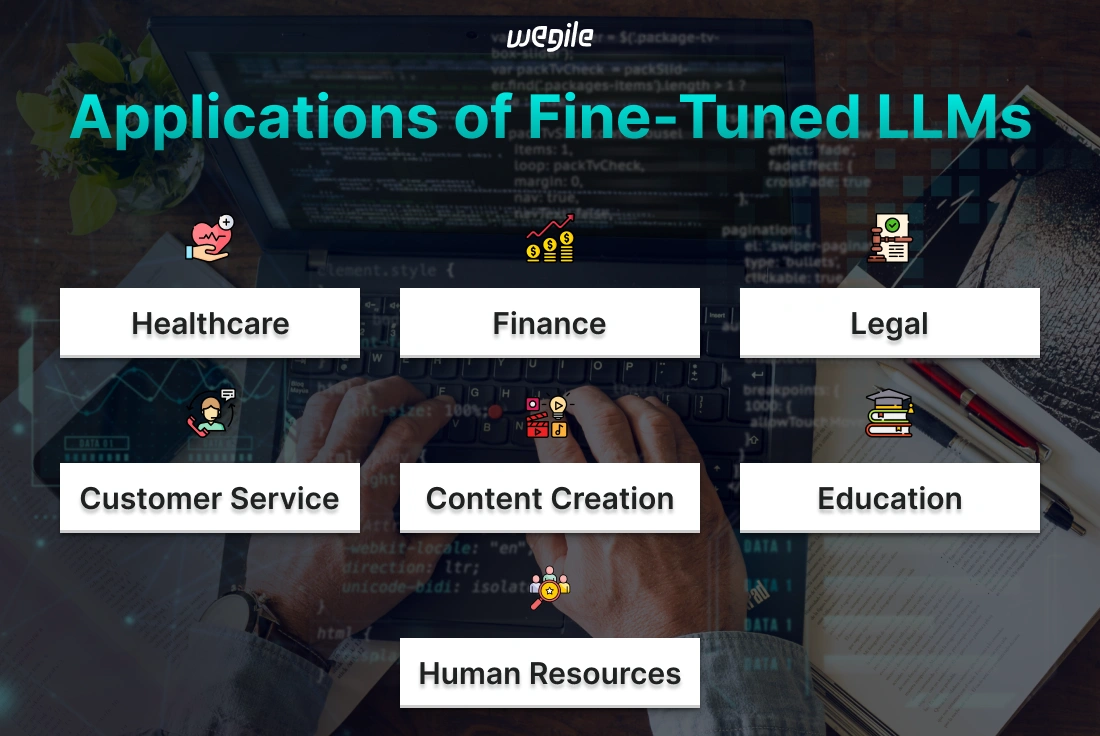
Fine-tuned LLMs are similar to highly skilled specialists; they effortlessly manage complicated jobs.
They can adapt to different industries’ needs with ease and are highly efficient at what they do.
Let’s explore some practical applications and see how these AI models are making waves across
different sectors.
1. Healthcare
Fine-tuned LLMs are changing the way we approach health care. These
models can be trained on vast amounts of
medical literature, patient records, and clinical guidelines. Later, the same is used to assist
doctors in diagnosing and treating patients more accurately.
-
Example: Let’s consider an example of a fine-tuned LLM that specializes in
rare diseases. A doctor can input a patient’s symptoms. At this point, the model will
swiftly go through a mountain of medical data and literature in search of possible diagnoses
and therapies. This ensures that patients get the most precise treatment possible while also
expediting the diagnosis procedure.
Must Read: Discover
the Transformative
Impact of Generative AI in Drug Discovery
2. Finance
LLMs are being used to automate financial processes
that would otherwise require significant
human effort. These models help financial institutions and fintech businesses save time and
reduce errors, be it analyzing
financial documents or generating reports.
-
Example: A bank might use a fine-tuned LLM to review and process loan
applications. The model can evaluate the applicant’s financial history, assess risk, and
even generate a summary report for the loan officer. All the process happens within minutes!
This speeds up the approval process and also guarantees that the bank’s decisions are based
on comprehensive data analysis.
3. Legal
Another field where refined LLMs are having a significant influence is the legal business. These
models can be trained via statutes, legal precedents, and case laws. This opens up all sorts of
possibilities for its future application in assisting legal professionals with tasks such as
research, document creation, and case outcome prediction.
-
Example: A law firm could use a fine-tuned LLM to draft contracts or legal
briefs. The model that’s trained on thousands of similar documents can generate accurate
drafts that are tailored to the specific needs of the case. This reduces the time lawyers
spend on drafting. The same time can be used for tasks that require more strategy and client
interaction.
4. Customer
Service
Fine-tuned LLMs are also transforming customer service. They’re enabling companies to offer instant,
accurate, and personalized support. LLM models can be trained on customer inquiries, FAQs, and
support documentation to provide quick and relevant responses.
-
Example: A tech company might deploy a fine-tuned LLM to handle customer
inquiries on its website. The model can instantly provide a detailed response in times when
a customer asks a question about troubleshooting an issue. This will be based on the
company’s support documentation. It can even guide the customer through complex steps and
mimic the assistance of a live agent. This enhances customer satisfaction by providing quick
resolutions. Moreover, it also frees up human agents to handle more complex or sensitive
issues.
5. Content
Creation
Fine-tuned LLMs are becoming indispensable tools in the content
creation space. Writers, marketers, and creative
professionals take support on these models in order to
generate everything from blog posts to marketing copy. This is because LLM models offer tailored
inputs that are specific to the audience or brand voice.
-
Example: A marketing agency could use a fine-tuned LLM to draft social media
posts for a new product launch. It can train the model on previous successful campaigns,
brand guidelines, and customer preferences and further produce engaging content that
resonates with the target audience. This ensures quick input along with consistency and
creativity across all platforms.
6. Education
Education
is
another field
where fine-tuned LLMs are making a
significant impact. These models can be tailored to provide personalized learning experiences so
that it adapts to the needs and pace of individual students.
-
Example: An online education platform might use a fine-tuned LLM to create
customized lesson plans for students. For that, the model will be used to analyze a
student’s past performance and learning preferences. This will lead to the creation of
exercises, quizzes, and even explanatory content that aligns with the students’ unique
needs. Thus, the use of models will lead to helping students learn more effectively and keep
them engaged in their studies.
7. Human
Resources
Fine-tuned LLMs are being used to improve recruitment processes and employee management. These models
can analyze resumes, match candidates to job descriptions. It can even assist in performance
evaluations.
-
Example: A company could employ a fine-tuned LLM to sift through hundreds of
resumes. This will lead to the identification of the most qualified candidates for the
dedication position. The model can highlight relevant experience, skills, and
qualifications. This presents HR managers with a shortlist of top candidates. Further, it
reduces the time spent on manual resume screening and helps ensure a better fit between
candidates and job roles.
Benefits of
Fine-Tuned LLMs
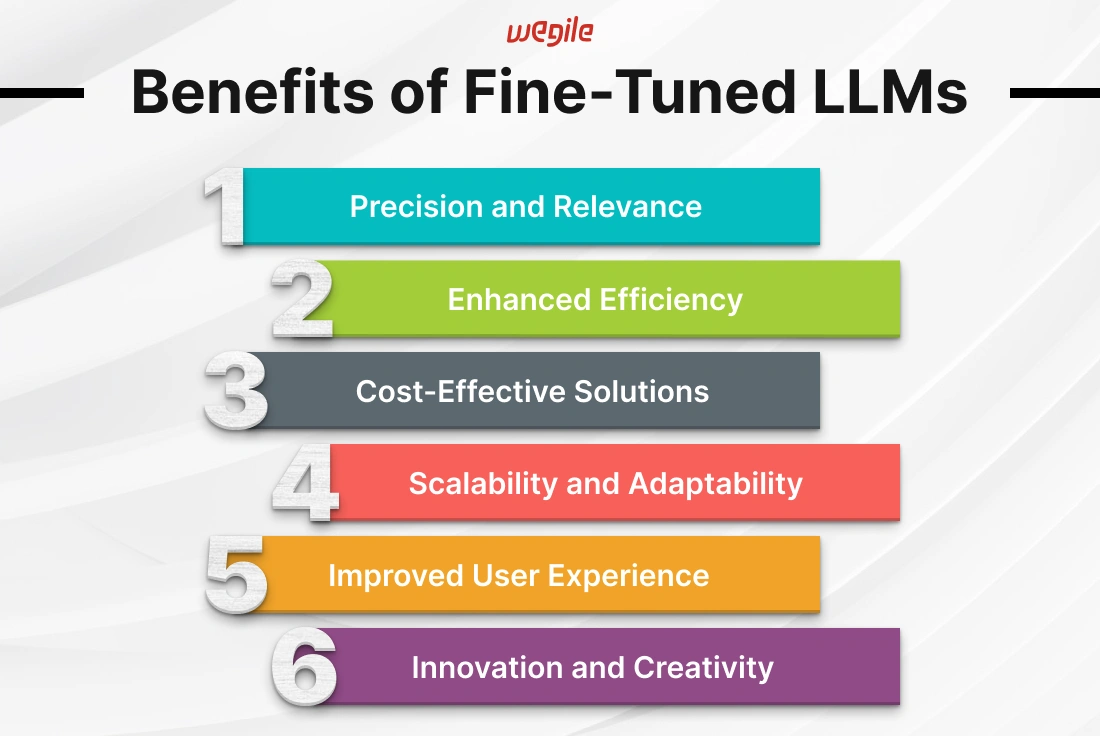
Fine-tuned LLMs are known to offer a range of benefits that make them incredibly valuable across
various use
cases. Let’s explore how
these specialized models can give
you an edge.
1.
Precision and Relevance
One of the standout benefits of fine-tuned LLMs is their ability to deliver precise and relevant
results. Fine-tuned LLMs are trained to understand the specific nuances of a particular field or
task, unlike the generic models that may give you a broad and sometimes vague output.
-
Why It Matters: This precision makes certain that the model’s outputs apart
from being accurate, they’re also directly applicable to the context at hand. Fine-tuned LLM
provides insights that are spot-on, especially when you’re drafting a legal document,
diagnosing a patient, or analyzing financial data. This saves you time and reduces errors.
2.
Enhanced Efficiency
Fine-tuned LLMs streamline processes that would otherwise be time-consuming or labor-intensive. They
can handle complex tasks quickly and effectively. These models free up human resources for more
strategic work.
-
Why It Matters: You can automate complex tasks such as drafting reports,
processing customer inquiries, or screening job applicants. Fine-tuned LLMs can do this and
more. This lets you focus on what truly matters: innovating and growing your
business.
Must Read: What
Every CEO Must Know About
Generative AI?
3.
Cost-Effective Solutions
Using fine-tuned LLMs can result in substantial cost savings because of their exceptional efficiency
in automating and optimizing a wide range of tasks. They make it easier to complete tasks and
prevent errors that could be expensive.
-
Why It Matters: Cutting costs without compromising on quality is a
remarkable ability. It can be a huge advantage in any industry, and fine-tuned LLMs can help
you achieve this by achieving more with less. Thus, the capabilities make these models a
smart investment for businesses looking to stay competitive.
4. Scalability and Adaptability
Fine-tuned LLMs are powerful apart from being highly adaptable. These models can be re-tuned or
scaled to handle new tasks or larger datasets as your needs evolve. This makes them a flexible tool
for long-term growth.
-
Why It Matters: This scalability ensures that your AI solution grows with
your business. A fine-tuned LLM can always adapt to meet your needs regardless of whether
you’re expanding into new markets, dealing with increasing data volumes, or facing new challenges.
5.
Improved User Experience
Fine-tuned LLMs can significantly enhance the user experience, especially in areas such as customer
service and content creation. They provide faster, more accurate responses and generate content that
feels more personalized and relevant.
-
Why It Matters: Providing a great user experience is something that you can
compromise in current times. Fine-tuned LLMs help you deliver the kind of quick, accurate,
and personalized interactions that keep customers happy and engaged.
6.
Innovation and Creativity
Finally, fine-tuned LLMs open the door to new levels of innovation and creativity. They can generate
ideas, suggest new approaches, and even help create original content. This way, they’re pushing the
boundaries of what’s possible.
-
Why It Matters: Having a tool that can think outside the box with you is
invaluable regardless of any field. Fine-tuned LLMs are crucial equipment that enhance your
current capabilities and further inspire new ways of thinking and working.
The
Technical Process of Fine-Tuning LLMs
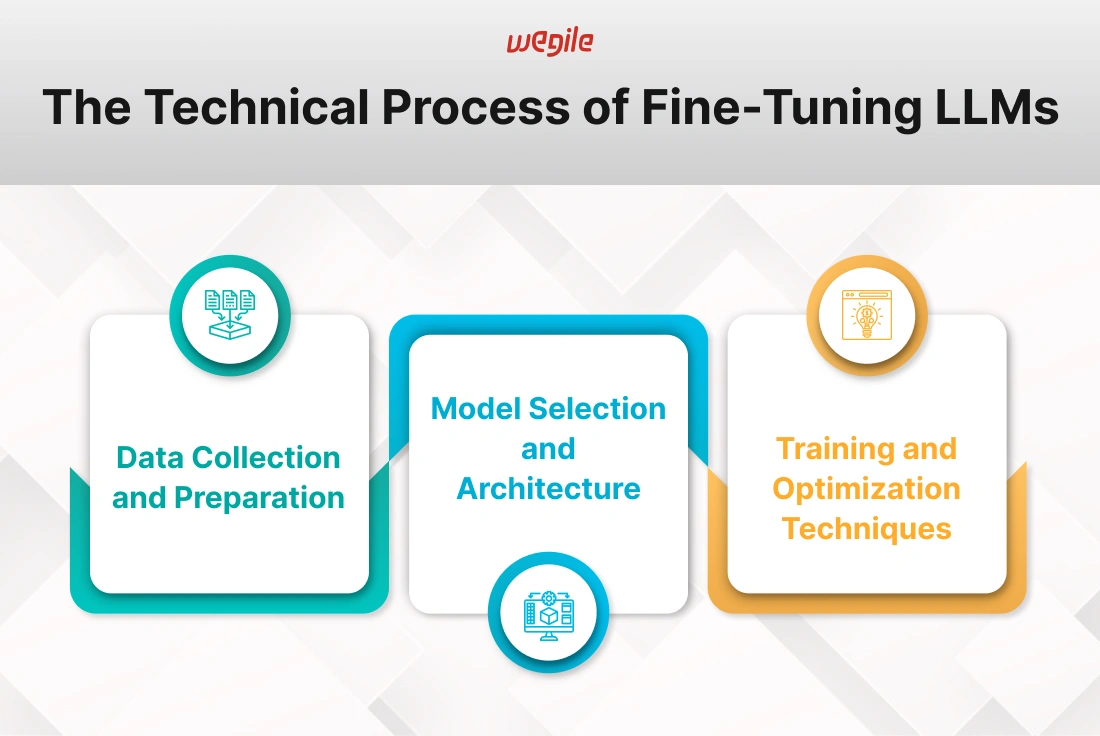
Fine-tuning a Large Language Model (LLM) is like teaching an already smart AI to become an expert in
a specific area. This process involves several important steps. Each one is critical to ensure the
model performs well for its intended purpose. Let’s break down the key stages in this journey.
1. Data
Collection and Preparation
The first and perhaps most crucial step in fine-tuning an LLM is gathering and preparing the right
data. Imagine trying to teach a chef to specialize in Italian cuisine. You’d want to provide them
with authentic recipes, not just general cooking tips. The same goes for AI models.
-
Gathering Data: Start by collecting datasets that are relevant to the task
in which your model wants to excel. For instance, you’ll need a vast array of legal texts,
cases, and regulations if you’re fine-tuning an LLM to generate legal documents. The quality
and relevance of the data directly impact the effectiveness of the fine-tuning. -
Preparing Data: Your collected data needs to be cleaned and structured
properly. This includes removing any noise or irrelevant information which makes certain
that there is consistency in format. It sometimes even requires labeling data to guide the
model’s learning process. High-quality data preparation is key for laying a solid foundation
for a building. The final product won’t be stable if the foundation is weak.
2. Model
Selection and Architecture
Picking the optimal LLM architecture for fine-tuning is like selecting the most suitable tool for a
given task. It’s pretty obvious you wouldn’t use a hammer to tighten a screw. The same principle
applies here with fine-tuning LLMs.
-
Model Selection: Different LLMs come with different strengths and sizes.
Some are lightweight and quick, while others are heavyweight with vast knowledge but require
more computational power. Selecting the appropriate model depends on your specific needs,
whether it’s for speed, accuracy, or the ability to handle complex tasks. -
Architecture Considerations: The architecture of an LLM includes layers of
neurons, attention mechanisms, and parameters that define its capacity and performance. You
might adjust these elements to better suit your task when fine-tuning. For instance, you may
tweak the number of layers or modify the attention mechanisms to help the model focus better
on relevant parts of the input data. Scalability is also a factor. Reassure whether the
model can handle an increase in data or task complexity as your project grows or not.
Balancing these aspects makes certain that the fine-tuned model is both effective and
efficient.
Must Read:
What Programming Language is
Used in Generative AI: Top 5 Choices
3. Training and Optimization Techniques
Training and optimizing the model is the next stage after obtaining the correct data and model.
Picture this as the part of the process where the AI gets plenty of experience until it becomes an
expert.
-
Training Techniques: During fine-tuning, the LLM is exposed to the prepared
dataset, learning to generate responses or perform tasks based on this new information.
Techniques like supervised learning or unsupervised learning can be employed. It’s a bit
like guiding a student through practice problems. They gradually get better with each
iteration. -
Optimization Strategies: Optimization is about perfecting the fine-tuning
process for better efficiency. This includes adjusting learning rates, using regularization
techniques to prevent overfitting, and employing strategies like early stopping. These
techniques ensure that the model learns effectively and generalizes well to new and unseen
data.
Best
Practices for LLM Fine-Tuning
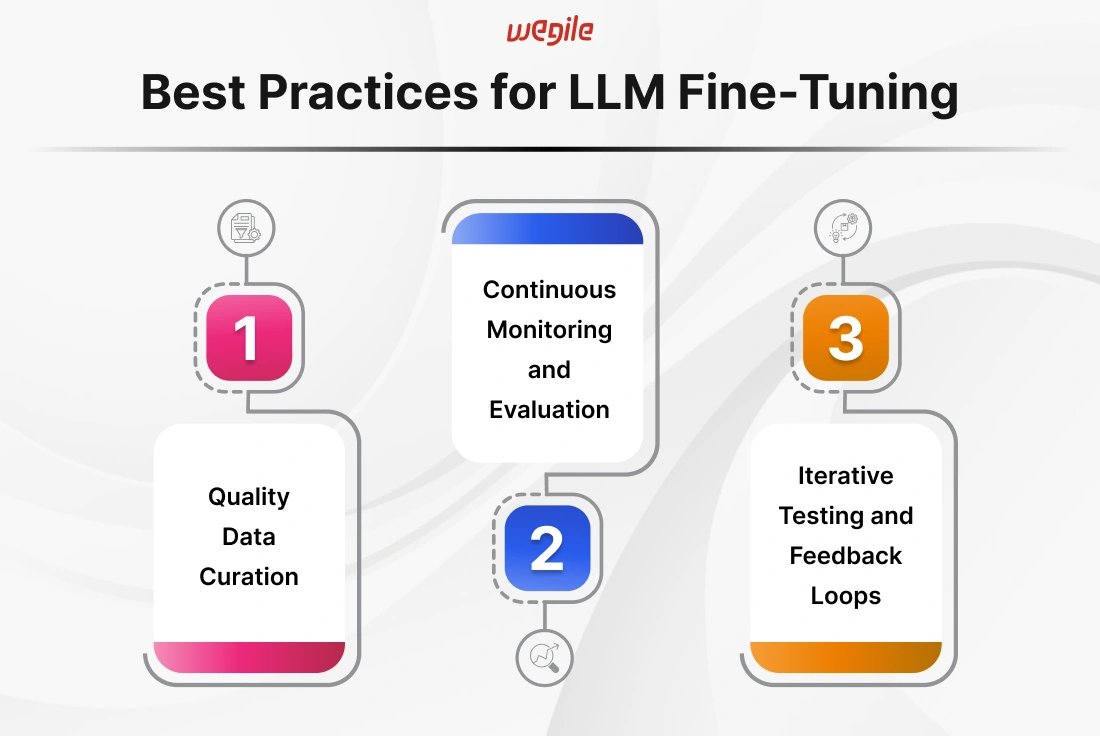
Fine-tuning an LLM isn’t just about tweaking a few settings and hitting “run.” You need to follow
some best
practices to truly unlock the model’s potential. This will
ensure that the process is both effective and efficient. Let’s dive into how you can make the most
out of your fine-tuning efforts.
1.
Quality Data Curation
High-quality data is the backbone of an effective tuning procedure. Just like a sponge, your LLM will
soak in any information you give it. The outcomes will be better if the inputs are good.
-
Curate with Care: Start by gathering datasets that are different from being
relevant but are diverse and representative of the task at hand. Do not feed the model
irrelevant or low-quality data; doing so can cause it to produce biased or bad results. It’s
similar to making a gourmet meal out of old ingredients. The result will be unsatisfactory
regardless of the skill level of the cook. -
Select Strategically: Choose datasets that are specific to the domain or
task you’re fine-tuning for. For example, use up-to-date medical literature and patient data
when you’re training a model to assist with medical diagnostics. This ensures that the
model’s learning is both accurate and applicable.
2.
Continuous Monitoring and
Evaluation
Fine-tuning LLMs doesn’t have a “set it and forget it” approach. You need to monitor the model’s
performance to make sure it is performing well.
-
Monitor Regularly: Implement ongoing monitoring systems to track the model’s
performance over time. This involves making sure the model is accurate, relevant, and not
showing any signs of drift. Thus, keep an eye on things on a regular basis to identify
problems before they escalate. -
Evaluate Thoroughly: Use a variety of evaluation metrics to assess the
model’s performance. Don’t just rely on a single accuracy score. Consider other factors like
precision, recall, and user satisfaction. This gives you a more holistic view of how well
the model is doing and where it might need adjustments.
3. Iterative Testing and Feedback Loops
Your model still isn’t set in stone even after fine-tuning. It’s crucial to test, refine, and
incorporate feedback continually.
-
Test Iteratively: Conduct regular testing to see how the model handles
different inputs and scenarios. This helps you identify areas where the model might struggle
or produce unexpected results. Think of it as a dress rehearsal before the big show. You
want to iron out any kinks before going live. -
Incorporate Feedback: It’s critical to build a system that lets users or
domain experts provide feedback on how the model is performing. This assures you that the
model is perfect and serves people’s real-world
needs.
Challenges and Considerations in Fine-Tuning
Fine-tuning LLMs is rewarding yet difficult. Understand potential problems and how to overcome them.
This is essential to properly fine-tune LLM. Let’s examine some common issues and crucial concerns.
1. Data Privacy and Ethical Concerns
Data privacy and ethics should be at the forefront of your mind when fine-tuning LLMs. This is
especially required for sensitive or proprietary applications.
-
Privacy Matters: Using sensitive or proprietary data can enhance the model’s
relevance. However, it also raises significant privacy concerns. You need to ensure that any
data used is handled with the utmost care. This includes anonymizing personal information
and securing data storage. You also need to follow all relevant regulations like GDPR.
Ignoring these aspects can lead to breaches of
trust or legal repercussions. -
Ethical Implications: There are ethical considerations beyond privacy in how
the model is trained and used. For instance, training a model on biased data can lead to
outputs that reinforce harmful stereotypes or unfair practices. Be mindful of the source and
nature of your data. Strive to use diverse, representative datasets and consider the broader
impact of the model’s decisions and actions.
2. Resource Allocation and Cost
There is a high monetary and computational expense attached with fine-tuning LLMs. Here, efficient
resource management is crucial to avoid unnecessary expenses.
-
Computational Resources: Fine-tuning requires significant computational
power. This often involves high-performance GPUs or cloud-based solutions. The costs can add
up quickly.. This is especially for large models or extensive fine-tuning. Thus, it’s
important to plan your resource allocation carefully. Consider whether the benefits of
fine-tuning justify the costs. Further, explore ways to optimize resource usage, such as
using smaller, more efficient models or limiting the scope of fine-tuning. -
Cost Management: In addition to hardware, the time and expertise required
for fine-tuning can also be costly. Training staff or hiring experts to manage the process
can strain budgets. One way to keep expenditures in check during a fine-tuning project is to
set clear targets and deadlines. Compare several platforms and tools to discover the best
budget-friendly choices. Also, consider whether it would be more beneficial to use
pre-fine-tuned models or outsource the work.
Wrapping Up
Fine-tuning LLMs is more than just an optimization approach; it’s the key to unlocking the full
potential of your AI projects. Tailoring these models to your specific needs will make certain that
you can achieve more accurate results, enhance user experiences, and bring a higher level of
intelligence to your applications. The benefits are clear: a smarter, more relevant AI that drives
success no matter whether you’re fine-tuning LLMs for customer engagement, content creation, or any
other specialized task.
Looking to fine-tune your AI models or build a generative AI app from
scratch? Wegile’s generative AI app
development services can help you create
solutions that stand out. Let us partner with you to turn your AI ambitions into reality. Reach out
to Wegile today, and let’s start building together!
Leave a Reply