Imagine a world where computers can write like Shakespeare, paint like Picasso, and think like
Einstein. Well, this is not just a fantasy anymore as it is becoming reality thanks to foundational
models in Generative AI. These aren’t your average AI models but they’re like the ultimate
multitools of the digital world.
Foundational models such as the famous GPT Generative Pre-trained Transformer and the innovative
DALL-E are leveling up how machines understand and create outputs. Be it spinning up an essay,
developing a stunning image from a simple description, or even cracking jokes, these models do it
all. Their power to learn from diverse information and then apply it across various fields is what
makes them so powerful and quite intriguing.
Let’s immerse ourselves in the fascinating world of foundational models. Also, get to know how they
are not just learning to mimic human creativity but are also preparing the stage for a future where
AI
and
generative AI help us all to think bigger, create more
content, and solve the toughest puzzles of our time.
What are Foundation Models in Generative AI?
Foundational models in generative
AI solutions are large-scale machine learning models.
They are trained on vast datasets to develop a broad understanding across multiple domains. They
form the backbone of contemporary AI by using deep learning techniques to curate text, images, or
other media that mimic human-like creativity and understanding. The “foundation” aspect of these
models is in their general-purpose nature. It allows for fine-tuning across various tasks without
the requirement of attaining training from scratch. This versatility not only enriches efficiency
but also drives innovation in AI applications. By understanding and predicting complicated patterns,
these models open new lanes for generative AI by making technology more adaptive and contextually
aware.
Core
Examples of Foundational Models in Generative AI
Let’s now discuss the main examples of foundation models in detail:
1.
GPT (Generative Pre-trained
Transformer)
Generative Pre-trained Transformer or GPT is developed by OpenAI. This series represents one of the
most well-known examples of foundation models. GPT foundational models started from GPT, advancing
to GPT-2, and then evolved into GPT-3 and GPT-4. Each of these iterations have been built on a
transformer architecture. They use deep learning to produce human-like text. These models are
trained on diverse internet text and can perform multiple tasks such as translation and
summarization. The adaptability of GPT models makes them incredibly valuable for businesses seeking
to level up their customer service or content creation processes.
2. BERT (Bidirectional Encoder
Representations from Transformers)
Google’s BERT has been a real game-changer for comprehending the context of words in search queries.
Unlike traditional models that process words in order one at a time, BERT considers the entire
sentence or query as a whole. The bidirectional training of BERT helps it to grasp the full context
of a word based on its surroundings. It leads to much more effective search results and enables
better user interaction with AI systems.
3. DALL-E
Another groundbreaking model from OpenAI is DALL-E. It leverages the GPT architecture to generate
images from textual descriptions. This model presents the flexibility of foundational models in not
only understanding and developing text but also building complicated images. They can include
anything from mundane objects to unreal scenes. DALL-E epitomizes the potential of AI and
generative AI in
creative industries. It is paving the way for
new forms of artistic AI collaboration.
4. CLIP (Contrastive Language-Image
Pre-training)
CLIP by OpenAI can understand images in context with textual descriptions. It bridges the gap
between
visual clues and language. This model has been trained on a variety of images and text from the
internet. It allows it to understand and classify unseen images more impactfully than previous AI
models. CLIP’s power to comprehend and analyze images through natural language is particularly
valuable in tasks that require robust image recognition and categorization.
5.
T5 (Text-to-Text Transfer
Transformer)
Google’s T5 converts all language problems into a unified text-to-text format. Here, tasks are
treated uniformly and solved using a consistent approach. This model stimulates the process of
applying AI in natural language processing tasks. It reduces the need for multiple specialized
models plus it streamlines operations and eliminates complexity.
Advantages of
Foundational Models
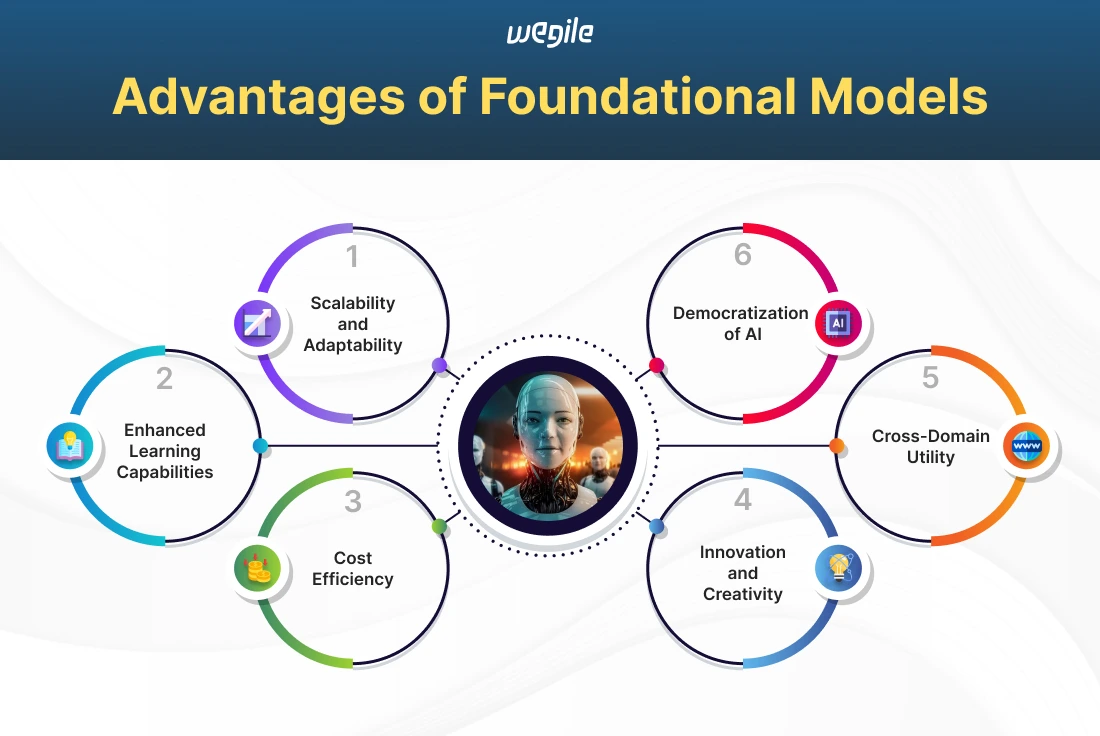
1. Scalability and Adaptability
Foundational models can be trained on extensive datasets and fine-tuned to specific tasks with
relatively little additional data. This adaptability makes them precious assets across different
applications and industries. These range from healthcare diagnostics to automated customer service
systems.
2. Enhanced
Learning Capabilities
Foundational models are planned to improvize continuously as they digest and assess more data. This
characteristic helps them to become more accurate and efficient over time. By using transfer
learning, these models can apply knowledge gained from one domain to another. They also cut the need
for extensive retraining and accelerating deployment timelines.
3. Cost
Efficiency
Deploying foundational models can result in significant cost savings for organizations. By
automating
routine tasks and optimizing operations, these models curtail the need for manual intervention. It
lowers labor costs and operational expenses. Also, their power to generalize from existing data
diminishes the costs linked with data acquisition and model training.
4.
Innovation and Creativity
Foundational models are a catalyst for innovation. They bring a versatile framework that researchers
and developers can build upon to create novel applications. Foundational models assist in generating
creative content by designing new materials. They also help in modeling complex systems and present
a starting point that can spur creative solutions to longstanding problems.
5.
Cross-Domain Utility
The utility of foundational models goes across domains. A model trained in one area, such as
language
understanding, can be adapted to enhance performance in another, such as sentiment analysis or legal
document review. This cross-domain applicability ensures that investments in foundational model
training have broad-reaching impacts.
6.
Democratization of AI
Foundational models also play a crucial role in the democratization of AI technologies. They provide
pre-trained models, smaller entities, and individual developers. They also gain access to powerful
tools that were once reserved for large organizations with substantial resources. This access
nurtures a more inclusive AI development landscape and encourages a wider range of innovations.
What is the Difference between a Foundational Model
and an LLM?
Foundational models and large language models (LLMs) are both fundamental to the field of artificial
intelligence. But, they fulfill different purposes and are constructed on distinct principles. Let’s
explore five key differences between foundational models and LLMs:
1. Scope
of Application
-
Foundational Model: Foundational models are designed to be flexible across
a
wide range of tasks and domains. They are trained on a broad dataset that includes various
types of information which helps them to develop a comprehensive understanding. This
versatility makes them suitable for tasks beyond natural language processing. It includes
image recognition, decision-making processes, and more. -
Large Language Model (LLM): In contrast, LLMs are specifically trained to
comprehend and generate human language. They are optimized for tasks such as translation,
summarization, and question-answering within the text domain. Their training focuses
exclusively on large volumes of textual data. It enriches their performance in
language-based tasks but restricts their applicability outside this domain.
2. Training Data
-
Foundational Model: The training data for foundational models is incredibly
diverse. It majorly encompasses text, images, audio, and other data types. This diversity
helps the model to curate a more comprehensive understanding of the world which is pretty
crucial for its adaptability to various tasks. -
Large Language Model (LLM): LLMs are trained primarily on text data. The
datasets used majorly comprises books, articles, websites, and other textual sources to
encircle a wide array of topics and languages. But, the focus remains rigorously on language
which lacks the multimodal data that foundational models are often exposed to.
3.
Complexity and Scale
-
Foundational Model: Foundational models embody greater complexity and
scale.
They are larger in terms of parameters and computational requirements which further reflect
their broader scope and the need to process and create diverse types of data. -
Large Language Model (LLM): While LLMs can also be large and complex, the
scale generally matches with the needs of processing extensive text collections. The
complexity is focused more on linguistic nuances rather than on bridging different types of
data inputs.
4. Adaptability and Fine-tuning
-
Foundational Model: One of the leading hallmarks of foundational models is
their adaptability. They can be fine-tuned with relatively small datasets to work well on
specific tasks in various domains. This adaptability is a consequence of their extensive and
diverse foundational training. -
Large Language Model (LLM): LLMs can also be fine-tuned but the fine-tuning
generally remains confined to the linguistic tasks. Their initial training on language tasks
means they are inherently less adaptable to non-linguistic tasks without major modifications
or integrations with other models.
5.
End Use and Implementation
-
Foundational Model: Foundational models are utilized as the base for
developing technological models. They are a starting point for researchers and developers
looking to produce generative AI solutions personalized to particular needs or industries
for leveraging the model’s broad capabilities. -
Large Language Model (LLM): LLMs are used directly for applications
including text. They are implemented in tools that need natural language understanding and
generation. They include chatbots, writing assistants, and extensive AI systems focused on
linguistics.
How to build
a Foundational model?
1. Define the Purpose and Scope
Explicitly define what you aim to achieve with the foundational model. Be it enriching natural
language processing or improving image recognition, a clear objective is necessary to guide all
subsequent decisions. State the scope of the model which includes the breadth of knowledge it should
cover and the specific functionalities it needs to possess including the limitations it must adhere
to.
2.
Gather and Prepare Data
Assemble a diverse and extensive dataset that contemplates the scope of the model. This data can
come
from publicly available datasets and proprietary information. Also, focus on:
-
Data Cleaning: To ensure that the data is clean and usable. It will remove
any inaccuracies or irrelevant information. This step is vital for the performance of your
model. -
Data Labeling: Accurately label the data which is integral for
supervised
learning models. The quality of labeling
directly affects the model’s output.
3. Choose the Right Algorithms and
Techniques
-
Algorithm Selection: Choose from algorithms like deep learning and
reinforcement
learning. Also, evaluate the trade-offs
between accuracy, speed, and computational efficiency. -
Technique Refinement: Go with techniques such as transfer learning or
multi-task learning to level up the model’s ability to generalize across different tasks.
4. Develop
a Prototype
-
Model Architecture: Design the architecture of the model by considering
factors like layers, nodes, activation features, and connectivity. -
Prototyping: Construct a prototype of your model to test its feasibility
and
initial performance on real-world tasks.
5. Train the
Model
-
Training Process: Instruct your model by employing the prepared dataset.
Evaluate for parameters like overfitting and underfitting by revising parameters like the
number of layers, learning rate, and dropout rates. -
Validation: Regularly validate the model utilizing a separate set of data
to
review its accuracy and impact.
6.
Evaluate and Iterate
-
Performance Evaluation: Carefully evaluate the model using metrics
appropriate to the specific tasks it is designed for such as precision, recall, F1 score,
and accuracy. -
Iteration: Refine the model further based on feedback and performance
evaluations. It may involve retraining it with adjusted parameters or additional data.
7. Implement Ethical Guidelines
-
Bias Mitigation: Go with strategies to detect and eliminate biases in the
model. This is important to guarantee fairness and ethical compliance. -
Privacy Considerations: Address privacy concerns, especially if the model
processes personal or vulnerable data. Adherence to regulations like GDPR or HIPAA may also
be required.
8. Deployment
-
Deployment Strategy: Plan how the model will be deployed by considering
whether it will be operated on cloud platforms, on-premises servers, or edge devices. -
Scalability: Make sure that the model is scalable and can handle the
expected load and work effortlessly under different conditions.
9.
Maintenance and Updating
-
Continuous Learning: Establish systems for the model to update continuously
from new data inputs to stay relevant and accurate. -
Maintenance Plan: Regularly inspect and maintain the model to fix issues,
patch vulnerabilities, and improve performance.
10.
Documentation and Transparency
-
Comprehensive Documentation: Document every characteristic of the model
from
development to deployment to guarantee transparency and facilitate troubleshooting. -
Open Communication: Maintain open lines of communication with all
stakeholders by providing updates about the model’s performance and receiving feedback.
Limitations of
a Foundation Model
While foundation models are powerful, they have many limitations:
-
1. Bias and Fairness: These models often perpetuate biases present in
their
training data which leads to fairness issues in their outputs. -
2. Interpretability: The complexity of foundation models makes them more
like
“black boxes”. Here, it’s challenging to comprehend how they come to specific conclusions. -
3. Data Privacy: The broad data present in training these models can result
in
privacy concerns especially if sensitive information is inadvertently included. -
4. Generalization: While foundational models are designed to be
general-purpose, they can sometimes fail in specialized or nuanced tasks without additional
fine-tuning. -
5. Resource Intensity: Training and running foundation models need
significant
computational resources which makes them less accessible for smaller organizations or
individuals.
Addressing
the Limitations of Foundational Models
1.
Combating Bias and Ensuring
Fairness
-
Diverse Data Sets: It is important to utilize diverse and representative
datasets that reflect various demographics and scenarios to combat bias. -
Bias Detection Tools: Install advanced tools and methodologies to catch and
reduce biases in the training data and the model’s output. -
Regular Audits: Execute regular audits of the model’s decisions to
guarantee
fairness and undertake corrective actions if any biases are detected.
2.
Enhancing Interpretability
-
Layer-wise Relevance Propagation: Techniques like Layer-wise Relevance
Propagation can help visualize which parts of the data are impacting the model’s decisions. -
Model Simplification: Streamlining model architecture or using more
interpretable models as proxies can assist stakeholders in comprehending the decision-making
process smoothly. -
Explainability Frameworks: Go with frameworks and tools designed to enrich
the transparency of model operations by providing mindful insights into their internal
workings.
3.
Safeguarding Data Privacy
-
Differential Privacy: Establish differential privacy techniques for data
collection and model training. It will help in ensuring that individual data points cannot
be re-identified. -
Data Anonymization: Before training models, make sure that the sensitive
information is anonymized to avert privacy breaches. -
Privacy by Design: Go with privacy considerations throughout the model
development process by sticking to relevant legal and ethical standards.
4.
Improving Generalization
-
Domain Adaptation: Go with domain adaptation techniques to fine-tune the
model on specific tasks where generalization may be poor. -
Continual Learning: Allow models to continually learn from new data and
scenarios to adapt over time without needing complete retraining. -
Specialized Sub-models: Develop specialized sub-models to enhance areas
where the general model falls short, and integrate them into the overall system for improved
performance.
5.
Reducing Resource Intensity
-
Efficient Model Design: Go with more efficient model architectures that
need
fewer computational resources without significantly compromising performance. -
Quantization and Pruning: Techniques like quantization and
pruning can cut
the model’s size and speed up its operations which makes it more accessible. -
Cloud-Based Solutions: Use cloud computing resources to curate scalable and
cost-effective access to foundational models without the necessity for extensive local
infrastructure.
Wrapping it up
Foundational models in generative AI are reshaping the landscape of technology. These models range
from GPT to DALL-E and they are demonstrating their vast potential to enrich various domains through
their power to understand and generate human-like text. They also assist in creating compelling
images and even comprehending complex patterns and contexts.
The incorporation of foundational models into generative AI app
development services is not just about
technological progress. It is about developing a more interactive, responsive, and personalized
digital experience. These models are continuing to evolve and they promise to deliver more
sophisticated solutions that could revamp industries such as healthcare, automotive, finance, and
entertainment.
Elevate your digital presence with the power of generative AI! At Wegile, we fetch the potential of
cutting-edge foundational models to deliver exceptional web and app development solutions tailored
for your business. Join us on the frontier of innovation and let’s create something truly remarkable
together. Connect with Wegile today, and take the first step towards a future shaped by creativity
and technological advancement. Let’s build something inventive and amazing together!
Leave a Reply