Large Language Models (LLMs) are taking shape as a revolutionary force in the AI domain. They are
reshaping how businesses and developers extensively use technology to enrich user experiences
and streamline operations. Right from crafting compelling marketing content to powering
sophisticated chatbots, LLMs are at the main door of AI modification.
This comprehensive guide to LLM Integration goes deep into how these powerful models are
integrated into various systems. It will unveil their potential to level up mundane tasks into
dynamic and intelligent workflows.
As businesses strive to stay competitive and innovative, comprehending and implementing LLM
integration is becoming pretty crucial. No matter if you’re a seasoned developer, a business
strategist, or simply an AI enthusiast, our guide brings mindful insights into the mechanics,
benefits, and complications of incorporating these advanced models into your projects.
Ready to get the full potential of LLMs in your applications? Keep reading our blog for a deep
plunge into the world of Large Language Models and learn how to utilize their tremendous power
for your technology solutions.
What are
Large Language Models?
Large Language Models (LLMs) are advanced artificial intelligence systems that process and curate
human-like text based on vast amounts of comprehensive data sets they have been trained on. The
top large language models are GPT-3, GPT-2, BERT, T5, and RoBERTa. LLMs are fundamental blocks
of use
cases of generative AI.
LLM models use deep learning techniques and specifically a structure of neural
networks known as transformers.
They
help them understand the nuances of
language and context. The training involves feeding the models with a large corpus of text data.
It enables them to learn grammar, syntax, semantics, and the context within text conversations
or documents.
Key
Features of LLMs:
-
Understanding Context: LLMs excel in grasping the context of a
conversation or text sequence. It allows them to produce relevant and coherent
responses. -
Text Generation: These models can generate text that mimics human
writing styles. They are useful in applications like content creation, chatbots, and
more. -
Scalability: LLMs can digest and generate responses from short tweets to
lengthy articles. It demonstrates versatility across different text lengths and
complexities.
What is LLM
Integration?
LLM Integration refers to the procedure of embedding Large Language Models into existing systems,
applications, and workflows. It helps enrich their capabilities or automate certain functions.
This integration helps businesses and developers use the advanced language processing power of
LLMs to improve user experience, increase efficiency, and bring in new services. LLM integration
also formulates the building blocks of AI
and
Generative AI tools.
How LLM
Integration Works?
Here is a brief overview of how LLM models or their integration works:
-
1. APIs: Most integrations take place through APIs or Application
Programming Interfaces. Here, the LLM is hosted on a server and other applications
interact with it through HTTP requests. -
2. Embedding: In some cases, models may be embedded right into
applications, especially for offline usage or times when response times are critical. -
3. Customization: Depending on the use case, the model might be fine-tuned
with specific data relevant to a specific business or industry to enrich performance and
relevance.
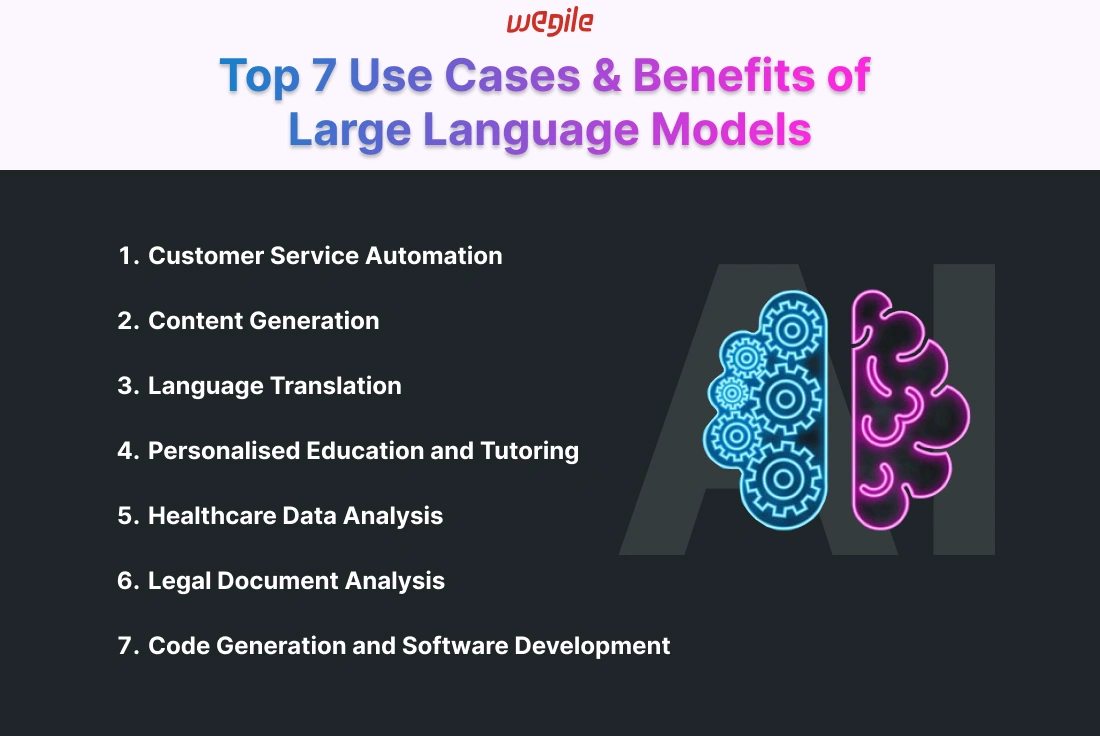
Top 7 Use
Cases & Benefits of Large Language
Models
1. Customer Service Automation
Use Case: LLMs are extensively used in customer service to power chatbots and
virtual assistants. LLM-driven generative AI and AI systems can handle inquiries, and solve
common problems. They also provide 24/7 customer support without human intervention.
Benefits: Customer service automation by LLMs reduces operational costs. It
results in increasing customer satisfaction through instant responses and freeing human agents
to deal with more complicated issues.
2. Content Generation
Use Case: Right from writing articles to creating marketing copy, LLMs can
generate readable and engaging content across various topics. Publishers, marketing teams, and
content creators utilize LLMs to draft content, brainstorm ideas, and even compose entire
articles.
Benefits: Content generation supports enriching creative processes which speed
up content production. It also provides content scalability without compromising quality.
3. Language Translation
Use Case: LLMs are employed to provide real-time translation services. They can
translate text and speech between multiple languages with immense precision and accuracy.
Benefits: Language translation supports facilitating international business
operations which enhances communication in multilingual communities. It also aids in making
information more accessible across language barriers.
4. Personalized Education and
Tutoring
Use Case: LLMs can be tailored to create personalized learning experiences and
tutoring systems. They can adapt to a student’s learning pace and style by providing
explanations, supplementary materials, and interactive learning sessions.
Benefits: The tint of personalization in the education sector by LLMs helps in
improving student engagement and understanding, offering scalable educational tools. It also
assists in traditional classroom settings.
5. Healthcare Data Analysis
Use Case: In healthcare, LLMs analyze patient data, medical notes, plus research
papers to help with diagnosis and treatment plans. They can outline patient histories and
suggest treatment protocols relying on current medical knowledge.
Benefits: This application helps in increasing the accuracy of diagnoses. It
also facilitates reducing the time doctors spend on paperwork and provides personalized patient
care.
6. Legal Document Analysis
Use Case: LLMs can go through extensive legal documents to assist in due
diligence and contract analysis. They also streamline and simplify the litigation processes.
They support in determining relevant information quickly and delivering summaries or insights
into large volumes of text.
Benefits: Legal Document Analysis by LLM aids in streamlining legal operations
which lessens the workload on legal professionals and cuts the time and cost associated with
legal research.
7. Code Generation and Software
Development
Use Case: LLM-based solutions specifically GitHub’s Copilot assist programmers
by suggesting code snippets. It supports debugging existing code and even writing entire
routines based on brief descriptions of functionality.
Benefits: This use case helps in increasing development speed. It reduces bugs
and enhances code quality by leveraging the model’s understanding of programming patterns and
practices.
How to
Integrate LLMs into Your Business?
Integrating Large Language Models (LLMs) into your business can enrich operations and intensify
customer interactions. It also levels up decision-making processes. Here’s a step-by-step guide
on how to integrate LLMs into your business with an impact:
1. Identify Business Use Cases
for LLM Integration
Start by specifying the specific areas in your business where LLMs can add value. Common use
cases are customer support chatbots and automated content generation. It also includes data
analysis and personalized marketing. Specify the objectives and expected outcomes for each use
case to ensure alignment with your business goals.
2. Choose the Right LLM for
Your Needs
Go with a Large Language Model that matches well with your business requirements. Go with factors
such as model size, capabilities, and cost. For example, GPT-4 is suitable for generating
human-like text and smaller models like GPT-3 could be more cost-effective for easier tasks.
Evaluate the trade-offs between performance and resource consumption to get the best fit.
3. Prepare and Preprocess Your
Data:
Data is crucial for the impactful use of LLMs. Compile and preprocess your business-specific data
by ensuring that it is clean and relevant. It should also be representative of the tasks at
hand. If you’re planning to fine-tune an LLM for a specific application, make sure the data is
labeled accurately and formatted perfectly for training.
4. Fine-Tune the Model for Your
Business
Fine-tuning an LLM on your business-specific data authorizes it to conduct more accurately in
your specific context. This step involves training the model on your data by adjusting
hyperparameters. It should also include iterating until the desired performance is achieved.
Fine-tuning makes sure the LLM understands your business’s unique language, terminology, and
customer interactions.
5. Integrate the LLM into
Business Applications:
Once the model is fine-tuned, combine it with your existing business applications. It could
include embedding the LLM into customer support platforms and content management systems. It
also involves implanting the models into marketing automation tools. Use APIs to connect the LLM
with your software infrastructure to facilitate seamless communication between systems.
6. Implement Monitoring and
Quality Control
Continuous monitoring is essential to guarantee the LLM performs as expected. Go with logging and
analytics to track the LLM’s output and user interactions. Also, use LLM for performance
metrics. Regularly study these metrics to determine any issues or areas for improvement. Quality
control measures which include human-in-the-loop processes can further help promote high
standards and correct any errors the LLM may produce.
7. Ensure Compliance and
Ethical Use
You should use LLMs ethically and in compliance with relevant regulations. Make sure that your
LLM deployment respects user privacy. Also, avoid generating biased or harmful content and
comply stringently with data protection laws. Regularly study and update your policies and
practices to match with the latest guidelines and best practices.
8. Scale and Optimize for
Performance
With the business growth and expansion, the demand for your LLM also increases. Revamp the model
for scalability by using techniques such as model compression ,
caching
, and load
balancing. Try to use cloud-based solutions to
supervise the increased computational load and ensure the LLM continues to perform efficiently
as usage scales.
9. Continuously Improve the LLM
The incorporation of LLMs is not a one-time task but an ongoing process. Constantly collect
feedback and retrain the model with new data. Keep updating the system to keep up with expanding
business needs and technological advancements. Regular updates and improvements will help
strengthen the effectiveness and relevance of the LLM in your business.
Challenges with Solutions of Using Large Language
Models
1. Data Quality and Bias in
Training
Challenge: Large Language Models (LLMs) are trained on massive datasets that
often include biased or low-quality data. This can lead to the model generating biased or
inappropriate responses.
Solution: To cut bias, make sure the training data is diverse and representative
of different demographics and perspectives. Regularly audit and filter training data to remove
biased content. Implement post-processing techniques and human-in-the-loop evaluations to
recognize and rectify biased outputs.
2. High Computational Costs
Challenge: Training and fine-tuning LLMs need significant computational
resources which makes it expensive and resource-intensive.
Solution: Optimize the training process by utilizing pre-trained models and
applying techniques like transfer learning to cut the computational load. Leverage cloud-based
GPU/TPU services that present scalable resources and explore model compression techniques to
reduce the model’s size without sacrificing performance.
3. Difficulty in Maintaining
Context
Challenge: LLMs can struggle to maintain context over long conversations which
results in incoherent or irrelevant responses.
Solution: Implement techniques such as attention mechanisms and memory-augmented
models to assist the LLM retain context over extended dialogues. Plus, fine-tune the model with
datasets specifically designed for long-form conversations to boost its power to maintain
contextual continuity.
4. Ethical Concerns and Content
Moderation
Challenge: LLMs may develop harmful or inappropriate content which raises
ethical concerns, especially in open-domain chat applications.
Solution: Use robust content moderation filters and ethical guidelines in the
LLM’s deployment. Regularly update the model with safe and moderated datasets. Also, engage with
human moderators to assess and improve the model’s responses by making sure that they sync well
with ethical standards.
5. Scalability and Real-Time
Performance
Challenge: Deploying LLMs in real-time applications, especially in customer
service chatbots can be pretty challenging due to latency and scalability issues.
Solution: Use optimized inference techniques such as model distillation and
quantization to improve real-time performance. Go with load balancing and distributed computing
strategies to manage high traffic efficiently. Plus, consider using smaller and more impactful
versions of LLMs for real-time applications where speed is crucial.
Wrapping up
The integration of Large Language Models into your systems isn’t just a technological upgrade but
a smart and strategic investment that can redefine how you engage with users and manage data.
The versatility and capability of LLMs to level up and personalize user interactions make them
an indispensable tool in the modern AI landscape. As you look to implement these powerful
models, don’t forget that the journey is as critical as the destination.
For those ready to take the next step and incorporate this powerful technology into your
projects, explore Wegile’s generative AI app
development services. They are your
ultimate gateway to unlocking new opportunities. By partnering with experts in the field, you
can tailor AI solutions that not only fulfill your present needs but also scale for future
demands. Our team of experts is ready to help you integrate powerful Large Language Models into
your applications. We will ensure you stay ahead in the competitive digital landscape. Don’t
miss out on the opportunity to modernize your operations and enhance user engagement with
advanced AI capabilities.
Welcome the power of Large Language Models with us and see how they can upgrade your applications
into more smart, powerful, and user-friendly platforms.
Frequntly Asked Questions (FAQ)
-
Is LLM generative AI?
type of generative AI. Generative AI refers
to systems that can create content. They can generate text, images, or audio,
from learned patterns in data. Large Language Models which include GPT-3.5 or
GPT 4 incorporate deep learning techniques to develop human-like text based on
input data. These models are trained on vast datasets of text. They can produce
responses, stories, or information based on the prompts they receive which makes
them a subset of generative AI. -
How to train LLM for a chat?
Training a Large Language Model (LLM)
for chat includes several key steps. It
starts with collecting and preprocessing a large and diverse dataset of
conversational text. It then includes choosing an appropriate model architecture
like GPT or pre-training the model on general text data. It includes fine-tuning
it specifically for chat interactions. Fine-tuning confirms the model generates
precise and contextually correct responses. Continuous monitoring and
human-in-the-loop evaluation are critical for maintaining quality and improving
the chatbot over time. Ethical considerations which include avoiding bias and
protecting user privacy are super important throughout the process. -
Is ChatGPT a large language model?
Yes, ChatGPT is a large language model or
LLM. It is based on OpenAI’s GPT
or Generative Pre-trained Transformer architecture which is a classification
of LLM. ChatGPT is designed to comprehend and generate text that is coherent
and contextually relevant which makes it effective for tasks like
conversation, content creation, and a lot more. It has been trained on vast
amounts of text data which enables it to generate human-like responses to a
wide range of prompts. -
What is LLM and how does it work?
LLM stands for Large Language Model which
is a type of artificial
intelligence model designed to understand and generate human-like text.
LLMs work by investigating large datasets of text to learn the patterns,
structure, and significance of language. These models use a neural
network architecture which is often based on transformers. They help to
process and foresee the next word or sequence of words in a given
context. The model is trained through a process called “pre-training,”
where it learns from a diverse range of text sources, and “fine-tuning”.
LLMs can do a lot of inventive tasks like translation, summarization,
and conversation by developing text that matches the input they receive. -
What is the difference between GPT and LLM?
GPT (Generative Pre-trained Transformer)
is a specific
implementation of a Large Language Model (LLM). While LLM refers to
the comprehensive category of models that are large and competent at
generating text, GPT is a particular model architecture developed by
OpenAI. GPT models, such as GPT-3.5, are designed utilizing the
transformer architecture and are pre-trained on extensive text data.
The key difference is that while all GPT models are LLMs, not all
LLMs are GPT models. GPT is renowned for its power to develop
coherent and contextually relevant text based on the input it
receives which makes it one of the most popular LLMs. -
What are LLM chatbots?
LLM chatbots are conversational agents
powered by Large Language
Models (LLMs). These chatbots use the powers of LLMs to understand
and curate human-like text which enables them to engage in natural
and coherent conversations with users. LLM chatbots can do a wide
range of tasks right from answering questions to delivering
recommendations or assisting with customer support. Due to their
advanced language processing abilities, LLM chatbots can deal with
complex queries and strengthen context across multiple interactions
which makes them highly effective for applications in customer
service, education, and more.
Leave a Reply