Generative AI is changing the way we handle knowledge. It is doing so by making it smarter, more
dynamic, and far more accessible. It’s no longer just about storing information; now, it’s about
transforming it into something truly valuable. Generative AI takes knowledge management to a whole
new level. It enhances and connects information instead of just organizing data. This makes it
easier to find insights and make informed decisions. Generative AI offers a fresh and innovative
approach irrespective of whether you’re managing a complex project or simply want to tap into your
team’s collective wisdom. It helps you get clear answers, discover new ideas, and make connections
that weren’t obvious before. So are you curious about how Generative AI can revolutionize your
knowledge management strategy? Let’s dive into the details and explore how you can leverage this
powerful tool to stay ahead and unlock new potential in your organization.
The Role
of Generative AI in Knowledge Management
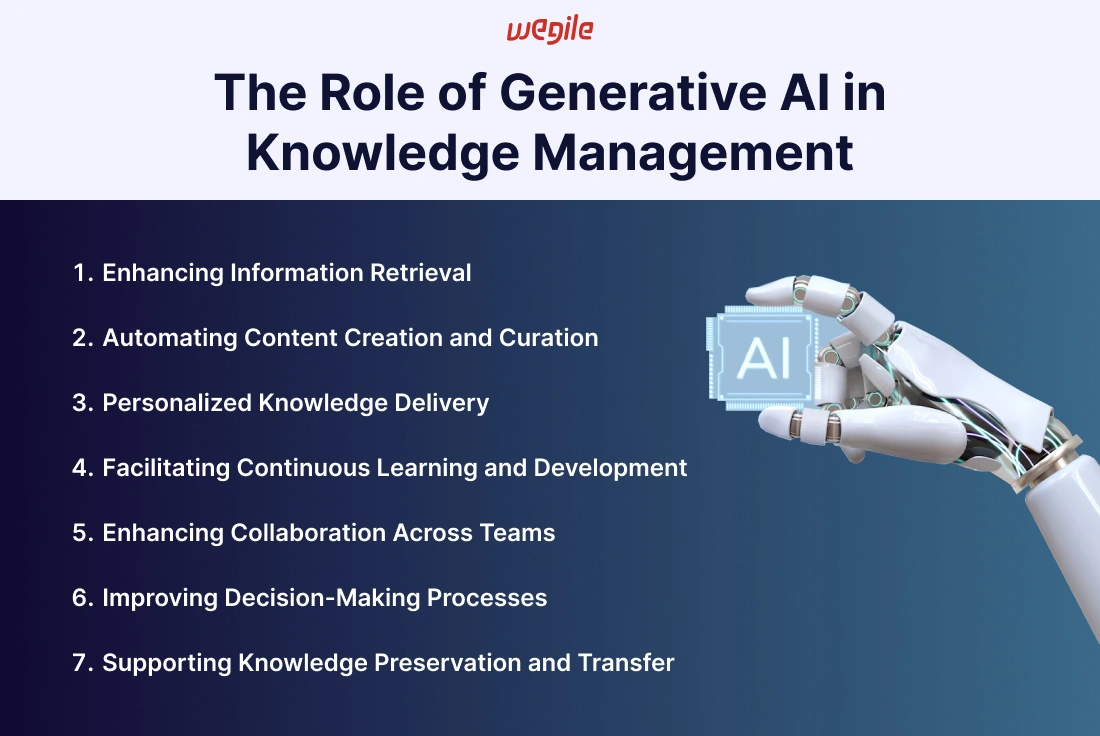
1.
Enhancing Information Retrieval
Generative AI has changed the way we discover information. It gets your queries and provides accurate
and useful responses immediately. This happens without you having to wade through long lists of
search results. It’s like having a super-smart assistant who knows exactly where to look and what to
bring you. This saves you time and effort. No more wondering if you’ve got the right document. Here,
generative AI ensures you’re getting the best and most accurate information instantly.
2. Automating Content Creation and
Curation
Keeping a knowledge base up-to-date can feel like a never-ending task. That’s where generative AI
steps in. It takes over the heavy lifting of content creation and curation. Gen AI can create new
articles, update old ones, and keep everything current without your help. This keeps your knowledge
base relevant and frees up your team to focus on more strategic work. Thus, with generative AI, your
content is always on point, and you’re never behind on the latest information.
Must Read: What Every CEO Must Know About Generative AI?
3.
Personalized Knowledge Delivery
Now, what if we told you that your knowledge system could know exactly what you need when you need
it? Generative AI makes that a reality by delivering personalized information based on your role,
preferences, and past searches. You can use AI to find specific articles for technical details or a
quick overview. This personalized approach makes it easier to find what you’re looking for and keeps
you engaged to make certain you’re always in the know.
4. Facilitating Continuous Learning
and Development
Learn and evolve to stay ahead in the current time. Generative AI as a personalized tutor can tailor
learning experiences to your needs. Generative AI can be your tutor who crafts learning experiences
that fit your needs perfectly. It can suggest courses, generate learning materials, and even adapt
content to your learning pace. AI helps you learn new skills and keep up with trends in the most
efficient way. This keeps you sharp and competitive.
5.
Enhancing Collaboration Across
Teams
Collaboration is essential for a team’s success, and generative AI can enhance it even further. It
helps teams collaborate more effectively. This is done by providing summaries, generating ideas, and
sharing insights. Gen AI also ensures that everyone’s on the same page and makes collaboration
effortless. AI’s subset makes brainstorming and project updates easier and more effective. This
improves outcomes for everyone.
6.
Improving Decision-Making
Processes
Quality decisions are a direct result of having access to reliable information, and generative AI is
designed to deliver precisely that. AI enhances decision-making by analyzing data and providing
valuable insights. This enables you to make more informed and efficient choices. Generative AI can
predict outcomes, suggest the best course of action, and give you the confidence to move forward. It
redefines decision-making by providing smart and data-driven choices that consistently lead to
success. This eliminates the need for speculation.
7. Supporting Knowledge
Preservation and Transfer
Employees frequently take important information with them when they go from an organization. This
knowledge may be preserved and shared with others with the help of generative AI. It can create
detailed guides, and training materials, and even simulate the know-how of experienced employees.
This makes certain that important knowledge isn’t lost. Further, it also makes onboarding new
employees knowledgeable and helps your organization maintain continuity, even as team members
change. Hence, your company’s collective knowledge is constantly safe and accessible with generative
AI.
Benefits
of Generative AI in Knowledge Management
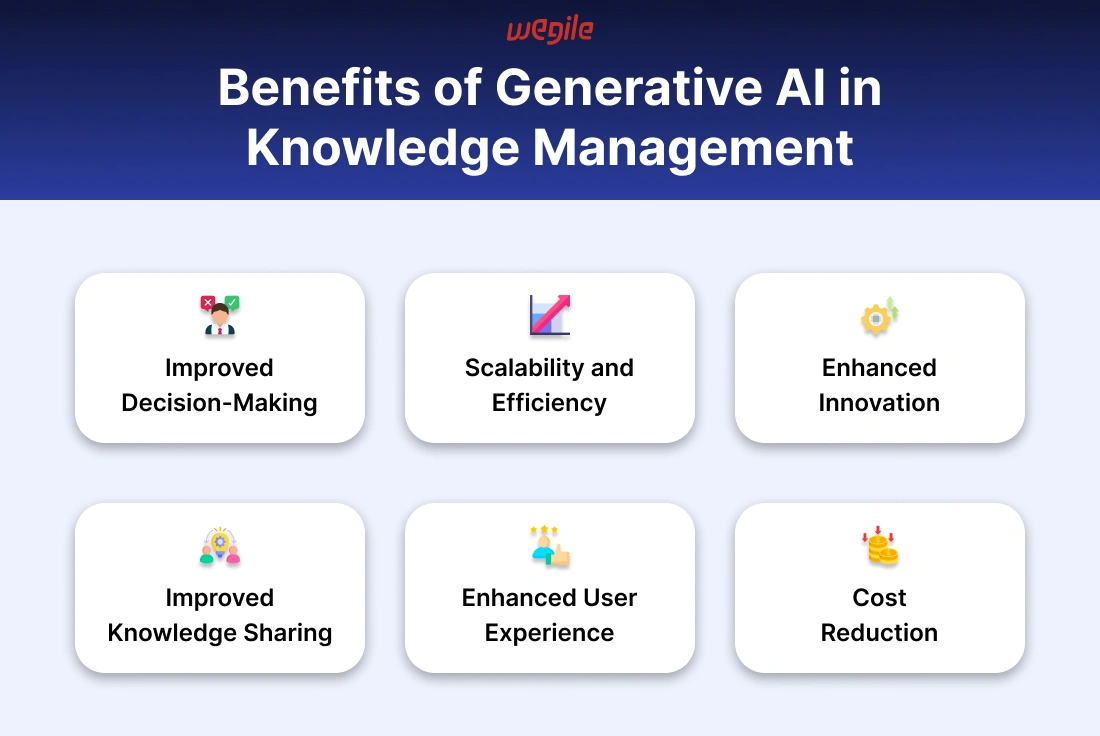
1.
Improved Decision-Making
Generative AI is like having a wise advisor by your side. It provides the right information you need
and exactly when you need it. AI can offer insights that help you make smarter decisions faster.
This is done by analyzing large amounts of data in real-time. Generative AI makes sure you are
up-to-date with relevant and accurate information. This is especially true when you’re addressing a
complicated problem or planning a strategy. You can rest assured that your decisions are supported
by reliable evidence, which leads to improved outcomes and provides you the confidence to continue
forward.
2.
Scalability and Efficiency
One of the biggest challenges in knowledge
management is scaling up while
maintaining costs. Generative AI offers a solution that boosts efficiency across the board. It can
handle large volumes of data effortlessly, update information in real-time, and manage content
without requiring a big team. This means your organization can grow and manage more knowledge
without needing to hire more people or increase resources. The secret to lasting success is learning
to do more with less, and generative AI can assist you in achieving just that.
3.
Enhanced Innovation
Generative AI is a powerful tool for uncovering new ideas on which innovation thrives. It can sift
through massive datasets and identify patterns, trends, and insights that might go unnoticed by
traditional methods. This ability of AI to connect the dots in ways humans might not see instills
creativity and drives innovation. It can even inspire innovations in product development, process
improvement, and market exploration. This gives your organization a competitive edge.
4.
Improved Knowledge Sharing
Generative AI makes sharing knowledge across your organization easier and more effective. It can
automatically generate reports, summaries, and even tutorials. This ensures that information is
easily accessible to everyone. AI helps to quickly and accurately distribute knowledge in aspects.
This saves time and ensures that everyone is on the same page. It also fosters a culture of
continuous learning and collaboration.
5.
Enhanced User Experience
Generative AI takes user experience to a whole new level by making interactions with knowledge
systems more intuitive and personalized. It can adapt to individual preferences, suggest relevant
content, and even provide interactive assistance. Users can find what they need and learn more
easily. Further, the improved user experience keeps people engaged and makes knowledge management
systems more valuable to the enterprise. Thus, users are more likely to rely on the system when it
is easy and enjoyable to use. This makes certain that knowledge is effectively managed and utilized.
6. Cost
Reduction
Generative AI boosts efficiency and significantly reduces costs associated with knowledge management.
AI minimizes the need for manual labor. It automates processes like content creation, data analysis,
and information retrieval. This results in savings on staffing, training, and operational costs.
Additionally, Generative AI reduces the risk of costly errors and miscommunications by making
certain that information is accurate and up-to-date. In the long run, the cost savings from
implementing AI can be substantial. This allows organizations to reinvest in other critical areas.
Challenges
and Ethical Considerations
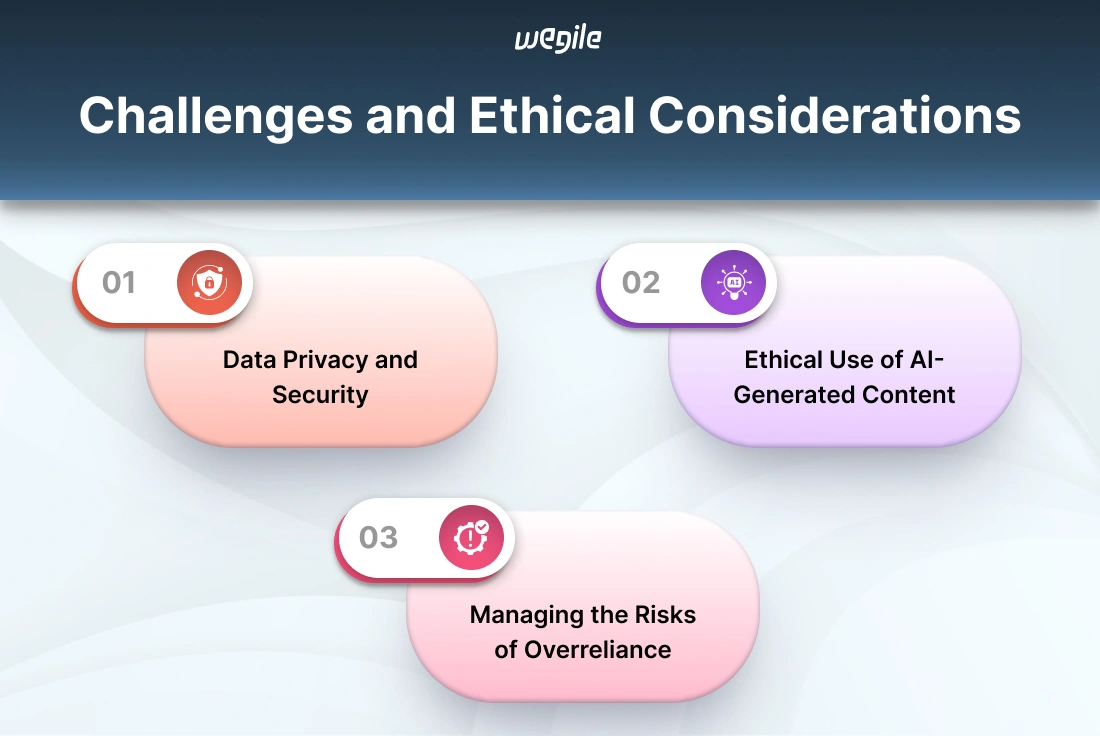
1.
Data Privacy and Security
Maintaining data privacy and security is one of the main difficulties that needs to be dealt with
when using generative AI for knowledge management. Effective operation of AI-based systems depends
on a huge volume of data. Plus, using it raises concerns about protecting sensitive information.
There’s always the risk of data breaches or misuse. This might have major effects on your company
and its stakeholders. Therefore, it is necessary to apply robust security policies and guarantee
that AI systems strictly follow privacy laws. This will allow you to harness the power of AI without
compromising your data.
2.
Ethical Use of AI-Generated
Content
AI is fantastic at generating content. Still, this raises a unique set of moral issues. For example,
AI can occasionally mirror prejudices in the data it has been trained on. This leads to skewed or
unfair outputs. There’s also the question of who owns the content that AI creates. Does it belong to
the AI, the organization, or the original data sources? And let’s not forget the need for human
oversight. AI can produce massive amounts of content quickly. However, people must be involved to
verify accuracy, fairness, and alignment with your organization’s values. Thus, balancing these
ethical considerations is key to using AI responsibly.
3.
Managing the Risks of
Overreliance
Generative AI is incredibly powerful, but there’s a risk in relying too heavily on it. Employee’s
heavy dependency on AI for every decision or task will result in the loss of their critical thinking
and problem-solving skills. This overreliance can sometimes lead to complacency and ignorance of
problems since everyone will trust the AI’s output. It’s important to strike a balance: use AI to
enhance and support human capabilities and not replace them. Encourage your team to stay engaged,
question outputs, and continue developing their skills alongside AI tools. That way,
you can leverage AI’s strengths without
losing the human touch.
Best Practices for Implementing Generative AI in
Knowledge Management
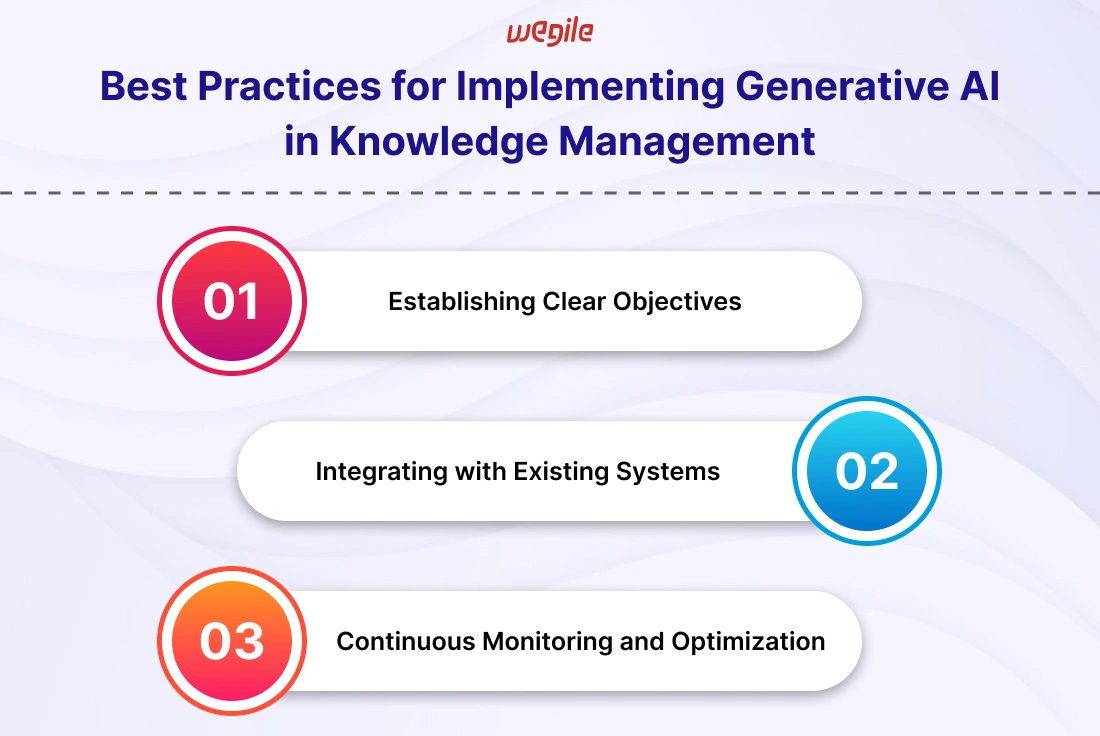
1. Establishing Clear Objectives
You need to have a pre-defined goal in mind before you enter into the field of generative AI. Set
clear goals to guarantee the success of your AI deployment. This will also ensure that it is in line
with your company’s aims. Do you want better content
creation, easier information exchange, or better
decision-making? It is important to set clear and quantifiable objectives from the beginning. This
will help your AI strategy steer you on the correct path and monitor your success efficiently.
Always keep in mind that well-defined goals are the bedrock of an effective AI initiative.
2.
Integrating with Existing
Systems
Including generative artificial intelligence in your knowledge management shouldn’t feel as if you
are cramming a square peg into a round hole. Smooth integration of artificial intelligence with your
current systems is crucial to prevent disturbances and guarantee flawless operation of all the
systems. This might mean tweaking some processes or updating old software to be more compatible with
AI tools. The goal is to enhance what you already have without causing unnecessary friction. Proper
integration of AI can complement and elevate your current systems. This makes the transition smooth
and beneficial for everyone involved.
Must Read: Top Generative AI Solutions: Scaling & Best Practices
3.
Continuous Monitoring and
Optimization
The work doesn’t stop once your generative AI system is up and running. Maintaining relevant and
efficient information management systems driven by AI depends on constant monitoring. Check system
performance often, identify any potential issues, and make required changes. AI is a dynamic tool
that evolves, so your approach to it should be just as flexible. Over time, optimizing your system
will help you maintain its alignment with your objectives and ensure that it will continue producing
the greatest results. Consider it routine maintenance to ensure the flawless operation of your AI
engine.
Wrapping Up
Here we end our journey of exploring the world of Generative AI in Knowledge Management. We’re
standing on the edge of something truly transformative. Generative AI revolutionizes
human
creativity and
knowledge access. Yet without the
appropriate partner, this tech is difficult to navigate. That’s where Wegile comes in. Our
generative AI app development company is ready to lend a hand and assist you with AI integration or
in case you require a personalized app to bring your vision to reality. Wegile specializes in
developing generative AI
applications tailored to your needs.
This way, we make sure you’re not just keeping up with the future; you’re leading it. So, are you
ready to leap? Let’s create something amazing together!
Leave a Reply