Imagine a supply chain that runs smoothly without delays or interruptions. Sounds like a fantasy,
right? That dream is now possible with generative AI. Gen AI is a revolutionary tool in the supply
chain. This cutting-edge technology is changing the domain by accurately anticipating demand,
optimizing routes, and managing inventory. It’s like having a crystal ball that can predict and
shape the future. What if you could cut expenses, boost customer satisfaction, and strengthen your
supply chain at the same? Yes, with generative AI, it’s possible! To keep ahead of the competition,
top organizations use this secret tool. The best part? Implementing it is simpler than you think.
Want to explore how generative AI can transform your business? Let’s explore how this technology is
changing the present and future of supply chain management.
Why
Generative AI Matters in Supply Chain
Generative AI is becoming crucial in the supply chain. As global supply chains become increasingly
complicated, smarter, faster, and more adaptive solutions are needed. Generative AI improves
production-to-delivery processes. It offers capabilities that traditional approaches cannot match.
Supply chains are increasingly using generative AI because it can efficiently process and analyze
enormous amounts of data in real-time. It helps organizations avoid mistakes, estimate demand, and
respond rapidly to disruptions. AI can transform reactive supply networks into proactive or
predictive ones. This helps companies remain ahead. Further, generative AI adds flexibility and
innovation. It can simulate various scenarios. This lets companies test strategies before
implementing them. Further, it reduces risk and advances progress. Thus, Generative AI is
transforming the supply chain and not just solely improving it.
Must Read: What
Every CEO Must Know About
Generative AI?
Transformative Role of Generative AI in
Supply Chain
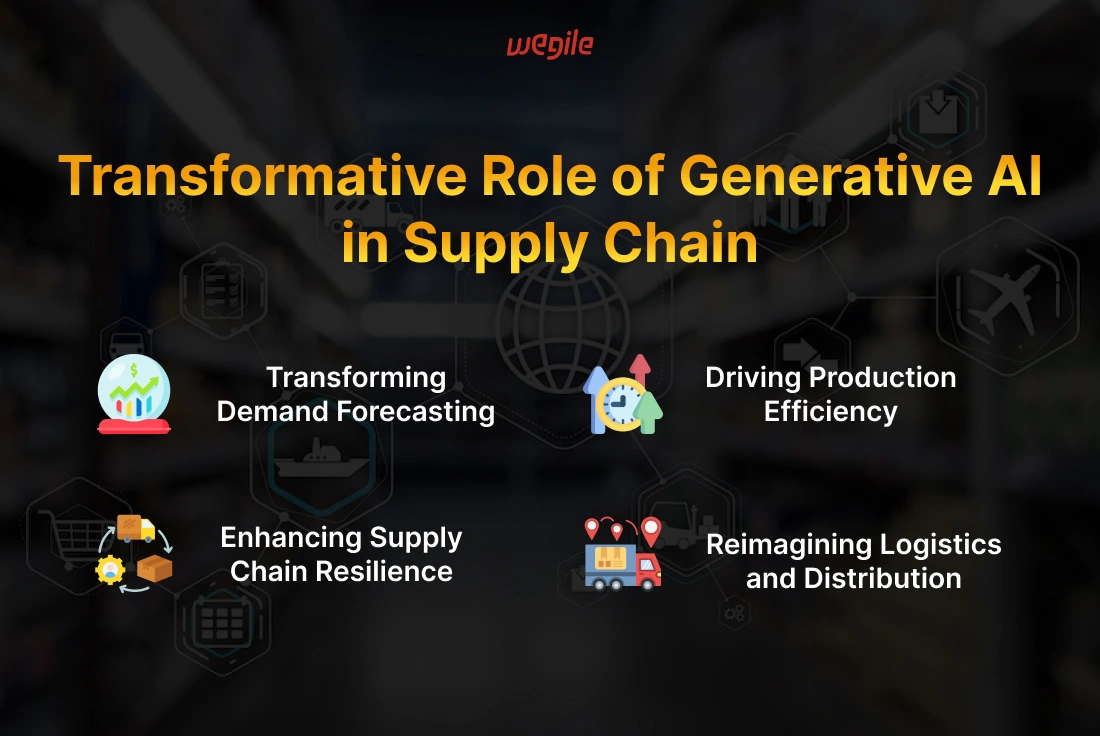
1. Transforming Demand Forecasting
The heart of any supply chain is demand forecasting. Get it wrong, and you have surplus inventory
or unfulfilled customer demand. Both scenarios can be costly if wrong practices are followed.
Generative AI analyzes massive datasets to improve prediction accuracy. It can analyze past
sales, market trends, consumer behavior, economic data, and social media sentiment. AI, based on
the same information, delivers precise demand forecasts to assist firms in planning inventories,
production, and logistics. This reduces inventory shortages or overstock and also optimizes
resource allocation. The result? A more flexible supply chain that responds instantly to market
changes.
2. Enhancing Supply Chain Resilience
Supply chain agility is more important than ever in times of uncertainty. Generative AI is
crucial to resiliency. It suggests flexible risk minimization strategies. AI also predicts
disruptions utilizing numerous data sources. For example, natural calamities, geopolitical
tensions, and consumer behavior can cause interruptions. AI helps firms anticipate risks, create
backup plans, and make informed decisions before a crisis. Additionally, AI-driven simulations
can model scenario impacts. This lets companies test and improve resilience strategies. Thus,
Generative AI improves supply chains beyond efficiency. They become resilient, flexible systems
that can weather uncertainty.
Must
Read: What is the Difference
between Generative AI and AI?
3. Driving Production Efficiency
A successful supply chain performance depends on efficiency. Here, generative AI is driving it to
new heights. This is particularly true in production. AI boosts production speed, cost, and
efficiency. AI is excellent at waste reduction, production schedule optimization, and production
improvement. Generational AI can discover manufacturing bottlenecks, inefficiencies, and
resource underutilization. It can then recommend output-maximizing manufacturing schedules. This
reduces downtime and resource use. AI-driven quality control systems can additionally identify
problems in real-time. So only high-quality goods are made. Thus, generative AI is vital for
fine-tuning manufacturing processes to increase production and reduce costs.
4. Reimagining Logistics and Distribution
Distribution and logistics are often the most challenging parts of the supply chain. It involves
numerous variables like traffic, weather, and delivery windows. These procedures are changing
with generative AI. It improves routes, enables live tracking, and prepares for self-driving
delivery. AI algorithms can optimize routes based on traffic, weather, and delivery schedules.
This saves fuel, speeds delivery, and improves customer happiness. Further, AI-powered real-time
tracking lets businesses and customers track shipments throughout. This increases trust and
transparency. Soon, AI-driven driverless cars and drones may dominate logistics. This will
further change the pattern of delivering goods.
Generative AI Supporting Key Supply Chain
Components
The modern supply chain goes beyond production to delivery. A company’s success depends on a complex
web of interconnected activities. Advanced Generative AI makes these processes more efficient,
durable, and flexible. Let’s see how generative AI improves each supply chain component.
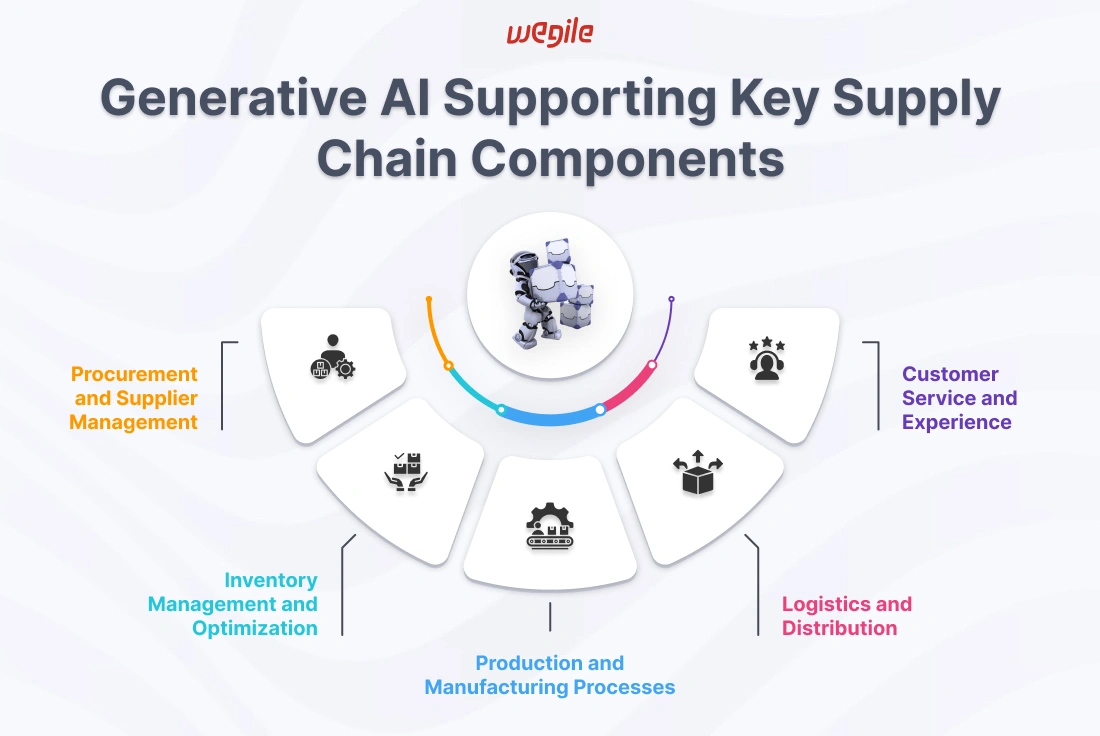
1. Procurement and Supplier Management
Every supply chain needs procurement and supplier management. Supplier selection, terms, and risk
management are essential for successful operations. Here, generative AI is crucial. Its ability
to analyze big datasets helps companies find trusted suppliers, predict interruptions, and
negotiate better contracts. For example, historical data and market and geopolitical
circumstances can help AI predict supplier performance. Forecasting helps companies make smarter
decisions and prevent supply chain interruptions. Moreover, AI-driven persuasion tools can
simulate situations to help procurement teams negotiate better bargains and reduce risk.
2. Inventory Management and Optimization
Inventory management requires balance. Avoiding surplus and shortages is crucial. Businesses’
inventory management is changing with generative AI. It offers predictive analytics and
real-time insights. AI algorithms can assess demand patterns based on seasonality, promotions,
and social media trends. Moreover, businesses can optimize inventory levels, cut holding costs,
and guarantee customers have products when they need them. AI can also recommend reorder points
and quantities to avoid overstocking or understocking.
Must Read:
How Generative AI Can Be
Used in the Real World?
3. Production and Manufacturing Processes
Production and manufacturing highly prioritize quality and efficiency. These methods benefit
greatly from generative AI. It improves automation, production scheduling, and quality control.
AI also simulates several production situations. It helps manufacturers find efficient
procedures and save downtime. AI can detect machine breakdowns and enable proactive maintenance,
eliminating costly interruptions. AI-powered quality control systems are vital. It detects
faults better than humans to ensure only the best products reach the market.
4. Logistics and Distribution
Logistics and distribution are the lifelines of the supply chain. They’re about delivering things
on time and in perfect condition. Generative AI improves this component. It optimizes routing,
fleet management, and warehousing operations. AI systems also assess traffic, weather, and
delivery windows. It determines the most efficient transit routes. The outcome is lower gasoline
expenses, faster delivery, and happier customers. Businesses can automate warehouse picking and
packing with AI-powered robots. These technologies generally eliminate errors and speed up order
fulfillment. Moreover, AI can also manage warehouse inventory
allocation to make high-demand
commodities accessible.
5. Customer Service and Experience
Customer service is essential in the current competitive environment. Here, Generative AI
supports businesses by improving interaction with clients. It offers personalized experiences,
faster response times, and purchase journey support. AI-powered chatbots and virtual assistants
can accept client requests 24/7. They give immediate support and free up agents to handle more
complex concerns. AI systems can additionally suggest products and improve customer experiences
using their data. Further, AI can
predict and resolve post-purchase issues. This guarantees loyalty and satisfaction.
Overcoming Challenges in
Implementing Generative AI in Supply Chains
Generative AI in supply chains seems like an abstract concept due to its transformative capabilities.
Yet, like any great tool, generative AI has drawbacks. Let’s examine these potential obstacles and
how firms might overcome them to maximize AI in supply chains.
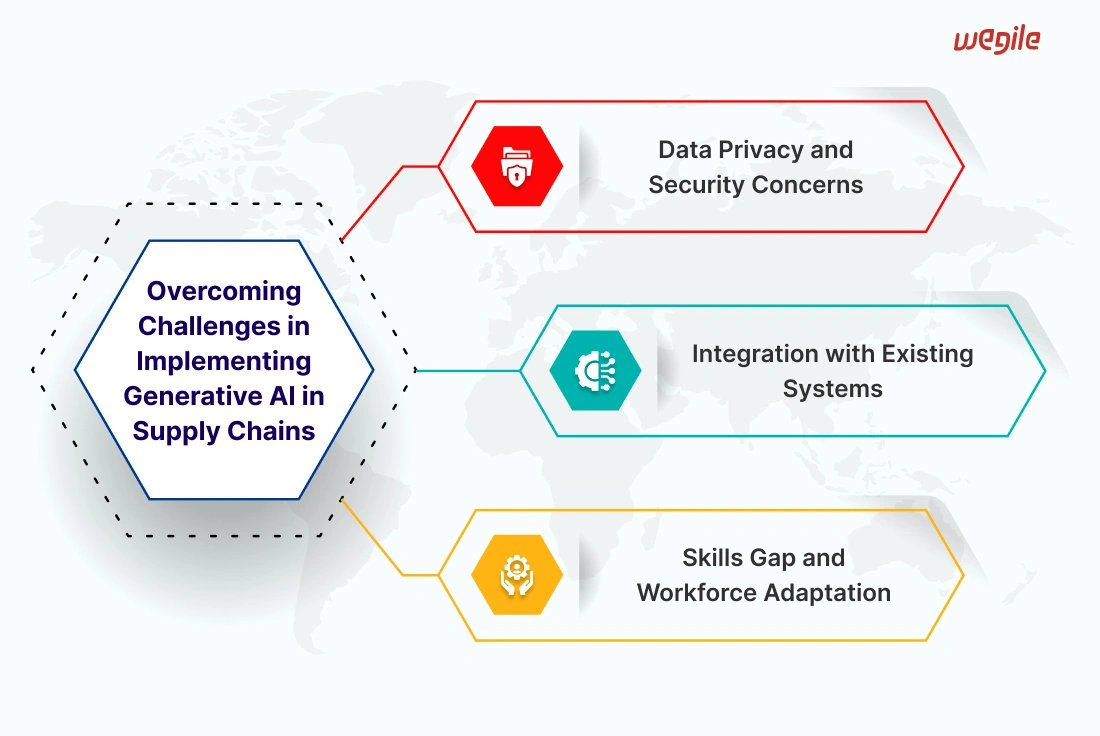
1. Data Privacy and Security Concerns
Data is a treasure in the digital era. But with great power comes responsibility, especially when
handling sensitive supply chain data. When given more data, generative AI performs better.
However, this data dependence presents severe privacy and security
problems. Businesses must safeguard their data
from breaches, leaks, and unwanted access. Strong encryption algorithms protect data at rest and
in transit. Companies should additionally invest in security assessments and updates to stay
ahead of threats. Further, transparency with stakeholders regarding data collection, storage,
and use builds trust in AI-driven operations.
2. Integration with Existing Systems
Adding generative AI to a well-established supply chain may seem like attempting to fit a square
peg into a round hole. However, older systems may not be compatible with modern AI technologies.
This causes inefficiencies. Businesses need to address this issue. Start by selecting the most
important areas where AI can immediately add value and integrate it into these systems. Use
middleware or APIs to connect legacy systems to new AI
platforms. Early involvement of IT and operational
teams assures they are ready for technological difficulties and can provide significant insights
for faster integration.
Must Read:
Top Generative AI Solutions:
Scaling & Best Practices
3. Skills Gap and Workforce Adaptation
The new approach of working with generative AI can be thrilling yet intimidating for the
workforce. AI in supply chains involves new abilities and task changes. This may leave the
workforce unprepared for AI-driven procedures as they don’t possess enough skills. So what’s the
solution here? Reskilling and upskilling. Company training programs should teach staff how to
operate with AI. This could involve workshops, online courses, or educational institution
partnerships. Fostering a culture of continuous learning encourages people to embrace new
technologies and perceive AI as a tool to enhance their responsibilities, not replace them. This
way, businesses can maximize productivity and ease the transition to AI-driven workflows by
supporting the workforce.
The Future of Generative AI in Supply
Chain Management
As we look ahead, the role of generative AI in supply chain management is set to grow even more
transformative. The future holds exciting possibilities as AI continues to integrate with other
cutting-edge technologies, drive sustainability, and become a key player in long-term strategic
planning. Let’s explore what the future might look like.
1. Emerging Technologies and AI Synergy
Generative AI is powerful alone, but when combined with IoT, blockchain, and robotics, the
possibilities are unlimited. Envision a supply chain where IoT connects every device, machine,
and component, feeding AI systems real-time data. This would enable unparalleled automation,
efficiency, and response. IoT sensors can track inventory levels in real-time, while AI predicts
supply needs. Blockchain’s secure and transparent ledger system might interact with AI to record
and verify every supply chain transaction and movement, minimizing fraud and errors. Further,
AI-powered robotics might manage assembly lines and warehouses with precision and speed that
humans cannot match. Thus, the combination of these technologies will produce a supply chain
that is predictive, adaptive, and able to respond to changes and disruptions faster than ever.
2. Sustainability and Ethical Considerations
Sustainability is not just a concept; it’s essential. Sustainable supply chain practices benefit
from generative AI. Artificial Intelligence can help firms reduce their environmental effect by
optimizing routes, waste, and resource management. It can further recommend fuel-efficient
routes or find ways to reuse or recycle items. This will result in a reduction of emissions and
waste. However, firms must address ethical issues as AI becomes increasingly prevalent in supply
chains. This involves ensuring that AI-driven decisions refrain from harming vulnerable groups
like developing country suppliers or displacing workers without proper support. Companies must
use transparent, fair, and ethical AI approaches to preserve trust and social responsibility.
Must Read:
How to Build Generative AI
Apps: A Comprehensive Guide
3. Long-Term Strategic Planning
The future is more about surviving rather than just thriving. Companies that wish to stay ahead
must incorporate generative AI into their long-term strategy. Think further over immediate
benefits and evaluate how AI might assist growth and innovation over the next decade and into
the future. Long-term AI planning involves identifying areas where AI can generate ongoing
development, such as predictive analytics for market trends or new business models based on AI
insights. It also requires training and development initiatives to prepare workers for an
AI-powered future. Companies must also invest in AI-supporting infrastructure and systems to
build a solid, flexible, and scalable technology stack. By doing so, they may position
themselves to fully leverage AI, converting obstacles into opportunities and ensuring long-term
success.
Wrapping Up
Generative AI in the supply chain isn’t a passing trend as we conclude our tour. It is here to stay
and is already causing industry waves. While the rewards are huge, generative AI can feel like
entering the unknown. The good news? You don’t have to face this new landscape alone. Generative AI
solutions can fit smoothly into your supply chain processes, improving efficiency and lowering
costs. However, implementing these tools
effectively requires a proper partner.
At this point, you might be wondering how to get started or even how to scale your existing AI
initiatives. That’s where Wegile comes in. Our custom generative AI app
development services can help you maximize
this technology for your organization. We can help you streamline your supply chain, improve
forecasting, or beat the competition. Together, we can make your supply chain a competitive
advantage that fosters growth and success. Ready to get started? The future of supply chain
management is here, and it’s powered by generative AI.
Leave a Reply