The power of generative artificial intelligence to revamp and modify industries is immense. And, its
impact is visible in the insurance sector. McKinsey also estimates that AI technologies could add up
to $1.1
trillion in annual value for the global insurance industry. This
big figure highlights the mighty power of AI particularly generative AI. It is setting new
benchmarks in invention and operational efficiency. As insurers deal with growing market demands and
increasing consumer expectations, generative
AI and AI emerge not just as tools for automation they are
growing as a vital provider of strategic advantage and customer satisfaction.
In this blog, we will immerse ourselves in the top five benefits and use
cases of generative AI in insurance. We will also explore how this technology is optimizing
current processes. We will also find out how this progressive technology is paving the way for new
possibilities in risk assessment, customer engagement, and beyond.
Top
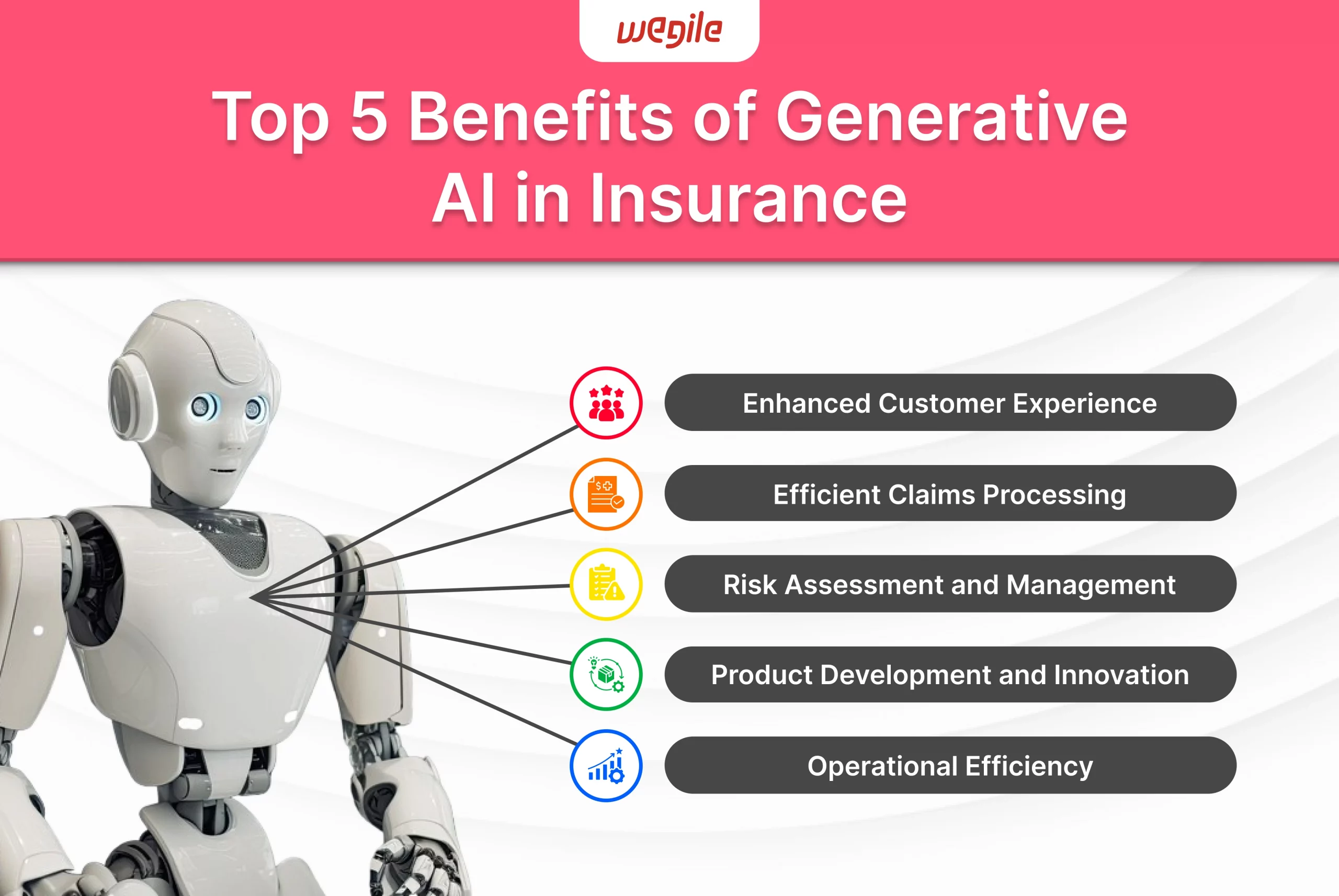
5 Benefits of Generative AI in Insurance
Using generative
AI solutions in insurance operations levels up efficiency
and customer service. It also provides insurers with a competitive edge by allowing them to innovate
and adapt quickly in a changing market.
-
Enhanced Customer Experience
Generative AI can significantly improve the customer experience in insurance. Insurers can
offer 24/7 support by automating customer service through chatbots and virtual assistants.
Also, these AI systems can personalize communications and recommendations based on
individual customer data. It eventually leads to more tailored policy offerings and advice. -
Efficient Claims Processing
Generative AI can also automate the claims-handling process. It reduces the time and manpower
needed to assess and approve claims. Generative AI models can analyze claims data and
photographs. It can also process other documents to make determinations at a faster rate
than human adjusters. This not only speeds up analysis but also helps in identifying
fraudulent claims more effectively. -
Risk Assessment and Management
Generative AI can enrich an insurer’s proficiency in evaluating price risk. The AI models can
recognize patterns and predict outcomes more accurately by analyzing vast amounts of data.
This leads to better risk pricing and highly tailored policy offerings. It also potentially
lowers costs for both insurers and policyholders. -
Product Development and Innovation
With the integration of generative AI, insurance companies can simulate various scenarios to
comprehend potential new markets and develop products accordingly. Generative AI can help
insurers recognize new opportunities for products such as cyber insurance and by analyzing
trends and predicting future risks. Moreover, generative AI facilitates the rapid
prototyping of insurance products. It does so by allowing companies to test and refine
offerings through the assessment of virtual customer feedback and behavioral data -
Operational Efficiency
Generative AI can modify back-office operations in insurance companies such as underwriting,
policy administration, and compliance. This powerful AI helps employees focus on more
complex and value-added activities by automating routine tasks and processes. This not only
reduces costs but also improves employee satisfaction and retention by alleviating them from
repetitive work.
How can Generative AI be used in the
Insurance Industry?
Generative AI is driving the insurance industry into a new and inventive era of innovation and
efficiency. Here are five distinct use cases that portray the mighty impact of this technology
across different areas of the insurance landscape:
1. Automated Policy Personalization
Generative AI can dynamically create personalized insurance policies. It creates content based on
individual customer profiles. This technology uses data such as past claims and lifestyle
information. It also uses personal preferences to curate policies that meet the unique needs of
each customer. This hyper-personalization not only enriches customer satisfaction but also
optimizes risk coverage. This makes it a game-changer for both insurers and policyholders.
2. Real-Time Risk Analytics
Insurers can now perform real-time risk assessments during the policy issuance process by using
AI. This application collects and processes incoming data streams. It can effortlessly process
telematics from vehicles or health data from wearables. This processing power helps generative
AI to adjust premiums and policy terms on the fly based on observed behaviors and conditions.
This immediate responsiveness to risk factors improves actuarial accuracy and customer fairness
in premium determination.
3. Claims Fraud Detection
Generative AI enriches the power to detect fraudulent activities by simulating and acknowledging
patterns that may contain deceitful claims. These systems can generate models that predict
typical fraud indicators by using historical data and ongoing learning capabilities. They can
further flag suspicious claims for further investigation. This assertive approach helps insurers
reduce losses and strengthen integrity within the claims process.
4. Virtual Damage Assessments
Generative AI can assist in virtual damage assessments in the event of an incident. This powerful
AI can quickly generate repair estimates and even help policyholders through the mitigation
process. It does so by processing images or videos of the damaged property or vehicle submitted
via mobile apps. This not only speeds up the claims process but also decreases the need for
physical inspections and saves time and resources.
5. Regulatory Compliance Automation
Generative AI proves invaluable in providing compliance in the landscape of insurance
regulations. AI systems can automatically generate reports and audit trails. They can even
curate compliance documents based on the exclusive rules and policies. This not only guarantees
that insurance companies meet all regulatory requirements effortlessly but also curtails the
risk of human error and non-compliance penalties.
Generative AI in Insurance: Real
Examples & Case Studies
The integration of generative AI into the insurance sector is driving significant modifications.
Let’s explore real examples from well-known insurance companies that are at the main door of
adopting these advanced technologies.
1. Automated Claims Processing
Case Study: Geico
Generative AI can dynamically create personalized insurance policies. It creates content based on
individual customer profiles. This technology uses data such as past claims and lifestyle
information. It also uses personal preferences to curate policies that meet the unique needs of
each customer. This hyper-personalization not only enriches customer satisfaction but also
optimizes risk coverage. This makes it a game-changer for both insurers and policyholders.
2. Personalized Policy Recommendation
Case Study: Progressive Insurance
Progressive uses AI to analyze individual driving data collected through their Snapshot
personalized rate program. This data helps generate personalized insurance rates based on actual
driving behavior. This further makes policies more tailored and often more affordable for safe
drivers.
3. Risk Assessment and Management
Case Study: Swiss Ree
Swiss Re has developed a generative AI model that simulates natural disasters and predicts their
potential impact on insured assets. This technology allows for better risk management and more
accurate pricing of property insurance in areas prone to natural catastrophes.
4. Fraud Detection and Prevention
Case Study: Prudential Financial
Prudential Financial uses AI to analyze patterns in claim submissions and recognize anomalies
that could suggest fraudulent activities. By using generative AI, they can detect fraud more
quickly and accurately. It can significantly reduce losses due to fraudulent claims.
5. Enhanced Customer Interaction
Case Study: Allstate
Allstate has introduced AI-powered virtual assistants. It can handle a variety of customer
queries right from billing questions to policy changes. These virtual agents are capable of
generating human-like responses and can escalate more complex issues to human representatives
seamlessly.
What is
Generative AI for Claims Processing?
Generative AI is redefining claims processing in the insurance industry by delivering a suite of
capabilities. These powers are aimed at automating, accelerating, and enriching the accuracy and
efficiency of traditional methods. Here is how it impacts the various characteristics of claims
processing:
1. Automation and Speed
Generative AI plays a key part in automating the claims process. It traditionally involves manual
and labor-intensive tasks. By incorporating AI, insurers can smoothly process claims faster. It
also reduces the turnaround time and improves customer satisfaction. This speed is crucial in an
era where customers expect quick and impactful services similar to those they experience with
digital applications.
2. Cost Efficiency
The use of generative AI in automating routine tasks curtails the operational costs linked with
manual claims processing. It allows claims handlers to focus on more complicated issues. It adds
greater value to the process and potentially lowers the overall cost of claims management.
3. Enhanced Accuracy and Fraud Detection
Generative AI when coupled with machine learning and natural language processing improves the
accuracy of damage assessments and claims eligibility decisions. It also enriches fraud
detection capabilities by examining patterns and discrepancies in claims data that might
indicate fraudulent activities.
4. Regulatory Compliance
Generative AI can automatically scrutinize and implement the latest regulatory changes. It
guarantees that claims processing remains compliant with current laws. This proactive compliance
assists insurers in avoiding penalties and administering risks more effectively.
5. Data-Driven Decision Making
Generative AI provides insurers with insights into claim trends and risk factors by utilizing
historical data and predictive modeling. It allows better resource allocation and
decision-making. This power not only optimizes the claims process but also helps in forecasting
future claims with more precision.
6. Personalized Customer Interaction
Generative AI technologies can enrich the customer experience by curating personalized
interactions and faster service. For example, generative AI can be used to summarize and explain
policy details to customers. It further speeds up the claims process and improves transparency
How can Generative AI Help Insurers in Detecting
Anomalies?
Generative AI is a powerful tool that can revamp the way insurers detect anomalies, ensuring greater
accuracy and efficiency in identifying irregular patterns that could indicate fraud, risks, or
system failures. Here’s how generative AI can be effectively utilized in the insurance sector for
anomaly detection:
-
Advanced Pattern Recognition
Generative AI excels in identifying complex patterns within large datasets. These often go
beyond the scope of traditional data analysis techniques. These generative AI systems can
determine subtle inconsistencies and irregularities that typically precede an anomaly. This
power is quite useful in areas like claims processing. Here, fraudulent claims might be
intermingled with legitimate ones. Generative AI can analyze claims against historical data
to detect unusual patterns. This further includes analysis of overutilization of services or
suspiciously timed claims submissions. -
Predictive Modeling
Generative AI can develop predictive models that simulate a range of possible future
scenarios based on historical data. This is particularly valuable in risk assessment because
here insurers need to predict potential risks that are not yet evident. For example, in
property insurance, generative AI models can predict which properties are likely to become
risks due to factors like changes in the local environment or aging infrastructure. This
assertive approach helps insurers mitigate risks before they lead to claims. -
Real-Time Monitoring and Alerts
Insurers can implement real-time monitoring systems that continuously analyze transactional
data as it comes in with AI’s utilization. These systems are designed to flag activities
that shift from the norm instantly. For example, in health insurance, such advanced systems
can detect anomalies in billing patterns. This may indicate healthcare fraud such as
duplicate billing or services not rendered. Real-time alerts help insurers to respond
promptly to potential fraud and minimize financial losses. -
Boosts Data Quality and Integrity
Generative AI also has a crucial part in retaining the integrity of insurance data. It can
automatically check and correct data anomalies as they are entered into the system. This is
vital because high-quality and accurate data is the spine of effective anomaly detection.
Generative AI helps in constructing robust models that are proficient in identifying true
anomalies rather than errors originating from poor data quality.
Challenges for Implementing Generative AI in
Insurance
Implementing generative AI in the insurance industry presents numerous opportunities for innovation
and efficiency. But, it also comes with numerous challenges that insurers must navigate to fully use
this technology. Understanding these hurdles is important for businesses striving to integrate AI
into their operations effortlessly.
-
Data Privacy and Security
One of the notable challenges in executing generative AI in insurance revolves around data
privacy and security. Insurers administer sensitive personal information which includes
health records, financial data, and personal identifiers. Guaranteeing the security of this
data while using generative AI systems to process and analyze it strikes a significant
challenge.Moreover, compliance with global data protection regulations such as GDPR in Europe and CCPA
in California needs robust data administration and protection strategies. Failure to stick
to these regulations can result in hefty fines and damage to the company’s reputation. -
Ethical and Bias Considerations
Generative AI systems are only as impactful as the data on which they are trained. Biased
data can result in discriminating outcomes and it potentially leads to unfair practices and
decisions within the insurance industry. It is also essential for insurers to carefully
curate and continually monitor their data to make sure that generative AI models operate
fairly and ethically.In the insurance industry, this can further manifest as unfair policy pricing, denial of
claims, and discriminatory practices. Guaranteeing that generative AI systems operate
ethically and impartially is a significant challenge. Insurers must continually audit and
update their generative AI models to guarantee fairness and eradicate any inherent biases
that may impact customer treatment. -
Integration with Existing Systems
Many insurance companies operate on legacy systems that may not smoothly integrate with
exclusive generative AI technologies. Upgrading these systems can be pretty expensive and
time-consuming. Also, incorporating new AI solutions needs comprehensive testing to make
sure they do not disrupt existing operations. This technological transition can be a
barrier, particularly for smaller insurers with restricted IT resources. -
High Initial Costs
While generative AI can result in significant cost savings in the long run, the initial
investment can be considerable. Expenses include not only software development or
acquisition but also training staff and upgrading infrastructure. The costs also include
maintaining generative AI systems and their models. These expenses can prevent insurers from
using AI technology especially when the return on investment (ROI) is uncertain or
long-term. -
Skill Gap and Training Needs
There is a big skill gap in the current workforce when it comes to generative AI technology.
Insurance companies need staff who are skilled in traditional insurance practices. They are
also looking for the ones proficient in AI and data science. Training existing employees and
hiring new talent with these specialized skills can be difficult and also quite expensive.
It poses yet another challenge for the across-the-board implementation of generative AI. -
Legal and Regulatory Challenges
Regulations surrounding AI are still evolving and insurers must deal with this uncertain
landscape. They need to stay informed about new laws and regulations that govern AI use and
this can vary significantly from one jurisdiction to another. -
Overcoming Resistance to Change
Finally, there is often cultural resistance to change within organizations. Introducing
generative AI-driven processes can be met with skepticism from employees accustomed to
conventional methods. Managing this change, addressing concerns, and nurturing an
organizational culture that welcomes innovation are crucial for successful generative AI
implementation.
Final Words
The incorporation of generative AI in the insurance sector offers phenomenal advantages and vast
potential. These benefits include enriching customer experience to streamlining operations and
beyond. The real-world applications and case studies illustrate that generative AI is not just a
futuristic concept but a practical tool revamping the insurance industry today. And, as technology
continues to evolve, the usage of generative AI will become a cornerstone for insurers seeking to
get a competitive advantage and meet the increasing demands of the digital age.
If you’re inspired by the potential of generative AI and looking to innovate within your own
business, try using Wegile’s generative AI app
development services. Our expertise in formulating
sophisticated AI solutions can help convert your ideas into reality. We will ensure you stay at the
main door of technology and innovation. Connect with us today to learn how we can assist you in
utilizing the power of generative AI to move your business forward.
Leave a Reply