Global spending on generative AI will reach $110 billion
in 2024. This highlights the growing value of generative AI and its impact. But have you ever
thought about what is at the base of generative AI? Well, it is generative AI models. And developing
generative AI models is not only about using computational power. It is about exploring and
experimenting with a new world of creativity and problem-solving capabilities. Thus, no matter if
you aim to create new images, compose novel music pieces, or simulate complex environments, this
article will take you through the essential steps to construct a generative AI model from the ground
up.
Let’s learn about the tools, techniques, and strategies needed to use the innovative potential of
generative AI and convert your visionary ideas into tangible results.
What are
Generative AI Models?
Generative AI models are classes of statistical models and advanced artificial intelligence systems.
They range from unimodal to multimodal AI. They are designed to
create
new and exclusive
content by digesting and analyzing large datasets.
Generative AI models are not like discriminative models that classify or predict based on input data.
They can generate novel data, and they rely on deep learning techniques such as Generative
Adversarial Networks (GANs), Variational Autoencoders (VAEs), and transformers. These technologies
help generative AI models to understand and replicate the complex distributions of real-world data.
This power makes them valuable for a wide range of applications. It includes boosting creative
processes and generating synthetic data to train other AI models. These models also assist in
personalizing user experiences in real time. Generative AI models form the base of
generative AI
tools
and solutions. These models can generate
anything from realistic images and music to complex text and code.
Step-by-Step Guide to Developing Generative AI Models
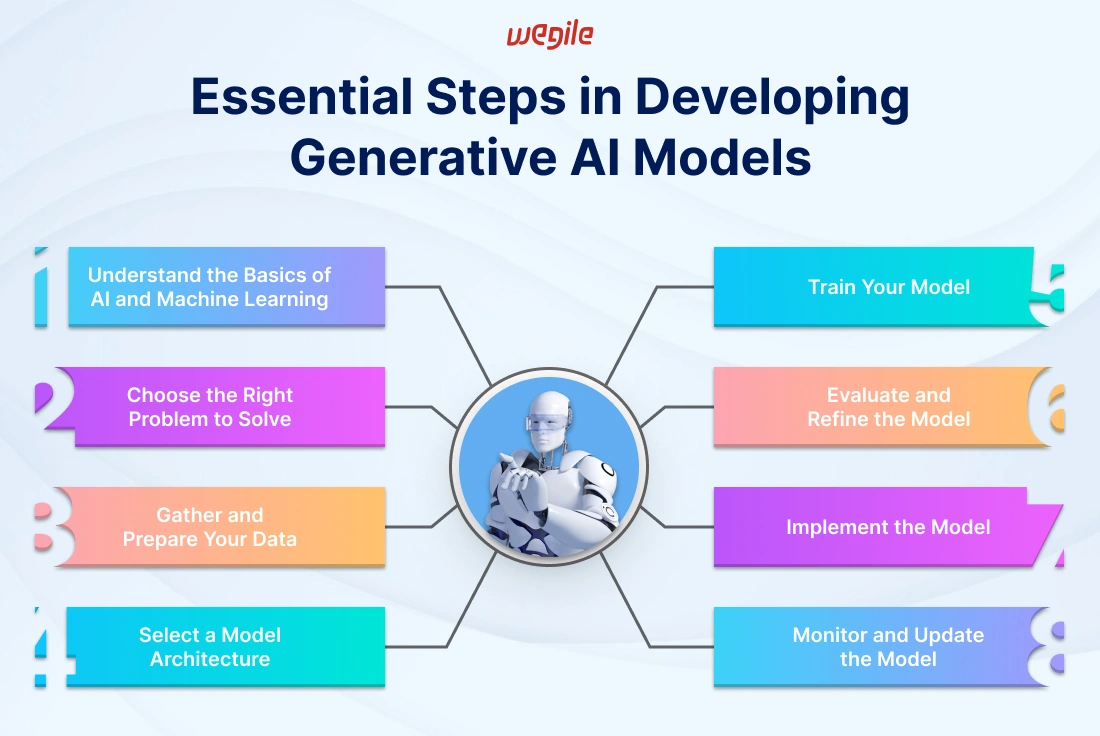
Step
1: Understand the Basics of AI and
Machine Learning
Artificial Intelligence (AI) and Machine Learning (ML) are leading technologies shaping various
industries. First, comprehending the fundamentals of AI and its subset, such as machine learning, is
important for anyone looking to build generative AI models.
Key Concepts and Terminologies
-
Artificial Intelligence (AI)
A broad field of computer science focused on developing smart machines capable of performing
tasks that require human intelligence. These tasks include decision-making, problem-solving,
and learning. -
Machine Learning (ML)
ML is a subset of AI in which machines learn from data to formulate decisions with minimal
human intervention. Tasks are explicitly programmed in traditional programming, but ML
models improve their performance by learning from data over time. -
Neural Networks
ML models are neural networks inspired by the human brain’s architecture. These networks are
layers of interconnected nodes or neurons that can comprehend complex patterns from data. -
Supervised Learning
This type of learning includes training a model on a labeled dataset. Here, the correct
answer or output is known. The model learns by comparing its output against the true output
to find errors and adjust accordingly. -
Unsupervised Learning
The data is unlabeled in the unsupervised learning. In this learning module, the model tries
to comprehend the underlying patterns without any clear feedback on its performance. -
Reinforcement Learning
A model learns to make sequences of decisions by obtaining rewards and penalties.
Step 2:
Choose the Right Problem to Solve
Selecting the right problem is important in curating effective generative AI models. An ideal problem
should have a significant impact, a clear definition, and data availability.
Strategies for Problem Selection
-
Assess Impact
Understand the potential impact of solving the problem. High-impact problems also lead to
significant improvements in efficiency, customer satisfaction, and economic benefits. -
Define Clearly
Make sure that the problem is clearly defined with measurable goals. Vague issues may result
in vague solutions. -
Data Availability
Check whether you have access to the essential data. The quality and quantity of data can
significantly affect your project; it can either make or break your AI project.
Step 3: Gather
and Prepare Your Data
Creating a generative AI model starts with one critical component: data. The quality and type of data
you collect impact the model’s performance and outcomes.
-
Data Collection Strategies
The most important step in building a robust dataset is identifying the type of data you
require. This majorly depends on your AI project’s goals and may include images, texts,
videos, or numerical data. Gathering high-quality data is crucial. You can consider
using
established datasets from reputable sources. You can also collect data on your own
through
surveys, sensors, digital interactions, and collaborations. -
Data Cleaning and Preparation
Once data collection is complete, the next step is data cleaning. It is a crucial phase
that
promises the accuracy and reliability of your model. This procedure includes:
1. Handling Missing Values
Check whether to impute missing values with statistical methods or withdraw the data points
altogether.
2. Removing Outliers
Identify and exclude outliers that could hamper your model’s performance.
3. Normalizing Data
Scale your data to a uniform range. This step is especially important for neural networks.
4. Data Encoding
Convert categorical data into numerical format so that the machine learning model can digest
and process it.
-
Importance of Diverse and Representative Data
A diverse dataset helps reduce biases in generative AI models and promises that the model
performs well across various scenarios and populations. It is important to use data that
represents all variations within the scope of your project.
Step 4: Select
a Model Architecture
The architecture of your AI model has a big role in its ultimate success. Different types of problems
need different model architectures.
-
Popular Model Architectures
1. Generative Adversarial Networks (GANs)
Perfect for projects involving image generation, GANs use two neural networks, which include
generators and discriminators. They work against each other to produce high-quality
synthetic outputs.
2. Variational Autoencoders (VAEs)
VAEs are best for generating new images, texts, or sounds from existing datasets. They create
outputs by learning latent or hidden spaces and distributions.
3. Transformers
Originally designed for natural language processing (NLP), transformers are also extensively
used in image recognition and other areas because they have immense power to deal with
sequences of data efficiently.
-
Select an Architecture Based on Problem Requirements
To select the most promising architecture, note the following points:
1. Complexity of the Problem
More complicated problems may need more sophisticated architectures like transformers.
2. Type of Data
The nature of your data might suit certain models better. For example, GANs are ideal for
image data. Transformers, on the other hand, are preferred for sequence data like text.
3. Computational Resources
Some models, like deep learning architectures, require massive computational power. Make sure
your choice complements the available resources.
Step 5: Train Your Model
Training is the most important stage in developing generative AI models. Here, the model learns to
make predictions or create data. This phase depends on the initial setup and includes the choice of
parameters, hardware, and software frameworks.
-
Setting Parameters
Before training begins, establish the right parameters or hyperparameters. These include
learning rate and number of epochs. They also cover batch size. Hyperparameter tuning can
impact the model’s proficiency to learn with an impact. -
Choosing Hardware
The selection of hardware can impact the speed and efficiency of your training process. GPUs
(Graphics Processing Units) are suitable for their capacity to handle parallel processing,
which makes them ideal for training complex AI models. Cloud-based solutions like AWS,
Google Cloud, or Azure offer scalable options, and you can adjust these options based on the
project’s demands. -
Using Software Frameworks
Frameworks like TensorFlow and PyTorch streamline the entire process of building and training
models. They deliver extensive libraries and tools that support the enforcement of complex
algorithms with fewer lines of code. TensorFlow is best for its flexible and comprehensive
ecosystem. PyTorch is celebrated for its simplicity and user-friendly interface.
Step 6:
Evaluate and Refine the Model
After training, evaluate the model’s performance. This step includes various metrics and tests to
check the model’s power and impact, helping you ensure it meets the expected standards.
-
Evaluating Performance
Common evaluation methods have three important metrics: accuracy, precision, and recall.
Other measurements include the F1 score for classification tasks and mean squared error
(MSE) for regression tasks. For generative models, other specific metrics are Inception
Score (IS) or Fréchet Inception Distance (FID). You can use these measures to evaluate
the
quality of generated outputs. -
Model Refinement
Based on the evaluation, refinements may be necessary to enrich the model’s performance.
This may involve:1. Retraining
It involves revising parameters and training the model with more epochs or on a
revised dataset.2. Adding Layers
Increasing the complexity of the model can sometimes get better nuances in the data.
3. Feature Engineering
It involves modifying or creating new features based on initial model outcomes to
improve accuracy. -
Iterative Improvement
AI model development is inherently iterative. Feedback loops include retraining,
re-evaluating, and refining. They are crucial until the desired performance is achieved.
Step 7: Implement the Model
After developing and refining your generative AI model, the next necessary step is implementation.
This includes integrating the model into real-world applications, which is referred to as “putting
the model into production.” It involves several technical considerations and deployment strategies.
-
Integration Techniques
1. APIs
Building an Application Programming Interface (API) is a common approach. It helps
integrate
AI models and allows different software systems to communicate with them. It enables
them to
be used across various applications and platforms.2. Microservices
Deploying your AI model as a microservice can improve scalability and manageability.
This
approach helps the model operate as an independent service that interacts with other
services through lightweight protocols.3. Embedded Systems
Embed the model directly into the hardware for hardware-focused applications. These
applications may include anything related to robotics or IoT devices. This way, you
can
optimize performance and boost speed. -
Deployment Challenges and Solutions
1. Scalability
The model should be able to handle a larger number of requests as demand increases.
Solutions
include using cloud services like Amazon Web Services or Google Cloud Platform to
reinforce
scalability options.2. Security
Protecting sensitive data and maintaining the integrity of the AI model is important.
Proper
encryption and access controls can help mitigate security risks.3. Latency
Reduce response times to provide user satisfaction in customer-facing applications.
Optimizing the model’s efficiency and considering edge computing can also help
reduce
latency.
Step 8:
Monitor and Update the Model
Deploying the model is just the beginning phase of its lifecycle. Continuous monitoring and regular
updates are further necessary to strengthen its accuracy and relevance.
-
Ways to Monitor AI Models
1. Performance Metrics
Regularly track performance measures like accuracy, speed, and reliability.
Monitoring tools
can alert you to any degradation in performance.2. User Feedback
User interactions can provide valuable insights into how well the model is performing
and
whether it is fulfilling user needs and expectations. -
Ways to Update AI Models
1. Data Drift
Over time, the original data the model was trained on can become outdated. It can
become less
representative of current conditions. These problems are part of a phenomenon known
as data
drift. Regularly retraining the model with new data is important to conserve its
relativity.2. Model Fine-Tuning
Update the model to incorporate exclusive techniques and improvements in machine
learning.3. Regulatory Compliance
For models used in regulated industries, guarantee compliance with new regulations.
Updates
are mandatory to maintain compliance as laws evolve.
Final Words
Generative AI models are indeed going to revamp industries by driving innovation and efficiency.
Building generative AI models is not only about programming or data science; in fact, it is about
pioneering solutions that can think, create, and inspire.
Generative AI models are the backbone of an expanding field that stretches the limits of creativity
across diverse applications. Right from creating stunning visual art to simulating complex
real-world scenarios, generative AI has the key to powerful technological strides.
If you are eager to carve out new images, compose transformative music pieces, or replicate
environmental models, then generative AI models are the ultimate way. Ready to bring your generative
AI model-driven project to life? Connect with Wegile’s expert team for top-tier generative AI
development services. No matter if you’re looking
to level up your industry or create unique user experiences, our professionals are here to help you
every step of the way.
Connect with us today to start transforming your ideas into reality with inventive solutions tailored
to your needs. Don’t wait to innovate; let’s make something amazing together!
FAQ
1. Are generative AI models statistical models?
Yes, generative AI models are indeed a type of statistical model. They depend on statistical
techniques to learn patterns and distributions from data. By understanding and modeling these
distributions, generative AI can create new data instances that mimic the original data. This
statistical foundation helps them perform tasks such as synthesizing realistic images and generating
texts.
2. How Do I Create My Own Generative AI Model?
To generate your own generative AI model, start by selecting a machine learning framework like
TensorFlow or PyTorch. Collect and preprocess a large dataset relevant to your generative AI’s task.
Designing a model architecture using GANs for images or RNNs for text will be suitable. Train the
model on your data and iteratively adjust parameters to improvize performance. Finally, observe and
analyze its effectiveness with test data.
3. How is Generative AI Built?
Generative AI is constructed by developing models that can learn from data to generate new data. It
involves using neural networks that are trained on large datasets. Two popular types of models are
Generative Adversarial Networks (GANs) and Variational Autoencoders (VAEs). Training includes
teaching the generative AI model to produce outputs that are distinct from the original data. It
includes techniques like reinforcement learning and backpropagation.
4. What Programming Language is Used in
Generative AI?
Python is the most famous programming language for generative AI. It is preferred due to its
simplicity and the extensive support of libraries, including TensorFlow, Keras, and PyTorch.
Python’s syntax is clear, and it is perfect for dealing with the matrix operations that are common
in AI development. Other languages used include R and Java, but Python is the preferred choice for
most developers.
5. How to Prepare for Generative AI?
Preparing for generative AI includes a combination of learning and infrastructure setup. Start by
understanding AI and machine learning basics. Get comfortable with Python and libraries like
TensorFlow or PyTorch. Experiment with small projects using online datasets. Also, make sure that
you have the computational resources needed. It may include GPUs for training models. Keeping
updated with generative AI research and new trends is also important.
6. Does Generative AI Use NLP?
Yes, generative AI extensively uses Natural Language Processing (NLP). It helps to handle and
generate human language. Applications include chatbots and content generation. One more notable
application is translation services. Models like GPT (Generative Pre-trained Transformer) are
specifically designed for NLP tasks. They use deep learning to produce text that effectively mimics
human writing styles.
Leave a Reply