Have you ever wished for a tool to translate speech into text in any
language and accent easily? Your
desire has come true! Meet OpenAI Whisper, the groundbreaking innovation that takes speech
recognition to a whole new level. Think about a system that hears and understands your voice,
whether in a noisy coffee shop, over a crackling phone call, or with a thick accent. Whisper uses
cutting-edge AI to decode human speech with pinpoint accuracy. Whisper can help entrepreneurs manage
calls and meetings; business owners can transcribe critical conversations and typing-tired people.
It handles many languages and real-world noise and even learns from the way you speak. Sounds cool,
right? Ready to explore voice technology’s future? Read this article to learn how OpenAI Whisper can
improve your work, communication, and creation!
What is OpenAI Whisper?
OpenAI Whisper is a groundbreaking voice recognition algorithm that accurately transcribes and
understands human speech. Whisper, unlike conventional speech-to-text models, uses advanced AI to
capture spoken language nuances, making it a powerful tool for various uses. Whisper delivers
accurate and trustworthy results when it comes to converting podcasts to text, transcribing live
conversations, or helping hearing-impaired people. It can accommodate several accents, dialects, and
languages, making it convenient for global use. Beyond translating words, the model recognizes
context, tone, and nuances that basic transcription techniques lack. Whisper’s deeper understanding
of voice makes it an invaluable tool in AI, advancing technology and improving communication.
Must Read: 6 Ways to
Use
Generative AI in
Creative Industries in 2024
-
Why is OpenAI Whisper Important in AI Development?
OpenAI
Whisper is redefining communication, accessibility,
and data analysis. Whisper is breaking down language barriers by offering more accurate and
context-aware transcription, making information more accessible to everyone, regardless of
language or hearing ability. Sectors like education, customer service, and media are
harnessing
the tool to accurately capture the meaning behind words. In AI development, Whisper raises
the
bar for speech recognition models by providing insights that older systems could not. Its
capacity to handle complicated speech patterns and chaotic surroundings allows it to be
employed
in real-time applications, enabling innovation in healthcare,
where
accurate and immediate data is crucial.
Thus, AI developers can enhance user experience and AI capabilities with Whisper.
The Technology Behind OpenAI Whisper
OpenAI Whisper uses cutting-edge speech recognition technology. Whisper combines advanced
machine
learning models and a neural network architecture to process human speech more naturally and
correctly than ever. Complex algorithms and extensive training data make the model successful.
Whisper’s ability to grasp numerous speech patterns, accents, and languages makes it a powerful tool
for various use cases. Let’s examine
Whisper’s unique tech.
-
Deep Dive into Whisper’s Neural Network Architecture
Whisper’s neural
network architecture is where the real miracle
happens. Whisper’s transformer-based architecture, a deep
learning model, understands language context and nuances better than traditional
speech
recognition models. Transformers
are ideal
for handling the complexities of
spoken language because they can analyze sequences of data. What sets Whisper apart is its
multi-layered neural network analysis of voice that distinguishes it. This allows the model
to
detect tone, inflection, and background noise that other models miss. The result? A more
accurate and natural transcription that mimics human speech and understanding.
-
Training Data and Methodologies Used
OpenAI Whisper’s accuracy comes from its smart design and its high-quality, diverse
training
data. Whisper has been trained on a vast scale using speech data from several
languages,
dialects, and situations. This large dataset ensures that the program can interpret
multiple
accents and noise levels. The model is trained by giving it hours of audio and
accurate
transcriptions to learn the relationship between spoken and written words. Data
augmentation,
which subtly alters training data to replicate multiple circumstances. This
intensive training
process makes Whisper one of the most accurate voice recognition systems available
today.Must
Read: Discover
the Transformative
Impact of Generative AI in Drug Discovery
Key Features and Capabilities of OpenAI Whisper
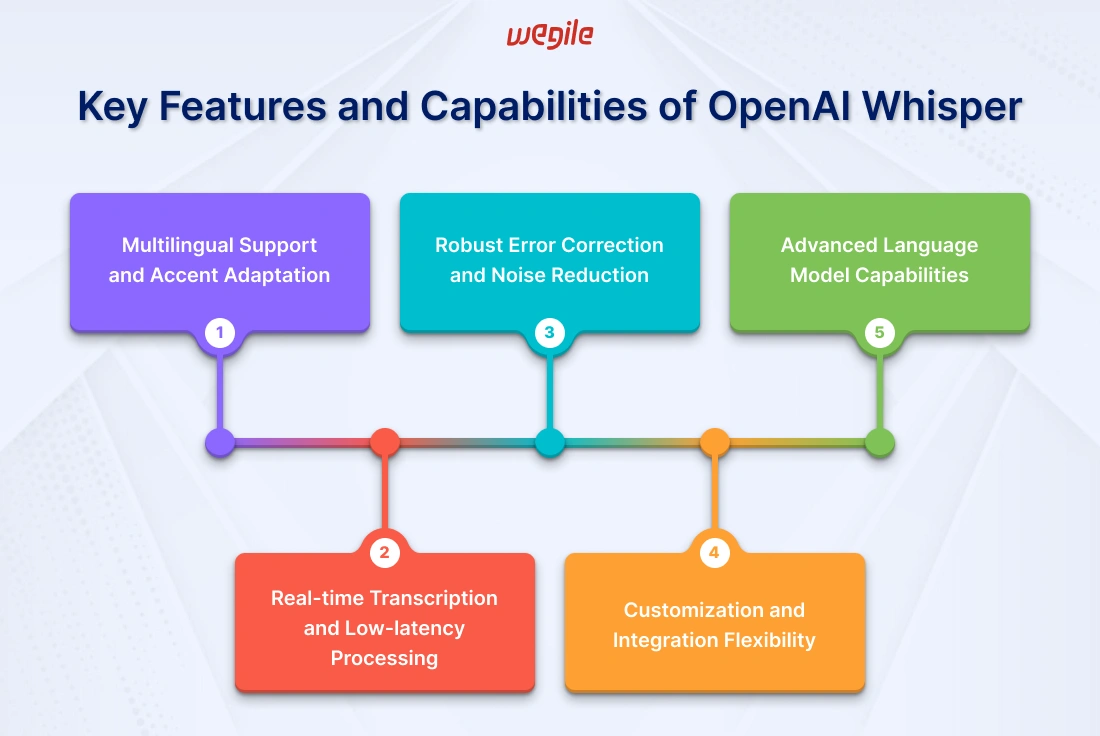
OpenAI Whisper’s qualities set it apart in the AI world. Whisper can meet a variety of applications
to handle multiple languages, accents, and transcription capabilities in real time. Applications
requiring great precision and reliability benefit from its powerful error correction, noise
reduction, and advanced language model. Let’s examine these aspects to see what makes Whisper so
effective and versatile.
1.
Multilingual Support and Accent Adaptation
OpenAI Whisper excels at language support and accent adaptation. Whisper is meant to work globally,
unlike other speech recognition programs that struggle with regional accents and languages. It can
understand and transcribe speech in different languages, making it a flexible international tool.
Whisper can handle English, Mandarin, Spanish, and even rare languages. Additionally, Whisper can
also accurately transcribe speech from people with strong regional accents because it can adapt to
diverse accents. This makes Whisper a valuable asset for businesses and organizations that operate
in multiple countries or serve a diverse audience. Its language-breaking abilities improve
communication and digital inclusion.
2.
Real-time Transcription and Low-latency Processing
Whisper’s real-time transcribing is remarkable when it comes to using it for live streaming,
conferencing, and online meetings. Whisper ensures near-instantaneous transcriptions in critical
situations. Whisper’s advanced neural network architecture optimizes speed and accuracy for
low-latency processing. The ability to provide real-time transcription means that broadcasters can
offer live captions. This enhances accessibility for viewers who are deaf or hard of hearing. It
also allows live translations and transcriptions in corporate meetings and Internet conferences,
improving cross-language collaboration. This capability is useful in fast-paced workplaces where
clear communication is crucial. Thus, Whisper’s real-time capabilities enable global communication,
collaboration, and connection.
3. Robust
Error Correction and Noise Reduction
Speech recognition requires accuracy, and OpenAI Whisper’s error correction and noise reduction
features are unmatched. Instead of being distracted by background noise or unclear speech, Whisper
uses powerful algorithms to focus on what’s important. Whisper transcribes effectively in noisy
cafés and conference rooms. The model also corrects minor speech errors like stumbles and
mispronunciations to avoid inaccurate transcriptions. Whisper can withstand difficult audio
settings, making it useful for dictating notes in a noisy office and conducting interviews in
dynamic environments. Whisper’s accuracy and reliability ensure it captures the essence of what’s
being said, regardless of noise.
4.
Customization and Integration Flexibility
Customizability and integration are other powerful features of OpenAI Whisper. Whisper can be
customized for many sectors and applications, unlike many AI technologies. Whisper can be tailored
to your needs in healthcare, media, education, and customer service. Integration with multiple
platforms and technologies makes it easy to integrate into workflows and systems. Developers can use
Whisper while preserving their specific functionality with this flexibility. For example, a media
organization may integrate Whisper into its editing tools for real-time transcription, while a
healthcare practitioner may use it to record patient sessions precisely. Whisper’s ability to adapt
to different contexts and applications makes it a versatile and valuable tool across various
sectors.
5. Advanced
Language Model Capabilities
Whisper’s powerful language model distinguishes it in speech recognition. Whisper understands word
context and meaning, unlike other models that just transcribe speech. Whisper transcribes complex
conversations more accurately and meaningfully due to its deep comprehension. Based on conversation
context, it can distinguish homophone words that sound the same but have different meanings.
Whisper’s understanding of language ensures that transcriptions are cohesive and accurate
representations of the source speech. Professional situations, including legal transcriptions,
academic research, and comprehensive note-taking, require exact communication. Advanced language
models improve transcription quality, making them more useful and trustworthy for diverse
applications.
Must Read: How to Build
Generative AI Apps:
A Comprehensive Guide
Applications and Use Cases of OpenAI Whisper
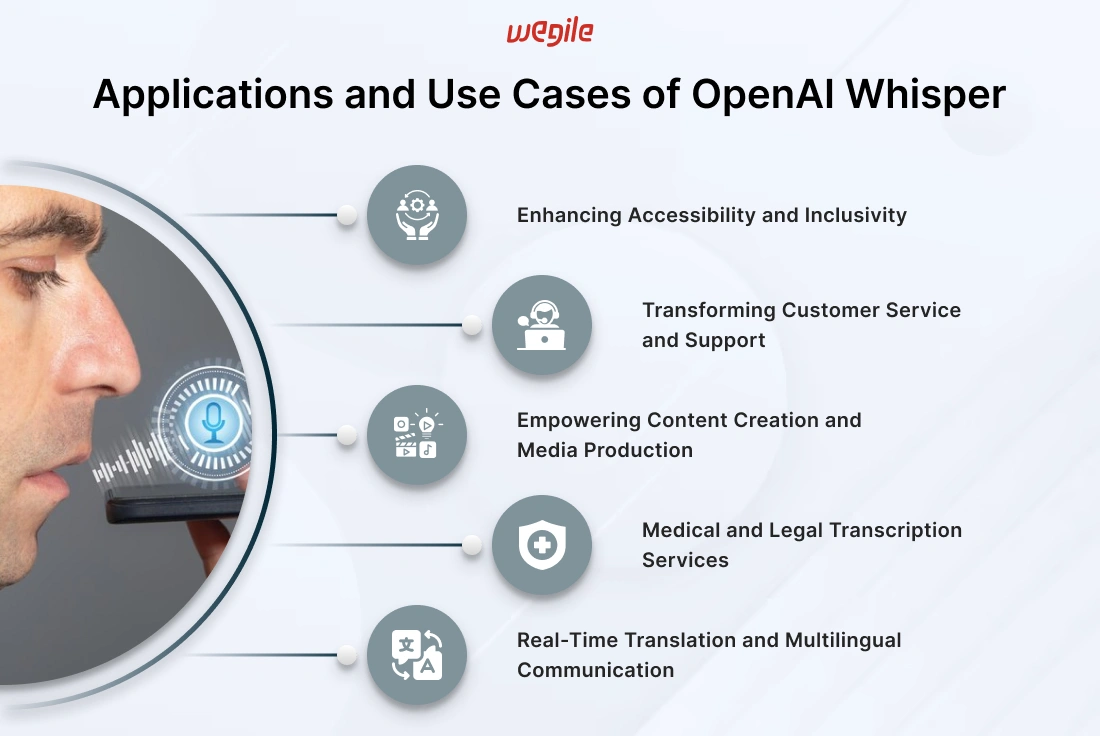
More than merely a speech recognition tool, OpenAI Whisper potentially benefits several industries
with its transformative benefits.
Whisper has completely changed customer service,
accessibility, and medical and legal transcribing. Let’s see how Whisper improves efficiency,
accessibility, and communication across industries.
1. Enhancing
Accessibility and Inclusivity
Improved accessibility and diversity are OpenAI Whisper’s biggest benefits. Whisper can transcribe
speech into text in real-time for hearing-impaired people, making content accessible in novel ways.
Educational settings benefit from this capability since deaf and hard-of-hearing students can follow
along with the lectures and debates as they happen. Whisper’s multilingual and accent-adaptive
capabilities help break down language barriers. This helps create multilingual content so that
non-native speakers can use media, education, and public services in their preferred language.
Whisper creates an inclusive environment where everyone, regardless of language or hearing ability,
can access information and contribute by offering real-time, accurate transcriptions and
translations.
2.
Transforming Customer Service and Support
OpenAI Whisper also impacts customer service. Whisper’s real-time transcribing helps boost call
center support agents’ productivity. By transcribing calls live, Whisper lets agents focus on
customers rather than taking notes, improving resolution times and customer satisfaction. Even in
difficult situations, Whisper’s context-aware answers let virtual assistants understand and answer
client questions. This capability lowers human intervention, cuts operational costs, and boosts
customer happiness. Thus, Whisper helps organizations personalize client interactions and give more
meaningful and responsive support, building customer loyalty and confidence.
Must Read:
Top Generative AI Solutions:
Scaling & Best Practices
3.
Empowering Content Creation and Media Production
For content creators and media producers, OpenAI Whisper is a game-changing tool. Whisper automates
podcast, video, and live stream transcription, freeing producers to focus on generating captivating
content.
Whisper’s high level of precision allows producers to
catch every word and nuance, accurately conveying the content in text form. This is beneficial for
making captions and subtitles, which help reach a wider audience, including hearing-impaired and
multilingual viewers. Whisper can automate interviews, reports, and broadcast transcription for
media companies, speeding up production and lowering expenses. Whisper streamlines content creation,
enabling producers to reach a wider audience.
4. Medical and
Legal Transcription Services
In specialized fields like medical and legal transcription, the stakes are high. OpenAI Whisper
excels in accuracy and confidentiality. Whisper accurately transcribes doctor-patient consultations,
medical dictations, and case notes in the medical industry to capture vital information. This helps
maintain accurate medical records and saves healthcare personnel time to focus on patient care.
Whisper’s ability to transcribe court proceedings, depositions, and legal dictations accurately
documents spoken words, which is vital for legal processes. Whisper can accurately transcribe in
noisy surroundings thanks to its advanced noise reduction capabilities. This makes it a reliable
tool for professionals in fields where every word matters and confidentiality cannot be compromised.
5.
Real-Time Translation and Multilingual Communication
OpenAI Whisper could revolutionize multilingual and real-time translation. Global businesses and
international interactions require multilingual communication. Whisper allows multilingual teams to
interact smoothly using real-time transcription and translation. Whisper can instantly translate
voice into different languages in meetings, conferences, and casual interactions. This capability
removes language barriers and creates a more inclusive, collaborative atmosphere where everyone can
participate. Whisper’s smart language model avoids misunderstandings in the instances where
diplomatic communication requires precise terminology. Hence, Whisper makes the world more connected
by opening up more possibilities for global collaboration and enabling real-time and multilingual
communication.
Must Read: The
Impact of Generative AI in
Real Estate
What is Better
than Whisper AI?
OpenAI Whisper is an advanced voice recognition model; however, alternate choices may be better
suited for particular use scenarios. Here are some significant alternatives and their offerings.
1. Deepgram
Speed and accuracy are Deepgram’s hallmarks, especially in real-time transcription. Its fast speech
processing makes Deepgram ideal for live applications like broadcasting, emergency services, and
real-time analytics. To serve a global audience, Deepgram offers several languages. Its flexible API lets
developers tweak the model for accents, jargon, and loud surroundings. The versatility and speed of
Deepgram make it a top choice for organizations that need fast and dependable transcription
services.
2. AssemblyAI
AssemblyAI has many
functionalities beyond speech-to-text. In interviews and conference calls, speaker identification is
essential. AssemblyAI lets users customize the model to meet their needs. It also interfaces well
with other tools and platforms, making it a great solution for businesses that want to easily
incorporate voice recognition into their workflows. Its user-friendly API and strong support
infrastructure ensure that even non-experts can effectively implement and utilize its services.
3. Rev AI
Rev AI is known for its accurate
transcriptions, which are crucial in legal and medical transcription. Rev AI allows users to
configure the model with unique terminologies to accurately transcribe technical jargon.
Professionals who need precise transcriptions prefer it. Rev AI also has strong security, which is
essential for handling sensitive data. Rev AI
is ideal for sectors where every word counts and secrecy is vital because of its accuracy,
customization, and security.
4. Speechmatics
Noisey offices, public spaces, and outdoor locations are ideal for Speechmatics. Its advanced
noise reduction technology and ability to reliably transcribe voice stand out for customers who need
dependable transcription in noisy environments. Speechmatics supports many languages and accents,
making it a viable alternative for companies operating in diverse linguistic settings. This allows
Speechmatics to manage different speech patterns and pronunciations, ensuring accurate,
environmental-free transcriptions.
5. IBM Watson Speech-to-Text
IBM Watson Speech-to-Text goes
beyond transcription. IBM Watson can transform speech into text, translate, and identify speakers,
making it a flexible tool for organizations. IBM Watson can readily integrate into various platforms
and apps, which is another remarkable benefit of the tool. This makes it excellent for enterprises
seeking a holistic approach to organizing and using voice data across languages and circumstances.
Its extensive feature set makes IBM Watson a great tool for organizations seeking a complete voice
recognition solution.
Must Read:
How Generative AI Can Be Used in
the Real World?
Wrapping Up
OpenAI Whisper excels in a communication-driven environment. Communication should be easier, faster,
and smarter, not merely transcribed. Whisper can revolutionize your workflow for businesses seeking
efficiency or creators pushing boundaries. Its excellent speech-to-text capabilities enable
accessibility, content production, and automation. If you’re thinking about creating your own custom
generative AI app, look no further than Wegile. As a top-tier generative AI development
company, Wegile specializes in
bringing innovative AI solutions to life. We can assist you in entering the AI future by creating
custom AI apps or pushing the limits. So, why wait? Dive into the power of AI and start transforming
the way you work today!
Leave a Reply