Getting the right Large
Language Model (LLM) for your
business can be a
game-changer in driving efficiency and improving customer interactions. The global AI market is
expected to reach $190.61
billion by 2025. More and more companies are turning to
LLMs to automate tasks like content creation, customer support, and data analysis. But, finding the
perfect LLM that connects with your unique business challenges needs careful consideration.
In this guide, we’ll walk you through 5 essential steps to help you discover the best LLM for your
needs. No matter if you’re focused on scalability, ROI, or seamless integration, these steps will
help you make an informed decision.
Read the full blog to discover how to select the perfect LLM for your business challenges:
What are LLMs?
Large Language Models (LLMs) are highly advanced and reliable AI models. They are designed to
understand, generate, and process human language in a sophisticated manner. These foundational
models include GPT and BERT and are trained on vast
amounts of text data. This helps them perform a wide range of tasks, which include understanding
natural language, summarizing text, generating content, and even answering complex questions.
LLMs find usage in industries like customer support, marketing, and data analysis to automate tasks
and improve efficiency. Their power to generate human-like text makes them valuable for businesses
seeking to level up communication and streamline operations.
Importance
of LLM for Your Business
The significance of Large Language Models (LLMs) for your business is in their proficiency in
streamlining operations. These models help enrich customer engagement and drive efficiency across
multiple functions. LLMs can automate time-consuming tasks like customer support and content
creation. They also assist in data analysis and free up valuable resources for strategic
initiatives.
Businesses can improve response times, deliver personalized experiences, and gain deeper insights
from unstructured data by using LLMs. They ultimately increase productivity and profitability. Thus,
no matter, if you’re looking to boost your marketing efforts, scale customer service, or optimize
decision-making, implementing an LLM, can be a game-changer for your business.
Top 5 Steps to Discover
the Perfect LLM for Your Business Challenges
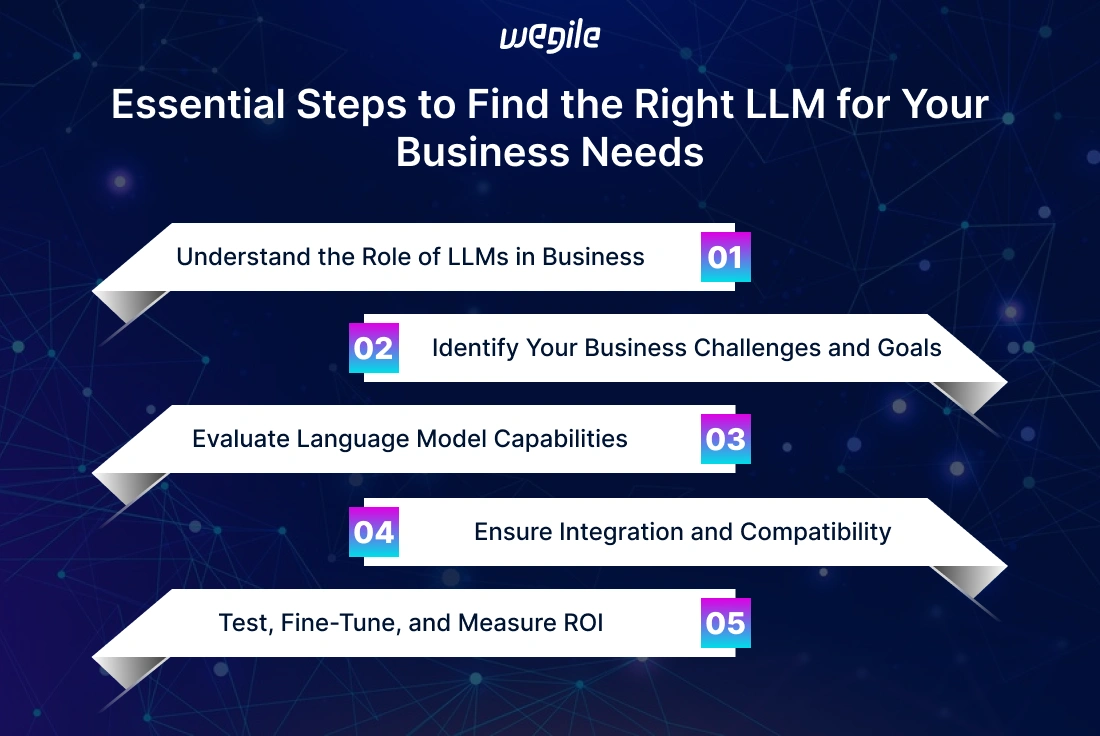
Here are the five key steps that you can follow to get the perfect LLM for your business. It will
help you simplify and streamline your business operations, assisting you in fighting away all the
challenges!
1. Identify Specific Business Needs
It is important to identify your company’s unique business challenges and goals before selecting a
large language model. It doesn’t matter whether you’re aiming to automate customer support, enrich
content generation, or streamline data analysis, defining your needs upfront will help in narrowing
down the perfect LLM for your business.
For example, if your company deals with high volumes of customer queries, you might prioritize models
with strong conversational AI capabilities. Businesses focused on content creation may need an LLM
that excels in natural language generation and creative writing. You can avoid wasting resources on
models that don’t match your objectives by pinpointing specific use cases.
If you operate in healthcare, finance, or legal sectors, you will need an LLM who can understand
specialized terminology and maintain compliance with relevant regulations. Connecting your selection
process with your business goals and industry needs provides a more targeted approach, which makes
it easier to find the right model that maximizes efficiency and ROI.
2. Evaluate Language Model Capabilities
Compare different LLMs based on their performance metrics after identifying your business needs.
Evaluate NLP (Natural Language Processing) capabilities and scalability. Check the model’s ability
to understand, process, and generate language in various contexts. Some models excel in semantic
understanding, which makes them ideal for data extraction. Others work better in contextualized
natural language generation, which can benefit marketing and content-heavy industries.
Also, check if the LLM has been trained on diverse datasets. A well-rounded model with exposure to
multiple domains will bring a more comprehensive understanding. It will reduce the need for
excessive fine-tuning. Also, evaluate whether
the
model can manage large
datasets and complex language structures without compromising on speed or accuracy.
Another key factor is scalability. Understand whether the LLM can grow with your business or not.
Look for a solution that supports scalable infrastructure and ensure that as your business expands,
the model can adapt to increased data loads and more complex tasks.
3. Assess Integration and Compatibility
It is also vital to ensure that the model can seamlessly incorporate with your existing systems and
tools. Check if the LLM offers flexible APIs or plugins that can be easily implemented into your
current technology stack. Integration is key to reducing friction during the onboarding process. It
allows the LLM to work alongside your CRM, ERP, or other custom software platforms without
disruptions.
Also, the level of customization the LLM supports should be reviewed. For example, suppose your
business needs specific workflows or operates in a niche industry. In that case, you may require an
LLM that can be customized to understand your unique business language, terminology, and data
structures. Selecting an LLM that fits smoothly into your operational framework does not reduce
downtime. It also optimizes the overall functionality and user experience.
4. Review Cost and ROI
Investing in an LLM needs a thorough review of the pricing structure. It also requires an analysis of
its potential return on investment (ROI). Begin by evaluating the initial implementation costs,
which can include setup fees and training expenses. Also, include the price of any additional
infrastructure needed to support the model. Beyond the upfront costs, it’s essential to factor in
ongoing expenses such as maintenance, updates, and model fine-tuning.
To evaluate ROI, consider how the LLM will impact your business in terms of efficiency gains, cost
reductions, or revenue growth. For example, implementing an LLM to automate customer support can cut
operational costs. It can also improve response times, which leads to enhanced customer
satisfaction. Estimate how long it will take for the LLM to deliver value by balancing the cost of
ownership with the projected gains in productivity and profitability.
5. Test and Fine-tune the Model
It is critical to conduct thorough testing in real business scenarios before fully committing to an
LLM. Run the model through actual use cases that connect with your key business objectives, such as
generating automated responses or conducting data analysis. This trial phase helps you to understand
how well the LLM performs in your unique environment. It provides insights into areas that may need
fine-tuning.
Fine-tuning the LLM makes sure that it understands your business language, industry terminology, and
specific workflows, enhancing its accuracy and relevance. Many LLMs allow for transfer learning or
training on custom datasets, which makes them adaptable to your particular needs. The more you
tailor the model, the better it will perform in essential tasks, which ensures it provides maximum
efficiency and ROI.
The Bottom Line
Incorporating the right Large Language Model (LLM) into your business can change and revamp the way
you operate. Right from streamlining workflows to enriching customer experiences, it brings in
numerous benefits. By following these five essential steps, you’ll be equipped to choose an LLM that
perfectly matches your specific business challenges. It will help you maximize its potential for
growth and efficiency. Implement these strategies today and empower your business with the perfect
LLM solution.
Get the full potential of your business by discovering the perfect LLM with Wegile’s expert guidance.
We deliver impactful generative AI
development
services and curate LLM models.
We will help you seamlessly integrate the right LLM to address your specific business challenge.
Partner with Wegile today and follow our proven 5-step process to find the best LLM that fits your
unique needs and brings long-term success and competitive advantage!
Leave a Reply