Sam Altman, CEO of OpenAI states:
“Generative AI is one of the most exciting and powerful technologies of our time, but it also
presents new challenges and risks that we need to address thoughtfully and
proactively”.
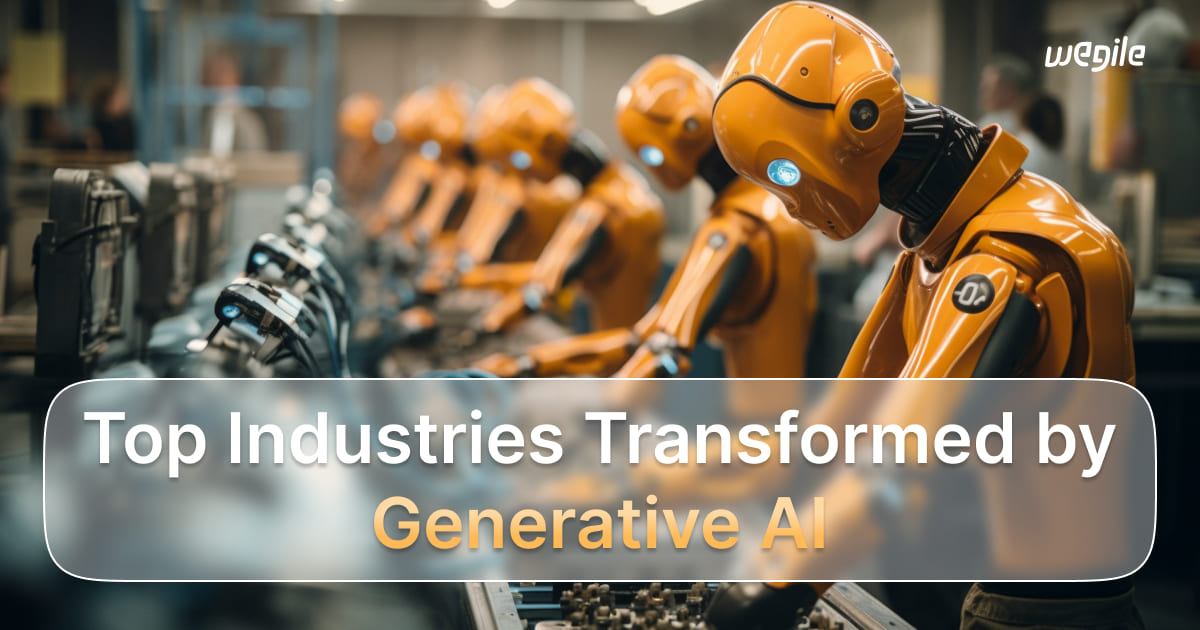
Generative AI is not just a futuristic concept. It is here, recarving industries with its tremendous
powers. Right from streamlining production in manufacturing to revamping customer service in
banking, generative AI is
becoming an essential tool for companies across
all industries to stay competitive and innovative.
With generative AI’s smart evolution, some sectors are witnessing more dramatic shifts than others.
So, let’s explore the industries where generative AI is making the biggest impact!
Generative
AI’s Impact on Industries: An Overview
According to McKinsey, generative AI will generate somewhere between $2.6
trillion to $4.4 trillion in annual value globally across
assorted sectors. In industries such as retail, generative AI will increase productivity by 1.2% to
2.0% of yearly revenues. It will add somewhere between $400
billion to $660 billion in value. This growth is driven by
generative AI’s mastery of intelligent
automation systems. It can skillfully automate
various functions, such as customer service and supply chain management.
Generative AI also assists in personalizing marketing efforts to enrich customer engagement. In
banking, the technology can contribute $200
billion to $340 billion . Here, it aids primarily in
streamlining operations such as risk management and regulatory monitoring.
In software development, 95% of developers use generative AI tools to curate new code. This
highlights AI’s role in speeding up the innovation cycle. Meanwhile, generative AI has seen a
massive surge in private investment. It attracted $25.2 billion in 2023 alone, which was nine times
higher than in 2022. These investments are leading to breakthroughs in various fields. They are
bringing momentum to all industries, from drug discovery in life sciences to content creation in
entertainment.
Top 5
Industries Impacted by Generative AI the Most
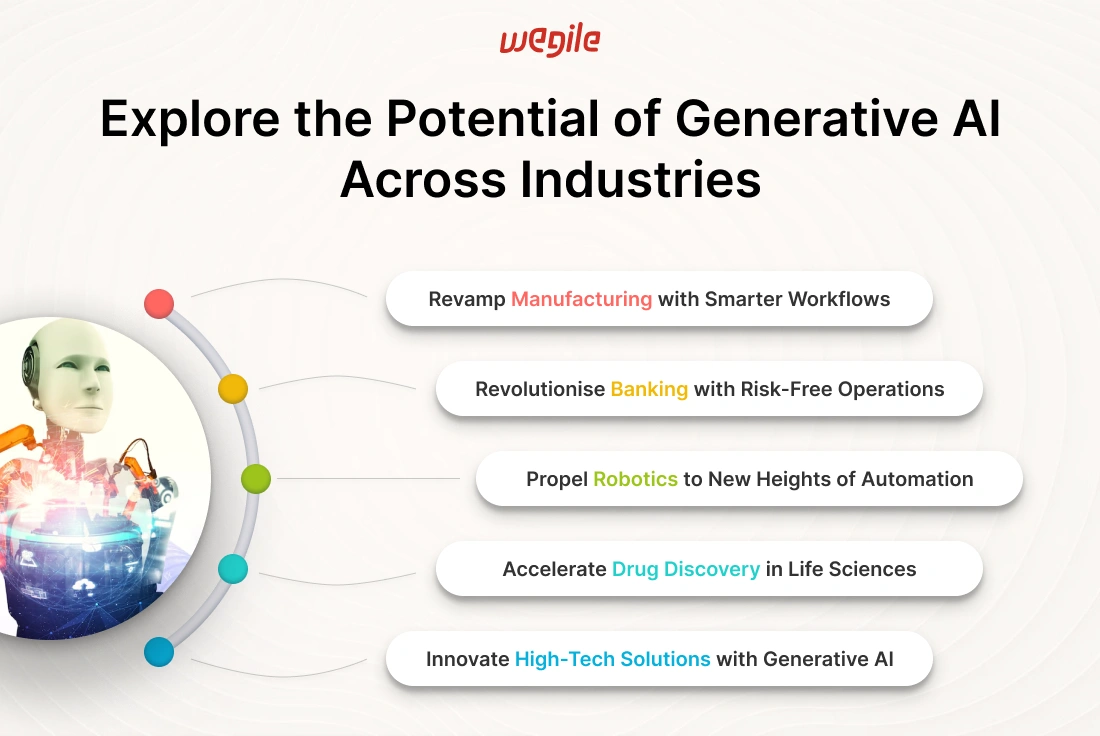
1. Manufacturing
The manufacturing sector is one of the top industries seeing immense adaptation through
generative
AI solutions. Generative AI helps manufacturers
streamline operations by automating design processes and optimizing production workflows. The
powerful AI also assists this sector in reducing costs and increasing innovation.
A McKinsey report shows that generative AI could unlock a 10%
to 15% improvement in overall R&D productivity. It will
directly impact the development of new products, materials, and production methodologies.
-
Powerful Product Design and Prototyping
One key benefit of generative AI in manufacturing is its power to assist in product design
and prototyping. Generative AI-driven design tools can generate multiple design
alternatives. They can further optimize themselves for factors like material efficiency,
cost, and performance. Companies like Airbus are using generative AI to design aircraft
components. These components turn out to be lighter and more fuel-efficient. They are
significantly reducing production costs and environmental impact with the power of AI.Moreover, AI’s integration into supply chain management helps in predictive maintenance. It
promises that machinery operates without downtime. It leads to fewer disruptions and
increased productivity. -
Improved Quality Control and Adaptive Manufacturing
Another vital application of generative AI is in quality control. Through advanced data
analysis and pattern recognition, generative AI systems can detect defects in products with
unprecedented precision. These systems help in enhancing product quality while reducing
waste. This technology also assists in adaptive manufacturing processes. Here, systems can
adjust parameters in real time based on the analysis of incoming data.As the global manufacturing industry adopts generative AI-driven solutions, it’s going to
enrich scalability, profitability, and sustainability across the board. Thus, we can
conclude that generative AI will heavily influence the future of manufacturing.
2. Banking
The banking sector is also experiencing a big impact with generative AI inclusion. AI is streamlining
operations and enriching customer experiences. McKinsey calculated that generative AI could
contribute an additional $200
billion to $340 billion in annual value for the banking
industry. The AI will accomplish this by automating tasks such as risk management and fraud
detection.
Generative AI will also impact customer service and acquisition positively. AI-driven solutions are
improving efficiency and creating new avenues for innovation in financial services.
-
Automating Risk Management and Fraud Detection
Generative AI is powerful and efficient in automating low-value tasks linked with risk
management and fraud detection. Conscious AI algorithms can analyze vast amounts of
transactional data. They can smartly identify suspicious patterns in real time. They also
help banks to deal with fraud before it escalates.According to a recent study, AI-backed fraud detection systems can cut fraudulent activity by
as much as 50%. This will significantly level up security for both financial institutions
and their customers.In addition to fraud prevention, generative AI is also improving credit risk assessments. It
does this by analyzing a more comprehensive set of data points. It further led to more
accurate loan approvals and reduced defaults. -
Personalized Customer Service and Product Offerings
Generative AI is revamping customer service in banking by encouraging highly personalized
interactions. AI-powered chatbots and virtual assistants are now managing routine customer
queries. They further free up human agents to focus on more complex tasks. A report from
Salesforce shows that 89%
of sales teams in India have completely enforced or
are experimenting with generative AI to engage customers. This portrays the massive impact
of Gen AI in the finance industry.Generative AI also allows banks to offer personalized financial products. These products
include tailored investment portfolios. They do this by analyzing a customer’s financial
behavior and preferences.
3. Robotics
Generative AI is playing a massive role in upgrading the robotics industry by facilitating
intelligent and adaptive systems. The integration of AI in robotics is enriching capabilities in
fields such as manufacturing, healthcare, and logistics. Here, robots are being deployed to perform
more complex and dynamic tasks.
Advancements in AI will also drive the global robotics market. Robots can now learn from data and
optimize processes in real time by leveraging generative AI. They can even develop new designs for
parts and systems, further revolutionizing automation.
-
Enhancing Robotic Design and Functionality
Generative AI-backed systems can generate optimized designs for robot components. They can
reduce material usage and improve functionality. For example, generative AI can be used to
simulate various operational scenarios. The AI helps identify the most efficient designs for
specific tasks, such as dealing with delicate items or working in hazardous environments.Also, generative AI is making robots more adaptable by enabling them to learn from their
surroundings and autonomously adjust to new conditions. This is pretty essential in
industries like logistics and healthcare. -
Autonomous Robotics and Real-Time Decision Making
Generative AI is encouraging robots to make real-time decisions based on vast amounts of
data. This is especially crucial in environments where conditions change frequently, such as
warehouses or hospitals. Generative AI-powered robots can deal with complex environments.
They can identify obstacles and adjust their routes on the fly, which ensures more efficient
operations.For example, in logistics, autonomous robots equipped with AI are being used for picking,
packing, and delivering goods. This is leading to faster and more accurate fulfillment
processes. In healthcare, AI-driven robots assist in surgeries and patient care, making
decisions based on real-time data and improving outcomes.Generative AI is revamping the robotics industry by enriching design, functionality, and
autonomous decision-making.
4. Life Sciences
The life sciences industry is also transforming, thanks to the integration of generative AI. Right
from drug discovery to clinical trials, AI is facilitating faster and more accurate research and
development processes. According to McKinsey, generative AI could improve R&D productivity by
10%
to 15%, with a significant impact on the discovery of new
drugs and materials.
The application of generative AI allows for the rapid identification of potential drug candidates by
modeling protein structures. It also helps optimize clinical trial designs and drastically reduces
time-to-market for new treatments.
-
Revolutionizing Drug Discovery with AI
Generative AI is streamlining the drug discovery process by analyzing vast datasets and
generating candidate molecules that can be tested for potential treatments. This power to
simulate molecular interactions accelerates the early stages of drug development. This helps
in reducing the need for expensive and time-consuming laboratory tests.
Companies like Entos have successfully integrated generative AI into their R&D. They are
using it to design small-molecule therapeutics faster and more efficiently. -
Enhancing Clinical Trials and Personalized Medicine
Generative AI is also making strides in optimizing clinical trials. This smart AI can analyze
patient data and predict which individuals are most likely to respond to a particular
treatment. It supports more targeted and efficient trial designs. This increases the chances
of trial success and also cuts costs linked with large-scale trials.Also, generative AI is driving advancements in personalized medicine, where treatments are
tailored to the genetic makeup and health profiles of individual patients. Researchers can
develop highly customized therapies by using AI to analyze complex genomic data. They can
improve patient outcomes and reduce adverse reactions.Generative AI is revolutionizing life sciences by accelerating drug discovery, enhancing
clinical trials, and advancing personalized medicine.
5. High Tech
The high-tech industry is at the main door of using generative AI to enhance innovation and speed up
software development. McKinsey estimates that generative AI could add between $400
billion and $660 billion in value to the tech industry,
particularly in software development and IT operations.
AI is automating everything right from code generation to cybersecurity protocols. It is supporting
companies to cut costs. It is helping them enhance product offerings and scale their solutions
faster than ever before.
-
Accelerating Software Development and IT Operations
One of the most significant impacts of generative AI in high tech is its proficiency in
accelerating software development. Generative AI-driven tools are being used by
90%
of developers to generate designs and codes. They
are also using generative AI to troubleshoot issues and even optimize performance.Generative AI cuts the time taken to formulate new software. It also enhances the accuracy
and efficiency of the development process. Also, generative AI can automate IT operations by
analyzing system logs. It helps minimize downtime and improve system reliability. -
Enhancing Cybersecurity and Personalization
Generative AI is helping companies stay ahead of sophisticated cyber threats. The inventive
AI systems can automatically detect and answer back probable security breaches. It does this
by analyzing data patterns and identifying anomalies in real time. This proactive approach
to security promises faster threat detection and effective resolution. It protects sensitive
data and maintains trust with users.Apart from cybersecurity, generative AI is upgrading customer personalization in the tech
industry. It helps companies to offer highly tailored user experiences by analyzing
behavioral data and predicting user needs. Generative AI is undoubtedly improving IT
operations and strengthening cybersecurity.
The Bottom Line
Generative AI is altering how businesses operate by bestowing incredible advantages in efficiency. It
encourages creativity and problem-solving skills across various industries. Right from automating
complex tasks to delivering personalized customer experiences, the potential of generative AI is
immense and waiting for us to utilize it.
If your business is ready to utilize the power of Generative AI Development
Services, Wegile can help you build
imaginative solutions tailored to your needs. Take the next step towards smarter and more efficient
operations with our expert generative AI development team. Connect with us today!
Leave a Reply